
Results
-
 £67.24
Pyrenean Carol Suite (Brass Band) David Taylor
This attractive suite for brass band by David Taylor features five traditional carols from the Pyrenees region of Spain, as follows: i. Nadal Tindaire (Jingling Christmas) - Occitan traditional This Occitan Christmas song tells of musical instruments used to celebrate the Nativity - 'fifes and trumpets, timpani and pipes, or you, clear little bells, along with the angels' choir.' ii. Gabriel's Message (Birjina Gaztetto Bat Zegoen) - Basque traditional The most widely-known of the chosen carols, honouring Jesus's mother Mary, this is often sung in its English version, but the melody came from the Basque country. The Basque words were adapted from the Mediaeval song Angelus ad Virginem. Here, we feature the flugel horn. This movement was originally written on its own, with organ accompaniment, for the composer's wife, Diane Scott. iii. El Noi de la Mare (The Child of the Mother) - Catalan traditional A beautiful Catalan carol celebrating the birth of Jesus, telling of the tasty gifts that the singer would bring - 'Raisins and figs and nuts and olives; Raisins and figs and honey and mato [a Catalan dessert cheese traditionally served with honey.]' Here we feature the euphonium. The tune was made famous by guitarist Andres Segovia, who used it as a favourite encore, and by John Rutter, who made a widely-used setting for choir. iv. Paure Satan (Poor Satan) - Occitan traditional This rather unusual carol tells of the pain that Satan is put to by the arrival of the infant Jesus. Its mocking and sarcastic tone is reflected here, where the tuba soloist (as Satan) is given musical trouble throughout by the other parts. At first they conflict with the soloist, then the soloist makes overtures of friendship, which are treated with suspicion followed by contempt. The soloist finally gives in to their accompaniment (or do they?). There are plenty of opportunities for little theatrical touches here, if the tuba player is so inclined! The tuba part in this movement is notably more difficult than the rest of the music, and a number of optional changes have been marked to make the part easier to play, if so desired. The player is also welcome to add suitable extra embellishments to taste if they wish, within the character of the music. v. Fum, Fum, Fum! - Catalan traditional A favourite Catalan Christmas song for centuries, this rousing melody provides a fitting way to round off the suite, with its repeated rhythmic refrain of the nonsense title phrase. It tells of the Nativity, and then it tells of the celebratory feasting and good times that the singers look forward to to honour it. Although the suite is intended to be performed whole, it is also intended for usage with a selection of movements on occasions where a shorter piece is wanted. Suggested formats include a single movement alone (2, 3, and 5 are likely most appropriate), a pair of movements (any of the first four, plus 5), and a suite of three or four movements (1 and 5, plus one or two of 2, 3, or 4 in the middle). It is suggested that a good way to design a 'pick-your-own-suite' from the movements is to think of the earlier movements as introductory to the final movement. To view a rolling score video featuring Kidlington Concert Brass please visit www.youtube.com/watch?v=QIGdul-yxxg PDF download includes score and parts. Sheet music available from: UK - www.brassband.co.uk USA - https://satradecentral.org Difficulty Level: 3rd Section + Length: 9.45 minutes Instrumentation: Soprano Cornet Eb Solo Cornet Bb Repiano Cornet Bb 2nd Cornet Bb 3rd Cornet Bb Flugel Horn Bb Solo Horn Eb 1st Horn Eb 2nd Horn Eb 1st Baritone Bb 2nd Baritone Bb 1st Trombone Bb 2nd Trombone Bb Bass Trombone Euphonium Bb Bass Eb Bass Bb Timpani Percussion 1-2
In Stock: Estimated dispatch 1-3 working days
-
 £79.95
Neverland - Christopher Bond
"All children, except one, grow up" wrote J.M. Barrie about Peter Pan in 1911; the first line and an expression of beautiful melancholy and fantasy, coming to represent one of the best-loved children's stories of the twentieth century. 'Peter & Wendy', as the book was first released, has subsequently been transformed into adaptations for film and stage, with subsequent books based on this iconic tale. In writing this new work for brass band, the composer has taken three of the main themes from J. M. Barrie's book, and used these themes to create new musical material, forming a work in three contrasting sections. I. Journey to Neverland The opening of the work, mysterious in its style, reflects the opening chapters of the story - a leafy London street, still in the dead of night - with the music transforming quickly as it builds in texture and momentum - a Journey to Neverland through the night sky; Second Star to the Right and straight on 'til morning. "Then Peter knew that there was not a moment to lose. 'Come,' he cried imperiously, and soared out at once into the night, followed by John and Michael and Wendy. Mr & Mrs Darling and Nana rushed into the nursery too late. The birds were flown." II. The Windows that Closed The central section of the work takes its inspiration from the sense of longing throughout the book, mainly by Peter Pan, the Darling Children & The Lost Boys. Distant memories of life before Neverland, memories of the Lost Boys' mothers, and regret at what the children have missed. Peter says "Long ago, I thought like you that my mother would always keep the window open for me; so I stayed away for moons and moons and moons, and then flew back; but the window was barred, for mother had forgotten all about me, and there was another little boy sleeping in my bed." III. Aboard the Pirate Ship The final section of the work takes its inspiration from the Pirate Ship, and Peter Pan's ultimate battle with its infamous Captain Hook. "In person, he was cadaverous and blackavized, and his hair was dressed in long curls, which at a distance looked like black candles, and gave a singularly threatening expression to his handsome countenance. His eyes were the blue of the forget-me-not, and of a profound melancholy, save when he was plunging his hook into you, at which time two red spots appeared in them and lit them up horribly."
Estimated dispatch 10-14 working days
-
 £29.88
Still, Still, Still (Horn Section Feature with Brass Band) arr. Stephen Tighe
Still, still, still is an Austrian Christmas carol and lullaby. The melody is a folk tune from the Salzburg area and the tune appeared for the first time in 1865 in a folksong collection. The words describe the peace of the infant Jesus and his mother as the baby is sung to sleep. They have changed slightly over the years, but the modern standard German version was established in the mid-19th century. This arrangement by Stephen Tighe features the flugelhorn and horn section with brass band. PDF download includes score and parts. Sheet music available from: UK - www.brassband.co.uk USA - www.solidbrassmusic.com Difficulty Level: 4th Section + Instrumentation: Soprano Cornet Eb Solo Cornet Bb Repiano Cornet Bb 2nd Cornet Bb 3rd Cornet Bb Flugel Horn Bb Solo Horn Eb 1st Horn Eb 2nd Horn Eb 1st Baritone Bb 2nd Baritone Bb 1st Trombone Bb 2nd Trombone Bb Bass Trombone Euphonium Bb Bass Eb Bass Bb Timpani Sleigh Bells Drum Kit Glockenspiel
In Stock: Estimated dispatch 1-3 working days
-
 £34.95
Descent, The - Christopher Bond
The Descent takes its inspiration from Victorian author Jules Verne; specifically, his work Twenty Thousand Leagues Under the Sea. In Twenty Thousand Leagues Under the Sea, Professor Arronax finds himself a prisoner of the mysterious Captain Nemo, on a remarkable submarine called the Nautilus. Nemo is one of Verne's most memorable characters. He's a man who has turned his back on the world, and his name - Nemo - means 'No Man.' He has vowed never to set foot on dry land ever again. Verne gives his hero's brilliance and benevolence a dark underside - the man's obsessive hate for Empires and Imperialism. Captain Nemo is a genius, an engineer, an artist, an athlete, sometimes a pacifist, sometimes a righter of wrongs, sometimes an out and out villain, and he invented the Nautilus. The Descent is based on the idea of a descent to the depths of the ocean in the Nautilus with Captain Nemo, with the cornet soloist expressing both the anguish and reflective sides of the character. On one hand, a troubled and agitated figure, juxtaposed with the reflective memories of his homeland, children, mother and father. The work was written for and commissioned by Flowers Band as part of their programme of music at Brass in Concert 2019.
Estimated dispatch 10-14 working days
-
 £34.95
Song of the Night Sky - Christopher Bond
Orpheus is known as the most talented music player of the ancient times. It is said that god Apollo was his father, from whom took his extreme talent in music, and the Muse Calliope was his mother. Tragedy struck when his wife, Eurydice stepped on a viper which in turn bit her, injecting its fatal venom. Nothing could stop his cries of anguish and sheer pain and sorrow upon realizing his beautiful Eurydice was dead. Orpheus decided to go into the Underworld to get his wife back. Apollo, his father, would talk to Hades, the god of the Underworld to accept him and hear his plea. And so Orpheus set off into the Underworld and was warned that for no reason must he look back while his wife was still in the dark, for that would undo everything he hoped for. As Orpheus was reaching the exit of the Underworld, he could hear the footfalls of his wife approaching him. As his was approaching the exit, his heart was beating faster and faster. The moment he stepped on the world of the living, he turned his head to hug his wife. Unfortunately, he got only a glimpse of Eurydice before she was once again drawn back into the underworld. When Orpheus turned his head, Eurydice was still in the dark, she hadn't seen the sun and, was drowned back to the dark world of the dead. Waves of anguish and despair swept over him and shuddering with grief he approached the Underworld again but this time, he was denied entry, the gates were standing shut and god Hermes, sent by Zeus, wouldn't let him in. His songs were no more joyful but extremely sad. His only comfort was to lay on a huge rock and feel the caress of the breeze, his only vision were the open skies. Song of the Night Sky was recorded by Tom Hutchinson and the Cory Band in June 2015, featuring on his debut solo album.
Estimated dispatch 10-14 working days
-
.png) £34.95
£34.95Casper's Lament (for Brass Band) - Jonathan Bates
'Casper's Lament' was composed for the Foden's Band's appearance at the 2021 Brass in Concert Championships held at The Sage, gateshead. The music is inspired by the lesser known side to 'Casper the Friendly Ghost'; a "good ghost" who much to the annoyance of his uncles chooses to help people rather than scare them. Despite the uplifting and joyful narrative to the 'Casper' stories, there is a much more tragic back story of how he come to be. Casper's mother passed away during his birth leaving him to be raised solely by his extremely devoted father until the age of 12 when having begged his father for a sled to play in the snow Casper contracted pneumonia from playing out in the cold for too long and passed away shortly after. Throughout Casper's childhood years, the pair were inseparable. So much so, that after his tragically young death, Casper simply could not leave his father to be alone in the mortal world and as a result he stuck around as the ghost we love come to know and love through the many books, series and films over the years. . .
In Stock: Estimated dispatch 1-3 working days
-
 £53.00
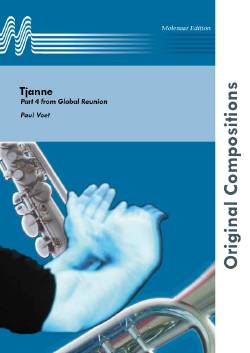
Tjanne - Paul Voet
Back to the southern part of Flanders where we tell a sad story about a mother and her children. Serious contemplative talk by the euphonium soloist in Tjanne. Eventually coloured by a harp.
Estimated dispatch 10-14 working days
-
 £29.95
Yankee Grit - Abe Holzmann - John Dutton
Abraham "Abe" Holzmann was born in New York in 1874 to a Hungarian-immigrant father and an American mother and studied music in Germany. Holzmann became the manager of the Orchestra Department at Jerome Remick & Company, the New York music...
Estimated dispatch 5-7 working days
-
 £74.95
Platform to the Heavens (Brass Band - Score and Parts)
The piece takes its inspiration from the mountain ranges from one of my favourite countries, Switzerland.I have visited the Swiss Alps on many occasions and I am still taken back by its sheer awesome beauty with every visit. This commission gave me the opportunity to pay homage to this wonderful landscape and paint my own musical picture of it.The piece opens with what I imagine daybreak would be like at one of its many peaks. With the sun growing behind the mountain range, the piece builds from a single note to a huge climatic chord revealing Mother Nature's creation.Then at rehearsal figure 'C' the tempo changes dramatically as we fly through the many slopes of the mountains as if on a manic skiing expedition, revealing the many dangers within the Swiss Alps.The twists, turns and climaxes begin to die away as we enter rehearsal figure 'M' - nightfall over the mountains. As the sun disappears, the sky darkens to reveal the beautiful starlit sky above the mountain range. This middle section starts with the various cadenzas that serve as echoes around the Alps. It then leads to a lyrical solo at rehearsal figure 'O' as the moonlight illuminates the icy mountain peaks. A final cadenza to conclude this section highlights the end of nightfall as the sun starts to rise again.This recapitulation from the opening, signals a new dawn as the sun rises above the snowy peaks once again. The music at this point in its slightly altered state highlights the dawn of a new day in the Alps. The fast manic ski ride follows which takes the piece to its grand finale conclusion.The idea behind the title of this piece is that the Swiss Alps are so beautiful and vast; I can only imagine that they could be a platform connecting the earth to the heavens above.Paul Lovatt-Cooper
Estimated dispatch 7-14 working days
-
 £59.95
Judd: The Long Cloud of Witnesses
This music was written for the Amsterdam Staff Band's 50th Anniversary. The idea for using this theme in appreciation of the pioneers of the band who had gone before came to me during the thanksgiving service for my own mother's life. She was a life-long Salvationist, and the large crowd that gathered for her thanksgiving in Winchester gave such an inspiring rendition of this hymn at the end of the service that it moved me to write the music. In the closing pages of the score I have tried to suggest that final parade when those who loved the Lord join the 'long cloud of witnesses' in procession to their eternal home. - Kenneth Downie
Estimated dispatch 7-14 working days
 Watch video
 View Music