
Results
-
 £38.95
Unity Series Band Journal - Numbers 502 - 505, February 2022
502: See, what a morning (Gary Rose)This music is based on the popular Easter song of the same title (also known as Resurrection Hymn) by Keith Getty and Stuart Townsend (S.B.S. Volume VII).503: Light Force (Stephen Gibson)Originally written for a Young People's Band play-day, this exciting work brings together original themes as well as references to Jesus bids us shine (S.A.S.B. 870) and Shine, Jesus, shine (S.A.S.B. 261).504: Cornet Solo - Into your holiness (Jrgen Ijsendorn)Written for Martin Oosterbeek, who served in the military and undertook a tour of duty in Afghanistan, this work uses When I look into your holiness (T.B. 927), a song that provided solace during his time away.505: March - Turn to the Lord (Charles Craig)A tradition-style march perfect for groups with little rehearsal time.
Estimated dispatch 7-14 working days
-
 £70.00
General Series Band Journal December 2017 Numbers 2174-2177
Festival March - Stowmarket 125 (Steven Ponsford)This festival march is traditional in style, abounds in energy and features the lesser known chorus 'In that city built four square' which the corps at Stowmarket have featured through the years.At the cross (Paul Sharman)This meditation was originally written for the Disciples of the Cross commissioning and features 'To thy cross, I come Lord', 'At the cross where I first saw the light' and other melodic references to 'The Cross of Christ' are also found within.Flugel Horn Solo How deep the fathers love (Andrew Mackereth)The beautiful contemporary song has been set in a developed Flugel Horn Solo which should have an instant appeal to both soloist and band.Evry time I feel the spirit (Dean Jones)The classic spiritual is given an up-tempo feel and has been featured by the International Staff Band in recent programmes.
Estimated dispatch 7-14 working days
-
 £50.00
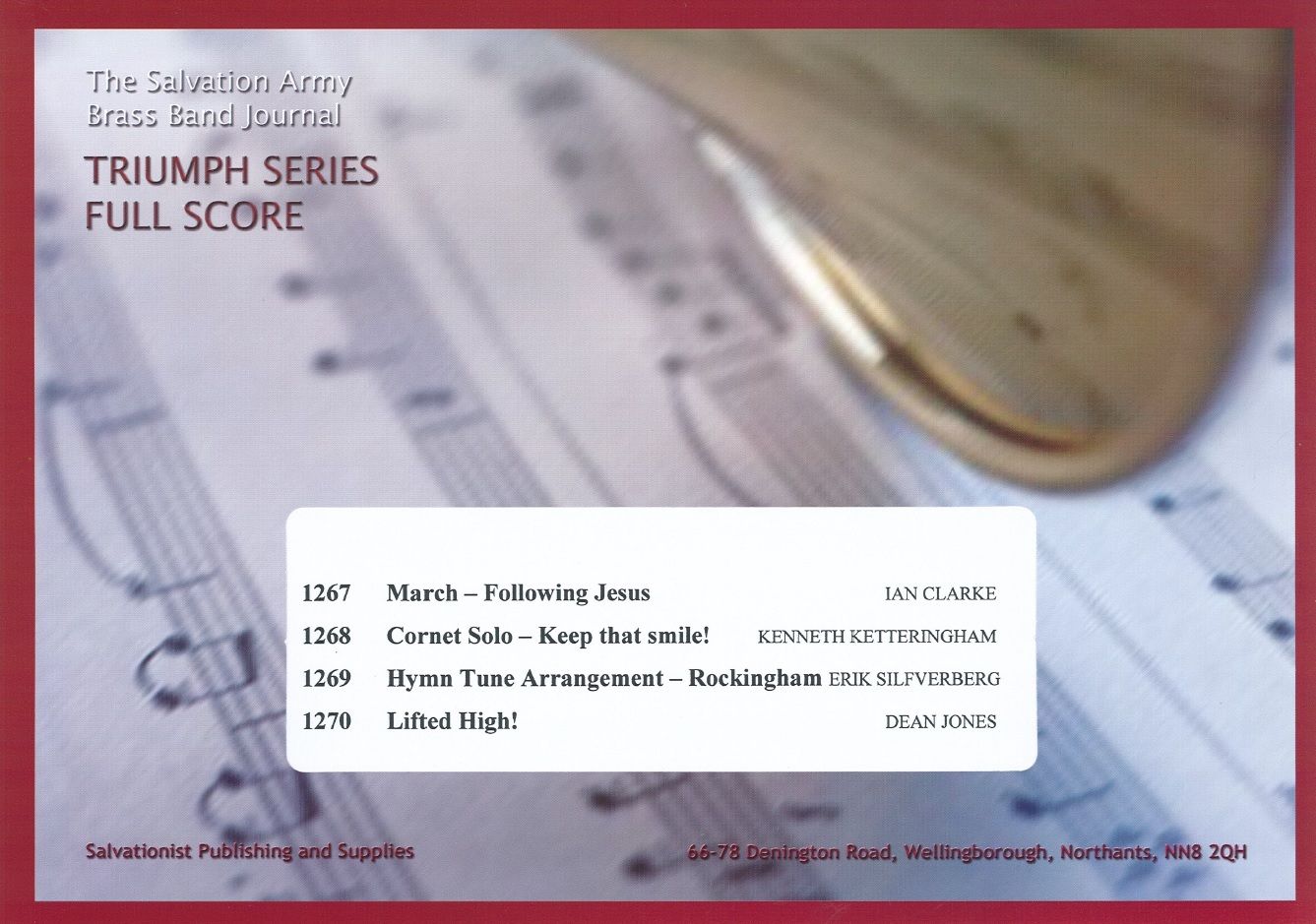
Triumph Series Band Journal November 2015 Numbers 1267 - 1270
No. 1267 March - Following Jesus (Ian Clarke)For more than two thousand years, countless Christians, the world over, have chosen to follow Jesus and try to live by his teachings. The words associated with the three tunes used in this march follow that theme: Sagina (T.B. 498), I will follow thee, my Saviour (T.B. 378) and There's joy in following (T.B.C.S. 206).No. 1268 Cornet Solo - Keep that smile! (Kenneth Ketteringham)This light-hearted, waltz-like solo features an old Army song written by Bandmaster George Marshall and Staff-Captain A.R. Wiggins.No. 1269 Hymn Tune Arrangement - Rockingham (Erik Silfverberg)A four-verse setting of the hymn tune, Rockingham, associated with the song 'When I survey the wondrous cross' by Isaac Watts.No. 1270 Lifted High! (Dean Jones)A bright, joyful arrangement of the song, 'Lord, I lift your name on high' in a Caribbean style.
Estimated dispatch 7-14 working days
-
 £39.95
Judd: The Victor
This Festival March was written for the Melbourne Staff Band and it features the hymn tune,Millennium (T.B. 227). Whilst the origin of the tune is unclear, its character is quite distinct. The composer thought it would be appropriate to suggest a hint of the style brilliantly employed by Australia's great march writer Arthur Gullidge.
Estimated dispatch 7-14 working days
-
 £34.95
Choose Freedom (Brass Band - Score and Parts)
Choose Freedom is largely derived from the composers' own setting of Richard Slater's words, 'Yes, there flows a wondrous river' for SATB choir which was published in The Salvation Army's Choral Festival Series under the title 'The mighty river'.After many allusions to the song, it is eventually stated in full in the trio section. Downie's effective use of varying harmonic colours, unusual instrumental voicings and modal harmonies stand out in this rhythmically diverse march. There are quite a few loud passages in the march so conductors should savour the quieter ones!
Estimated dispatch 7-14 working days
-
 £38.95
Unity Series Band Journal June 2016 Number 442 - 445
No. 442 March - Christmastime (Ian Feltwell)This Christmas march is based on two carols, I saw three ships come sailing in (N.C.P. 38) and It came upon the midnight clear (N.C.P. 44), with numerous references to other carols throughout and finishing with a rousing rendition of We wish you a merry Christmas (N.C.P. 110).
Estimated dispatch 7-14 working days
-
 £38.95
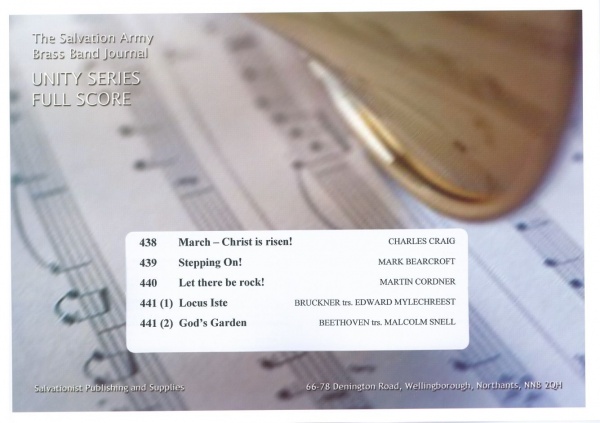
Unity Series Band Journal February 2016 Number 438 - 441
No. 438 March - Christ is risen! (Charles Craig)This march, as its title implies, was written for Easter morning celebrations. The opening two bars states 'Up from the grave he arose' (T.B. 905). At section B, the chorus of Graham Kendrick's song, In the tomb so cold is presented. The words associated with this are:Christ is risen! Christ is risen!Death has been conquered.Christ is risen! Christ is risen!He shall reign for ever.
Estimated dispatch 7-14 working days
-
 £29.95
Judd: In The Firing Line
Bramwell Coles wrote over 50 marches and so has been dubbed The Salvation Armys march king! First published in 1925, this march has stood the test of time and remains a favourite.
Estimated dispatch 7-14 working days
-
 £29.95
Judd: To Regions Fair
Clive Bright, in his score note when To Regions Fair was originally published in 1958, predicted that the march would 'have a good run'. In retrospect, this turned out to be something of an understatement as this march (and many other Bearcroft marches) remains vibrantly active fifty years after its original publication. The title is derived from the song 'Meet in bliss' which is featured in the trio section.
Estimated dispatch 7-14 working days
-
 £29.95
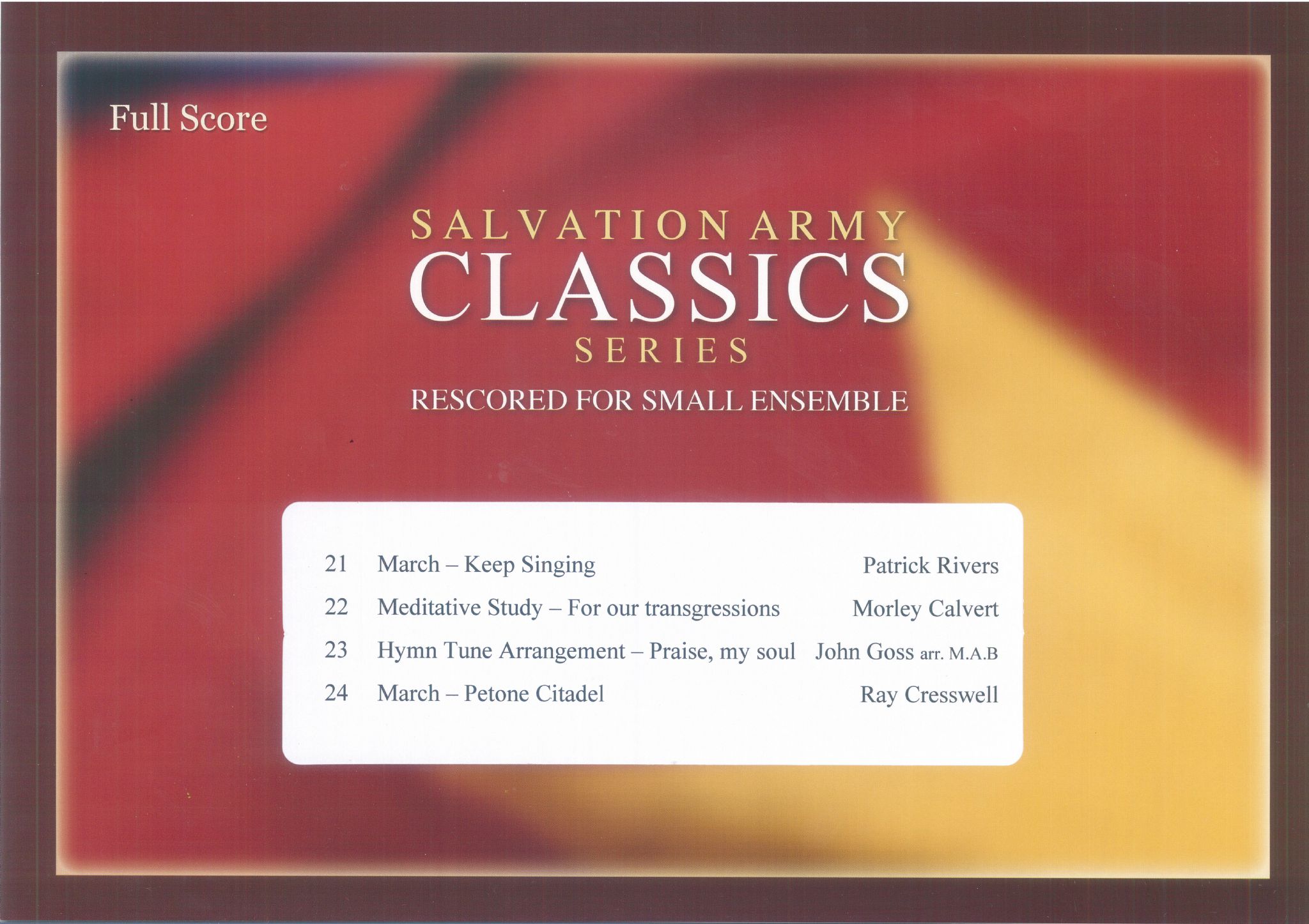
Salvation Army Classics 21-24 for Small Ensemble
Salvation Army Classics arranged for Smaller Ensembles Series 21-24March - Keep Singing; Selection (Patrick Rivers)Meditative Study - For our transgressions (Morley Calvert)Hymn Tune Arrangement - Praise, my soul (John Goss arr. Michael Babb)March - Petone Citadel (Ray Cresswell) This series features pieces that have been rescored for Unity Series (five-part) scoring.PART I 1st Cornet BbPART II 2nd Cornet Bb and 1st Horn EbPART III 2nd Horn Eb and Baritone or Trombone BbPART IV Euphonium BbPART V Bass Eb and Bass BbThese transcriptions have been carried out in such a way to facilitate the addition of any original parts that may be available.Where relevant, suggestions are made for a variation in tone colour (i.e. 2nd Cornet, Flugel, Baritone, Trombone) as well asthe occasional opportunity for rest.
Estimated dispatch 7-14 working days