
Results
-
 £68.99
Majesty (Brass Band - Score and Parts) - Deleruyelle, Thierry
Majesty is a powerful and spectacular overture. The work opens with a brilliant fanfare before making way for a majestic hymn. The end of the piece repeats the opening fanfare as a monumental finale in the style of an American symphonic march. This composition is dedicated to Queen Elizabeth II.Duration: 6.15
Estimated dispatch 7-14 working days
-
 £42.95
Fairy Doll (Brass Band - Score and Parts) - Wiffin, Rob
This is a version of Bizet's Farandole using Christmas melodies. Having already made an arrangement of Bizet's famous Farandole, Rob Wiffin felt a novel Christmas piece could be produced by re-writing it using appropriate tunes. This work uses phrases from God Rest You Merry, Gentlemen and Joy to the World to form the main theme and counters with Hark, the Herald Angels Sing, with a few other favourites making brief appearances.Duration: 3.45
Estimated dispatch 7-14 working days
-
 £55.00
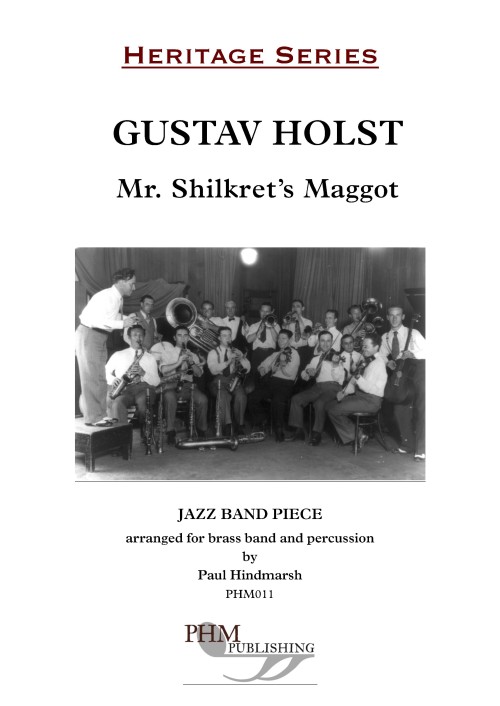
Mr Shilkret's Maggot (Brass Band - Score and Parts) - Holst, Gustav - Hindmarsh, Paul
This short piece was composed in 1932 during a visit Gustav Holst was making to the USA. He was invited by the band leader Nathaniel Shilkret to contribute to a series of piece for concert jazz band based on a folk song. Rather than using a traditional tune, Holst invented one of his own in folk song style and therefore the piece was not performed. Holst considered various titles for the piece including Mr. Shilkret's Dump, Folly and Maggot. On the manuscript he described it as a Jazz Band Piece. When the composer's daughter Imogen re-scored the piece for the English Chamber Orchestra to record under her direction in 1967, she changed decided to use the title Capriccio.Her re-orchestration involved removing the saxophone quartet, adding cor anglais and a second bassoon and changing cornet parts to trumpets. She retained the harp, extensive percussion, piano and celesta. My brass band version is based on the composer's manuscript, held at the British Library. It retains the composer's cornet parts, re-voices the woodwinds and strings, and places keyboards and harp onto glockenspiel, marimba, vibraphone and xylophone.I have selected the title Mr. Shilkret's Maggot for my scoring of Jazz Band Piece, which was first performed by The Cory Band, conducted by Philip Harper, at the Royal Northern College of Music Brass Band Festival, 29 January 2017.- Paul HindmarshDuration: 5.30
Estimated dispatch 7-14 working days
-
 £23.95
The Red Kite (Euphonium Solo with Brass Band - Score and Parts) - Wiffin, Rob
At one time the Red Kite was close to national extinction in the UK but now it is possible to admire this distinctive bird of prey with its red colouring and forked tail. I love watching it soaring so gracefully through the sky. I attempted to catch that feeling in this solo composed for Martin Smith. In writing it I had in mind making the euphonium glide solitary and effortlessly, occasionally swooping down then reclaiming its high altitude.To create the desired atmosphere, I avoided too many root position chords and enhanced the feeling of floating by adding notes to a lot of the harmony, giving it subtle colour. The harmonic rhythm is slow but the movement switches in the way that the Red Kite can make slight changes of direction by minor adjustments of its tail. On top of this accompaniment the soloist is left to sing with a sense of grace and freedom.- Rob WiffinDuration: 3.45
Estimated dispatch 7-14 working days
-
 £44.95
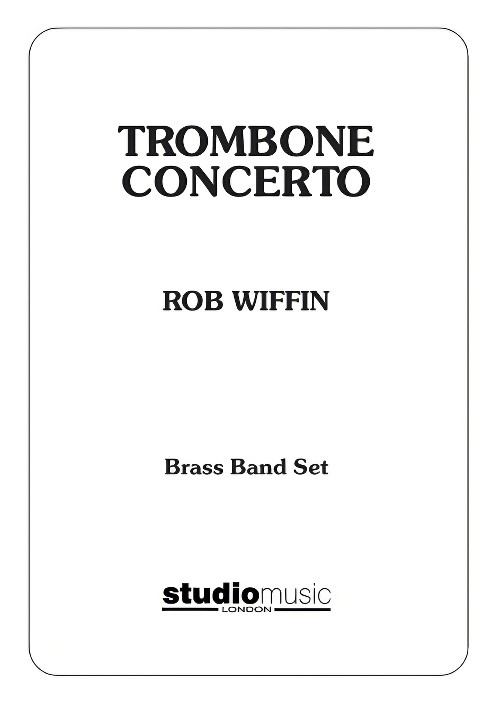
Trombone Concerto (Trombone Solo with Brass Band - Score only) - Wiffin, Rob
My Trombone Concerto was commissioned by Brett Baker following an earlier piece I had written for him called Shout! It was composed in Spain in the summer of 2010. Once I started writing I realised that this concerto was inevitably going to draw on my own experiences as a trombone player. The first movement was really a matter of getting the right thematic ideas and balancing the tutti and solo passages so, for formal structure, I studied the Gordon Jacob Trombone Concerto. There is a lyrical section preceding the first Allegro that owes much in spirit (but not in the actual music) to The Eternal Quest, Ray Steadman-Allen's Salvation Army solo. The slow movement seemed determined to come out in the vein of a Richard Strauss song. I wanted to write something ineluctably 'cantabile' as we trombone players rarely get a chance to play the melody. There is a brief allusion to that wonderful moment when the trombone gets to sing above the orchestra in Sibelius' seventh symphony. Arthur Wilson, that great exponent of the singing style in trombone-playing and my teacher at college died in the summer of 2010 so it seemed appropriate to dedicate this movement to him. The last movement is the lightest of the three in style and is slightly jazz-inflected, hopefully providing some fun for the soloist. While wanting to test the instrument I did not set out with the intention of making the concerto difficult but there are undoubtedly challenges of technique, range and style to be met by the soloist.- Rob Wiffin
Estimated dispatch 7-14 working days
-
£87.95
Trombone Concerto (Trombone Solo with Brass Band - Score and Parts) - Wiffin, Rob
My Trombone Concerto was commissioned by Brett Baker following an earlier piece I had written for him called Shout! It was composed in Spain in the summer of 2010. Once I started writing I realised that this concerto was inevitably going to draw on my own experiences as a trombone player.The first movement was really a matter of getting the right thematic ideas and balancing the tutti and solo passages so, for formal structure, I studied the Gordon Jacob Trombone Concerto. There is a lyrical section preceding the first Allegro that owes much in spirit (but not in the actual music) to The Eternal Quest, Ray Steadman-Allen's Salvation Army solo.The slow movement seemed determined to come out in the vein of a Richard Strauss song. I wanted to write something ineluctably 'cantabile' as we trombone players rarely get a chance to play the melody. There is a brief allusion to that wonderful moment when the trombone gets to sing above the orchestra in Sibelius' seventh symphony. Arthur Wilson, that great exponent of the singing style in trombone-playing and my teacher at college died in the summer of 2010 so it seemed appropriate to dedicate this movement to him.The last movement is the lightest of the three in style and is slightly jazz-inflected, hopefully providing some fun for the soloist.While wanting to test the instrument I did not set out with the intention of making the concerto difficult but there are undoubtedly challenges of technique, range and style to be met by the soloist.- Rob Wiffin
Estimated dispatch 7-14 working days
-
 £64.95
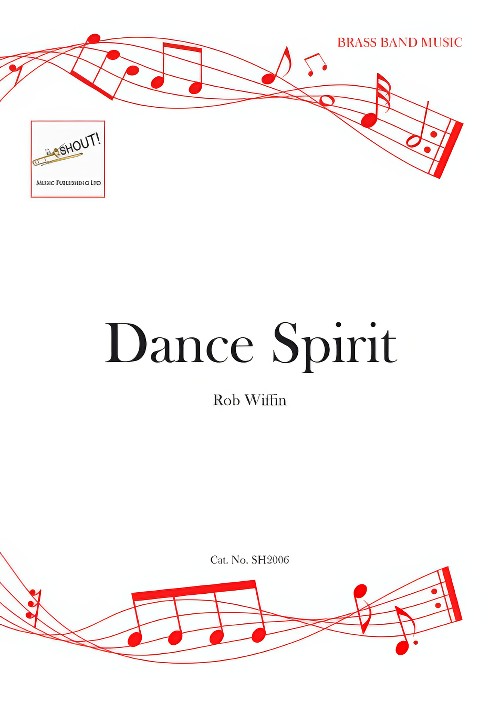
Dance Spirit (Brass Band - Score and Parts) - Wiffin, Rob
Dance Spirit is a three movement suite of dances comprising Stomping Dance, Waltz Interlude and Duende linked by solo dancer cadenzas. It started life as the wind band piece Spirit of the Dance. In it I attempted to capture some of the elements of this most fundamental of human activities, the urge to move our bodies to the rhythm of the music. In re-working it for brass band I extended the duration of the Waltz Interlude and increased the technical level in some areas with the intention of making it a suitable test piece.Stomping Dance - The suite starts with perhaps the most basic dance feeling, the desire to stomp our feet to the music, unrefined, no knowledge of steps needed. The heavy stomp is not always present in the music here, and sometimes you can sense the dancers trying something a little more refined, but it is always lurking in the background, ready to draw us back to the elemental rhythm of the beat.Waltz Interlude - Of course, dance does not always have to have heat, it can be elegant and restrained, emphasising fluidity of line and movement. In the waltz it is occasionally suspended by the held poses before the motion starts again. Unlike the outer movements, the Waltz Interlude is cool, danced in moonlight rather than under the sun. The two dancers sometimes move as one and at other times the man provides a frame for the more intricate arabesques of his partner.Duende - During my time living in Spain I went to watch some flamenco dancing. I was expecting the normal tourist cliches but the dancers were serious students of Flamenco Nuevo y Viejo (new and old). They performed with passion to some pounding asymmetric rhythms and their performance was the inspiration for Duende. Duende as a term is hard to define. It is a spirit of performance - that moment when you are right in the middle of the creative spirit of the music. It is about soul and a heightened state of emotion. Federico Garcia Lorca wrote: I have heard an old maestro of the guitar say, The duende is not in the throat; the duende climbs up inside you, from the soles of the feet. Meaning this: it is not a question of ability, but of true, living style, of blood, of the most ancient culture, of spontaneous creation.- Rob WiffinDuration: 13.45
Estimated dispatch 7-14 working days
-
 £79.95
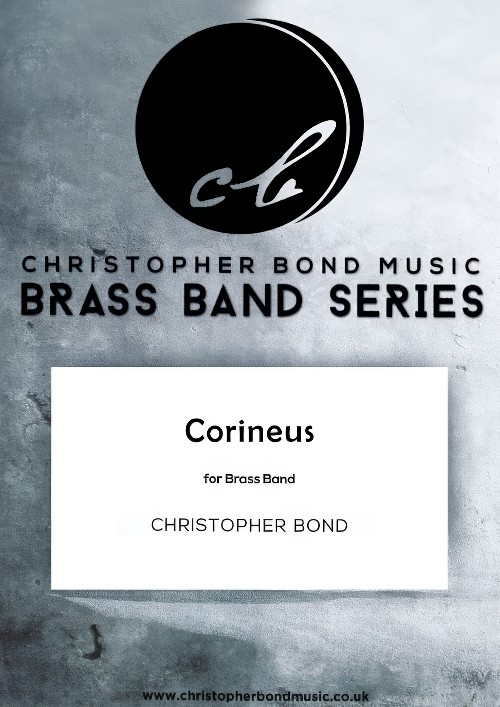
Corineus (Brass Band - Score and Parts) - Bond, Christopher
Regionals 2024 - 3rd Section test piecePremiered by Cory Band at the 2018 Festival of Brass, Manchester. Selected as the set-work for the Championship Section at the 2019 National Youth Championships of Great Britain.Corineus, in medieval British legend, was a prodigious warrior, a fighter of giants, and the eponymous founder of Cornwall. The first of the legendary rulers of Cornwall, he is described as a character of strength and power. It is on the medieval ruler that this new work, Corineus, is based, presented in three contrasting sections. The work opens with heraldic fanfares and a sense of jubilance before presenting musical material which changes and develops organically, portraying the journey taken by Corineus, Brutus, and the Trojans from modern-day mainland Europe to Britain. The central section of the work is slower, creating a feeling of longing. Brutus' son, Locrinus, had agreed to marry Corineus' daughter, Gwendolen, but instead fell in love with a German princess. In writing this part of the work, the composer portrays the longing of Gwendolen for her husband, knowing he is in love with somebody else. After Corineus died, Locrinus divorced Gwendolen, who responded by raising an army in Cornwall and making war against her ex-husband. Locrinus was killed in battle, and legend suggests that Gwendolen threw Locrinus' lover into the River Severn. This dramatic battle provides the inspiration for the final part of the work. In writing this work, the composer hopes to flare the imagination of young brass players around the country, in an engaging new take on a firm fixture in British folklore.Duration: 11.00
Estimated dispatch 7-14 working days
-
£29.95
Corineus (Brass Band - Score only) - Bond, Christopher
Regionals 2024 - 3rd Section test piecePremiered by Cory Band at the 2018 Festival of Brass, Manchester. Selected as the set-work for the Championship Section at the 2019 National Youth Championships of Great Britain.Corineus, in medieval British legend, was a prodigious warrior, a fighter of giants, and the eponymous founder of Cornwall. The first of the legendary rulers of Cornwall, he is described as a character of strength and power. It is on the medieval ruler that this new work, Corineus, is based, presented in three contrasting sections. The work opens with heraldic fanfares and a sense of jubilance before presenting musical material which changes and develops organically, portraying the journey taken by Corineus, Brutus, and the Trojans from modern-day mainland Europe to Britain. The central section of the work is slower, creating a feeling of longing. Brutus' son, Locrinus, had agreed to marry Corineus' daughter, Gwendolen, but instead fell in love with a German princess. In writing this part of the work, the composer portrays the longing of Gwendolen for her husband, knowing he is in love with somebody else. After Corineus died, Locrinus divorced Gwendolen, who responded by raising an army in Cornwall and making war against her ex-husband. Locrinus was killed in battle, and legend suggests that Gwendolen threw Locrinus' lover into the River Severn. This dramatic battle provides the inspiration for the final part of the work. In writing this work, the composer hopes to flare the imagination of young brass players around the country, in an engaging new take on a firm fixture in British folklore.Duration: 11.00
Estimated dispatch 7-14 working days
-
 £60.99
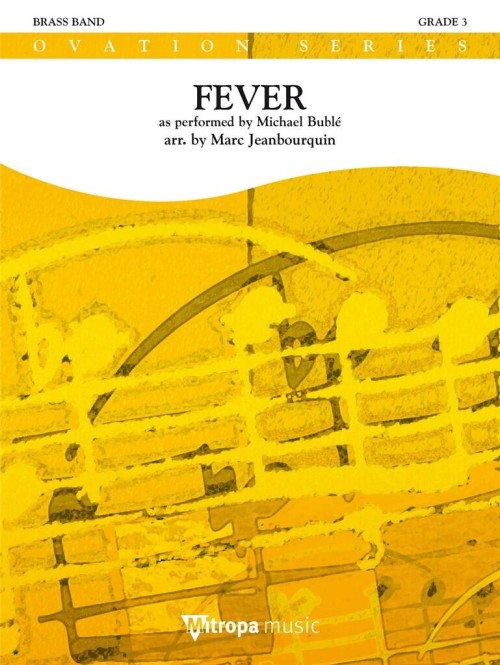
Fever (Brass Band - Score and Parts) - Jeanbourquin, Marc
This song from 1956 has been covered by a number of artists over the years - Peggy Lee, Elvis Presley, Madonna and Michael Bubl to name a few. Each one of these artists recorded covers of this song, making it an all-time classic.Duration: 3.45
Estimated dispatch 7-14 working days
 View Music