
Results
-
 £59.99
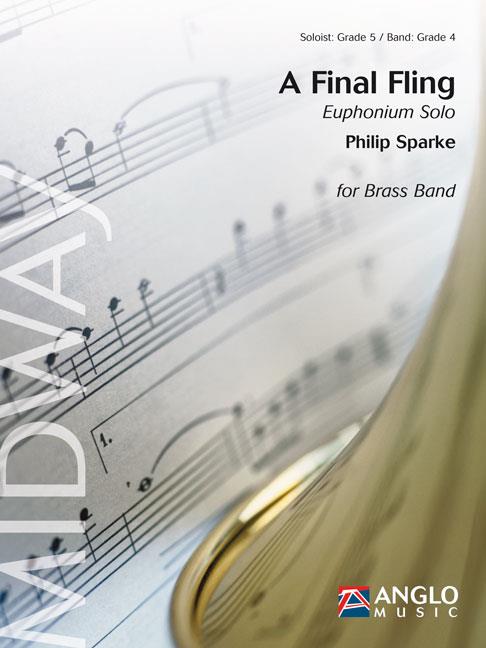
A Final Fling (Euphonium Solo with Brass Band - Score and Parts) - Sparke, Philip
A Final Fling was written at the request of David Childs for a CD recording with a Celtic theme, which he released in 2007. The phrase 'a final fling' means a last quick effort at doing something, perhaps when this item is used as an encore, and also, a fling is a type of Scottish Highland dance, which tied in with the Celtic theme. A light- hearted piece, A Final Fling starts in the mood of a folk dance and quotes from The Irish Washerwoman before flying to a close. A perfect way to put your euphonium player in the spotlight.Duration: 2:00
Estimated dispatch 7-14 working days
-
 £134.99
Dances and Alleluias (Brass Band - Score and Parts) - Sparke, Philip
Dances and Alleluias was commissioned by the British Federation of Brass Bands for the inaugural English National Brass Band Championships, held in the Lyric Theatre at The Lowry, Salford Quays, on July 1st 2006. In this fantastic work the composer mixes wonderful slow music, vocal in nature and ecstatic in mood, along with faster dances to create a challenging piece, which will bring out the best in any band.Duration: 14:30
Estimated dispatch 7-14 working days
-
£13.99
Dances and Alleluias (Brass Band - Study Score) - Sparke, Philip
Dances and Alleluias was commissioned by the British Federation of Brass Bands for the inaugural English National Brass Band Championships, held in the Lyric Theatre at The Lowry, Salford Quays, on July 1st 2006. In this fantastic work the composer mixes wonderful slow music, vocal in nature and ecstatic in mood, along with faster dances to create a challenging piece, which will bring out the best in any band.Duration: 14:30
Estimated dispatch 7-14 working days
-
 £94.95
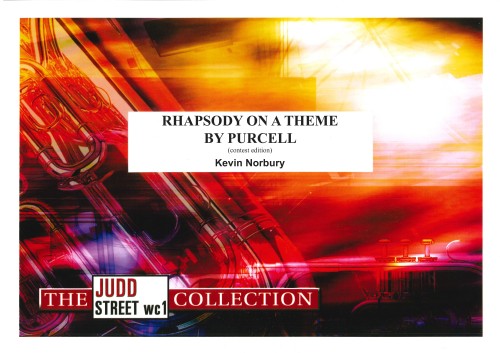
Rhapsody on a Theme by Purcell (Brass Band - Score and Parts) - Norbury, Kevin
Contest VersionIn his relatively short lifetime, Henry Purcell (1659 -1695) achieved stellar musical success and was known and admired internationally by his contemporaries. He is justifiably considered one of England's greatest composers.I thought long and hard before using this magnificent theme as the basis for a band piece because I think that Benjamin Britten has said just about everything possible regarding it in his The Young Person's Guide to the Orchestra. Bearing this in mind, I tentatively set about working on this composition. Once started though, the job became fun because the theme still yielded possibilities - even after Britten!The piece is basically a set of linked variations, much like Rachmaninov's great Rhapsody on theme by Paginini. The music starts slowly and makes much use of crisply dotted rhythms - a Purcellian characteristic. The theme is heard twice before the music changes into a jaunty duple time variation based on the opening motif of Purcell's theme. After this, the mood changes to a waltz-like variation in which clear references to the original theme can be heard. The slow movement follows, and is based on rising and descending scalic figures. This variation is an 'A-B-A' movement with two similar passages framing a more vigorous middle section which features antiphonal fanfare-like figures. Without any preamble, the last variation launches itself - a rumbustious dance which has a distinctive feel to it.The theme eventually reappears as a counter-melody to this dance music before a final triumphant treatment of the melody featuring a somewhat athletic bass line. The music accelerates at the Coda and disappears in a 'puff of smoke'.- Kevin Norbury
Estimated dispatch 7-14 working days
-
 £39.95
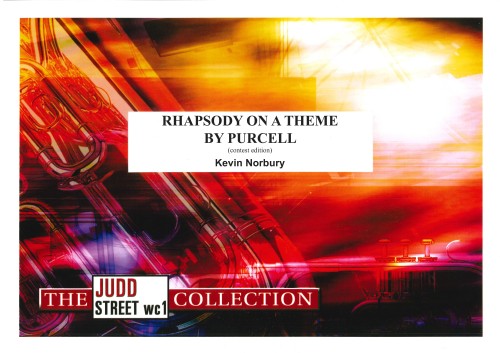
Rhapsody on a Theme by Purcell (Brass Band - Score only) - Norbury, Kevin
Contest VersionIn his relatively short lifetime, Henry Purcell (1659 -1695) achieved stellar musical success and was known and admired internationally by his contemporaries. He is justifiably considered one of England's greatest composers.I thought long and hard before using this magnificent theme as the basis for a band piece because I think that Benjamin Britten has said just about everything possible regarding it in his The Young Person's Guide to the Orchestra. Bearing this in mind, I tentatively set about working on this composition. Once started though, the job became fun because the theme still yielded possibilities - even after Britten!The piece is basically a set of linked variations, much like Rachmaninov's great Rhapsody on theme by Paginini. The music starts slowly and makes much use of crisply dotted rhythms - a Purcellian characteristic. The theme is heard twice before the music changes into a jaunty duple time variation based on the opening motif of Purcell's theme. After this, the mood changes to a waltz-like variation in which clear references to the original theme can be heard. The slow movement follows, and is based on rising and descending scalic figures. This variation is an 'A-B-A' movement with two similar passages framing a more vigorous middle section which features antiphonal fanfare-like figures. Without any preamble, the last variation launches itself - a rumbustious dance which has a distinctive feel to it.The theme eventually reappears as a counter-melody to this dance music before a final triumphant treatment of the melody featuring a somewhat athletic bass line. The music accelerates at the Coda and disappears in a 'puff of smoke'.- Kevin Norbury
Estimated dispatch 7-14 working days
-
 £59.99
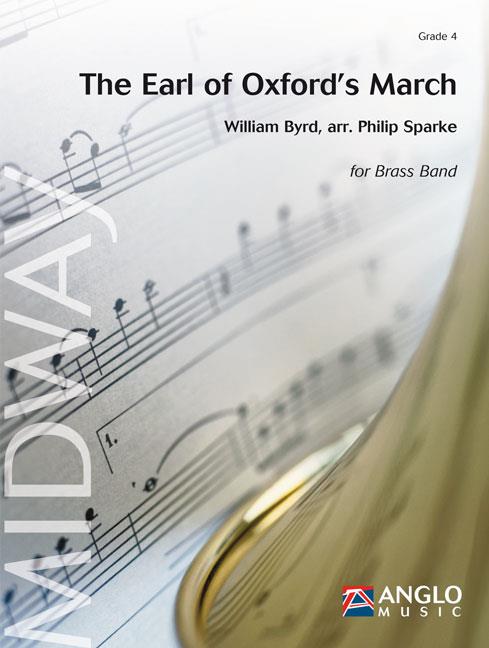
The Earl of Oxford's March (Brass Band - Score and Parts) - Byrd, William
The Battell was written during the late 14th Century when England was in a mood of national celebration after victory over the Spanish and French Armadas. The movement which Byrd called Marche Before The Battell became known as The Earl of Oxford's Marchand it appears with that title in an early manuscript copy of the Fitzwilliam Virginal Book. Written while Byrd was at the height of his powers, it still stirs the soul to this day. A perfect opener for your concert performances.Duration: 4:45
Estimated dispatch 7-14 working days
-
 £59.99
Madrigalum (Brass Band - Score and Parts) - Sparke, Philip
The idea behind this work was to create an opening piece, something to start a concert in an unusual way. The title is a portmanteau word derived from madrigal. The work indeed begins in Renaissance mood however gradually tries to shake of its modal start and, by contrasting different instrumental families, the work changes into modern clothes. Why not add a little Renaissance splendour to any concert with this unique new work?Duration: 4:30
Estimated dispatch 7-14 working days
-
 £91.99
Fiesta de la Vida (Brass Band - Score and Parts) - Sparke, Philip
The Latin American mood of this piece is truly infectious and will make all players, and audience members, get up and dance.Why not add a little Latin spice to any concert with this lively new work.Duration: 8:45
Estimated dispatch 7-14 working days
-
 £89.95
The Trumpets of the Angels (Brass Band - Score and Parts) - Gregson, Edward
The Trumpets of the Angels was commissioned by the Fodens (Courtois) Band for their centenary concert at The Bridgewater Hall in 2000. It is based on a work written for the BBC Philharmonic and Huddersfield Choral Society in 1998, the starting point of which was a quotation from the Book of Revelation:and I saw the seven angels which stood before God; and to them were given seven trumpetsThus the idea behind the work is dramatic and I have tried to achieve this by the spatial deployment of seven solo trumpets around the band, four on-stage, the others off-stage. Six of the solo trumpets eventually join the band, but Trumpet 7 remains off-stage and, indeed, has the most dramatic and extended cadenza representing the words of the seventh angel ...and time shall be no more.The Trumpets of the Angels is a large-scale work, scored for seven solo trumpets, brass band, organ and percussion (deploying 'dark' instruments such as tam-tams, bass drum and two sets of timpani). The work opens with a four-note motif announced by off-stage horns and baritones and answered by fanfare figures on solo trumpets. In turn, each of the first four solo trumpets play cadenzas and then all four join together, independently playing their own music. The organ enters dramatically with its own cadenza, leading to the entry of solo trumpets 5 and 6 with music that is more urgent and rhythmic, describing the horsemen of the Apocalypse.The music reaches another climax, more intense this time, with the horns and baritones (now on-stage) again sounding the transformed motif, before subsiding into what might be described as a lament for humanity, slow music which builds from low to high, from soft to loud, with a melody that is both simple and poignant. At the climax, Trumpet 7 enters playing the opening four-note motif, dramatically extended to almost three octaves. This cadenza (to the partial accompaniment of tam-tams) introduces new material and foreshadows the ensuing scherzo which is fast and aggressive. Despite the somewhat desolate mood of this music, it slowly moves towards an optimistic conclusion, transforming the 'humanity' music into an affirmative and triumphant statement.- Edward Gregson
Estimated dispatch 7-14 working days
-
 £44.95
The Trumpets of the Angels (Brass Band - Score only) - Gregson, Edward
The Trumpets of the Angels was commissioned by the Fodens (Courtois) Band for their centenary concert at The Bridgewater Hall in 2000. It is based on a work written for the BBC Philharmonic and Huddersfield Choral Society in 1998, the starting point of which was a quotation from the Book of Revelation:and I saw the seven angels which stood before God; and to them were given seven trumpetsThus the idea behind the work is dramatic and I have tried to achieve this by the spatial deployment of seven solo trumpets around the band, four on-stage, the others off-stage. Six of the solo trumpets eventually join the band, but Trumpet 7 remains off-stage and, indeed, has the most dramatic and extended cadenza representing the words of the seventh angel ...and time shall be no more.The Trumpets of the Angels is a large-scale work, scored for seven solo trumpets, brass band, organ and percussion (deploying 'dark' instruments such as tam-tams, bass drum and two sets of timpani). The work opens with a four-note motif announced by off-stage horns and baritones and answered by fanfare figures on solo trumpets. In turn, each of the first four solo trumpets play cadenzas and then all four join together, independently playing their own music. The organ enters dramatically with its own cadenza, leading to the entry of solo trumpets 5 and 6 with music that is more urgent and rhythmic, describing the horsemen of the Apocalypse.The music reaches another climax, more intense this time, with the horns and baritones (now on-stage) again sounding the transformed motif, before subsiding into what might be described as a lament for humanity, slow music which builds from low to high, from soft to loud, with a melody that is both simple and poignant. At the climax, Trumpet 7 enters playing the opening four-note motif, dramatically extended to almost three octaves. This cadenza (to the partial accompaniment of tam-tams) introduces new material and foreshadows the ensuing scherzo which is fast and aggressive. Despite the somewhat desolate mood of this music, it slowly moves towards an optimistic conclusion, transforming the 'humanity' music into an affirmative and triumphant statement.- Edward Gregson
Estimated dispatch 7-14 working days
 View Music