
Results
-
 £38.95
Unity Series Band Journal - Numbers 478 - 481, June 2019
478: March - Seize the day (Andrew Mair)This march features the tunes God's love is wonderful (T.B. 130) and Everybody should know, and makes reference to Rescue the perishing (T.B. 808) and the chorus Able to save (T.B. 538)479: Jingle bells jazz! (Richard Phillips)The familiar strains of Jingle Bells (C.C. 121) have featured in Salvation Army music countless times over the years (perhaps more than any other non-religious song), whether as the main theme, countermelody, or as a derived frament or motif. This is an attractive laid-back jazz setting of the tune.480: Poor, wayfarin' stranger (Thomas Mack)This arrangement of the Spiritual depicts a poor wayfarin' stranger's journey through life using a minor key and a slow walking style.481: Selection - No crib for a bed (Charles Craig)This simple setting reminds us that, amidst the joy and exuberance that often accompanies the Christmas season, Jesus' birth was a very humble event.
Estimated dispatch 7-14 working days
-
 £45.00
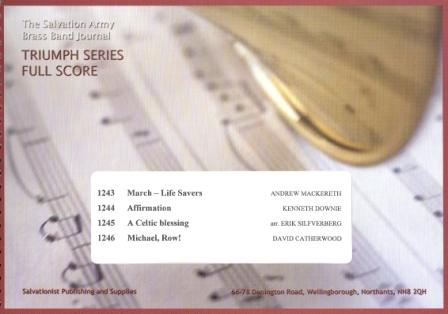
Triumph Series Band Journal November 2013 Numbers 1243-1246
No. 1243 March - Life Savers (Andrew Mackareth)This march was written for the band weekend at Belfast Citadel and incorporates the tune Jesus Saves (T.B. 703)No. 1244 Affirmation (Kenneth Downie)The title comes from the affirming tone of the chorus on which the music is built, He is the Lord, which itself is inspired by Phillippians, chapter 2. The chorus does not appear in its entirety at any point, but is obvious to a greater or lesser extent, in the texture of the music.No. 1245 A Celtic Blessing (arr. Erik Silfverberg)This is a simple arrangement of c Celtic traditional tune used to the lyrics of the familiar blessing:May the road rise to meet you,May the wind be always at your back,May the sun shine warm upon your face,The rain fall soft upon your fields,Until we meet again,May God hold you in the palm of his hand.No. 1246 Michael, Row! (David Catherwood)This arrangement of the traditional chous, 'Michael, row the boat ashore' (T.B. 285), is in a light swing style and also incorporates the tunes, 'Love lifted me' (T.B. 725) and 'Will uour anchor hold?' (T.B. 60).
Estimated dispatch 7-14 working days
-
 £29.95
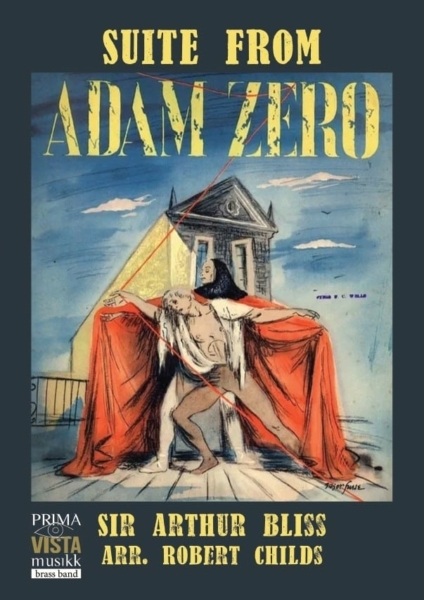
Adam Zero, Suite from (Brass Band - Score only) - Bliss, Arthur - Childs, Robert
Selected as the Section 2 test piece for the National Brass Band Championships of Great Britain 2025Following his ballet Checkmate, Bliss composed another score for the, by then, Sadler's Wells Ballet, Miracle in the Gorbals, which was choreographed by Robert Helpmann, to a scenario by Michael Benthall. Premired in 1944, the ballet made a considerable impact and was a box-office success. It was followed in turn by a further collaboration with Helpmann and Benthall, Adam Zero. This would serve Helpmann, in the eponymous role, as a vehicle in two respects: demonstrating his gifts as a dancer-actor and as a choreographer. First performed at the Royal Opera House, Covent Garden, on 8 April 1946, Adam Zero was conducted by Constant Lambert, the work's dedicatee. Bliss considered it 'his most varied and exciting ballet score'. Benthall provided a synopsis for the programme:There is a philosophy that life moves in an endless series of timeless cycles. As Nature passes through Spring, Summer, Autumn and Winter, so man is born, makes a success in his own particular sphere, loses his position to a younger generation, sees his world crumble before his eyes and only finds peace in death. This age-old story is told in terms of a Company creating a ballet and calling on the resources of the theatre to do so. Lighting, stage mechanism, dance conventions, musical forms and costumes and scenery of all periods are used to symbolize the world of 'Adam Zero'.Apart from Adam, as the Principal Dancer, other main roles included the Stage Director (representing Omnipotence), and Adam's Fates (Designer, Wardrobe Mistress, and Dresser). 'The Woman in this allegory', wrote Bliss, 'under the symbol of the Choreographer, was both the creator and destroyer of Adam: his first love, his wife, his mistress, and finally the figure of beneficent Death.' When the curtain rose, the 'audience saw the Covent Garden stage right back to the wall, completely empty except for the protagonists, 'the Company poised, still and expectant, as they await the birth of... Adam Zero.'Unfortunately, soon after the premire, Helpmann injured himself and had to withdraw from the remaining performances. Despite generally positive reviews, the ballet did not capture the imagination of audiences and, to Bliss's considerable disappointment, was not revived. Seventy years would elapse before its first major return to the stage, in 2016, performed by the ballet company of Stadttheater Bremerhaven with choreography by Sergei Vanaev.Bliss extracted a concert suite from the ballet, conducting its first performance with the City of Birmingham Symphony Orchestra on 28 October 1948. For his own suite, arranged for brass band in 2023, Dr Robert Childs chose three dances linked to the seasons, book-ending them with the ebullient 'Fanfare Overture' and 'Fanfare Coda'. After Adam has grown to manhood, his Fates clothe him in a costume synonymous with confident youth, appropriate for the virile, ardent 'Dance of Spring'. In the 'Approach of Autumn', Adam, now wearing a sombre costume, has grown older: his Fates have streaked grey in his hair and put lines on his face. But they had earlier raised Adam to the zenith of his power, and the 'Dance of Summer' depicts him in the prime of life, in music of sweeping grandeur. The 'Fanfare Coda' signals that the next cycle of life is about to begin.Duration: 10.30
Estimated dispatch 7-14 working days
-
£19.65
Adam Zero, Suite from (Brass Band - Study Score) - Bliss, Arthur - Childs, Robert
Selected as the Section 2 test piece for the National Brass Band Championships of Great Britain 2025Following his ballet Checkmate, Bliss composed another score for the, by then, Sadler's Wells Ballet, Miracle in the Gorbals, which was choreographed by Robert Helpmann, to a scenario by Michael Benthall. Premired in 1944, the ballet made a considerable impact and was a box-office success. It was followed in turn by a further collaboration with Helpmann and Benthall, Adam Zero. This would serve Helpmann, in the eponymous role, as a vehicle in two respects: demonstrating his gifts as a dancer-actor and as a choreographer. First performed at the Royal Opera House, Covent Garden, on 8 April 1946, Adam Zero was conducted by Constant Lambert, the work's dedicatee. Bliss considered it 'his most varied and exciting ballet score'. Benthall provided a synopsis for the programme:There is a philosophy that life moves in an endless series of timeless cycles. As Nature passes through Spring, Summer, Autumn and Winter, so man is born, makes a success in his own particular sphere, loses his position to a younger generation, sees his world crumble before his eyes and only finds peace in death. This age-old story is told in terms of a Company creating a ballet and calling on the resources of the theatre to do so. Lighting, stage mechanism, dance conventions, musical forms and costumes and scenery of all periods are used to symbolize the world of 'Adam Zero'.Apart from Adam, as the Principal Dancer, other main roles included the Stage Director (representing Omnipotence), and Adam's Fates (Designer, Wardrobe Mistress, and Dresser). 'The Woman in this allegory', wrote Bliss, 'under the symbol of the Choreographer, was both the creator and destroyer of Adam: his first love, his wife, his mistress, and finally the figure of beneficent Death.' When the curtain rose, the 'audience saw the Covent Garden stage right back to the wall, completely empty except for the protagonists, 'the Company poised, still and expectant, as they await the birth of... Adam Zero.'Unfortunately, soon after the premire, Helpmann injured himself and had to withdraw from the remaining performances. Despite generally positive reviews, the ballet did not capture the imagination of audiences and, to Bliss's considerable disappointment, was not revived. Seventy years would elapse before its first major return to the stage, in 2016, performed by the ballet company of Stadttheater Bremerhaven with choreography by Sergei Vanaev.Bliss extracted a concert suite from the ballet, conducting its first performance with the City of Birmingham Symphony Orchestra on 28 October 1948. For his own suite, arranged for brass band in 2023, Dr Robert Childs chose three dances linked to the seasons, book-ending them with the ebullient 'Fanfare Overture' and 'Fanfare Coda'. After Adam has grown to manhood, his Fates clothe him in a costume synonymous with confident youth, appropriate for the virile, ardent 'Dance of Spring'. In the 'Approach of Autumn', Adam, now wearing a sombre costume, has grown older: his Fates have streaked grey in his hair and put lines on his face. But they had earlier raised Adam to the zenith of his power, and the 'Dance of Summer' depicts him in the prime of life, in music of sweeping grandeur. The 'Fanfare Coda' signals that the next cycle of life is about to begin.Duration: 10.30
Estimated dispatch 7-14 working days
-
£64.95
Adam Zero, Suite from (Brass Band - Score and Parts) - Bliss, Arthur - Childs, Robert
Selected as the Section 2 test piece for the National Brass Band Championships of Great Britain 2025Following his ballet Checkmate, Bliss composed another score for the, by then, Sadler's Wells Ballet, Miracle in the Gorbals, which was choreographed by Robert Helpmann, to a scenario by Michael Benthall. Premired in 1944, the ballet made a considerable impact and was a box-office success. It was followed in turn by a further collaboration with Helpmann and Benthall, Adam Zero. This would serve Helpmann, in the eponymous role, as a vehicle in two respects: demonstrating his gifts as a dancer-actor and as a choreographer. First performed at the Royal Opera House, Covent Garden, on 8 April 1946, Adam Zero was conducted by Constant Lambert, the work's dedicatee. Bliss considered it 'his most varied and exciting ballet score'. Benthall provided a synopsis for the programme:There is a philosophy that life moves in an endless series of timeless cycles. As Nature passes through Spring, Summer, Autumn and Winter, so man is born, makes a success in his own particular sphere, loses his position to a younger generation, sees his world crumble before his eyes and only finds peace in death. This age-old story is told in terms of a Company creating a ballet and calling on the resources of the theatre to do so. Lighting, stage mechanism, dance conventions, musical forms and costumes and scenery of all periods are used to symbolize the world of 'Adam Zero'.Apart from Adam, as the Principal Dancer, other main roles included the Stage Director (representing Omnipotence), and Adam's Fates (Designer, Wardrobe Mistress, and Dresser). 'The Woman in this allegory', wrote Bliss, 'under the symbol of the Choreographer, was both the creator and destroyer of Adam: his first love, his wife, his mistress, and finally the figure of beneficent Death.' When the curtain rose, the 'audience saw the Covent Garden stage right back to the wall, completely empty except for the protagonists, 'the Company poised, still and expectant, as they await the birth of... Adam Zero.'Unfortunately, soon after the premire, Helpmann injured himself and had to withdraw from the remaining performances. Despite generally positive reviews, the ballet did not capture the imagination of audiences and, to Bliss's considerable disappointment, was not revived. Seventy years would elapse before its first major return to the stage, in 2016, performed by the ballet company of Stadttheater Bremerhaven with choreography by Sergei Vanaev.Bliss extracted a concert suite from the ballet, conducting its first performance with the City of Birmingham Symphony Orchestra on 28 October 1948. For his own suite, arranged for brass band in 2023, Dr Robert Childs chose three dances linked to the seasons, book-ending them with the ebullient 'Fanfare Overture' and 'Fanfare Coda'. After Adam has grown to manhood, his Fates clothe him in a costume synonymous with confident youth, appropriate for the virile, ardent 'Dance of Spring'. In the 'Approach of Autumn', Adam, now wearing a sombre costume, has grown older: his Fates have streaked grey in his hair and put lines on his face. But they had earlier raised Adam to the zenith of his power, and the 'Dance of Summer' depicts him in the prime of life, in music of sweeping grandeur. The 'Fanfare Coda' signals that the next cycle of life is about to begin.Duration: 10.30
Estimated dispatch 7-14 working days
-
 £44.95
Deus Invictus - God Unconquered (Brass Band - Score and Parts) - Mackereth, Andrew
Deus Invictus draws its inspiration from well-known words from Romans 8: 38-39; 'For I am convinced that neither death nor life, neither angels nor demons, neither the present nor the future, nor any owers, neither height nor depth, nor anything else in all creation, can separate us from the love of God'. The music reflects the confidence and certainty of the scripture text while, as in everyday life, trials and tests come along which are reflected in a sequence of musical skirmishes. The work introduces the 19th century hymn 'St Albinus' to a wider audience and also includes references to the tunes 'St Margaret' and 'Rachie'. A setting of the Easter Hymn, 'Christ the Lord is risen today!', is heard followed by a final reprise of 'St Albinus'.
Estimated dispatch 7-14 working days
-
£22.50
Deus Invictus - God Unconquered (Brass Band - Score only) - Mackereth, Andrew
Deus Invictus draws its inspiration from well-known words from Romans 8: 38-39; 'For I am convinced that neither death nor life, neither angels nor demons, neither the present nor the future, nor any owers, neither height nor depth, nor anything else in all creation, can separate us from the love of God'. The music reflects the confidence and certainty of the scripture text while, as in everyday life, trials and tests come along which are reflected in a sequence of musical skirmishes. The work introduces the 19th century hymn 'St Albinus' to a wider audience and also includes references to the tunes 'St Margaret' and 'Rachie'. A setting of the Easter Hymn, 'Christ the Lord is risen today!', is heard followed by a final reprise of 'St Albinus'.
Estimated dispatch 7-14 working days
-
 £124.95
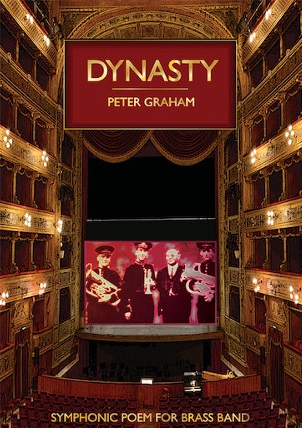
Dynasty (Brass Band - Score and Parts) - Graham, Peter
Dynasty takes the form of a Symphonic Poem, a musical form first introduced to a contest audience at the Crystal Palace in 1913 by Percy Fletcher in his work Labour and Love.Using key passages from the autobiography of Harry Mortimer, On Brass, as the source for the narrative, the work opens with a four-note leitmotif (Harry's theme, "as if descending from the heavens"), and the timeline unfolds as follows:Harry - One's destiny decided at birth "I'll make him the best cornet player in England"War - Why do the nations so furiously rage together? Fred volunteers for military serviceTheatre - And suddenly "I dashed to the rescue like a hero in the silent movies I was about to get to know so well"Journey - Comfort Ye A new life and new challengesTogether - Come unto me "A golden age"Farewell - For behold, darkness "Fred's death surely marked the passing of an era"Amen - The Trumpet shall soundListeners familiar with brass band repertoire will recognise a few pertinent quotes within the piece.In my imagination Harry is joined by Fred on cornet and the euphoniums of Alex and Rex for the quartet cadenza from Sovereign Heritage by Jack Beaver in Together.The Amen section from Handel's Messiah provides the basis for a contrapuntal flight of fancy as the work moves towards a conclusion. Other less overt fragments contribute to the story.Dynasty was co-commissioned by the British Open Brass Band Championships for the September 2019 contest, and the Brass Band Committee VLAMO for the Belgian Brass Band Championships 2019.- Peter GrahamDuration: 17.00
Estimated dispatch 7-14 working days
-
£89.99
Ross Roy (Brass Band - Score and Parts) - De Haan, Jacob
In this composition, Jacob de Haan sees the "Ross Roy" as a metaphor for the years spent at school (a monument in time), where one's personality is formed. So, the opening theme the artist calls the Ross Roy theme initially has monumental characteristics.The rhythmic motion, which strides along in the lower register and percussion at the beginning of the next section is typical of "Tempo di Marcia". This movement, accompanied by repetitions of sound, is a metaphor for the structure and discipline in school. This is the introduction to a march theme, symbolic of "passing through" the classes up to the final examinations.Then, the Ross Roy theme is dealt with again, now in a playful, humorous variation. As if the composer is saying there should also be time for a smile in school. The same theme can be heard in major key and a slower tempo in the following section, expressing pride and self-confidence. This is also the introduction to the expressive middle section that represents love, friendship and understanding.We then return to the march theme in a slightly altered construction. The oriental sounds, constituting the modulation to the final theme, are symbols of the diversity of cultures in the school. The characteristic final theme first sounds solemn, but turns into a festive apotheosis. It is no coincidence that the final cadence is reminiscent of the close to a traditional overture, for the school years can be considered the "overture" to the rest of one's life.Duration: 9:20
Estimated dispatch 7-14 working days
-
 £35.00
GOD ONLY KNOWS (Flugel feature/Brass Band) - Baker, Leigh
Recorded in 1966 as a part of the Beach Boys' landmark?Pet Sounds?album, this ballad has become a prime example of Brian Wilson's innovative approach to songwriting and recording. Hailed for its formal and harmonic complexities as well as a memorable hook, "God Only Knows" has remained popular through the years, and was featured prominently in the biographical film Love & Mercy?about the life of Brian Wilson.This Beach Boys Classic is arranged as a Flugel Solo, and features a Trombone Quartet (spotlight your 'sectret' Trombonist or use a Baritone/Valve Trombone soloist from your Euphonium/Baritone Team.Commissioned by The Leland Band for their Brass in Concert performance 2012 this is a real favourite with audiences and something a little bit different. This is ripe for Choreography.
Estimated dispatch 7-14 working days
 View Music