
Results
-
 £59.99
Magga - Philip Sparke
The Four Noble Truths was commissioned by the Dutch National Brass Band Championships for their 2003 competition.The Four Noble Truths are the most basic expression of the teaching of Buddha and therefore still form the guidelines for Buddhists to this day. They concern themselves with Dukkha, which has no exact translation but can mean suffering, stress or sadness etc. Magga is The Noble Truth of the Path Leading to the Cessation of Dukkha - the Fourth Noble Truth - which gives us a description of eight disciplines which can help us eliminate the origins of stress from our lives.
Estimated dispatch 5-14 working days
-
 £72.99
New Horizons - Morten J. Wallin
The Norwegian composer Morten J. Wallin dedicated "New Horizons" to his three children, of 8, 20 and 23 years old. Each of them lives in a world of their own and is at a different stage of life, with their own school, friends and hobbies. They also all dream of the future in their own way, and of a life that is always offering new perspectives and ... a new horizon
Estimated dispatch 5-14 working days
-
 £54.99
It Started with a Kiss - Timothy Travis
This delightful ballad, in which the solo horn plays a leading role, will remind many people of a very special moment in their lives. A lot could be said about it, but perhaps it is better to let the music speak for itself. While listening to this romantic ballad, unforgettable moments are sure to be relived by many people. Daydreaming is allowed, but don't forget to pay some attention to the soloist's performance it will be worth your while.
Estimated dispatch 5-14 working days
-
£76.99
Durkle Bandrydge Suite - Bruce Fraser
Durkle Bandrydge is the name of the composers imaginary world, but it could very well be anyones invisible dream world with a different name. In this very versatile suite by Bruce Fraser, 8 characters are featured, each with its ownpeculiarities, making Durkle Bandrydge such a colourful place. Do these characters differ that much from us? That is for you to find out! In the last part, all characters come together in a special way.Durkle Bandrydge exists at the end ofyour street. It is invisible to humans, but Durkle Bandrygators can watch us with great interest. The music will introduce you to some of the characters who live in this unusual place. The parts: Somnanbulyss, who is a giant trollguarding the entrance to Durkle Bandryde. At least, he is supposed to, but he tends to sleep most of the time. His music is therefore very slow moving and sleepy. Long Gwysteen is a tall, mysterious, and somehow sophisticated character,who walls around with a shell on his back. His music glides along rather gracefully. Squelfitch is a rather unpleasant and smelly character who lives in a bog, which is why his music sounds rather slimy and a bit like trying to walkthrough quicksand. Perfydlia is a meddling old woman, who gossips about everybody and squeals with sudden delight at the small exciting bits of tittletattle about others in the village. In the music you can hear her sudden little squealsof delight. Maryann Lovely is a beautiful young lady, graceful, gorgeous, absolutely devine, and her music is obviously just the same. Thistledoo Nicely is a lively character who spends and spends and spends with her credit card,buying the latest fashion and never worries about having to pay the bills. Her music reflects her excitement when shopping and het 'happy go lucky' approach to life. Marsyn Edginton is the Lord of the manor, the richest man in town, the'big cheese', the man with all the power and, of course, the biggest house. He is very grand and his music like he could be a king. Jimmy McScotsmyn is a red haired scotsman wearing tartan cap. He misses his home country terribly and eatslots of shortbread, oatcakes, scotch eggs, porridge and drinks an enormous amount of Scotch Wisky, which helps him to have fond memories of the kind of music he would like to dance to when he was a younger man. His favourite dance is a Jig andthis is the music he remembers. Grand March of the Durkle Bandrydgators. We hope that you have enjoyed meeting these characters from Drukle Bandrydge and would invite you to listen to all the villagers now march along in a grand parade -it is a pity that you can not see them, what is a wonderful sight. If you listen carefully, you will hear the melodies which belong to the characters as they march past. Oh what a grand spectacle!
Estimated dispatch 5-14 working days
-
 £76.99
Animal Kingdom - William Vean
In this composition William Vean takes you on a journey through the fascinating and exciting world of animals. Apart from it being a composition filled with "special effects", Animal Kingdom contains many educational elements, such as playing inswing (triplets feeling), chromatics, flutter tonguing, gypsy tuning, varying keys, and, of course, dynamics and articulation. The melodic lines occur in all four voices, as well as in all percussion parts, providing each musician with theopportunity to play a solo or to accompany. Highly recommended for your youth band! William Vean is an educational composer. He knows how to musically shape the special elements from our daily lives. His music is therefore veryexpressive, containing creative solutions to possible problems. Special ways of playing make his music particularly interesting for the winds, but the percussion section is also featured in his special effects. The world of the animalsalways plays on ones imagination. In Animal Kingdom, William Vean has portrayed a number of animals in a special manner: Kevin Kangaroo - The jumping character of this animal can be heard in different voices. The swing style alsoemphasizes the characteristic movements of the kangaroo. Playing in swing style can be practised by using scales. Eddy Elephant - For some of his smaller fellow fauna friends this can be quite an ordeal, but for Eduard (Eddy for friendsand intimates) it is his daily walk. Baldrick Bat - Baldrick the Bat is a mysterious character. This can be heard in the fast moving valves and keys, accompanied by special effects in the percussion section. Curtis Camel - Curtisthe Camel trudges across the desert, feeling bored. The idea that the horizon will never change does not affect him anymore. He has accepted his fate. The distinctive tones from the gypsy scale provide the suitable oriental sounds. BettyButterfly - Butterfly Betty elegantly, and without worries, flutters from flower to flower in the garden. Her motto: Carpe Diem (Seize the Day). Betty is a one-day butterfly. Marvin Monkey - A "swing" monkey stirs up the feelings. Evenmembers of the orchestra will look like real monkeys. How about your audience? Each part has its own difficulties and challenges. Important in the first part is playing "in swing" (triplets feeling). This can be practised usingscales. In the second part ensemble playing and balance are important. In Baldrick additional information on the effects that have to be played might be useful. "New" sounds are, of course, welcome. Curtis the Camel introduces thegypsy scale. Additional explanation of the use of the scale might be useful. Key changes are interesting in this part. A slight accent on the first beat of the bar will add to the charm of this part. Marvin the Monkey brings back the swingrhythm that was introduced in the first part, alternated by a "straight" part with attention to chromatics and articulation. A story teller will definitely be an asset when performing this composition.
Estimated dispatch 5-14 working days
-
 £133.40
The Witch and The Saint - Steven Reineke - Erik Rozendom
A tone poem in one movement. This work from the American composer, Steven Reineke tells the story of the lives of Helena and Sibylla, twin sisters born in Germany in 1588. The sisters were separated at an early age, and one became a witch, and the other became a saint. The composer uses many various musical variations to illustrate the turbulent life of the sisters. This is one of Steven Reineke's most famous works and has now been arranged by Erik Rozendom.
Estimated dispatch 5-14 working days
-
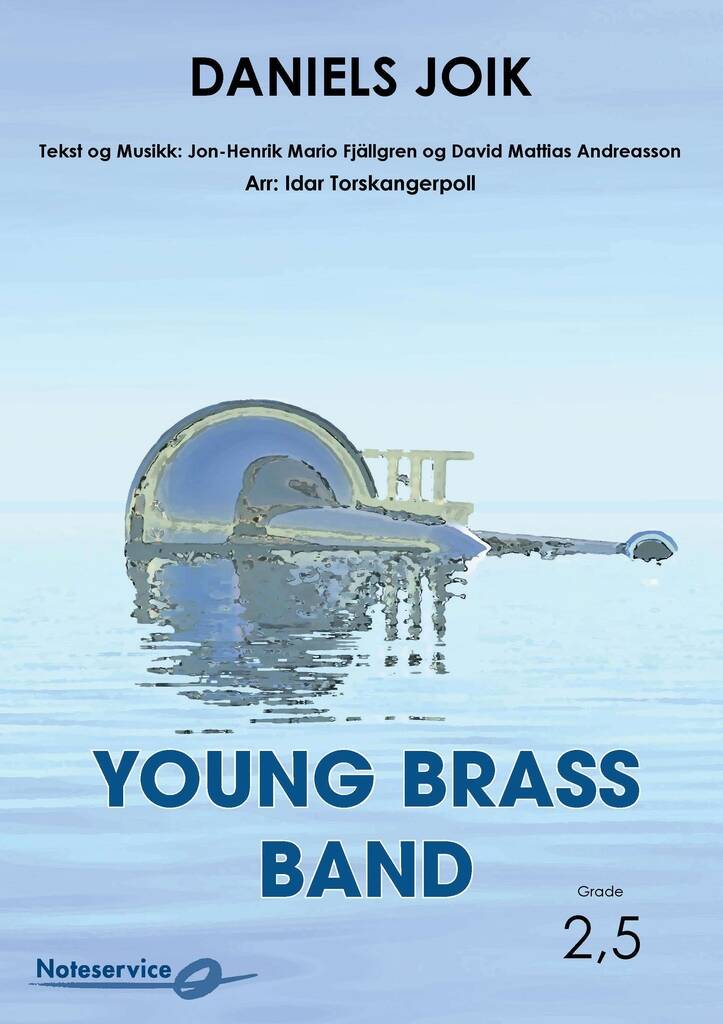 £105.20
Daniels Joik - Jon-Henrik Fjâllgren - Idar Torskangerpoll
Jon Henrik Mario Fjallgren became instantly well-known after his appearance in Sweden's "Got Talent" where he performed "Daniels Joik" written for his recently passed best friend.Fjallgren was born in Cali, Columbia in 1987 but adopted by a Swedish Sami family and lives now as a reindeer herder, singer and composer. He debuted on stage in 2003, 14 years old and on record two years later.After the success with "Got Talent", he has also participated twice in the Swedish Eurovision Song Contest.This arrangement can be performed in a long or shorter version, for short version cut bars 58-78.
Estimated dispatch 5-14 working days
-
 £118.99
Abaddon - Kevin Houben
Abaddon was commissioned by the NLBB (Noord-Limburgse Brassband North Limburg Brass Band) from Belgium. Abaddon is the demon reigning over the underworld. In the New Testament in the Book of Revelation by John (9:11) he is calledthe angel of the bottomless pit. The work Abaddon lives up to its name. Technically and physically, it holds an enormous challenge for every band in the champions division. The composition has a traditional form structure (fast slow fast), and it consists of ornamentationsaround the letters IVAN, after Ivan Meylemans, the conductor who since 2001 has obtained great successes with the NLBB, and who in this case has also been essential in taming the demon in Abaddon.
Estimated dispatch 5-14 working days
-
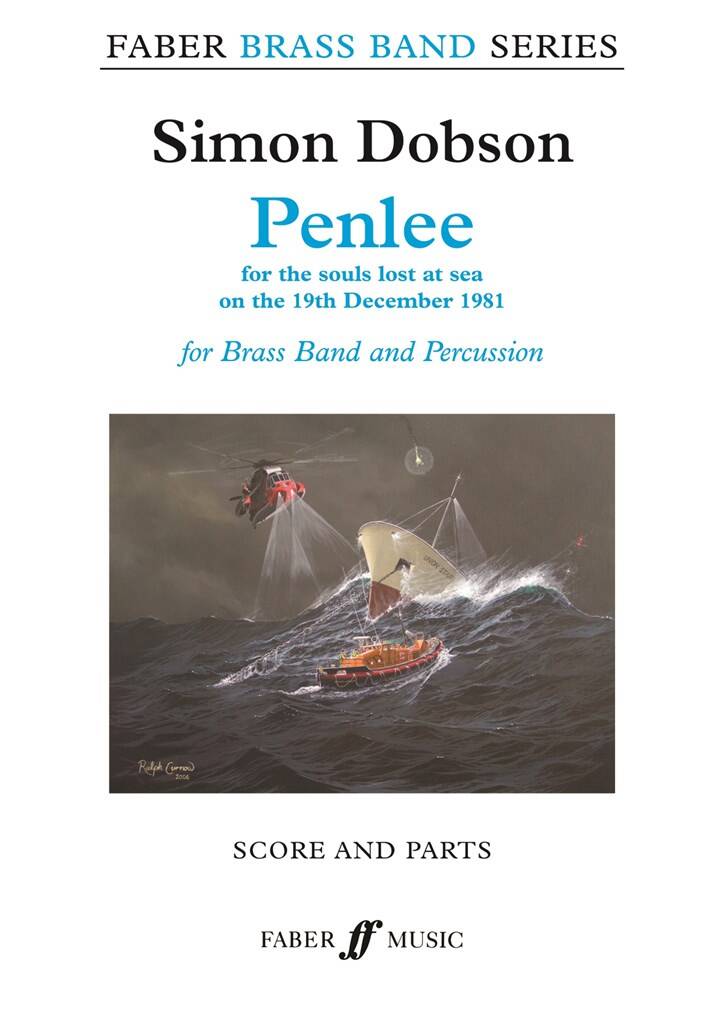 £95.00
Penlee - Simon Dobson
To some, the tragic story of the Penlee lifeboat, Solomon Browne, would need no introduction, and to some the pain felt is still very much a reality. The composer, born just a few weeks before that fateful night on the19th December 1981, has created this work as a musical homage to the bravery of the souls who lost their lives and has dedicated it to their memory. Penlee was commissioned by the Cornwall Youth BrassBand using funds bequeathed by Michael Pickett. The first performance was given by the Cornish Youth Brass Band, conducted by Ian Porthouse, at St. Michael's Church, Newquay, on 30th December 2008.Penleehas been voted into the Classic FM Hall of Fame 2011 at No.106. Not only is it the first time a brass work has been featured in the Hall of Fame, but it was also thehighest new entry. The work has subsequently been recorded by the Leyland Band, conducted by Jason Katsikaris, on the CD entitled Penlee.Brass Band Grade 4: Advanced Youth and 3rd Section Duration: 13 minutes
Estimated dispatch 5-14 working days
-
 £109.99
The Power of the Megatsunami - Carl Wittrock
The word 'tsunami' is of Japanese origin. When you look it up in a dictionary, you will find that it means 'a great sea wave produced by submarine earth movement or volcanic eruption'. A megatsunami is the superlative of this awesome expressionof power that nature can create, and has catastrophic consequences. When Carl Wittrock completed this composition not many such big earth movements had occurred, but since then we have become all too familiar with the disastrousconsequences which a tsunami may have. On the 26th of December 2004 a heavy seaquake took place near the Indonesian island of Sumatra. Tidal waves 10 meters in height ravaged the coastal regions of many countries for miles around. The tsunamitook the lives of thousands of people and destroyed many villages and towns. There are more areas which run the risk of being struck by a tsunami, such as the island of La Palma, one of the Canary Islands. This island is based on oceaniccrust at a fracture zone and as such is one of nature's time bombs. The consequences of a natural calamity like a megatsunami are immense. In the case of La Palma, the tidal wave will move in the direction of South America, where it may reach 50km inland, destroying everything on its way. In his composition Wittrock describes an ordinary day which will have an unexpected ending. Right from the beginning there seems to be something in the air, the music creating an oppressiveatmosphere of impending disaster. Themes are interrupted, broken off suddenly, followed by silence, suggesting the calm before the storm. Suddenly a short climax (glissandi in the trombone part) indicates the seaquake, and the megatsunami isa fact. Hereafter follows a turbulent passage symbolising the huge rolling waves. After nature's force has spent itself, resignation sets in and the composition ends with a majestic ode to nature.
Estimated dispatch 5-14 working days
 View Music