
Results
-
 £34.00
Meditation: It is Well With My Soul
ABOUT THIS PIECE: Cantatio are pleased to release this hymn meditation on the much-loved hymn by Adam D J Taylor. Commissioned by the world famous Wingates Band, this arrangement became a centrepiece of the band's online presence during the COVID pandemic. Story time... Horatio Spafford was a successful attorney and real estate investor who lost a fortune in the great Chicago fire of 1871. Around the same time, his beloved four-year-old son died of scarlet fever. Thinking a vacation would do his family some good, he sent his wife and four daughters on a ship to England, planning to join them after he finished some pressing business at home. However, while crossing the Atlantic Ocean, the ship was involved in a terrible collision and sunk. More than 200 people lost their lives, including all four of Horatio Spafford's precious daughters. His wife, Anna, survived the tragedy. Upon arriving in England, she sent a telegram to her husband that began: "Saved alone. What shall I do?" Horatio immediately set sail for England. At one point during his voyage, the captain of the ship, aware of the tragedy that had struck the Spafford family, summoned Horatio to tell him that they were now passing over the spot where the shipwreck had occurred. As Horatio thought about his daughters, words of comfort and hope filled his heart and mind. He wrote them down, and they have since become a well-beloved hymn: When peace like a river, attendeth my way, When sorrows like sea billows roll-- Whatever my lot, thou hast taught me to say It is well, it is well with my soul. ENSEMBLE: Standard British Brass Band WHEN YOU BUY THIS PRODUCT, YOU GET: High-quality printed score and parts LEVEL: 2 - 3 LISTEN: DURATION: c. 7-minutes, 30-seconds EXAMPLE SCORE: Click here LEVEL GUIDE: Level 1- Accessible to all Level 2 - c. UK third section and higher Level 3 - c. UK second section and higher Level 4 - c. UK first section and higher Level 5 - c. UK championship section level
Estimated dispatch 5-7 working days
-
 £30.00
Here's That Rainy Day
Trombone Solo.In 1953, a new musical by Johnny Burke and Jimmy Van Heusen was staged, "Carnival in Flanders". Unfortunately, it was not successful. However, one of the songs, "Here's that Rainy Day" became a standard on the cabaret scene.I have arranged this memorable song for solo trombone and brass band. It begins in a Latin style, then moves to the famous Jazz Big Band style. Good key players make the band parts playable by most bands - as long as they like to 'swing'! The trombone part is not easy, on the other hand, neither is it aimed at the 'select few' virtuoso players. Impressive stuff though, with 'written' sections that sound like improvisation.
In Stock: Estimated dispatch 3-5 working days
-
 £127.95
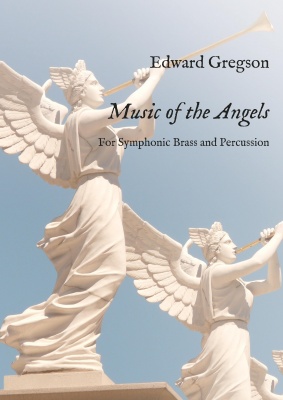
Music of the Angels (Symphonic Brass Ensemble - Score and Parts)
In 1998 Gregson was commissioned by conductor Martyn Brabbins to write a short concert opener with choir to mark his debut as Music Director of the Huddersfield Choral Society. Entitled ...and the seven trumpets... this ten minute flourish is founded on a verse from Chapter 8 of the Revelation To John (The Apocalypse), the last book in the Bible: 'and I saw the seven Angels which stood before God: and to them were given seven trumpets'. The performance employed the full power of the Huddersfield Town Hall organ and the brass section of the BBC Philharmonic, including seven trumpets and four horns placed strategically around hall.The following year, when Gregson received a commission from the Cheshire-based Foden's Brass Band (conducted at that time by Nicholas Childs) for a work to mark its centenary in 2000, he turned to the first portion of ...and the seven trumpets... as the basis for an ambitious celebratory work entitled The Trumpets of the Angels. "The opportunity to create an extended work which would break out of the brass band mould was an important milestone for me," the composer says. In 2015 he was asked by Nicholas Childs to create a new performing edition without organ for the Black Dyke Band. This received its first performance in April 2016 at the European Brass Band Festival in Lille. In 2018, Gregson revisited the music for a third time, returning the opening fanfares to orchestral brass and transforming substantial portions of the 'Black Dyke' version to create Music of the Angels, a dramatic canvas for symphonic brass and percussion.An array of bells and gongs offer an unmistakable key to the source of Gregson's inspiration. Inscribed In tribute to Olivier Messiaen, the work's principal material and its sound world, but crucially not the underlying musical processes, are influenced by Messiaen's masterpiece for wind and percussion, Et exspecto ressurectionem mortuorum (1964). Music of the Angels begins with braying of horns suggestive of the start of an ancient ritual. Six 'angel' trumpeters, set behind the ensemble, answer in sequence, with the evocative sound of tam-tams creating the Messiaen-like aura. Once the horns have reached the performing space, four of the trumpeters deliver highly contrasting fanfare cadenzas. At the climax of this episode, the individual fanfares are presented together, as if, perhaps, to reflect the Biblical writer's apocalyptic visions of hail, fire, seas of blood and the cataclysmic destruction of man and beast.This powerful vision of death and destruction gives way to a prayerful lament, re-imagining a sung Kyrie Eleison from the 'Black Dyke' edition, with flugel horn and euphonium obligati. The hushed atmosphere is broken by tenor and side drums, and trumpets five and six, which gallop away like the Horsemen of the Apocalypse. In the biblical account their steeds had 'heads like lions with fire and smoke and sulphur issuing from their mouths'.As the reverberation of a dramatic climax dies we hear the entry of the seventh trumpet, from 'on high', blazing forth with a version of the main that extends across the entire compass of the instrument - almost three octaves. Supported by a 'holy trinity' of gongs, an 'epic' final cadenza introduces new material which is further developed in a frenetic final section. This is announced by two sets of timpani, to the left and right. Braying brass (euphoniums and horns) once more adds an air of foreboding. As the music builds towards a magisterial conclusion, the Messiaen-inspired tritones of the principal motif are smoothed out into perfect 5ths and combined with the earlier material in a full-voiced chorale, over which the seventh trumpet blazes in triumph.- Programme note by Paul HindmarshScored for1 Trumpet in E flat (Trumpet 5)6 Trumpets in B flat (Trumpet 4 doubling Flugel Horn)4 Horns in F3 Tenor Trombones1 Bass TromboneEuphonium2 Tubas2 Timpani (Percussion 3 doubles Timpani 2)Percussion (3 players): 3 Tam-tams, 3 Suspended Cymbals, Bass Drum, Tenor Drum, Snare Drum, Tubular Bells.Duration: 16.00
Estimated dispatch 7-14 working days
-
 £29.88
Fanfare for the Olympians (Brass Band) Aaron Stanley
VIEW SCORE PDF This uplifting and rhythmic fanfare by American composer J. Aaron Stanley will be an ideal alternative to the traditional fare that is written in celebration of the Olympic Games. The composer writes: 'Most of my works start with a concept and working title in mind before I even begin composing. But Fanfare for the Olympians, on the other hand, was titled afterward, allowing the music to suggest its own title. The festive, anticipatory nature of the work seems to build excitement and tension for something celebratory and grandiose, like the Olympic Games. Written in 2000, at the time, I was obsessed with quartal harmonies and asymmetrical meters. But the driving eighth-note pulse of alternating 2+2+3 / 3+2+2 is what drives the fanfare forward to its epic climax.' Sheet music available from: UK - www.brassband.co.uk USA - www.solidbrassmusic.com Difficulty Level: 2nd Section + Instrumentation: Soprano Cornet Eb Solo Cornet Bb Repiano Cornet Bb 2nd Cornet Bb 3rd Cornet Bb Flugel Horn Bb Solo Horn Eb 1st Horn Eb 2nd Horn Eb 1st Baritone Bb 2nd Baritone Bb 1st Trombone Bb 2nd Trombone Bb Bass Trombone Euphonium Bb Bass Eb Bass Bb Timpani Percussion 1-2
In Stock: Estimated dispatch 1-3 working days
-
 £59.77
Variations on 'Sine Nomine' (Brass Band) Andrew Wainwright
This magnificent work was written in 2019 for the London Central Fellowship Band and Bandmaster David Rudd. It is based on the hymn tune by Ralph Vaughan Williams, which is also known as For all the Saints. Its release in the summer of 2022 marks the 150th anniversary of Vaughan Williams' birth. The work is set in four contrasting movements, which follow an opening statement of the hymn in its full form. Variation I (Leggiero) is based on the first few notes of the chorale and is lively and sprightly in nature, with regular time changes permeating throughout. There are regular statements of the hymn, with the movement closing with a full statement of the tune in its full glory. Variation II (Andante Espressivo) derives its material from the final strain of the verse. The music is generally calm and ethereal in nature before building to an impassioned fortissimo featuring the full band, and finally dying away. Variation III (Allegro Vivace) is in compound time and, like Variation I, is based on the first few notes of the hymn. The music is joyful and playful, epitomised by syncopated rhythms, and snippets of the tune are heard throughout. Variation IV (Allegro Giocoso) is in the form of a fugue which commences with the cornets, before the theme is handed to each section of the band at various points. After several statements of the theme, the music grows into the final strain of the chorale, which is given a grandiose setting. A frenzied Presto coda leads into organ-like chords, before a series of upward major scales bring the work to its final chord. To view a video of the Canadian Staff Band performing the work please visit https://www.youtube.com/watch?v=QZ1pYH0ftv0 Sheet music available from: UK - www.brassband.co.uk USA - www.solidbrassmusic.com Difficulty Level: Second Section + Instrumentation: Soprano Cornet Eb Solo Cornet Bb 1st Cornet Bb 2nd Cornet Bb Flugel Horn Bb Solo Horn Eb 1st Horn Eb 2nd Horn Eb 1st Baritone Bb 2nd Baritone Bb 1st Trombone Bb 2nd Trombone Bb Bass Trombone Euphonium Bb Bass Eb Bass Bb Timpani Percussion 1-2
In Stock: Estimated dispatch 1-3 working days
-
 £84.95
Concerto for Tenor Horn - Lucy Pankhurst
I wrote this tenor horn concerto for Owen Farr in 2002, whilst we were both studying at the RNCM in Manchester. I had never heard a brass player like Owen before and was stunned by his technical brilliance as well...
Estimated dispatch 5-7 working days
-
 £15.00
Anvil Chorus from Il Trovatore - Verdi
Programme Notes from Andrew Duncan:Like many of the arrangements in the Flexi-Collection - Popular Classics Series I have simplified the rhythms and time signature, etc. I have also omitted trills for ease of playing.Dynamics form a very important aspect of this arrangement and it is important to observe these, especially the p markings. Every dynamic from p through to ff is used as well as some crescendos.The 1st Cornet/Trumpet part is perhaps more difficult than in some of the other arrangements in the series, but the other parts are fairly simple in comparison.The Percussion part (which is optional) is unusual in that it calls for two 'Anvils' to be played. However if these are not available then a good effect can be obtained by hitting two pieces of metal with metal hammers.The Flexi-Collection ApproachFlexible scoring tailored to your needs - A perfect solution for expanding the repertoire of training and junior brass bands. The Flexi-Collection currently offers two series - Popular Classics and World Tour. Based on four-part harmony, these collections provide groups with the advantage of complete flexibility when they may not be balanced. If players or instruments are missing, the show can still go on!The Flexi-Collection - Popular Classics Series, encapsulates all that is great about the wonderful range of musical styles produced by Holst, Elgar, Handel, Verdi, Tchaikovsky, Grieg, Bizet and Parry.The thoughtful scoring and arranging by Andrew Duncan now means that groups of all abilities have access to a truly flexible set of music for their needs. With world parts, rudimentary theory, terminology translations and large format typesetting, The Flexi-Collection ticks all the boxes when it comes to bringing interesting music to the training and junior band/brass group environment.Available for Brass Band - The Flexi-Collection offers flexibility in every sense of the word.(Available individually or as part of the money-saving Flexi-Collection Popular Classics Album)
In Stock: Estimated dispatch 3-5 working days
-
 £38.95
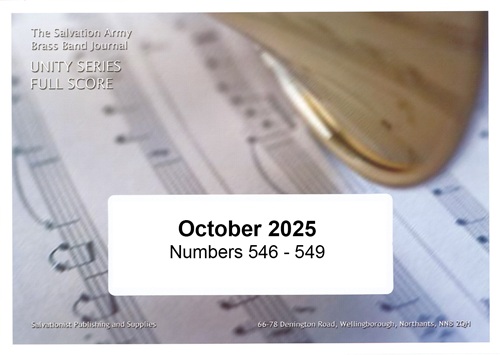
Unity Series Band Journal - Numbers 546 - 549, October 2025
546: Tell that story! (Martin Cordner)A joyful and engaging arrangement combining the songs Blessd assurance and Tell me the stories of Jesus, celebrating the personal testimony of faith in Christ.547: This love I know (Dale Pittock)A reflective and harmonically rich setting of the classic hymn Jesus loves me! This I know, capturing the enduring message of Christ's love through close textures and lyrical phrasing.548: There's no one like Jesus (Douglas Engle)Inspired by mission experiences in Malawi, this energetic piece reflects global worship traditions with rhythmic vibrancy and a clear declaration of Christ's uniqueness.549: Thank you, Lord (Andrew Mackereth)Based on a beloved gospel chorus, this expressive tribute conveys heartfelt gratitude and testimony, supported by warm harmonies and a simple, sincere melodic line.
Estimated dispatch 7-14 working days
-
 £14.95
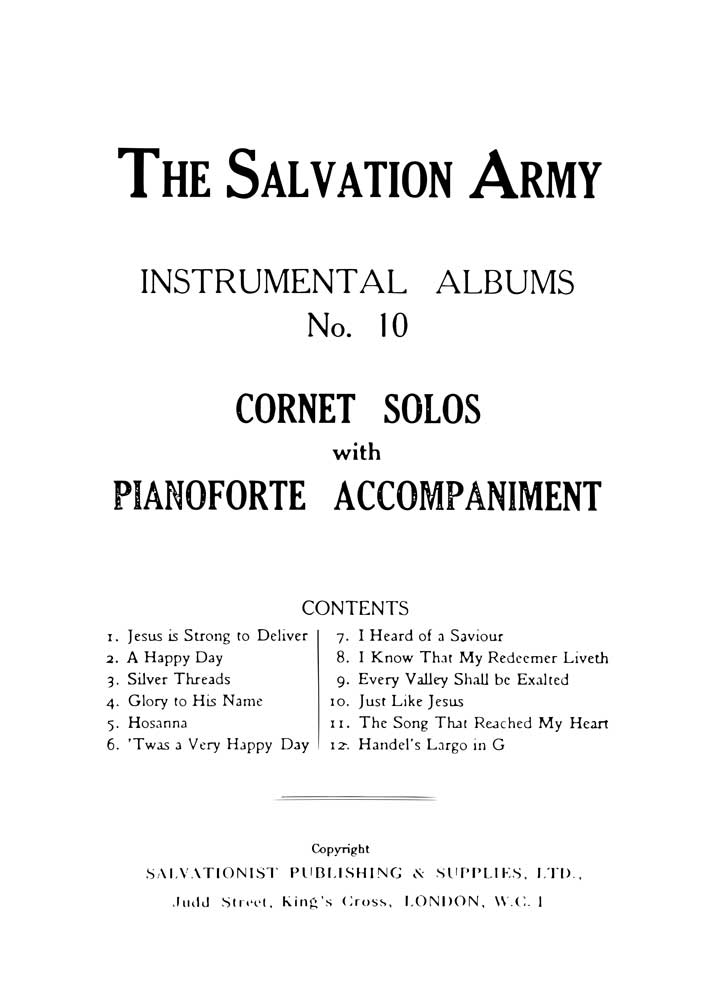
Instrumental Album No.10 - Cornet Solos
Includes: Jesus is strong to deliver; A Happy Day; Silver Threads; Glory to his name; Hosanna; Twas a Very Happy Day; I Heard of a Saviour; I Know that my redeemer liveth; Every valley shall be exalted; Just like Jesus; The song that reached my heart; Handel's Largo in GInstrumentation: Cornet with Piano Accompaniment
Estimated dispatch 7-14 working days
-
 £30.00
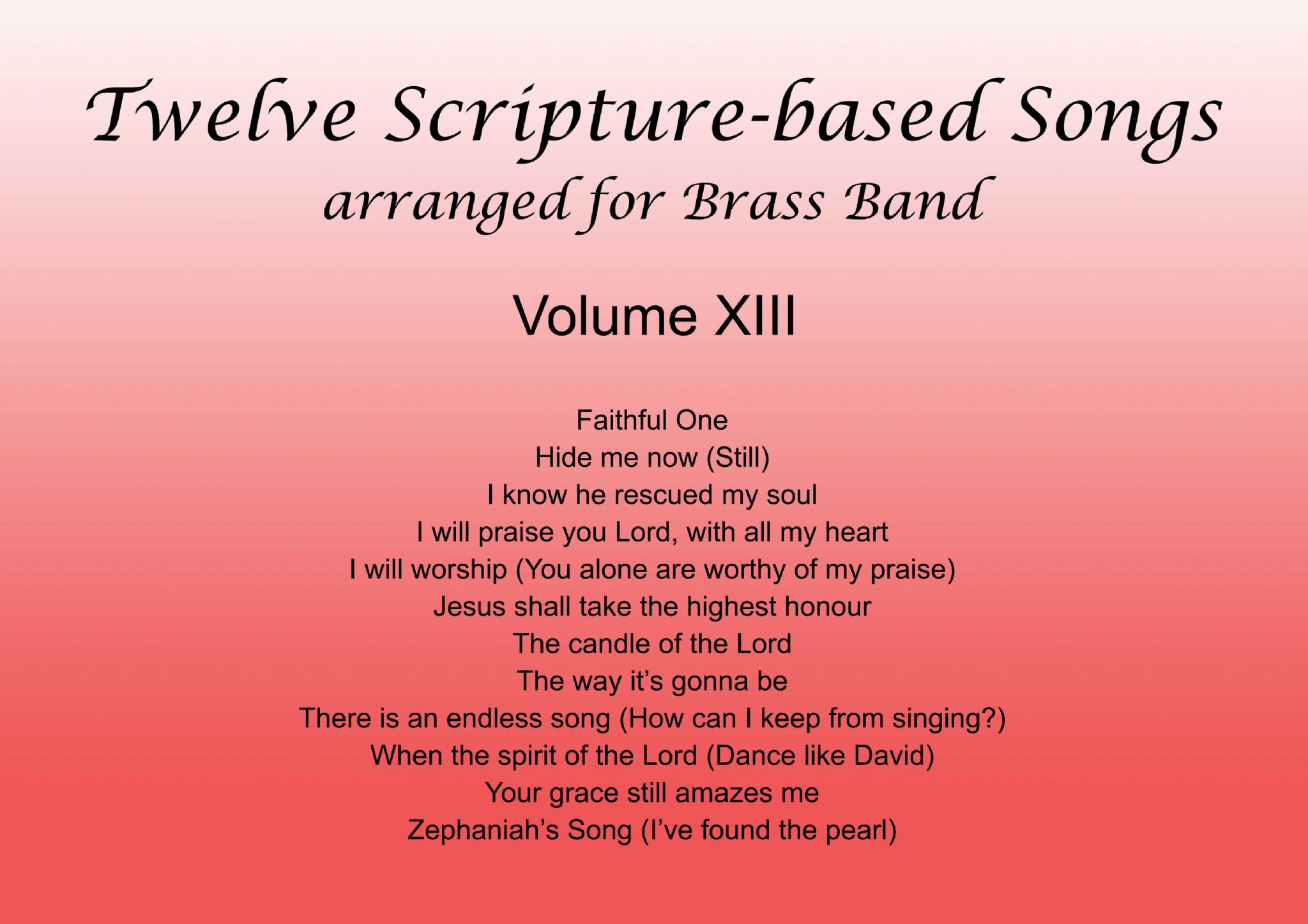
Twelve Scripture-Based Songs Volume XIII
Twelve scripture-Based Songs arranged for Brass Band (Volume XIII) are packaged and marketed in complete sets which include a full score and a set of master parts. It is intended that these parts be used as 'masters', for the purpose of photocopying a quantity of parts to accommodate the precise instrumentation needs of the band for which this has been purchased.Faithful One Brian Doerksen arr. Mervyn ClarkeHide me now (Still) Reuben Morgan arr. Paul SharmanI know he rescued my soul (My redeemer lives) Reuben Morgan arr. Dean JonesI will praise you Lord, with all my heart Dick KrommenhoekI will worship (You alone are worthy of my praise) David Ruiss arr .Dean JonesJesus shall take the highest honour Chris Bowater arr. Steven PonsfordThe candle of the Lord Joy Webb arr. Michael KenyonThe way it's gonna be Doug Horley arr. Dean JonesThere is an endless song (How can I keep from singing?) Chris Tomlin, Matt Redman and Ed Cash arr. Brian HoggWhen the spirit of the Lord (Dance like David) Anon arr. Andrew MackerethYour grace still amazes me Craig Phillips and Dean Phillips arr. David E JonesZephaniah's Song (I've found the pearl) arr. William Himes
Estimated dispatch 7-14 working days
 Watch video