
Results
-
 £107.80
Myrsnipa - Vocal or Instrumental Solo - Jan Eggum - David Hveem
Jan Eggum released "Myrsnipa" on the album "Hjerteknuser", which was released in 2007. The text is a variant of the folk tale with the moral "everyone likes their own children best and has for many years been one of Eggum's regular encores at concerts.The arrangement is attempted to stay true to Eggum's version and has retained its somewhat delicate character in order to support the text as much as possible. Although the arrangement is written for vocal soloist, it also works great with a solo instrument instead, and you can also choose whether you want a guitar or not, to keep it even more true to the original recording.The arrangement requires good balance and intonation, but will be a nice part of the concert repertoire the audience is guaranteed to recognize.
Estimated dispatch 5-14 working days
-
 £60.99
Crimond - Traditional - Herman Oldenstijl
This lovely Scottish hymn, also known as The Lord's My Shepherd, first appeared in 1929 in the Scottish songbook Northern Psalter, where it was incorrectly credited to David Grant, an Aberdeen businessman and amateur musician. It was, in fact, composed by Jessie Irvine the daughter of the parish minister at Crimond. This arrangement will be a musical jewel in your concert repertoire.
Estimated dispatch 5-14 working days
-
 £105.20
A Dream is a Wish Your Heart Makes - David Mack - Haakon Esplo
Music has always been of great importance in Disney's magical world. The instrumental music and songs of the animated feature films provide a unique background and magic to any Disney story. Every Christmas, many families gather to watch the fascinating story of Cinderella who eventually gets her prince. One of the most beautiful songs from this movie is A dream is a wish your heart makes.,br> This Young Band arrangement is written with simple 2nd parts and some 1st parts challenges. It will surely be a hit in your next Christmas concert.
Estimated dispatch 5-14 working days
-
 £101.30
Wonderful Peace - Gustaf Nordquist - Idar Torskangerpoll
This song is one of the most used and loved Christmas songs in Sweden during the 20th century. The lyrics describe Christmas as white and snowy, and describe the blessings of Christmas as well as the hope that Christmas will bring peace onearth.To the conductorThis arrangement has soloist parts for several instruments or a vocalist. It can be used by band and choir (swedish lyrics).
Estimated dispatch 5-14 working days
-
 £50.00
Cartoon Classics - Andrew Duncan
In Cartoon Classics, Andrew Duncan has brought together four classic cartoon themes in one medley that will be a sure-fire hit with audiences everywhere. It features the Looney Tunes Theme (Merrily We RollAlong), The Pink Panther, The Flintstones and The Simpsons. Brass Band Grade 4: Advanced Youth and 3rd Section Duration: 4 minutes
Estimated dispatch 5-14 working days
-
 £54.99
The Logical Song - André Waignein
The Logical Song was written by the lead singer of the famous British pop band Supertramp - a song about a happy, carefree child growing up to become a cynical adult. It was one of the group's biggest worldwide hits. Andre Waignein's brass band arrangement will be a big hit with all Supertramp fans and may well attract many new fans!
Estimated dispatch 5-14 working days
-
 £59.77
Horizon: The Promise of the Lord (Brass Band) Andrew Wainwright
Horizon: The Promise of the Lord was written at the request of Bandmaster Stephen Cobb for The International Staff Band. It is based on the much loved hymn of the church, Cwm Rhondda (Guide me O thou great Jehovah). The work was recorded on the ISB's CD Manuscripts II (released 2023). This highly descriptive piece will be an excellent addition to concert programs, as well as being appropriate as a test piece. The inspiration for the work comes from the book of Exodus. Whilst the music is not intended to be directly programmatic, like the hymn Cwm Rhondda, the work takes the listener through the Exodus from Egypt to the promised land of Israel as a metaphor of the spiritual pilgrimage of the individual Christian through his or her earthly life. The music aims to evoke a sense of God's guidance through strife and affirm the reality that God provides for us and redeems all the wrong in the world. This God who provided for the Hebrew people wandering amidst 'barren lands' with 'bread of heaven' is still and ever will be a God of provisional grace. Through listening to the music, it is the composer's intention that we are reminded of God's promise of Deliverance as set out in Exodus 6 v7-8: 'I will take you as my own people, and I will be your God. Then you will know that I am the Lord your God, who brought you out from under the yoke of the Egyptians. And I will bring you to the land I swore with uplifted hand to give to Abraham, to Isaac and to Jacob. I will give it to you as a possession. I am the Lord.' Like the hymn, Horizon: The Promise of the Lord is intended as a prayer for guidance. The Christian is a pilgrim through 'this barren land'. The music is often chromatic and in large parts verging on atonality, as a reflection of the strife that the Israelites endured in their 40 years in the wilderness. However, it ends in climactic fashion with the Hebrew people finally reaching their destination after many years of wandering in the desert - as they approach the 'Horizon' promised by the Lord. To view a performance of the work by the National Youth Brass Band of Great Britain please visit www.youtube.com/watch?v=LjOHf7QEw1g PDF download includes score and parts. Sheet music available from: UK - www.brassband.co.uk USA - https://satradecentral.org Difficulty Level: 1st Section + Length: c11.00 minutes Instrumentation: Soprano Cornet Eb Solo Cornet Bb Repiano Cornet Bb 2nd Cornet Bb 3rd Cornet Bb Flugel Horn Bb Solo Horn Eb 1st Horn Eb 2nd Horn Eb 1st Baritone Bb 2nd Baritone Bb 1st Trombone Bb 2nd Trombone Bb Bass Trombone Euphonium Bb Bass Eb Bass Bb Percussion 1-4
In Stock: Estimated dispatch 1-3 working days
-
 £45.00
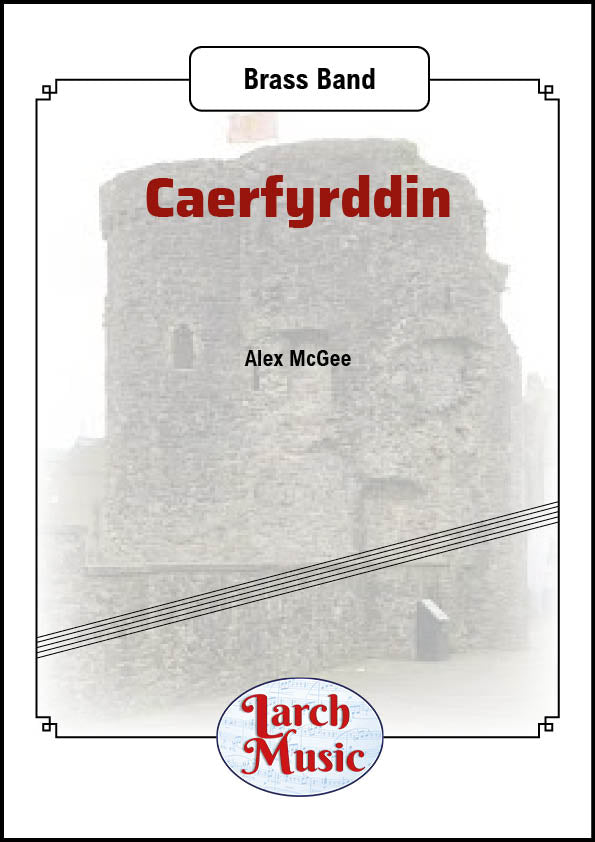
Caerfyrddin - Brass Band - LM957
COMPOSER: Alex McGeeA four movement work describing the historic county town of Carmarthen.1. FanfareThe first movement is an opening Fanfare,2. Castell Caerfyrddyn(Carmarthen Castle)The second movement is a lament describing the now ruined castle.Carmarthen Castle(Welsh:Castell Caerfyrddin) is a ruinedcastleinCarmarthen,West Wales. First built by Walter, Sheriff of Gloucester in theearly 1100s, the castle was captured and destroyed on severaloccasions before being rebuilt in stoneduring the 1190s. The castle was captured byOwain Glyndrin 1405.Henry VII's father died at Carmarthen Castle in 1456. During theWars of the Rosesthe castle fell toWilliam Herbertand, during theCivil War,was captured by Parliamentary forces. It was dismantled by order ofOliver Cromwellin the mid 1600s.It has been used as the site of Carmarthen's gaol until the 1920s.The remains of the castle were given a Grade Iheritage listingin 1954and is currently a tourist attraction and site of the town's Tourist Information Centre.3. Pysgota Cwrwgl(Coracle Fishing)The third movement is a Scherzo which depicts coracle fishing on the river Towy.Should you take an evening stroll down by the River Towy,if the weather and river conditions are suitable, you may be lucky enough to see apair of coracles float gently down river with a net suspended between them.The coracle man will hold the net in one hand and skilfully moving the paddle in afigure of eight motion in the other. As soon as a fish in caught, which many havedescribed as a 'silent noise travelling from the fish, into the net and up into thefisherman's arm', the two coracles are drawn together by pulling at the net.Sewin (sea trout) or salmon being the chosen catch.4. MarchThe Fourth movement is a March representing the town itself. Carmarthenshire in West Wales lies on the River Towy and claims to be the oldest town in Wales. Some variants of theArthurian legendclaim thatMerlinwas born outside the town and that he lies imprisoned in a cave in nearbyBryn Myrddin(Merlin's Hill), which stands right by the A40 trunk road.The myth maintains that his groans can be heard issuing forth from the hill and will continue until he is called to help his fellow countrymen. It is also claimed that, when Merlin's Oak fell, it would be the downfall of the town.For many years great effort was employed to brace the tree, situated in the town.Although it eventually died, it is hoped that catastrophe was averted by preservingsome bits in theCarmarthenshire County Museum.Larger branches are in the Civic Hall in Nott Square and a statue of Merlincarved from another local tree stands in the town centre.St. Peter's Church, the largest parish church in Wales,also has thelongest navemeasuring 60 metres and its tower containseight bellswith the heaviest weighing just under a tonne.It is surprising that few traces survive of the medieval town; however,a small section ofCivil War defences, thrown up by the Royalists, survives on the south-west of the town. They are known as "The Bulwarks," and consist of an earthwork bank and a well-preserved four-sided bastion.Suitable for Most Bands - Duration 8 mins (Approx.)
In Stock: Estimated dispatch 3-5 working days
-
 £29.95
The Strong Tower (Brass Band - Score and Parts)
Following the popularity of Turris Fortissima, I decided, albeit many years later, to revisit some of the material it contains and create a shorter piece, expanding on some of the ideas and motifs, allowing myself to follow those in different directions altogether. The result is this piece which I hope will also excite players and listeners alike.The music is marked at a quick tempo from the start, but despite several changes in meter, the tempo doesn't change until the small accelerando leads us into the presto section. In order to maintain the excitement and drama, it's important to set the pace and keep it consistent throughout.Section A introduces a few of the motifs that will be developed during the piece, including the main Turris Fortissima theme from bar 13 to 18.At section B, ensure the quavers are tight across the whole band with a strong attack, making an obvious difference in dynamic when fff is marked, in bars 23, 25 and 27. A more lyrical approach will be effective from the Horns in section C, with vigorous interruptions from the rest of the band breaking up their melody.Section D features long notes from muted 1st and 2nd Cornets and Trombones, with crescendos each time. These should be significant and sound as though they emerge from nowhere, completely cutting through the overall texture.Section D features long notes from muted 1st and 2nd Cornets and Trombones, with crescendos each time. These should be significant and sound as though they emerge from nowhere, completely cutting through the overall texture.Sections E and F are both passages of building intensity. Various contrasting motifs are layered, including a subtle reference to the hymn tune Ein' feste Burg (A mighty fortress is our God) from the Euphonium. The music becomes more busy and muddled, before reaching its climax at section G where the lyrical melody is heard again, this time from the Solo Cornets and Euphonium.In bars 141 to 145, there is a reference to Dean Goffin's My strength, my tower in the Basses, as used in Turris Fortissima. Allow this motif to dominate, keeping the notes full and grand-sounding. In bars 149 to 151 there is further use of the line from Ein' feste Burg in the Baritones, Trombones, Euphoniums and Basses leading into the final section.- Steven Ponsford
Estimated dispatch 7-14 working days
-
 £38.95
Unity Series Band Journal - Numbers 550 - 553, February 2026
550: March - Century of celebration (Stephen Smith)This march follows a traditional pattern and should be accessible for most bands. It was written for the 100th anniversary of Camp Gifford in Loon Lake, Washington, therefore included are well-known songs with references to water as the camp is located on the shores of Deer Lake.551: Going Home (Alan Williams)Richard Jukes' song I'm a soldier bound for Glory (S.A.S.B. 856) displays the confidence of someone with a steadfast faith who is certain that by loving and serving their God they will be accepted into his Kingdom. This assurance results in a joyful song of testimony. Whilst not a direct setting of the five verses, the dance-like rhythm of this cha-cha should reflect the positive and encouraging nature of the lyrics and be full of joy and spirit.552: Whosoever will may come (Noel Jones)This is a two-verse arrangement of the song Whosoever will may come (S.A.S.B. 405), with words written by William John McAlonan and music composed by Alfred Braine. This song is included in the Invitation and Challenge section of the song book. The arrangement should be played in a spirited style.553: March - Sing a praise of celebration (Marcus Venables)This music was written at the request of the Singapore Central Corps Band, who asked that the work be based on two specific meaningful melodies. The first is To the Glory and Praise of God by Robert Redhead, a tune rooted in corporate worship and joyful proclamation, calling God's people to lift their voices in thanksgiving. The other is Home, a beloved Singaporean song that speaks of belonging.
Estimated dispatch 7-14 working days
 View Music