
Results
-
£60.00
Manchester Concertino - Peter Meechan
Manchester Concertino is a concertino in three movements for trumpet or cornet. It was written in late summer/early autumn in, as the title suggests, Manchester, UK.The first movement, Fanfare, was written for Belgian cornetist Harmen Vanhoorne, and explores the main musical idea behind the piece, a minor third. The loud fanfare gives way to a cadenza over a timpani roll, before a reprise of the opening fanfare.The second movement, Dream, was commissioned by Keith Johnson and is dedicated to Jess Tredrea. It is a slow, lilting, movement - almost as if the listener was hearing the piece through a summer haze.The final movement is simply titled Finale and is dedicated to Roger Webster. New material is fused with the fanfare from the opening movement leading to a climatic finish to the work.
Estimated dispatch 12-14 working days
-
Bernie's Song - Miller/Leiber/Stoller ver.Mulligan, arr.John Dankworth - Len Jenkins
Bernie's Tune is a 1953 jazz standard with music written by Bernie Miller and lyrics by Jerry Leiber and Mike Stoller. It was popularised through a recording by the quartet of the American saxophonist and composer Gerry Mulligan, and the tune was a popular choice for musicians jamming at the time. Information about the composer is scarce. All that people really know of him is that he was a piano player from Washington DC. Gerry Mulligan's version was subsequently arranged by the late, legendary John Dankworth and this arrangement for brass band has been faithfully based on it to evoke the atmosphere of that golden era.
-
Codebreakers : Bletchley Park - Len Jenkins - Len Jenkins
Bletchley Park was the centre for Allied codebreaking in World War 2, responsible for decoding secret military codes used by enemy forces, in particular those related to the use of the 'Enigma' and other encoding machines. In the course of its endeavours it developed what was effectively the first electronic computer and brought to prominence the genius of Alan Turing when its wartime work was declassified and made public. The composer, Len Jenkins, still lives near Bletchley Park, went to school nearby, and attended training courses there when, after the war, it was used as a telecommunications training centre. This march is dedicated to the memory of all those who worked at Bletchley Park.
-
 £55.00
Triumph Series Brass Band Journal, Numbers 1367 - 1370, November 2024
1367: March - Risen, conquering Son (Noel Jones)Two uplifting Easter songs are featured in this march; Low in the grave he lay (S.A.S.B. 228) with words and music written by Robert Lowry, and Thine is the glory (S.A.S.B. 276) with words by Edmond L. Budry and music by George F. Handel. Both serve as a powerful reminder of the resurrection of Jesus.1368: Horn Solo - O how much he cared for me (Keith Wilkinson)This solo was originally penned for Bandsman Frank Taylor, who plays Solo Horn at Stapleford Citadel Corps. As its basis, it uses the popular hymn No one ever cared for me like Jesus by Charles F. Weigle, a Baptist evangelist who wrote more than a thousand hymns.1369: My Redeemer lives (Olaf Ritman)This arrangement of Reuben Morgan's well-known worship song (S.A.S.B. 223) was first written as an accompaniment for congregational singing and can still be used in that way. It was inspired by the American R&B group Tower of Power and is meant to sound soulful and funky.1370: Selection - With life anew (Mervyn Clarke)This selection features music associated with two hymns; Blessd Saviour, now behold me (S.A.S.B. 575) by William Baugh and Breathe on me, breath of God (S.A.S.B. 294) by Edwin Hatch. Although Edwin Hatch's hymn-writing output was very small, this hymn has seen numerous settings and melodies associated with the words from which the piece takes its title; two of these melodies are featured here in Trentham and Carlisle.
Estimated dispatch 7-14 working days
-
 £40.00
Abide With Me (Euphonium Solo with Brass Band - Score and Parts)
My arrangement of William H. Monk's tune of 1861, uses the euphonium soloist as the central figure for the melodic line in the three verses. Surrounding the solo line is an irregular pulsed figure in the percussion to give the music an unsettled feel whilst the muted ensemble lightly colour the melodic contour of the soloist. From the low beginnings of the piece, where no high instrumentation is used, we are led through the darkened texture to a bright finale, although the sense of the forbidding is always present.Abide With Me has always been a favourite hymn of mine and it was when watching the film 28 Days Later that I believed it would make a rather striking arrangement for brass band. This was confirmed further when the hymn was used at the 2012 opening ceremony of the London Olympics. The juxtaposition between the static, slow moving melody and the rhythmic effects of the dancers was something that I thought could be captured in an arrangement.- Paul McGheeDuration: 5.00
Estimated dispatch 7-14 working days
-
 £45.00
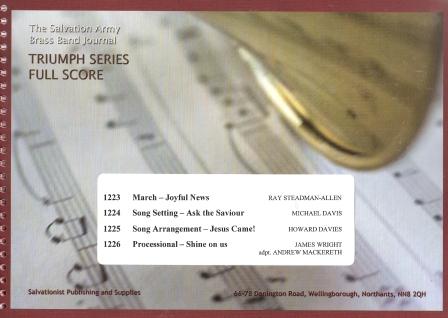
Triumph Series Band Journal March 2012 Numbers 1223-1226
No.1223 March - Joyful News (Ray Steadman-Allen)the composer freeli admits that it was probably 'doodling' on the piano that prompted this march! The title is linked to one of the incorporated tunes, 'My bonnie lies over the ocean' which, in The Salvation Army, is linked to the words, 'God's love is as high as the heavens'. In style, the march has a light swing feel.No.1224 Song Setting - Ask the Saviour (Michael Davis)A setting of the well-known melody, 'Yield not to temptation'.No.1225 Song Arrangement - Jesus Came! (Howard Davis)An arrangement of an old Salvation Army song, 'Jesus came with peace to me, His strong arm was stretched to me, Then my burden took from me - My Saviour'.No.1226 Processional - Shine on us (James Wright adapted by Andrew Mackereth)This bolero-style setting of Michael W Smith's anthem was originally made for s wedding at Sheffield Citadel. It was subsequently adapted for use at the Belfast Temple Music School when players entered the arena in groups, through several entrances, playing from memory.
Estimated dispatch 7-14 working days
-
 £112.00
March Slav (Brass Band - Score and Parts)
March Slav was composed in 1876 for a charity concert to support the war in the Balkans. It was completed in the remarkably short time of 5 days and was encored twice at its first performance! The themes are based loosely on Serbian folk songs and there is also a reference to the Russian national anthem. The mood is funereal in style at the opening but this gives way to a very triumphant style by the end.This arrangement was prepared for the 2007 Summer concerts of Brass Band of the Western Reserve, musical director Dr Keith M Wilkinson (www.bbwesternreserve.org). It has been recorded by BBWR on the CD Slides Rule!
Estimated dispatch 7-14 working days
-
 £55.00
Purcell Variations (Brass Band - Score and Parts)
Purcell Variations, composed in 1995, the year of the tercentenary of the death of the great English composer, was a watershed work in that it was Downie's first extended composition to be published independently of The Salvation Army and intended for wider use.For his theme, Downie has chosen what has come down to us as the hymn tune Westminster Abbey, which is in fact an adaptation made in 1842 by Ernest Hawkins, who was a Canon of Westminster Abbey where Purcell himself had been organist. Purcell's original is actually the closing section of an anthem, O God, Thou art my God, where it provides the final paean of praise, sung to repeated 'Hallelujahs'. Purcell's tune, particularly the opening triadic gesture, is used as a source of thematic and harmonic material - a quarry for ideas if you like: "I was obsessed with the intervals of thirds in Purcell's tune, rather like Brahms in his Third Symphony", the composer says.There are five variations, preceded by an extended introduction and theme. In the first variation, Purcell's lilting dance pulse has been transformed into a bright, playful sequence, in which each phrase of the melody is given its own transformation. In the second, Purcell's opening gambit is extended into a graceful, flowing waltz, featuring solo and first horn at the top of the register. The composer offers a range of metronome speeds in this movement, in which he is emulating the wistful elegance of Erik Satie's famous Gymnopedie. We enter the world of big band jazz in variation three, where Purcell's tune strides along with added syncopation and bluesy major/minor thirds to the fore. After the breathless energy and blazing brass of the big band, Downie moves into his 'home territory' for a beautifully worked lyrical variation. There is an enhanced urgency about the final variation, which opens with an extended reprise of the work's introduction. Purcell's second and third phrases provide the preparation for the exuberant return, in customary triumph of Purcell's 'Hallelujah'.
Estimated dispatch 7-14 working days
-
 £37.95
Benvenuto Cellini (Brass Band - Score only)
Berliozs opera Benvenuto Cellini was first produced in Paris in 1838 but was withdrawn as a failure, and it was not until the production in Dresden in 1888 that it was finally acclaimed by the Germans as a triumph. Adapted from certain episodes recorded in the memoirs of Benvenuto Cellini, Tuscan sculptor and goldsmith, the story, laid in Rome during the mid-sixteenth century, is not strictly historical. The short opening Allegro, marked deciso con impeto, is conceived in the most brilliant Berlioz manner, utilising full instrumentation. In the Larghetto we meet at once the first of the opera themes " the Cardinals aria (from the last act) introduced in the bass, quasi pizzicato. A second melody leads to a resumption of the Allegro, the contrasting second subject in the tenor horns being an adaptation of Teresas aria (Act I). Towards the end the Cardinal theme is re-introduced by trombones, fortissimo against an energetic cornet and euphonium passage (senza stringendo " without hurry, says the score). After a unison passage storming skywards, there is a sudden, dramatic three-bar silent pause broken by Eb basses alone, again stating the Cardinal theme. A simple molto crescendo on the dominant, begun piano, leads to the long, resounding chord.
Estimated dispatch 7-14 working days
-
 £82.95
Benvenuto Cellini (Brass Band - Score and Parts)
Berliozs opera Benvenuto Cellini was first produced in Paris in 1838 but was withdrawn as a failure, and it was not until the production in Dresden in 1888 that it was finally acclaimed by the Germans as a triumph. Adapted from certain episodes recorded in the memoirs of Benvenuto Cellini, Tuscan sculptor and goldsmith, the story, laid in Rome during the mid-sixteenth century, is not strictly historical. The short opening Allegro, marked deciso con impeto, is conceived in the most brilliant Berlioz manner, utilising full instrumentation. In the Larghetto we meet at once the first of the opera themes " the Cardinals aria (from the last act) introduced in the bass, quasi pizzicato. A second melody leads to a resumption of the Allegro, the contrasting second subject in the tenor horns being an adaptation of Teresas aria (Act I). Towards the end the Cardinal theme is re-introduced by trombones, fortissimo against an energetic cornet and euphonium passage (senza stringendo " without hurry, says the score). After a unison passage storming skywards, there is a sudden, dramatic three-bar silent pause broken by Eb basses alone, again stating the Cardinal theme. A simple molto crescendo on the dominant, begun piano, leads to the long, resounding chord.
Estimated dispatch 7-14 working days
 View Music