
Results
-
 £107.95
When Worlds Collide (Score and Parts)
Subtitled: Little Green Men in Intergalactic Spaceships with Ray-Guns and Phasers, A Space Symphony for Brass band. Written for the free choice test piece for Brass Band Buizingen for the Flemish Open Brass Band Championships. When Worlds Collide seeks to recreate the atmosphere and sentiment of the American cult Sci-Fi movies of the 1950's such as Robert Wise's 1951 film 'The day the Earth Stood Still' and 'Invasion of the Body Snatches' directed by Don Siegel in 1956, as well as Rudolph Mate's 1951 film 'When Worlds Collide'. It is programmatic with subtitled sub-sections as follows: Crop Circles; Lights in the Sky; Strange Happenings; Sightings; "We Come in Peace"; Alien Abduction; Analysis of the Earthlings; Teleportation; New Understandings; Visions of Far Off Worlds; Colonisation.
Estimated dispatch 7-14 working days
-
 £49.95
When Worlds Collide (Score Only)
Subtitled: Little Green Men in Intergalactic Spaceships with Ray-Guns and Phasers, A Space Symphony for Brass band. Written for the free choice test piece for Brass Band Buizingen for the Flemish Open Brass Band Championships. When Worlds Collide seeks to recreate the atmosphere and sentiment of the American cult Sci-Fi movies of the 1950's such as Robert Wise's 1951 film 'The day the Earth Stood Still' and 'Invasion of the Body Snatches' directed by Don Siegel in 1956, as well as Rudolph Mate's 1951 film 'When Worlds Collide'. It is programmatic with subtitled sub-sections as follows: Crop Circles; Lights in the Sky; Strange Happenings; Sightings; "We Come in Peace"; Alien Abduction; Analysis of the Earthlings; Teleportation; New Understandings; Visions of Far Off Worlds; Colonisation.
Estimated dispatch 7-14 working days
-
 £79.95
The Lost Village of Imber (Brass Band - Score and Parts) - Bond, Christopher
The Lost Village of Imber was commissioned by Bratton Silver Band in 2019 in celebration of 160 years of the band; 1859-2019. Structured in three movements, the complete work was premiered by Cory Band at Wiltshire Music Centre in February 2020.The village of Imber on Salisbury Plain had been inhabited for over one thousand years when it was evacuated in 1943 to make way for military training in the Second World War. At the time, with preparations for the Allied invasion of Europe underway, most villagers put up no resistance, despite being upset, with the belief that they'd return once the war had concluded. To this day, Imber and its surrounding land remain a military training ground. The villagers never returned, and just the shell of what was once a community remains.Structured in three movements, it is on this very real story that the work is based, setting out the series of events of 1943 in chronological order.The first movement, On Imber Downe, portrays a sense of jollity and cohesiveness, a community of individuals living and working together before news of the evacuation had broken. Sounds of the village are heard throughout, not least in a series of percussive effects, the anvil of the blacksmith; the cowbell of the cattle and the bells of the church.The second movement, The Church of St. Giles, begins mysteriously and this sonorous, atmospheric opening depicts Imber in its desolate state and the apprehension of residents as they learn they have to leave their homes. Amidst this is the Church, a symbol of hope for villagers who one day wish to return, portrayed with a sweeping melodic passage before the music returns to the apprehension of villagers facing eviction around their sadness at losing their rural way of life.In complete contrast, the third movement, Imemerie Aeternum, portrays the arrival of the military, complete with the sounds of the ammunition, firing and tanks, sounds which were all too familiar to those living in the surround areas. To close, the Church of St. Giles theme returns in a triumphant style, representing the idea that the church has always been, even to this day, a beacon of hope for the villagers and local community, both the centrepiece and pinnacle of a very real story.Duration: 13.30
Estimated dispatch 7-14 working days
-
 £95.00
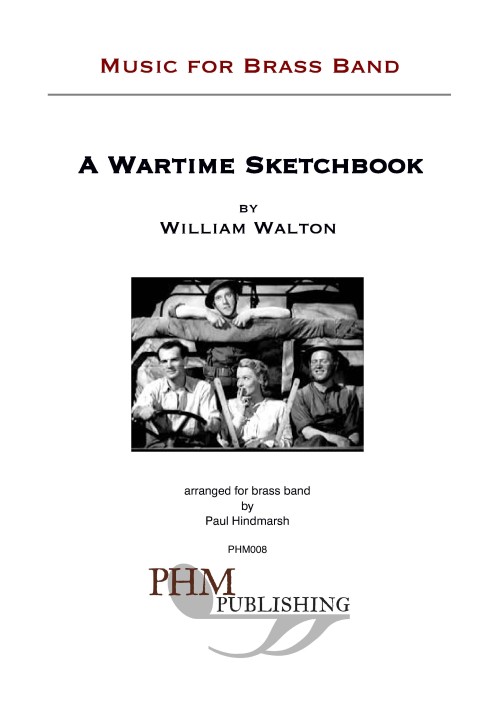
A Wartime Sketchbook (Brass Band - Score and Parts) - Walton, William - Hindmarsh, Paul
Early in 1941 William Walton, 39, received his call-up papers. He was by then one of the most eminent of British composers and was exempted from military service on condition that he provided music for films deemed to be of 'national importance'. Scoring Lawrence Olivier's Shakespeare epic Henry V in 1943 was the most substantial of these wartime projects. His role in patriotic films from 1941 and 42 like The Foreman went to France, Next of Kin, Went the day Well and The First of the Few was to provide appropriate title music and some underscoring at key moments. Walton extracted the most substantial portions of the latter as the popular Spitfire Prelude and Fugue for orchestra. The remaining music remained unpublished until 1990, when Christopher Palmer assembled the highlights into A Wartime Sketchbook. I was intrigued to hear these examples of Walton's wartime music and having discovered that they would fit naturally and idiomatically onto the brass band, I arranged six of the numbers into a suite for Besses o' th' Barn Band, which I was conducting at the time.In 1995 the brass band suite was recorded by the famous Black Dyke Mills Band as part of an all Walton album which I produced for the ASV label (ASV CD WHL 2093). This award- winning CD also included Walton's First Shoot, in the edition by Elgar Howarth, my transcription of movements from Music for Children and two substantial brass versions by Edward Watson of the suite from Henry V (with narrator) and the March and Siegfried Music from The Battle of Britain music.Prologue: This is the stirring title music from Went the day Well, a screen play by Graham Greene about a German airborne invasion of an English village. The main theme leads toBicycle Chase: Characteristic musical high-jinks for J.B.Priestley's The Foreman went to France.Refugees: From the same film, this is a poignant accompaniment to the long march of refugees. As Ernest Irving, the film's musical director, put it, "this really makes your feet sore and your knees sag."Young Siegfrieds: This lively movement comes from the music that Walton composed for The Battle of Britain in 1968, with the assistance of Malcolm Arnold, but which the film's producer rejected. It portrays first the Berliners, cheerfully ignoring the black-out and then, in the trio, the Young Siegfrieds of the Luftwaffe, courtesy of a parody of Siegfried's horn call from Wagner's opera.Romance: A soldier and a Dutch refugee snatch a few tender moments together in Next of Kin.Epilogue: At the end of The Foreman went to France, the French look forward with hope and optimism to eventual liberation.- Paul HindmarshDuration: 14.00
Estimated dispatch 7-14 working days
-
£40.00
A Wartime Sketchbook (Brass Band - Score only) - Walton, William - Hindmarsh, Paul
Early in 1941 William Walton, 39, received his call-up papers. He was by then one of the most eminent of British composers and was exempted from military service on condition that he provided music for films deemed to be of 'national importance'. Scoring Lawrence Olivier's Shakespeare epic Henry V in 1943 was the most substantial of these wartime projects. His role in patriotic films from 1941 and 42 like The Foreman went to France, Next of Kin, Went the day Well and The First of the Few was to provide appropriate title music and some underscoring at key moments. Walton extracted the most substantial portions of the latter as the popular Spitfire Prelude and Fugue for orchestra. The remaining music remained unpublished until 1990, when Christopher Palmer assembled the highlights into A Wartime Sketchbook. I was intrigued to hear these examples of Walton's wartime music and having discovered that they would fit naturally and idiomatically onto the brass band, I arranged six of the numbers into a suite for Besses o' th' Barn Band, which I was conducting at the time.In 1995 the brass band suite was recorded by the famous Black Dyke Mills Band as part of an all Walton album which I produced for the ASV label (ASV CD WHL 2093). This award- winning CD also included Walton's First Shoot, in the edition by Elgar Howarth, my transcription of movements from Music for Children and two substantial brass versions by Edward Watson of the suite from Henry V (with narrator) and the March and Siegfried Music from The Battle of Britain music.Prologue: This is the stirring title music from Went the day Well, a screen play by Graham Greene about a German airborne invasion of an English village. The main theme leads toBicycle Chase: Characteristic musical high-jinks for J.B.Priestley's The Foreman went to France.Refugees: From the same film, this is a poignant accompaniment to the long march of refugees. As Ernest Irving, the film's musical director, put it, "this really makes your feet sore and your knees sag."Young Siegfrieds: This lively movement comes from the music that Walton composed for The Battle of Britain in 1968, with the assistance of Malcolm Arnold, but which the film's producer rejected. It portrays first the Berliners, cheerfully ignoring the black-out and then, in the trio, the Young Siegfrieds of the Luftwaffe, courtesy of a parody of Siegfried's horn call from Wagner's opera.Romance: A soldier and a Dutch refugee snatch a few tender moments together in Next of Kin.Epilogue: At the end of The Foreman went to France, the French look forward with hope and optimism to eventual liberation.- Paul HindmarshDuration: 14.00
Estimated dispatch 7-14 working days
-
£107.95
WHEN WORLDS COLLIDE (Brass Band - Score and Parts) - Clarke, Nigel
Subtitled: Little Green Men in Intergalactic Spaceships with Ray-Guns and Phasers, A Space Symphony for Brass band. Written for the free choice test piece for Brass Band Buizingen for the Flemish Open Brass Band Championships. When Worlds Collide seeks to recreate the atmosphere and sentiment of the American cult Sci-Fi movies of the 1950's such as Robert Wise's 1951 film 'The day the Earth Stood Still' and 'Invasion of the Body Snatches' directed by Don Siegel in 1956, as well as Rudolph Mate's 1951 film 'When Worlds Collide'. It is programmatic with subtitled sub-sections as follows: Crop Circles; Lights in the Sky; Strange Happenings; Sightings; "We Come in Peace"; Alien Abduction; Analysis of the Earthlings; Teleportation; New Understandings; Visions of Far Off Worlds; Colonisation. Duration: approx. 19 mins.
Estimated dispatch 7-14 working days
-
£49.95
WHEN WORLDS COLLIDE (Brass Band - Score only) - Clarke, Nigel
Subtitled: Little Green Men in Intergalactic Spaceships with Ray-Guns and Phasers, A Space Symphony for Brass band. Written for the free choice test piece for Brass Band Buizingen for the Flemish Open Brass Band Championships. When Worlds Collide seeks to recreate the atmosphere and sentiment of the American cult Sci-Fi movies of the 1950's such as Robert Wise's 1951 film 'The day the Earth Stood Still' and 'Invasion of the Body Snatches' directed by Don Siegel in 1956, as well as Rudolph Mate's 1951 film 'When Worlds Collide'. It is programmatic with subtitled sub-sections as follows: Crop Circles; Lights in the Sky; Strange Happenings; Sightings; "We Come in Peace"; Alien Abduction; Analysis of the Earthlings; Teleportation; New Understandings; Visions of Far Off Worlds; Colonisation. Duration: approx. 19 mins.
Estimated dispatch 7-14 working days
 View Music