
Results
-
 £30.00
Midnight - Lucy Pankhurst
Written for and premiered by the Leyland Band with euphonium soloist Philippe Schwartz in 2010, Midnight is a haunting euphonium solo which features the engaging combination of lyrical melodies and strident energy.The piece opens with peaceful serenity and then moves towards an energetic and exciting passage which really showcases the soloist and the band alike. Lots of percussion highlights are included in the scoring which adds immense depth to the writing. Following is a return to an atmospheric spotlight on the soloist, developing into an impressive cadenza and eventually closing with the original tranquility.Comments by the composer, Lucy Pankhurst, on writing collaboratively for a band:"I didn't intend to tailor [this piece] specifically, other than knowing I could pretty much write whatever I wanted to for the band and soloist.They are such great players and have a cracking percussion section. The only stipulation I was given was for something 'atmospheric'.This is actually one piece that I started at the first bar and composed chronologically. Everything grew from the opening marimba ostinato."Midnight is featured on the Leyland Band CD - Age of Chivalry.
In Stock: Estimated dispatch 3-5 working days
-
 £30.00
Hot Gospel - Various
Tim Paton has creatively arranged for brass band this selection of familiar hymns/religious songs to create a 5-movement, gospel-styled work. With features for soloists across the band and a great mix of styles including swing, traditional jazz, blues, and calypso, this makes for a versatile concert feature either as a complete piece piece (9 minutes); using the alternative optional cuts (4.5 minutes); or simply by cherry-picking the individual movements in order to spotlight the different styles/melodies/soloists of your choice.With solo features in each section, the piece includes:The Church's One Foundation - Swing version with Tenor Horn soloNearer My God To Thee - Traditional jazz style with Cornet soloThe Old Rugged Cross - Bluesy with Flugel soloHow Great Thou Art - Calypso with Euphonium soloJust A Closer Walk With Thee - Finale with jazzy Trombone soloTim comments:The community gospel choir sound has become very popular in recent years. "Hot Gospel" is my attempt to capture this charismatic experience in a medley of well known sacred music. Each of the five songs chosen follows a similar pattern - a verse for full band followed by a solo, and all solos are intended to sound like improvisation.I've included Optional Cuts which would reduce the play length from c. 9 minutes, down to approximately 4.5 mintues, should your concert programming not allow for the full version. The optional cuts simply side-step the solo section of each song.However you wish to perform Hot Gospel, it will definitely bring variety to programme choice.Also available for wind/concert band.
In Stock: Estimated dispatch 3-5 working days
-
 £74.95
Platform to the Heavens (Brass Band - Score and Parts)
The piece takes its inspiration from the mountain ranges from one of my favourite countries, Switzerland.I have visited the Swiss Alps on many occasions and I am still taken back by its sheer awesome beauty with every visit. This commission gave me the opportunity to pay homage to this wonderful landscape and paint my own musical picture of it.The piece opens with what I imagine daybreak would be like at one of its many peaks. With the sun growing behind the mountain range, the piece builds from a single note to a huge climatic chord revealing Mother Nature's creation.Then at rehearsal figure 'C' the tempo changes dramatically as we fly through the many slopes of the mountains as if on a manic skiing expedition, revealing the many dangers within the Swiss Alps.The twists, turns and climaxes begin to die away as we enter rehearsal figure 'M' - nightfall over the mountains. As the sun disappears, the sky darkens to reveal the beautiful starlit sky above the mountain range. This middle section starts with the various cadenzas that serve as echoes around the Alps. It then leads to a lyrical solo at rehearsal figure 'O' as the moonlight illuminates the icy mountain peaks. A final cadenza to conclude this section highlights the end of nightfall as the sun starts to rise again.This recapitulation from the opening, signals a new dawn as the sun rises above the snowy peaks once again. The music at this point in its slightly altered state highlights the dawn of a new day in the Alps. The fast manic ski ride follows which takes the piece to its grand finale conclusion.The idea behind the title of this piece is that the Swiss Alps are so beautiful and vast; I can only imagine that they could be a platform connecting the earth to the heavens above.Paul Lovatt-Cooper
Estimated dispatch 7-14 working days
-
 £85.92
Chorale Tangents (Brass Band) Kenneth Downie
VIEW SCORE PDF This magnificent work by Kenneth Downie was commissioned by Festival Brass Band of Belgium, and its conductor Manu Mellaerts. It was first performed by the band on 10th October 2010, in Mechelen, a beautiful old city in the province of Antwerp. The composer writes: 'The chorale in the title is the famous one associated with the words 'Now thank we all our God', dating from 17th century Germany. The words were written by Martin Rinkart and the music by Johann Cruger. The use of the word 'tangents' in the title can best be understood as variations. This is another set of variations, in the line of St. Magnus, Princethorpe and Purcell Variations. I still cannot resist the urge to present familiar material in an unfamiliar way! Hopefully, the listener can relate to these tangents, and experience some of the joy that I receive when writing them.' To view a video of Festival Brass Band performing the work please visit: https://www.youtube.com/watch?v=Kc83_BYkZSc Sheet music available from: UK - www.brassband.co.uk USA - www.solidbrassmusic.com Instrumentation: Soprano Cornet Eb Solo Cornet Bb Repiano Cornet Bb 2nd Cornet Bb 3rd Cornet Bb Flugel Horn Bb Solo Horn Eb 1st Horn Eb 2nd Horn Eb 1st Baritone Bb 2nd Baritone Bb 1st Trombone Bb 2nd Trombone Bb Bass Trombone Euphonium Bb Bass Eb Bass Bb Timpani Percussion 1-3
In Stock: Estimated dispatch 1-3 working days
-
 £29.88
Fanfare for the Olympians (Brass Band) Aaron Stanley
VIEW SCORE PDF This uplifting and rhythmic fanfare by American composer J. Aaron Stanley will be an ideal alternative to the traditional fare that is written in celebration of the Olympic Games. The composer writes: 'Most of my works start with a concept and working title in mind before I even begin composing. But Fanfare for the Olympians, on the other hand, was titled afterward, allowing the music to suggest its own title. The festive, anticipatory nature of the work seems to build excitement and tension for something celebratory and grandiose, like the Olympic Games. Written in 2000, at the time, I was obsessed with quartal harmonies and asymmetrical meters. But the driving eighth-note pulse of alternating 2+2+3 / 3+2+2 is what drives the fanfare forward to its epic climax.' Sheet music available from: UK - www.brassband.co.uk USA - www.solidbrassmusic.com Difficulty Level: 2nd Section + Instrumentation: Soprano Cornet Eb Solo Cornet Bb Repiano Cornet Bb 2nd Cornet Bb 3rd Cornet Bb Flugel Horn Bb Solo Horn Eb 1st Horn Eb 2nd Horn Eb 1st Baritone Bb 2nd Baritone Bb 1st Trombone Bb 2nd Trombone Bb Bass Trombone Euphonium Bb Bass Eb Bass Bb Timpani Percussion 1-2
In Stock: Estimated dispatch 1-3 working days
-
 £29.88
Skidaddle (Brass Band) Barrie Gott
Skidaddle will be the perfect item to provide a lighter moment in your band's programme. The composer Barrie Gott writes: ''Skidaddle' literally means to move in a hurry. This piece means exactly that - to get moving. I was experimenting at the piano at school one morning waiting for my first students and this little ditty came to mind. Four hours later I had the first draft done! It is supposed to be a bit of fun with a few technical demands for cornet and euphonium in particular. The semi-quaver (sixteenth) work needs to be precise. Try and get the audience involved and they'll be yours for the larger works on the programme.' Difficulty Level: 2nd Section + Sheet music available at www.brassband.co.uk (UK) or https://satradecentral.org (USA) Instrumentation: Soprano Cornet Eb Solo Cornet Bb Repiano Cornet Bb 2nd Cornet Bb 3rd Cornet Bb Flugel Horn Bb Solo Horn Eb 1st Horn Eb 2nd Horn Eb 1st Baritone Bb 2nd Baritone Bb 1st Trombone Bb 2nd Trombone Bb Bass Trombone Euphonium Bb Bass Eb Bass Bb Timpani Drum Set Xylophone
In Stock: Estimated dispatch 1-3 working days
-
 £59.77
Variations on 'Sine Nomine' (Brass Band) Andrew Wainwright
This magnificent work was written in 2019 for the London Central Fellowship Band and Bandmaster David Rudd. It is based on the hymn tune by Ralph Vaughan Williams, which is also known as For all the Saints. Its release in the summer of 2022 marks the 150th anniversary of Vaughan Williams' birth. The work is set in four contrasting movements, which follow an opening statement of the hymn in its full form. Variation I (Leggiero) is based on the first few notes of the chorale and is lively and sprightly in nature, with regular time changes permeating throughout. There are regular statements of the hymn, with the movement closing with a full statement of the tune in its full glory. Variation II (Andante Espressivo) derives its material from the final strain of the verse. The music is generally calm and ethereal in nature before building to an impassioned fortissimo featuring the full band, and finally dying away. Variation III (Allegro Vivace) is in compound time and, like Variation I, is based on the first few notes of the hymn. The music is joyful and playful, epitomised by syncopated rhythms, and snippets of the tune are heard throughout. Variation IV (Allegro Giocoso) is in the form of a fugue which commences with the cornets, before the theme is handed to each section of the band at various points. After several statements of the theme, the music grows into the final strain of the chorale, which is given a grandiose setting. A frenzied Presto coda leads into organ-like chords, before a series of upward major scales bring the work to its final chord. To view a video of the Canadian Staff Band performing the work please visit https://www.youtube.com/watch?v=QZ1pYH0ftv0 Sheet music available from: UK - www.brassband.co.uk USA - www.solidbrassmusic.com Difficulty Level: Second Section + Instrumentation: Soprano Cornet Eb Solo Cornet Bb 1st Cornet Bb 2nd Cornet Bb Flugel Horn Bb Solo Horn Eb 1st Horn Eb 2nd Horn Eb 1st Baritone Bb 2nd Baritone Bb 1st Trombone Bb 2nd Trombone Bb Bass Trombone Euphonium Bb Bass Eb Bass Bb Timpani Percussion 1-2
In Stock: Estimated dispatch 1-3 working days
-
 £41.09
Verklarte Nacht (Brass Band) Arnold Schoenberg arr. Rob Bushnell
Composed in just three weeks in 1899, Verklarte Nacht (Transfigured Night) is a string sextet in one movement by Arnold Schoenberg. Whilst known better for tone rows, his dodecaphonic music and the Second Viennese School, Schoenberg was a master of harmony (writing a number of books on the subject) and, in his early life, was inspired by the music of Brahms and Wagner. This is his best-known tonal work. Its description as a tone poem is not surprising given it takes its inspiration from Richard Dehmel's poem of the same name, as well as Schoenberg's strong feelings towards his future wife, Mathilde Zemlinsky, sister of his teacher, Alexander von Zemlinsky. The work is said to have five sections, one for each of the stanzas in the poem. The poem, from 1896, describes a man and woman walking through a dark forest on a moonlit night. The woman shares a secret with him, that she is pregnant but not with his child. The man reflects upon this before warmly accepting (and forgiving) the news. The work premiered on 18 March 1902 in the Vienna Musikverein by the Rose Quartet. As was normal at the time, Schoenberg produced a string orchestra version that was premiered on 29 November 1916 in Prague, conducted by Zemlinsky, which was later revised in 1943 to better support the soloists, also adding more articulation and tempo markings. Whilst the piece was controversial at the time, both musically and due to the poem's "inappropriate" subject matter, Richard Dehmel himself was impressed, writing "I had intended to follow the motives of my text in your composition, but soon forgot to do so, I was so enthralled by the music." This arrangement is for the British-style brass band, with alternative parts for horns in F and bass-clef lower brass. To view a recording of the original composition please visit www.youtube.com/watch?v=vqODySSxYpc. Difficulty Level: 2nd Section + Duration: approx. 6.40 minutes Sheet music available from www.brassband.co.uk Instrumentation: Soprano Cornet Eb Solo Cornet Bb Repiano Cornet Bb 2nd Cornet Bb 3rd Cornet Bb Flugel Horn Bb Solo Horn Eb 1st Horn Eb 2nd Horn Eb 1st Baritone Bb 2nd Baritone Bb 1st Trombone Bb 2nd Trombone Bb Bass Trombone Euphonium Bb Bass Eb Bass BbTimpani Percussion 1-3
In Stock: Estimated dispatch 1-3 working days
-
 £38.95
Unity Series Band Journal - Numbers 482 - 485, October 2019
482: Euphonium Solo - The Spirit withinThis accessible solo for Euphonium is based on the popular song Move, Holy Spirit! (S.A.S.B. 323).483: Waltz - I love to Sing (David Edmonds)A light and simple waltz based on Gsta Blomberg's song I love to sing (S.A.S.B. 845).484: Walking in faith and victory (Daniel Elson)A relaxed arrangement of the well-known chorus Be bold, be strong.485: Unto Thee (Ruben Schmidt)This piece is based on the old hymn Unto thee, O Saviour-King (S.A.S.B. 686).
Estimated dispatch 7-14 working days
-
 £40.00
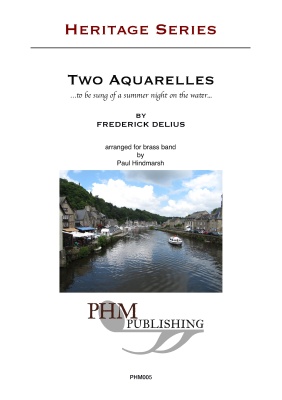
Two Aquarelles (Euphonium Feature with Brass Band - Score and Parts)
In the late spring of 1917, the Bradford born composer, Frederick Delius (1856 - 1934) composed two short part-songs at his home in Grez-sur-Loing. The river ran along the bottom of his garden and he called the two miniatures To be sung of a summer night on the water. The First World War was at its height, but one would never guess that from the languid and serene quality of these richly textured nocturnes. The songs were first heard in London on 28 June, sung by the Oriana Madrigal Society, conducted by Charles Kennedy Scott. In 1932 Delius's amanuensis, Eric Fenby, arranged them for string orchestra as Two Aquarelles. While I have taken Fenby's title, my arrangement is a note-for-note transcription of the choral original. It was prepared in early in 1993 for Besses o' th' Barn Band, of which I was Musical Director at the time. In the second song, the prominent tenor solo has been given to the solo euphonium, who should stand apart from the band in performance.- Paul HindmarshDuration: 5.00
Estimated dispatch 7-14 working days
 Watch video