
Results
-
£76.99
Jubilant Prelude - Toon Hagen - Dirk Annema
'Jubilant Prelude' is an orchestration of the 'Preludium over Psalm 150' originally composed for organ by Toon Hagen. Since 1998 Toon Hagen has been organ-player of the 'Grote or Sint Michaelskerk' in Zwolle (the Netherlands). He has written several 'contemporary' compositions for organ.'Jubilant Prelude' has a capricious character by the use of irregular measures and its many measure changes. The structure of the Prelude is that of a fugue and is based on motives from the psalm.After the first climax, which is both dynamic and harmonic, the theme in the Andante Jubiloso is clearly audible and it is alternated with erratic motifs. Tension increases until at last the psalm itself isheard in all its glory. The melody of the psalm sounds as a cantus firmus in tenor register, with motifs in ornamentation for saxophones, bugles and trumpets. The finale, like the prelude is capricious and vehement.The instrumentation for brassband was made by Dirk Annema. It is particularly colourful and has a surprising role for the percussion section.
Estimated dispatch 5-14 working days
-
 £54.95
Sonata - Derek Bourgeois
This work, composed in 1998, was commissioned by the American trombonist Don Lucas as a work for trombone and piano and first performed by him in Birmingham on 19th May 2000. Subsequently, I arranged the music for both solo trombone and brass band and solo trombone and wind band so that it now exists in three formats. The first movement, in B flat major, is brisk and energetic, and is cast in sonata form. The second subject is gentler and more lyrical. The second movement, a scherzo in C major, is the most complex of the four. Basically the structure is a rond. For a long time the music remains in the opening 5/8 time until a new theme introduces more broken rhythms in a more jazzy idiom. After a return of the opening theme the following episode is more tonally ambiguous. Finally, the main theme returns to round off the movement. The third movement, a lyrical adagio, is really one long extended melodic flow. The harmonies are lush and the textures simple and direct. The tonal center is A minor, but the music meanders through so many keys, that this key centre is heavily disguised. The finale is a fiery affair. G minor is really its home key, but throughout the movement the music moves about a lot and the second subject is first heard in A flat minor. The movement's underlying sonata structure is masked not only by its loose tonality but also by its frequently changing time signatures. Like the first movement the second subject is more lyrical in nature and for a while it seems that the music will end peacefully, but a final flurry heralds a triple forte unison on the home note of the first movement - B flat. Derek Bourgeois
Estimated dispatch 5-14 working days
-
 £66.00
Ballet for Band - Joseph Horovitz
Composer Joseph Horovitz will celebrate his 90th birthday in May, with 2016 already seeing a welcome retrospective of some his finest works at the RNCM Brass Band Festival in Manchester in January.It included Ballet for Band, written in 1983 at the set-work for the National Final at the Royal Albert Hall, and which has since become one his most popular major test-pieces - played on numerous occasions throughout the banding world. It is a wonderfully elegant, mischievous composition - a brass band ballet, not of programmatic intent but of fertile imagination; beautifully crafted with a delicacy of touch as light on its feet as any arabesque.The composer has admitted that he had a clear vision of the characters that inhabit his score, yet has never divulged any details - leaving the bands and listeners, as he says, "...to exercise their own imaginations rather than being influenced bymine!"
Estimated dispatch 5-14 working days
-
 £68.90
Three Pictures for Band - Oliver Waespi
This composition consists of three sound pictures. Numerous associations mutually link those parts as far as motifs and harmony are concerned. The motif of the ascending and descending fourth plays an important role in many a theme. There are many fourth chords by means of which I try to put a harmonic and unifying stamp on the composition as a whole. Moreover there are similar or identical, though varied, motifs in the successive parts. The first part 'Cortege' (Procession) describes the dignified majestic procession by means of simple, precise rhythms. At first, the music is scarcely audible, as if coming from a distance; it gradually comes nearer until it reaches its climax in large chords, before fading away again. At each quarter note one could imagine a step. The second part 'Dialogue' consists in broad outlines of dialogues between the different orchestral groups. Some instruments are asking questions, others are giving answers. After a rather sad passage, the music turns into a climax followed by a second passage that brings comfort and leads to a quiet ending. In the third part, there is a sudden movement coming up in the shape of 'Waves'. The principle of the wave, successively swelling and decreasing, dominates the entire musical structure of this part, even in the separate motifs.Oliver Waespi
Estimated dispatch 5-14 working days
-
 £147.10
Rainforest Concerto - Saskia Apon
Rainforest Concerto has been commissioned by the Brass Band Rijnmond. This double concerto for two trombones and wind band consists of three parts with the cadenza in the slow niddle movement. Saskia Apon was inspired by the threat of the destruction of the rainforest. In the first part, Creation, we hear an accelerated reproduction of the birth of this impressive natural phenomenon. We hear the first birds, we see the growth of the mangrove trees and we witness the struggle for light and the force necessary to keep the realized equilibrium in a perpetual balance.The second part, Ode, is a tribute to the wonder and splendour of the rainforest. By means of subtle and extremely delicate sonorities we hear how nature adds an inestimable value to the rainforest. However it is also extremely fragile and this engenders a certain melancholy due to the awareness of man's impotence to respect this beautiful nature.In the last part, Contra Demolition, we hear the threatening decline, but also the revolt against this possible ruin. It is a heartfelt cry to leave nuture in peace and to work hard for the preservation of the beauty and the value of the rainforest.
Estimated dispatch 5-14 working days
-
 £52.70
Irish Air - Willy Hautvast
The complete title of this Irish tune is : 'Believe me if all those endearing young charms'. The character of this song is rather nostalgic, but yet it is popular all over the world as it has been sung and performed by all kinds of ensembles and singers. This piece can be used at several occasions and the well-known tune will be a huge success.
Estimated dispatch 5-14 working days
-
 £59.80
Joy Ride - Andrew Pearce
While conducting younger groups in the UK, Andrew Pearcer wrote a funky and accessible piece that younger musicians would appreciate playing. The piece begins with a repeated quaver motif in low brass which is answered by a funky riff in Saxophones. It is cool, fun and will keep the younger bands entertained and cheerful as they learn it in no time.
Estimated dispatch 5-14 working days
-
 £50.60
La Bamba - Henk Ummels
This single from Ritchie Valens from 1958 is originally a Spanish song from Mexican folklore. Years later it was picked by Rolling Stone magazine as the only non-English song in their 500 Greatest Songs of All Time list at number 345. In 1987 it was covered by the American band Los Lobos, for the film La Bamba, about the life of Ritchie Valens. This arrangement has been made for flexible setting, and is suitable for a developed student band.
Estimated dispatch 5-14 working days
-
 £127.30
Skogtrollet - Hans Peter Nielsen - Øystein Sjøvaag Heimdal
The Wood Troll was composed in 1950 for bassoon solo with orchestra.This arrangement is written for tuba soloist (Eb or Bb) with brass band.It's a funny and challenging piece for an intermediate soloist.To the conductorPlease pay attention to the dynamics when the soloist play. To make shure that the balance between soloist and accompaniment is good, it's preferred toomit some players in the biggest sections of the band.
Estimated dispatch 5-14 working days
-
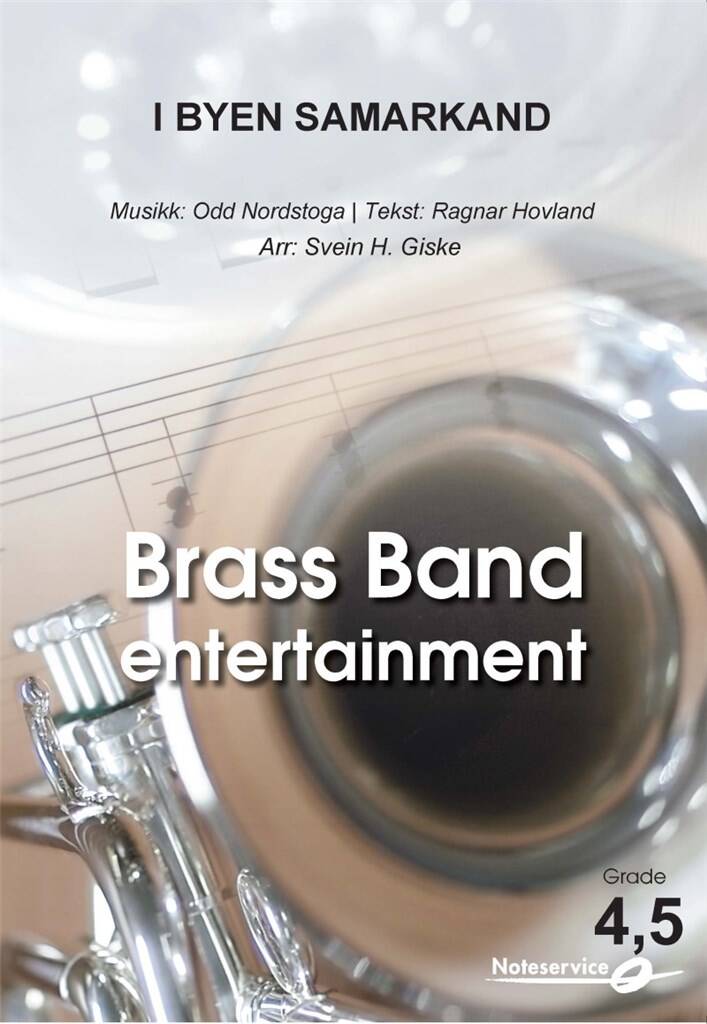 £127.30
I Byen Samarkand - Nordstoga - Svein H. Giske
Odd Nordstoga is an award winning Norwegian artist who has been active since the 1990's, working in the popular-/folk music genre. I have listened to a lot of Odd Nordstogas music, in particular the Heim te mor-album. When preparing for Askoy Brass Band's participation at Siddis Brass in 2008, I came across I byen Samarkand, another of Nordstogas tunes. This was from the Pilegrim album. I thought it had an exciting mix of expressions and included it in the band's repertoire for the Siddis Brass competiton. Pilegrim was initially a commision by the Bergen International Festival back in 2005, based on lyrics by author Ragnar Hovland and Odd Nordstoga's music. -Svein H. Giske -
Estimated dispatch 5-14 working days
 View Music