
Results
-
 £72.99
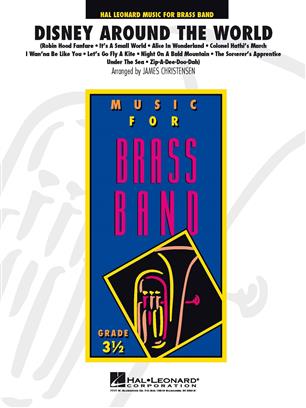
Disney Around the World (Brass Band - Score and Parts)
If youre a Disney fan, this is your moment! This medley for brass band by James Christensen contains many of the great hits from the rich Disney repertoire: Alice in Wonderland, Colonel Hathis March, I Wanna Be Like You (Jungle Book), Its A Small World, Lets Go Fly A Kate (Mary Poppins), Night on Bald Mountain, Robin Hood, The Sorcerers Apprentice, Under the Sea and Zip-A-Dee-Doo-Dah.
Estimated dispatch 7-14 working days
-
 £8.99
£8.99Disney Around the World (Score Only)
If you're a Disney fan, this is your moment! This medley for brass band by James Christensen contains many of the great hits from the rich Disney repertoire: Alice in Wonderland, Colonel Hathi's March, I Wanna Be Like You (Jungle Book), It's A Small World, Let's Go Fly A Kate (Mary Poppins), Night on Bald Mountain, Robin Hood, The Sorcerer's Apprentice, Under the Sea and Zip-A-Dee-Doo-Dah.
Estimated dispatch 7-14 working days
-
 £95.00
Concertante (Piano Solo with Brass Band - Score and Parts)
This work was written in 1966, when I was a student at the Royal Academy of Music in London. It was the first major work to be written for this combination. The Concertante is unashamedly romantic in idiom and is cast in three movements: Prelude, Nocturne and Rondo.The Prelude is in sonata form with a contracted recapitulation. There are two main themes, the first announced after the opening flourish on piano. The second theme is lyrical in character and the interplay between these two themes forms the main focus of the movement.The pensive Nocturne opens with an introduction from the band which contains hints of the two main ideas to follow. The solo piano announces the main theme, which has a slightly 'blues' character in its flattened third and seventh notes of the scale. The band enters with the chorale theme already heard in the introduction. Eventually the first theme returns, this time from piano and band and building to a powerful climax before subsiding to a peaceful ending.The Rondo is full of energetic rhythms and changing time patterns. The main theme is 'giocoso' in character and in the first episode there is more than a hint of the tune 'Onward Christian Soldiers' in what amounts to a good humoured parody. Before the final coda there is a long piano cadenza underlying the virtuoso element of the work.The work had a number of public performances leading up to a memorable one in the Royal Albert Hall in 1989 as part of the Gala Concert that used to be held after the National Brass Band Championship in the Royal Albert Hall. That year, the 'centre band' in the massed bands concert were the GUS Band (then known for sponsorship reasons as 'Rigid Containers Group Band'!) conducted by my great friend and champion, Bramwell Tovey, with myself as the soloist.- Edward GregsonDuration: 18.00
Estimated dispatch 7-14 working days
-
 £50.00
Triumph Series Band Journal July 2017 Numbers 1287-1290
March - AFB Celebrations (Steven Ponsford)Originally written for the 15th anniversary of the Aukland Fellowship Band this march abounds in energy. It features the traditional Maori tune 'Hine e Hine' and the ever popular song 'Ill go in the strength of the Lord'.My Jesus I love thee (Kevin Downing)Having written a beautiful and thoughtful setting of this popular tune, this works introduces a new composer to our journals. Kevin Downing is a young American Salvationist and this piece was originally written for the National Capitol and Virginia Divisional Youth Band.Some day (1) (Kenneth Downie)A reflective yet lifting setting of the song as titled by Dr. Kenneth Downie.Trombone Solo Silent Night (2) (David Rowsell)This is a simple setting which should be accessible for most Trombone Soloists to feature within the Christmas season.Christmas Bells (Noel Jones)This collection of carols features 'Sweet chiming Christmas bells, sweet chiming bells' and 'Ding dong merrily on high!'
Estimated dispatch 7-14 working days
-
 £70.00
General Series Band Journal April 2017 Numbers 2166-2169
Festival March - Faith on track (Andrew Blyth)Originally written for the Peterborough Citadel Band where the composer is the Bandmaster. This march features 'This train is bound for Glory' and 'The Gospel Train' in reference to the association with the City of Peterborough and its strong links with the Railway. Also found is the song 'Share your faith' which speaks of the evangelistic nature of the Corps and its people.Flashpoint (Martin Cordner)Written for The Melbourne Staff Band and featured at the Boundless Congress in 2015, the 'John Williams type' main theme is supplemented with an exciting setting of the song 'I'll stand for Christ'.Wells (Sam Creamer)A simple hymn tune arrangement based on the title of the work.All your anxiety (Brian Hogg)The tune 'All your anxiety' has been given a developed and thoughtful setting by Australian Salvationist Brian Hogg.
Estimated dispatch 7-14 working days
-
 £70.00
General Series Band Journal December 2016 Numbers 2162 - 2165
No. 2162 Coronation Fanfare and Intrada (Kenneth Smith)Numerous Scripture verses refer to Jesus as 'King of Kings and Lord of Lords'. In addition, he is described in Revelation 5:13, 7:10 and 21:15 as 'the Lamb who sits upon the throne'. Furthermore we're told in Philippians 2:10-11 that one day 'every knee will bow...and every tongue confess that Jesus Christ is Lord'. This arrangement celebrates Jesus' heavenly coronation, bringing together two well-known hymns inviting us to crown Jesus as King.No. 2163 Telling It! (Sam Creamer)A lively, salsa setting of Sidney Cox's well-known song, 'I want to tell what God has done'.No. 2164 The Christ of Calvary (Mervyn Clarke)This arrangement of the much-loved tune 'Annie Laurie', is often associated with Nathan Atkinson Aldersley's words to 'The Christ of Calvary'.No. 2165 Festival March - The Return (Ray Steadman-Allen)The Return was written for the occasion of Chatham corps returning to its refurbished hall.
Estimated dispatch 7-14 working days
-
 £24.95
Time-Shift (Brass Quartet)
For brass quartet (2 Trumpets/Cornets, Horn Eb and Euphonium)Time-shift was commissioned by The Swiss National Committee for the 2015 National Quartet Championships, held in Colombier, Switzerland.The work is cast in three movements and develops themes taken from my brass band work The Triumph of Time. The three movements are I - Intrada, II - Meditation, III - Toccata.
Estimated dispatch 7-14 working days
-
 £34.95
Deep River (Eb Solo with Low Brass Ensemble - Score and Parts)
Solo for Eb Bass with Low Brass Ensemble (Euphoniums 1 & 2, Eb Bass 2 and Bb Bass 1 & 2)Deep River is one of the best known of the spirituals originating among the enslaved Africans in the United States during the 18th and 19th centuries. Although primarily expressions of religious faith, spirituals were also veiled protest songs, the sense of oppression conveyed in the lyrics being clear to present day performers:Deep River,My home is over Jordan.Deep River, Lord.I want to cross over into campground.Oh, don't you want to go,To the Gospel feast;That Promised Land,Where all is peace?(Includes treble and bass clef parts)
Estimated dispatch 7-14 working days
-
 £38.95
Unity Series Band Journal June 2016 Number 442 - 445
No. 442 March - Christmastime (Ian Feltwell)This Christmas march is based on two carols, I saw three ships come sailing in (N.C.P. 38) and It came upon the midnight clear (N.C.P. 44), with numerous references to other carols throughout and finishing with a rousing rendition of We wish you a merry Christmas (N.C.P. 110).
Estimated dispatch 7-14 working days
-
 £34.20
Those Magnificent Men in their Flying Machines (10 Piece Brass Ensemble - Score and Parts)
Those Magnificent Men in their Flying Machines, or How I Flew from London to Paris in 25 Hours 11 Minutes is a 1965 British period comedy film featuring an international ensemble cast including Stuart Whitman, Sarah Miles, Robert Morley, Terry-Thomas, James Fox, Red Skelton, Jean-Pierre Cassel, Gert Frobe and Alberto Sordi. The film, revolving around the craze of early aviation, was directed and co-written by Ken Annakin, with a musical score by Ron Goodwin. Now it is availble for your 10 piece brass ensemble!
Estimated dispatch 7-14 working days