
Results
-
 £40.00
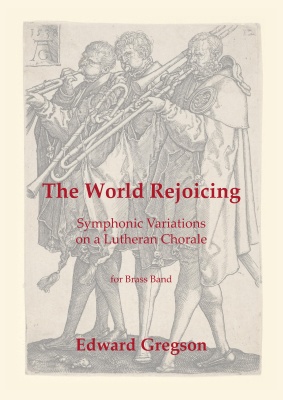
The World Rejoicing (Brass Band - Score only)
The World Rejoicing was commissioned by the National Brass Band Associations of Belgium, Netherlands, Norway, Switzerland, and the British Open, as the test piece for their competitions in 2020/21. Although the work was completed in 2019, the pandemic of 2020 meant that these competitions were postponed until 2021/22. The premiere took place in September 2021 at Symphony Hall, Birmingham, UK.In searching for a common link between the brass band traditions of the various European countries that commissioned this work, I considered the fact that hymns have always played an important role in the relationship that brass bands have with their particular communities; and thus I turned to a well- known Lutheran chorale, Nun danket alle Gott (Now thank we all our God), written around 1636 by Martin Rinkart, with the melody attributed to Johann Cruger. A number of composers have incorporated this chorale into their music, most famously J.S. Bach in his Cantatas no. 79 and 192, and Mendelssohn in the Lobsegang movement of his 2nd Symphony (the harmonisation of which is usually used when this hymn is sung).It seemed fitting therefore for me to return to a compositional form I have used many times before (Variations) and to write a work based on this hymn. I have used it in a similar way to that which I employed in my Variations on Laudate Dominum of 1976 - that is, rather than writing a set of variations using elaborations of the complete tune, I have taken various phrases from the chorale and used them within the context of other musical material, applying an overall symphonic process of continuous variation and development. The structure, or sub-divisions of the work, which is through composed and plays without a break, is as follows:Prelude, Capriccio, La Danza 1, Processional, La Danza 2, Arias and Duets, Fuga Burlesca, Chorale, and Postlude.The work, which is around 16 minutes in length, is also partly autobiographical - in the manner say of Strauss's Ein Heldenleben - in that I have incorporated into the score brief quotations from many of my other major works for brass band. In that respect, The World Rejoicing sums up a particular facet of my life as a composer, and reflects the admiration I have always had for what is surely one of the great amateur music-making traditions in the world.Duration: 16.00
Estimated dispatch 7-14 working days
-
 £15.00
The World Rejoicing (Brass Band - Study Score)
In searching for a common link between the brass band traditions of the various European countries that commissioned this work, I considered the fact that hymns have always played an important role in the relationship that brass bands have with their particular communities; and thus I turned to a well-known Lutheran chorale, Nun danket alle Gott (Now thank we all our God), written around 1636 by Martin Rinkart, with the melody attributed to Johann Crger. A number of composers have incorporated this chorale into their music, most famously J.S.Bach in his Cantatas no. 79 and 192, and Mendelssohn in the Lobsegang movement of his 2nd Symphony (the harmonization of which is usually used when this hymn is sung).It seemed fitting therefore for me to return to a compositional form I have used many times before (Variations) and to write a work based on this hymn. I have used it in a similar way to that which I employed in my Variations on Laudate Dominum of 1976 - that is, rather than writing a set of variations using elaborations of the complete tune, I have taken various phrases from the chorale and used them within the context of other musical material, applying an overall symphonic process of continuous variation and development. The structure, or sub-divisions of the work, which is through composed and plays without a break, is as follows: Prelude, Capriccio, La Danza 1, Processional, La Danza 2, Arias and Duets, Fuga Burlesca, Chorale, and Postlude.The work is also partly autobiographical - in the manner say of Strauss's Ein Heldenleben - in that I have incorporated into the score brief quotations from many of my other major works for brass band. In that respect, The World Rejoicing sums up a particular facet of my life as a composer, and reflects the admiration I have always had for what is surely one of the great amateur music-making traditions in the world.The World Rejoicing is dedicated 'in loving memory of my brother', Bramwell Logan Gregson, who sadly passed away in the Autumn of 2018.Edward Gregson
Estimated dispatch 7-14 working days
-
 £35.00
Postcard to Grimethorpe (Brass Band - Score and Parts)
I composed the original version of Postcard to Grimethorpe in 1993 at the request of Elgar Howarth, for a concert at the Queen Elizabeth Hall, London, given by the Grimethorpe Colliery Band. This was at a time when after the Grimethorpe Colliery pit closed the future of the band was in severe jeopardy. The concert was given in aid of the band, both through publicity and funding.Then in late 2022 Jack Stamp, the American composer, conductor and educator, and at that time international composer-in-association with Grimethorpe, contacted me to say that he had discovered my short piece in the band library, and asked if I might extend it for a recording he was sponsoring for the band - the repertoire to consist entirely of music specially composed for Grimethorpe.I agreed and decided to extend the piece by using the miner's hymn Gresford, as a symbolic gesture of protest at the many thousands of miners in the UK who were made redundant from their jobs. After an angular (quasi-atonal) first section, the hymn enters, softly at first, but with each phrase it becomes more powerful and insistent, ending with the final phrase triumphantly accompanied by melodic percussion (replacing the drums and cymbals of the earlier phrases, as if the band were then on the march). However, this short work ends softly and gently, as if anger has been replaced by quiet resolution and determination, looking to the future with confidence.- Edward GregsonDuration: 3.00
Estimated dispatch 7-14 working days
-
 £50.00
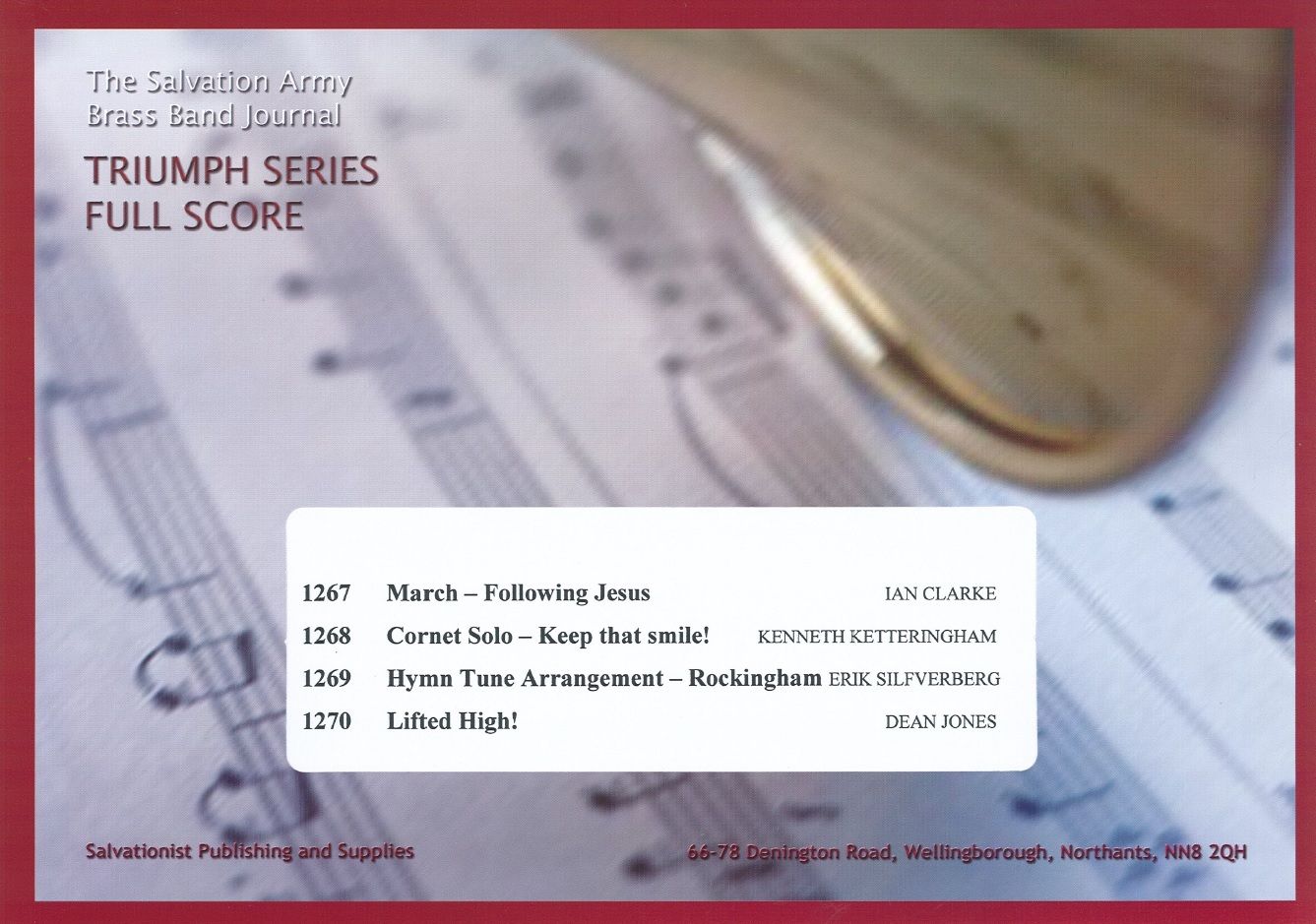
Triumph Series Band Journal November 2015 Numbers 1267 - 1270
No. 1267 March - Following Jesus (Ian Clarke)For more than two thousand years, countless Christians, the world over, have chosen to follow Jesus and try to live by his teachings. The words associated with the three tunes used in this march follow that theme: Sagina (T.B. 498), I will follow thee, my Saviour (T.B. 378) and There's joy in following (T.B.C.S. 206).No. 1268 Cornet Solo - Keep that smile! (Kenneth Ketteringham)This light-hearted, waltz-like solo features an old Army song written by Bandmaster George Marshall and Staff-Captain A.R. Wiggins.No. 1269 Hymn Tune Arrangement - Rockingham (Erik Silfverberg)A four-verse setting of the hymn tune, Rockingham, associated with the song 'When I survey the wondrous cross' by Isaac Watts.No. 1270 Lifted High! (Dean Jones)A bright, joyful arrangement of the song, 'Lord, I lift your name on high' in a Caribbean style.
Estimated dispatch 7-14 working days
-
 £50.00
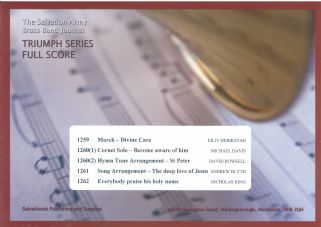
Triumph Series Band Journal March 2015 Numbers 1259 - 1262
No. 1259 March - Divine Care (Eiliv Herikstad)The message of this march is 'God will take care of you!' The introduction reflects the beginning of the song, God will take care of you (T.B.C.S. 124), which is presented in full at sections C and D.No. 1260 (1) Cornet Solo - Become aware of him (Michael Davis)A setting for Cornet and band of Colonel Robert Redhead's song, Become aware of him, which was originally published in The Musical Salvationist.No. 1260 (2) Hymn Tune Arrangement - St Peter (David Rowsell)An arrangement of the tune, St Peter, associated with the song, In Christ there is no east or west.No. 1261 Song Arrangement - The deep love of Jesus (Andrew Blyth)The strong hymn tune of Ebenezer (T.B. 433) was composed by Welshman, Thomas John Williams (1869-1944), who served as organist and choir director at various churches in and around Llanelli. This arrangement is more relaxed in style than the original and attempts to convey the freedom of the verses mostly associated witht he tune by Samuel T. Francis (1835-1925) O deep, deep love of Jesus, vast, unmeasured, boundless, free.No. 1262 Everybody praise his holy name (Nicholas King)A bright arrangement by Nicholas King of Remco Hakkert's song, Praise his holy name.
Estimated dispatch 7-14 working days
-
 £38.95
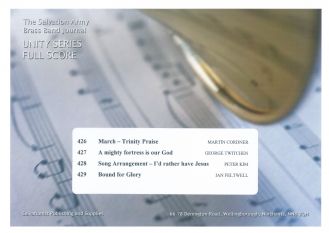
Unity Series Band Journal February 2015 Number 426 - 429
No. 426 March - Trinity Praise (Martin Cordner)Written in 2013 for the first anniversary of the Trinity Brass training band (a joint initiative between Rock Ferry and Birkenhead corps), this march celebrates God the Father, Son and Holy Spirit and calls to mind two songs: Father, we love you and verse 5 of Will J. Brand's song, Sing we many years of blessing.No. 427 A mighty fortress is our God (George Twitchen)The words and melody to this great hymn were written by Martin Luther and are based on PSalm 46. It has been called 'The battle hymn of the Reformation' for the effect it had on increasing support for the Reformer's cause. The words and melody are so closely associated with its author, that the first lines are inscribed on Luther's monument at Wittenberg.No. 428 Song Arrangement - I'd rather have Jesus (Peter Kim)Bandmaster Peter Kim from the USA Central Territory presents an arrangement of the popular gospel song, 'I'd rather have Jesus than silver or gold.' The lyrics were written by Rhea F. Miller in 1922 and have proved popular with many Christian denominations ever since.No. 429 Bound for Glory (Ian Feltwell)The song 'I'm a soldier bound for glory' was first published in 1922, is a great Salvation Army song of testimony and still remains a firm favourite today.
Estimated dispatch 7-14 working days
-
 £40.00
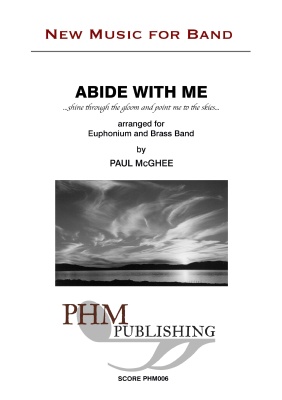
Abide With Me (Euphonium Solo with Brass Band - Score and Parts)
My arrangement of William H. Monk's tune of 1861, uses the euphonium soloist as the central figure for the melodic line in the three verses. Surrounding the solo line is an irregular pulsed figure in the percussion to give the music an unsettled feel whilst the muted ensemble lightly colour the melodic contour of the soloist. From the low beginnings of the piece, where no high instrumentation is used, we are led through the darkened texture to a bright finale, although the sense of the forbidding is always present.Abide With Me has always been a favourite hymn of mine and it was when watching the film 28 Days Later that I believed it would make a rather striking arrangement for brass band. This was confirmed further when the hymn was used at the 2012 opening ceremony of the London Olympics. The juxtaposition between the static, slow moving melody and the rhythmic effects of the dancers was something that I thought could be captured in an arrangement.- Paul McGheeDuration: 5.00
Estimated dispatch 7-14 working days
-
 £70.00
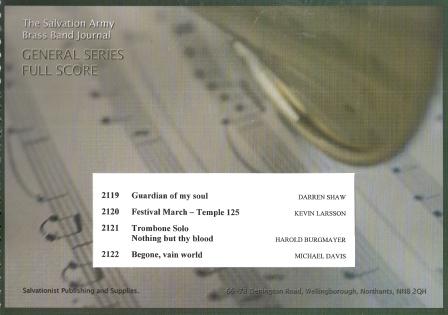
General Series Band Journal April 2013 Numbers 2119-2122
No.2119 Guardian of my soul (Darren Shaw)This arrangement combines the composer's own song 'I worship you', with the well-known hymn 'O Jesus, I have promised' (S.A.S.B. 862), both of which contain the phrase, 'Guardian of my soul', within their lyrics.No.2120 Festival March - Temple 125 (Kevin Larsson)This march was written for the 125th anniversary of Bromley Temple, which is where the composer grew up and still considers his 'home corps'. This arrangement uses two songs that are closely associated with Bromley, the first being 'Jesus is all I need' (STTL Vol.1, part 1) by Hans Knutzen, who was a soldier of the corps and a member of the 'Bill Booth Revival Machine'. The second song is 'He came to give us life (T.B. 662) from the Gowans and Larsson musical, 'Jesus Folk', which was premiered using a cast from Bromley Temple.No.2121 Trombone Solo - Nothing but thy blood (Harold Burmayer)Donna Peterson's recent melody, set to the time-honoured words of Richard Slater, provides a vehicle for solo trombone with band accompaniment.No.2122 Begone, vain world (Michael Davis)A setting of the hymn tune of the same title, with which we associate the words, 'I want, dear Lord, a heart that's true and clean'.
Estimated dispatch 7-14 working days
-
 £34.95
Judd: Almighty - Roger Trigg
'Almighty' was written for Bandmaster Ross Johnson and Camberwell Citadel Band (Australia) for use on the band's 2009 tour of New Zealand. This energetic work takes its title from the opening line of the well-loved hymn, 'Praise to the Lord, the Almighty, the King of creation' (S.A.S.B. 19). It is based on the hymn tune 'Lobe den Herren' (T.B. 721) and whilst the tune is only heard in its entirety once, fragments of the tune can be heard throughout the music. The music is a shout of acclamation to the King of Kings.
Estimated dispatch 7-14 working days
-
 £24.95
Judd: Love Divine
Sir John Stainer's fine tune is often associated with Charles Wesley's hymn, 'Love divine, all loves excelling'. The introduction is designed to evoke a feeling of awe, and a broad, confident style will set the pattern for the whole arrangement. Contrast in colour has been sought in the scoring but special effects must not be allowed to obscure the melody. The arrangement ends in an atmosphere suggested by the final line of the hymn, 'Lost in wonder, love and praise'.
Estimated dispatch 7-14 working days