
Results
-
 £104.99
Toccata Festiva - Jan Van der Roost
'Toccata Festiva' was commissioned in 1994 by the Dutch Brass Band Championships. The wind band version was made a year later by the composer himself. Historically speaking, the toccata is considered to be one of the first independent instrumental forms for keyboard instruments. Originally the toccata was typically more or less improvised, later this musical form was given a more regulated structure. Both elements are used in the 'Toccata Festiva': on the one hand the different themes are developed freely, on the other, the piece has an orderly structure. It is in a three part form (quick-slow-quick) and includes both strong rhythmical figures and broad melodic lines. Partof the composition is written in a more or less archaic tone idiom, referring to the period from which the toccata form originates (16th century).
Estimated dispatch 5-14 working days
-
 £60.99
Artemis - Jan Van der Roost
Artemis is the Greek goddess of hunting and forests. In western art she is often pictured with deer, lions or bears with a bow in her hand. The tempo of this march is stately and the themes are "concertante" in character making Artemis best suited as a concert march rather than a street march. Technically this march is not too difficult although at times some dexterous fingering is necessary. The trio melody is especially lyrical and offers various sections within the band the possibility to show off their skill in playing the expressive melody. This excellent new concert march is sure to become a classic and be performed time and time again.
Estimated dispatch 5-14 working days
-
 £54.99
They are Coming - John Emerson Blackstone
There are people who are capable of planning well. They live their lives in a well-structured manner and know exactly what they have to do. On the other hand, there are also people who are the exact opposite: they want to do too many things at once and are often somewhat absent-minded, which occasionally results in frantic situations. The outcome of one such situation is 'They are coming'. John Emerson Blackstone had been working on a new composition for some time when he received a telephone call from his editor, who told him that the deadline was approaching rapidly, even worse, that it would expire at the end of that same day and that he would drop by in person to fetch thecomposition! Blackstone set to work in a frenzy and completed the last details. When his editor arrived, the piece was finished ..... and got its definitive title: 'They are coming'.
Estimated dispatch 5-14 working days
-
 £102.99
La Geometria - Bert Appermont
Geometric figures, with their corresponding symbolism and numbers, appeal to the imagination. In La Geometria, the square, the circle, and the triangle are musically explored. On the one hand, the atmosphere and character of each figure formed a source of inspiration; in addition, the matching number in each case influenced the melody, harmony, and time signature. An interesting starting point with an excellent result!
Estimated dispatch 5-14 working days
-
 £115.60
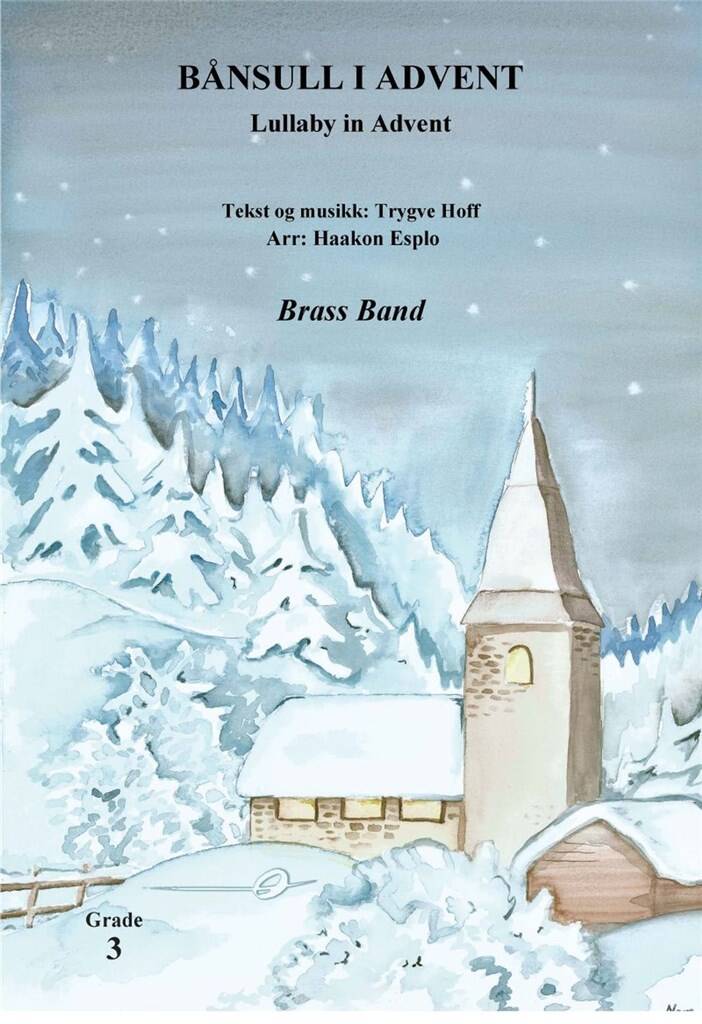
Bansull i advent - Trygve Hoff - Haakon Esplo
The composer and musician Trygve Hoff was born and raised at Rognan in Nordland and gained a lot of inspiration for his texts from the North Norwegian culture. He is a composer and copywriter of many of our most popular songs. "Ei hand a holde i" and "Har en drom" with music by Svein Gundersen and especially his own "North Norwegian Christmas Psalm" are famous songs in Norway. "Lullaby in advent" may not be among his most famous songs, but it's a beautiful and thoughtful melody that will fit well with any Christmas concert. Hoff himself varied with musical styles on this song. This arrangement is written as a jazz-version with swing feel.
Estimated dispatch 5-14 working days
-
 £60.99
Minerva - Jan Van der Roost
Minerva by Jan Van der Roost was composed on the commission of the German "Musikverein Braunshausen" on the occasion of the 75th anniversary of the orchestra. The composition, first performed on September 17, 1999, is not a street march but a concert march, just like Mercury and Arsenal. The use and variation of different rhythmic patterns gives the first part of this march a distinctly dynamic character. Two main themes are presented in several instrumental combinations. The theme from the trio, on the other hand, is characterized by a broad melodic approach using large intervals. This theme, wreathed by high woodwinds, is heard one more time after a contrasting newpart, but now in a somewhat slower tempo. The counterpoint in this part refers to the first part of the march. The brilliant ending suits a festive anniversary march!
Estimated dispatch 5-14 working days
-
 £115.60
Sjakkmatt! - Hans Offerdal
How do you experience the final thrilling minutes of a chess game when your opponent has taken the upper hand? And how does it actually feel being beaten checkmate? This piece gives you the answers! There are challenges in use of dynamics, articulation, intensity and gradually increasing tempo. Dissonances are present several places, but the voice leading is diatonic and often in repeating patterns. The whole piece is based on one single scale: Bb major scale with augmented fourth and minor seventh. It is notated as a concert Bb major scale with two accidentals. Feel free to use it during warm-up!
Estimated dispatch 5-14 working days
-
 £79.99
The Duke of Marlborough - Percy Aldridge Grainger
Based on the English folkong "The Duke of Marlborough". The first thime heard (behind platform) it typifies memories of long-past wars - vague, far-off, poetic. The second time (on platform) it typifies war in the present - fast-moving, close at hand, debonair, drastic.
Estimated dispatch 5-14 working days
-
 £74.99
Drink to Me Only with Thine Eyes - J. W. Callcott - Philip Sparke
The lyrics to Drink to Me Only with Thine Eyes can be traced to English poet Ben Jonson, a contemporary of Shakespeare. The melody's origin, on the other hand, is not certain. In this three- movement arrangement, Philip Sparke provides the soloist with plenty of substance while respecting the beautiful simplicity of the original tune.
Estimated dispatch 5-14 working days
-
 £35.00
Ascension - Lucy Pankhurst
A major work written for the RNCM Brass Festival Competition 2005, and inspired by the nature of Ascension - creating a Musical depiction of the spiritual journey towards enlightenment, sanctuary and ultimate inner peace.As aninitial muse for this work, the 'Tibetan Singing Bowl' is utilised with the Brass Band in order to represent this path to Serenity, together withBaoding Balls(Chinese Health Balls) to mark the point of Final Ascension.Programme notes from the composer, Lucy Pankhurst:Ascension is a Musical depiction of the Spiritual Journey towards enlightenment, sanctuary and ultimate inner peace.As my initial muse for this work, the Singing Bowl is utilised with the Brass Band in order to represent this path to Serenity. "Tibetan" Singing Bowls date back to the 8th Century A.D., originating in the pre-Buddhist shamanic Bon Po culture in the Himalayas and are still used in modern Monasteries. The original purpose of them still remains a mystery, with accounts stating that it is forbidden to disclose the true function of the Bowls, as the "secrets of sound" yield so much Power, that they must be kept hidden.Listening to the tones created by the Singing Bowl effectively silences the internal dialogue of the listener, making it an excellent tool for Meditation, Centering and entering trance-like states. In Buddhism, as with many cultures, sound is an important part of Spiritual Practice. There are 9 methods to reach Enlightenment in the Buddhist Doctrine ; the seventh is SOUND.These Bowls are used by Healers in a similar way to help balance the body's residual energies. The Bowls are usually made from seven different sacred metals, intended to correlate directly to the seven sacred "Planets" : GOLD (Sun), SILVER (Moon), MERCURY (Mercury), COPPER (Venus), IRON (Mars), TIN (Jupiter), ANTIMONY (Saturn). Any one Bowl can create up to seven different frequencies (tones) simultaneously. In Healing, the Singing Bowl is played whilst balanced on the palm of the hand, struck three times to stabilise the surrounding energies, before rotating the wooden "beater" around the outer circumference of the Bowl to create the "singing" effect.I have included an optional Vibraphone part (to be played with a Double Bass Bow) with Tubular Bells, to be used only in performances where a Singing Bowl cannot be acquired. However, a traditional Bowl should be used whenever possible, to create this specific and unique sound.Baoding Balls or Chinese Health Balls are also utilised in this work. Their appearance in the Music here, however, is to mark the point of Final Ascension, where the music reaches its ultimate goal. These delicate cloisonne iron Balls are said to stimulate the acupressure points on the hand, thus improving the Chi and Energy Paths (Life Force) throughout the entire body. The delicate "tinkle" produced by these spheres is hypnotic and captivating. For this reason, where no Baoding Balls are obtainable for performance, only delicate metallic percussion should be used in replacement (i.e. Crotales, Antique Cymbals or (liberal) single strikes on a Triangle etc.). Bell Trees, Wind Chimes and Cow Bells should not be used.As in many cultures, the number three is important in Ascension, as it represents not only the purification from the Singing Bowl, but also it is a number of confirmation, reiterated throughout the music in the metallic percussion in addition to the Brass, re-affirming the correct path to Enlightenment.
In Stock: Estimated dispatch 3-5 working days
 View Music