
Results
-
 £59.77
Horizon: The Promise of the Lord (Brass Band) Andrew Wainwright
Horizon: The Promise of the Lord was written at the request of Bandmaster Stephen Cobb for The International Staff Band. It is based on the much loved hymn of the church, Cwm Rhondda (Guide me O thou great Jehovah). The work was recorded on the ISB's CD Manuscripts II (released 2023). This highly descriptive piece will be an excellent addition to concert programs, as well as being appropriate as a test piece. The inspiration for the work comes from the book of Exodus. Whilst the music is not intended to be directly programmatic, like the hymn Cwm Rhondda, the work takes the listener through the Exodus from Egypt to the promised land of Israel as a metaphor of the spiritual pilgrimage of the individual Christian through his or her earthly life. The music aims to evoke a sense of God's guidance through strife and affirm the reality that God provides for us and redeems all the wrong in the world. This God who provided for the Hebrew people wandering amidst 'barren lands' with 'bread of heaven' is still and ever will be a God of provisional grace. Through listening to the music, it is the composer's intention that we are reminded of God's promise of Deliverance as set out in Exodus 6 v7-8: 'I will take you as my own people, and I will be your God. Then you will know that I am the Lord your God, who brought you out from under the yoke of the Egyptians. And I will bring you to the land I swore with uplifted hand to give to Abraham, to Isaac and to Jacob. I will give it to you as a possession. I am the Lord.' Like the hymn, Horizon: The Promise of the Lord is intended as a prayer for guidance. The Christian is a pilgrim through 'this barren land'. The music is often chromatic and in large parts verging on atonality, as a reflection of the strife that the Israelites endured in their 40 years in the wilderness. However, it ends in climactic fashion with the Hebrew people finally reaching their destination after many years of wandering in the desert - as they approach the 'Horizon' promised by the Lord. To view a performance of the work by the National Youth Brass Band of Great Britain please visit www.youtube.com/watch?v=LjOHf7QEw1g PDF download includes score and parts. Sheet music available from: UK - www.brassband.co.uk USA - https://satradecentral.org Difficulty Level: 1st Section + Length: c11.00 minutes Instrumentation: Soprano Cornet Eb Solo Cornet Bb Repiano Cornet Bb 2nd Cornet Bb 3rd Cornet Bb Flugel Horn Bb Solo Horn Eb 1st Horn Eb 2nd Horn Eb 1st Baritone Bb 2nd Baritone Bb 1st Trombone Bb 2nd Trombone Bb Bass Trombone Euphonium Bb Bass Eb Bass Bb Percussion 1-4
In Stock: Estimated dispatch 1-3 working days
-
.png) £34.95
£34.95Casper's Lament (for Brass Band) - Jonathan Bates
'Casper's Lament' was composed for the Foden's Band's appearance at the 2021 Brass in Concert Championships held at The Sage, gateshead. The music is inspired by the lesser known side to 'Casper the Friendly Ghost'; a "good ghost" who much to the annoyance of his uncles chooses to help people rather than scare them. Despite the uplifting and joyful narrative to the 'Casper' stories, there is a much more tragic back story of how he come to be. Casper's mother passed away during his birth leaving him to be raised solely by his extremely devoted father until the age of 12 when having begged his father for a sled to play in the snow Casper contracted pneumonia from playing out in the cold for too long and passed away shortly after. Throughout Casper's childhood years, the pair were inseparable. So much so, that after his tragically young death, Casper simply could not leave his father to be alone in the mortal world and as a result he stuck around as the ghost we love come to know and love through the many books, series and films over the years. . .
In Stock: Estimated dispatch 1-3 working days
-
The Crown of Roses - Tchaikovsky - Len Jenkins
Tchaikovsky wrote this in his 'Songs for Young People' in Moscow in 1883 to words by Pletchtcheev. The story it tells is about Jesus Christ when he was a young child, having a small wild garden in which roses grew. Passing children saw the roses and plucking them mockingly asked if he wove rose garlands in his hair. Christ says to take the roses, but to leave the thorns. Instead, they make a crown of these and forced it onto his head so that it bleeds, symbolic of what was going to happen later in his lifetime. The melody contains all the passion that we associate with Russian church music and is equally suitable for a contemplative Christmas or Passiontide. This arrangement is faithful to the four verses of the original lyrics, but with an optional ending half-way if preferred.
-
 £39.95
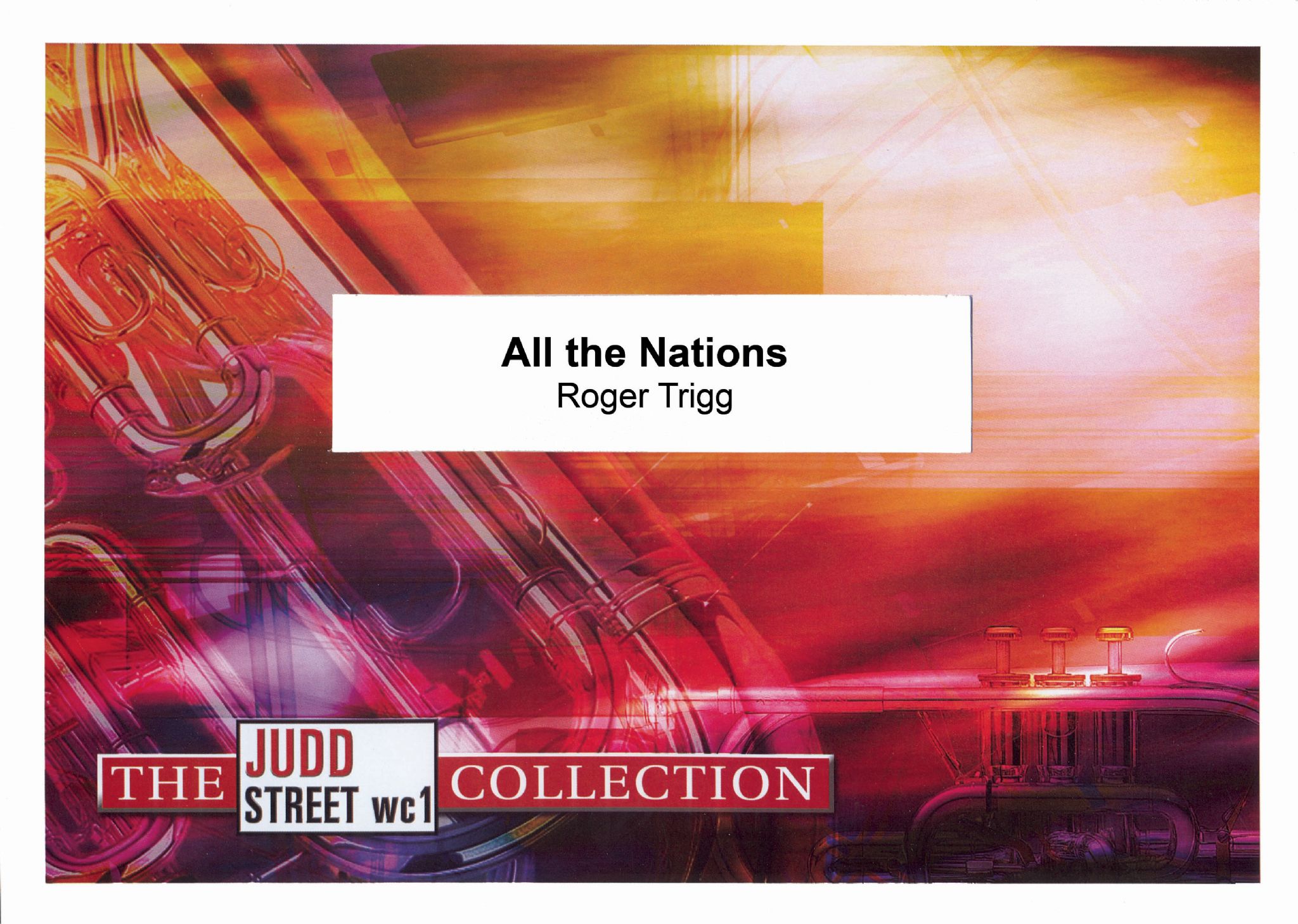
Judd: All the Nations
September 2017 ReleaseAll the Nations (Roger Trigg)Originally written for the Melbourne Staff Band 125th Anniversary, the central theme of the music is from Psalm 86 verse 9. The tune is derived from 'Lobe den herren' before a setting of the tune 'St Peter' in a more reflective manner is presented. An invitation to worship as a group of Gods people is presented in the contemporary song 'Come, now is the time to worship' before the original material is presented and the tune 'St Peter' is heard in a full, exciting conclusion.
Estimated dispatch 7-14 working days
-
 £24.95
The M-lisada March - Jim Trott
All proceeds from "The M-lisada March" are donated to Brass for Africa, a charity making a positive change to the lives of disadvantaged children and young people in Africa through brass music and brass music education. The composer, Jim Trott, is the founder of a charity called Brass for Africa and one of the organizations the charity supports and works with is the MLISADA organization located in the slums of Kampala, Uganda. MLISADA is a home for ex-street kids, orphans and vulnerable children and at the heart of the home is music and dance. MLISADA have a junior and senior brass band and the bands earn income to feed the home by playing at functions and marches. Jim has often been with the band as they work up anthems and themes for their various engagements and he thought it would be great for MLISADA to have their own theme. So, he has written this short March for these inspiring young people and is delighted that they love to play it whenever they can.
Estimated dispatch 5-14 working days
-
 £76.99
The Shopping Centre - William Vean
Many people when asked the question 'Do you have any hobbies?' will answer 'Shopping' (even though the female part of the population may be more interested in this than the male one). Of course it is great fun to walk about in a Shopping Mall, browsing in various small shops, looking for things you have always wanted to possess. This was what William Vean was doing one day when he came across the idea to write a composition in which several shops could try to sell their wares (and this idea didn't cost him a penny). First, the audience are taken to a 'Jeans store', then a 'Phone shop' is visited, after which a visit is made to a 'Perfumery'. Thefourth part depicts a profession which is practised in several premises, namely that of shoplifter. In the fifth part there is room for a bite to eat at a Chinese restaurant, and finally after a visit to the hairdresser's it's time to go home.
Estimated dispatch 5-14 working days
-
 £84.99
Voyage with the VOC - William Vean
The Netherlands have been an important trading nation for a long time partly as a result of their geographical situation. One of the first multinationals in The Netherlands was the 'Verenigde Oostindische Compagnie' (VOC). The aim of the VOC was to send ships to Asia in order to buy pepper and spices, and to take over the Portuguese monopoly in this field. The Company was successful. An era of great prosperity resulted, in which the art of painting (Rembrandt van Rijn) as well as science (Constantijn Huygens) flourished alongside a thriving economy. 1. The Sails are set : There is a lot of hustle and bustle on the quay. The crew are preparing fordeparture. Goodbyes are said and once the sails have been hoisted the ship sets out to sea.2. A Visit to the Rajah of Yogyakarta: After a voyage of many months the place of destination is reached. A visit to the Radja, the king of the area around Yokyakarta, follows. The dishes and beverages and the native culture in general are very pleasant after having been on a diet of ship's biscuit and water for such a long time.3. The Holds have been loaded: The holds have been loaded to the brim, and the voyage home can be begin!4. Death sails along: Life at sea is rough. not seldom did a sailor die of a tropical disease or scurvy. After a memorial service, the Captain would speak the words 'One, two, three, in God's name ...' and the body, wrapped in canvas, would be committed to the sea.5. A joyful homecoming: After many months of hardship coming home is perhaps the best part of the entire voyage. The quay is filled with people eager to give the crew a warm welcome.
Estimated dispatch 5-14 working days
-
 £104.99
Lake of the Moon - Kevin Houben
The travels of the Aztec people as they headed south through North America looking for a new home, acted as the inspiration for Lake of the Moon.The composition contains small fragments of Oriental music and South American rhythms and occasionally, Russian Cossacks seem to raise their heads. The journey from North to South is not without danger, which is represented by threatening sounds within the music.In the Adagio divotothe composer takes us along to the Texcoco Lake, which the Aztecs called the lake of the moon. Bring a little bit of South American history to your concert with Lake of the Moon.
Estimated dispatch 5-14 working days
-
 £64.40
The Master Plan! - Dean Jones
We all have a purpose...whether those are found in daily routines or much larger parts of our lives. Having a plan or a goal is a great way we can measure our success. Here's a small piece of music that explores 3 such elements:Covert Mission - a militaristic theme where the music conveys action and drama.Finding Someone - at some point, we share our lives with people who are special to us. The music has a more lyrical feel to help illustrate affection.Life Goals! - the strong rhythmic pattern to this section is the undertone for portraying a a sense of focus. We need to match desire with action when attempting something new - the sense of excitement and hope will need to be drawn from the music to convey this message.The music tells a compelling story of purpose, hope and passion....in the words of Col. Hannibal Smith from the A-Team, "I love it when a plan comes together!"
Estimated dispatch 5-14 working days
-
 £109.99
The Power of the Megatsunami - Carl Wittrock
The word 'tsunami' is of Japanese origin. When you look it up in a dictionary, you will find that it means 'a great sea wave produced by submarine earth movement or volcanic eruption'. A megatsunami is the superlative of this awesome expressionof power that nature can create, and has catastrophic consequences. When Carl Wittrock completed this composition not many such big earth movements had occurred, but since then we have become all too familiar with the disastrousconsequences which a tsunami may have. On the 26th of December 2004 a heavy seaquake took place near the Indonesian island of Sumatra. Tidal waves 10 meters in height ravaged the coastal regions of many countries for miles around. The tsunamitook the lives of thousands of people and destroyed many villages and towns. There are more areas which run the risk of being struck by a tsunami, such as the island of La Palma, one of the Canary Islands. This island is based on oceaniccrust at a fracture zone and as such is one of nature's time bombs. The consequences of a natural calamity like a megatsunami are immense. In the case of La Palma, the tidal wave will move in the direction of South America, where it may reach 50km inland, destroying everything on its way. In his composition Wittrock describes an ordinary day which will have an unexpected ending. Right from the beginning there seems to be something in the air, the music creating an oppressiveatmosphere of impending disaster. Themes are interrupted, broken off suddenly, followed by silence, suggesting the calm before the storm. Suddenly a short climax (glissandi in the trombone part) indicates the seaquake, and the megatsunami isa fact. Hereafter follows a turbulent passage symbolising the huge rolling waves. After nature's force has spent itself, resignation sets in and the composition ends with a majestic ode to nature.
Estimated dispatch 5-14 working days
 View Music