
Results
-
 £45.00
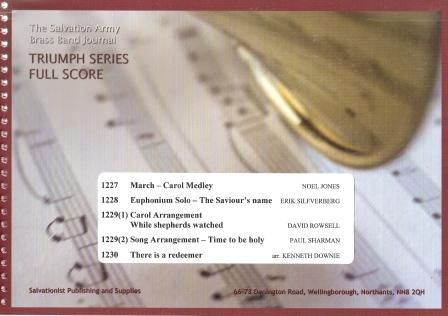
Triumph Series Band Journal July 2012 Numbers 1227 - 1230
No. 1227 March - Carol Medley (Noel Jones)This march features three carols, 'God rest ye merry, gentlemen', Hark! The herald angels sing' and 'Deck the Hall' together with brief references to others in a medley form. A couple of these references are somewhat camoflaged which provides further interest.No. 1228 Euphonium Solo - The Saviour's Name (Erik Silfverberg)A setting of Jane Clarke's lovely melody set to familiar words, 'There is a name I love to hear'.No. 1229 (1) Carol Arrangement - While shepherds watched (David Rowsell)A four-verse setting of the 16th Century tune, 'Winchester Old' commonly associated with the carol, 'While shepherds watched their flocks by night'.No. 1229 (2) Song Arrangement - Time to be holy (Paul Sharman)This arrangement of George Cole Stebbins' tune was originally made for the 2010 World Youth Convention in Sweden, the theme of which was 'Time to be holy'.No. 1230 There is a redeemer (Kenneth Downie)Melody Green-Sievright's popular song, 'There is a redeemer' was first published in 1982, 30 years before the appearance of this new setting.
Estimated dispatch 7-14 working days
-
 £54.95
Wall of Sound (Brass Band - Score and Parts)
This piece was commissioned by Dr Nicholas Childs and Philip Biggs for the National Children's Band of Great Britain.As the commission was for a youth band, I wanted to compose a piece of music that alluded to the styles and genres of music that are abundant in the current popular music market. However, the National Children's Band isn't just any old youth band; they are some of the finest young musicians in Great Britain. So the challenge was to compose a piece that included many popular music styles whilst providing enough of a test to keep the music technically interesting to work on and perform.The driving force behind the whole piece is the percussion section and in particular, the drum kit which is constant throughout. From the start the music is rhythmic and repetitive, similar to many dance tracks. The music begins to slowly unfold and build in texture and at bar 24 the syncopated main theme appears. This theme reappears throughout the piece along with various other motifs and solo lines. The music uses the styles, rock, pop, latin, funk and dance within the score and has a real fun factor about it.There are lots of opportunities for soloists to play and it is marked in the score where to stand and soloists can come out to the front of the stage. I really enjoyed working on this piece and I'm sure performers and audience members will enjoy it too.Paul Lovatt-Cooper
Estimated dispatch 7-14 working days
-
 £30.00
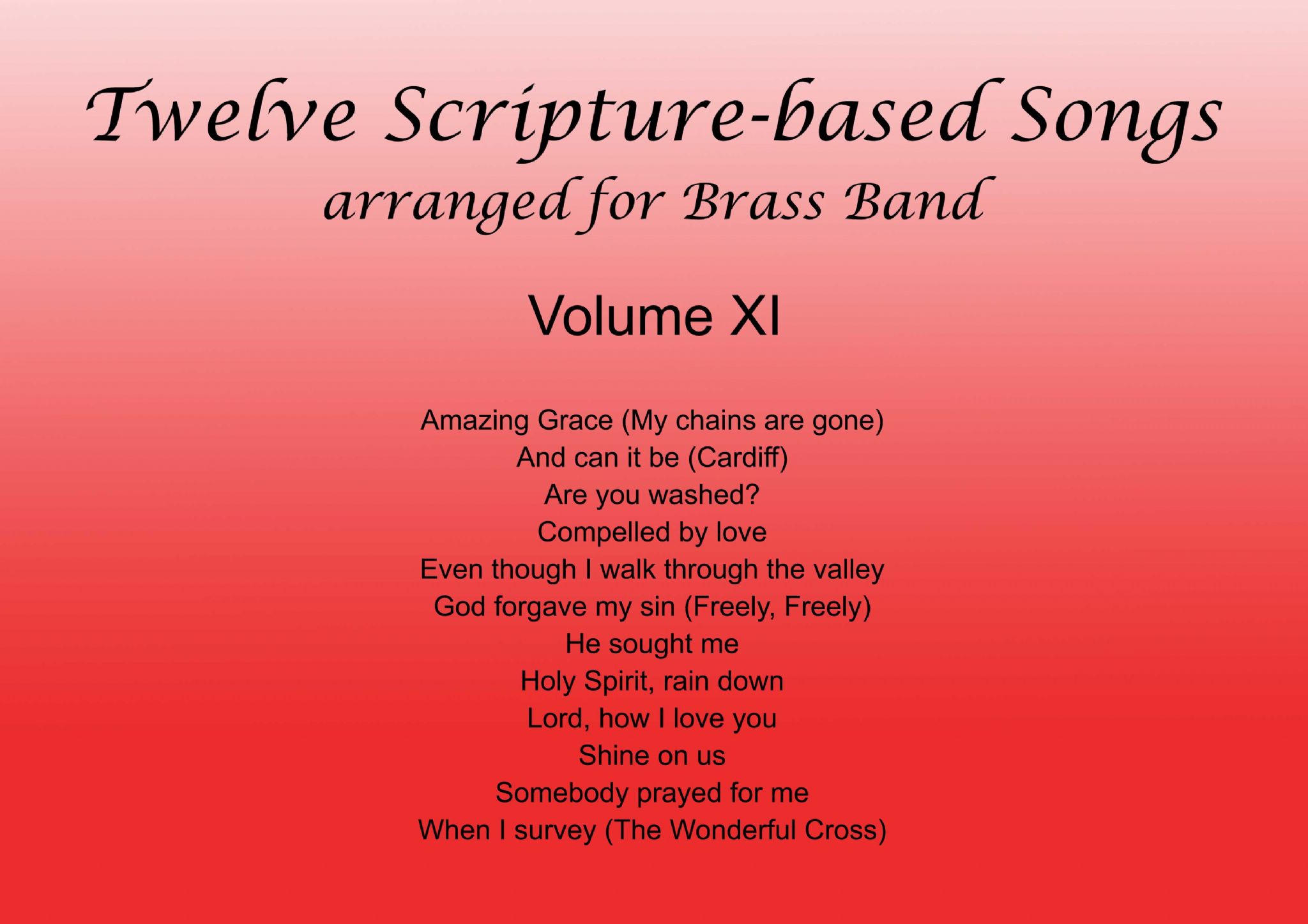
Twelve Scripture-Based Songs Volume XI
Twelve scripture-Based Songs arranged for Brass Band (Volume XI) are packaged and marketed in complete sets which include a full score and a set of master parts. It is intended that these parts be used as 'masters', for the purpose of photocopying a quantity of parts to accommodate the precise instrumentation needs of the band for which this has been purchased.Amazing Grace (My chains are gone)And can it be (Cardiff)Are you washed?Compelled by loveEven though I walk through the valleyGod forgave my sin (Freely, Freely)He sought meHoly Spirit, rain downLord, how I love youShine on usSomebody prayed for meWhen I survey (The Wonderful Cross)
Estimated dispatch 7-14 working days
-
 £30.00
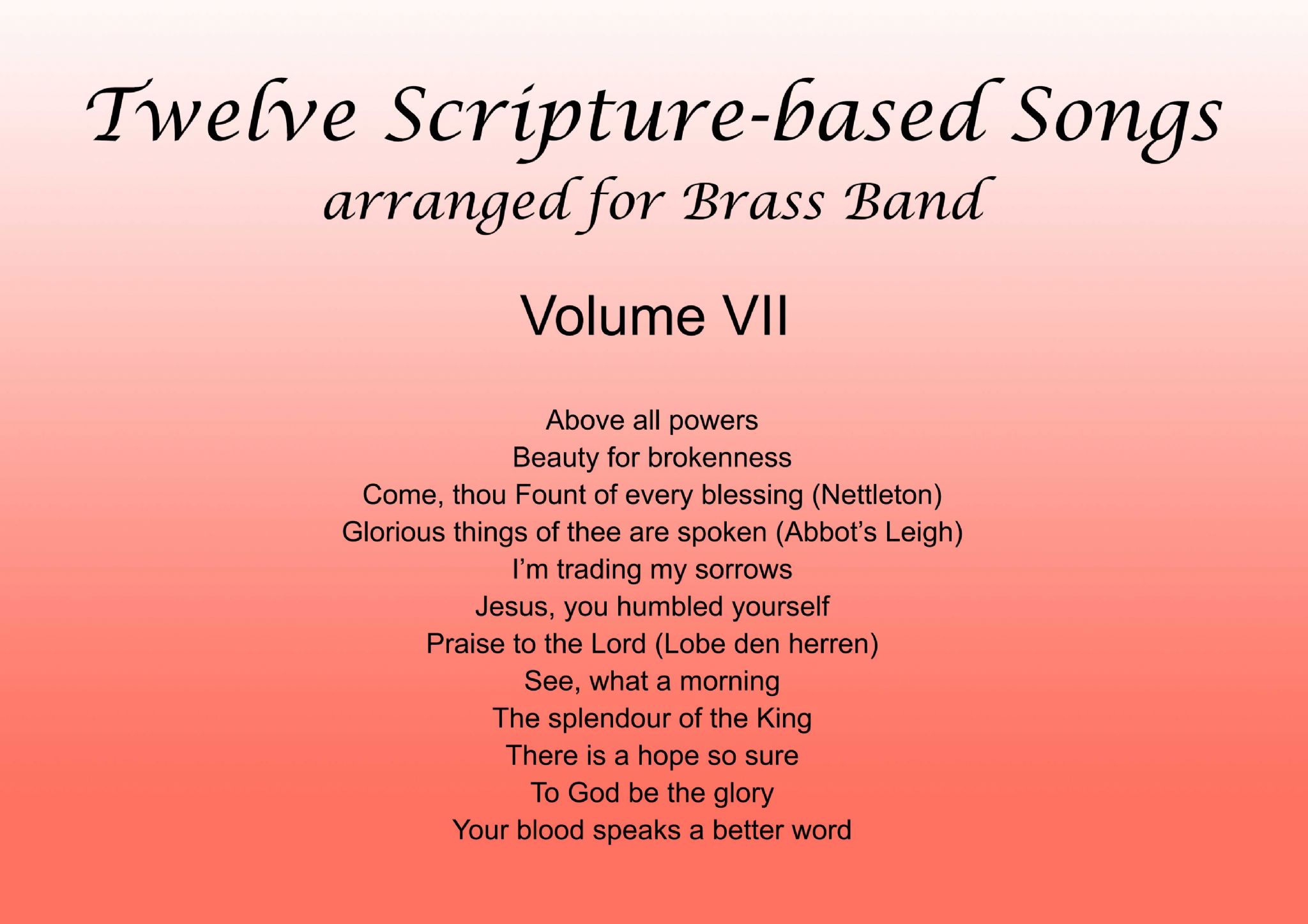
Twelve Scripture-Based Songs Volume VII
Twelve scripture-Based Songs arranged for Brass Band (Volume VII) are packaged and marketed in complete sets which include a full score and a set of master parts. It is intended that these parts be used as 'masters', for the purpose of photocopying a quantity of parts to accommodate the precise instrumentation needs of the band for which this has been purchased.Above all powersBeauty for brokennessCome, thou Fount of every blessing (Nettleton)Glorious things of thee are spoken (Abbot's Leigh)I'm trading my sorrowsJesus, you humbled yourselfPraise to the Lord (Lobe den herren)See, what a morningThe splendour of the KingThere is a hope so sureTo God be the gloryYour blood speaks a better word
Estimated dispatch 7-14 working days
-
 £30.00
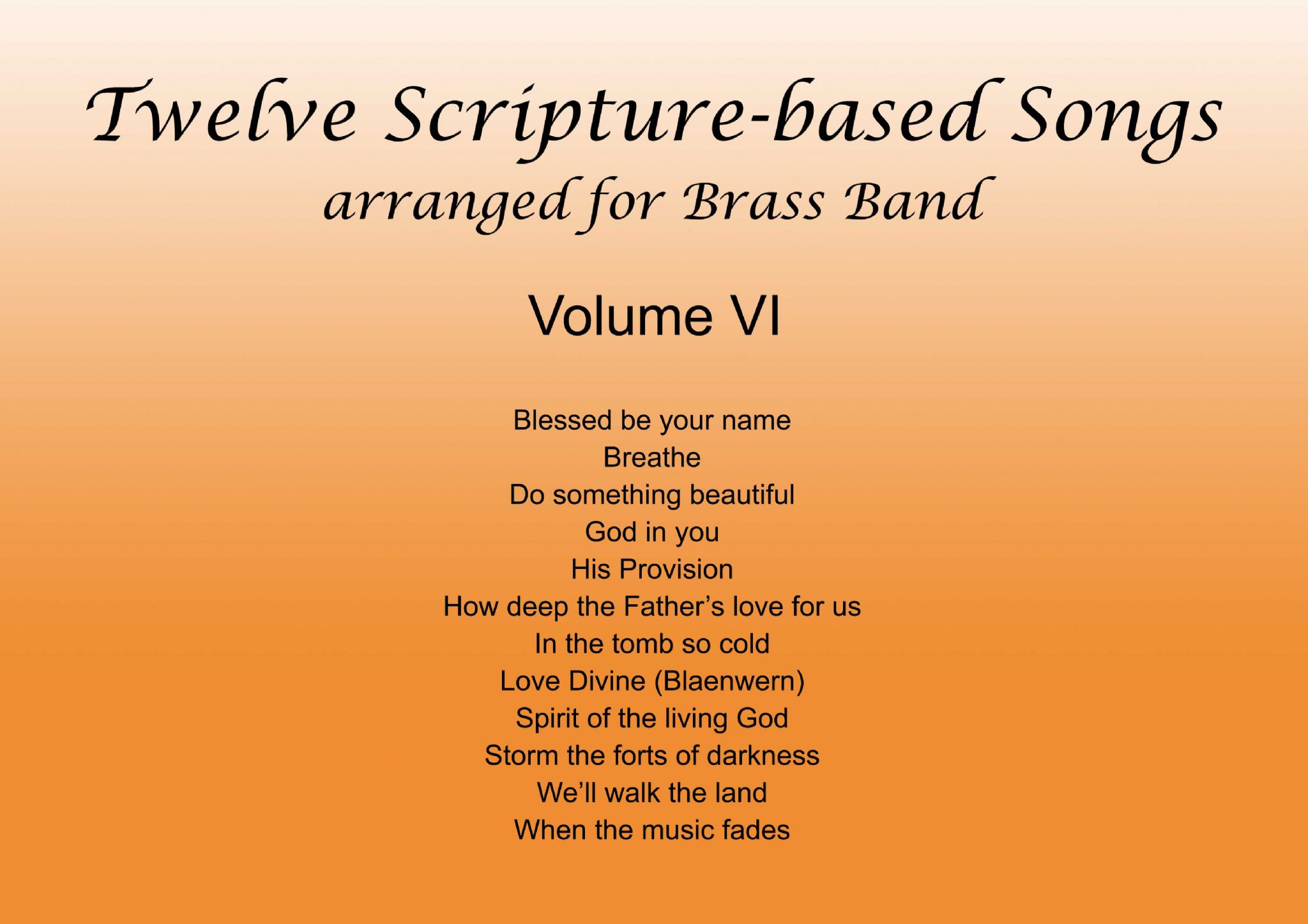
Twelve Scripture-Based Songs Volume VI
Twelve scripture-Based Songs arranged for Brass Band (Volume VI) are packaged and marketed in complete sets which include a full score and a set of master parts. It is intended that these parts be used as 'masters', for the purpose of photocopying a quantity of parts to accommodate the precise instrumentation needs of the band for which this has been purchased.Blessed be your nameBreatheDo something beautifulGod in youHis ProvisionHow deep the Father's love for usIn the tomb so coldLove Divine (Blaenwern)Spirit of the living GodStorm the forts of darknessWe'll walk the landWhen the music fades
Estimated dispatch 7-14 working days
-
 £30.00
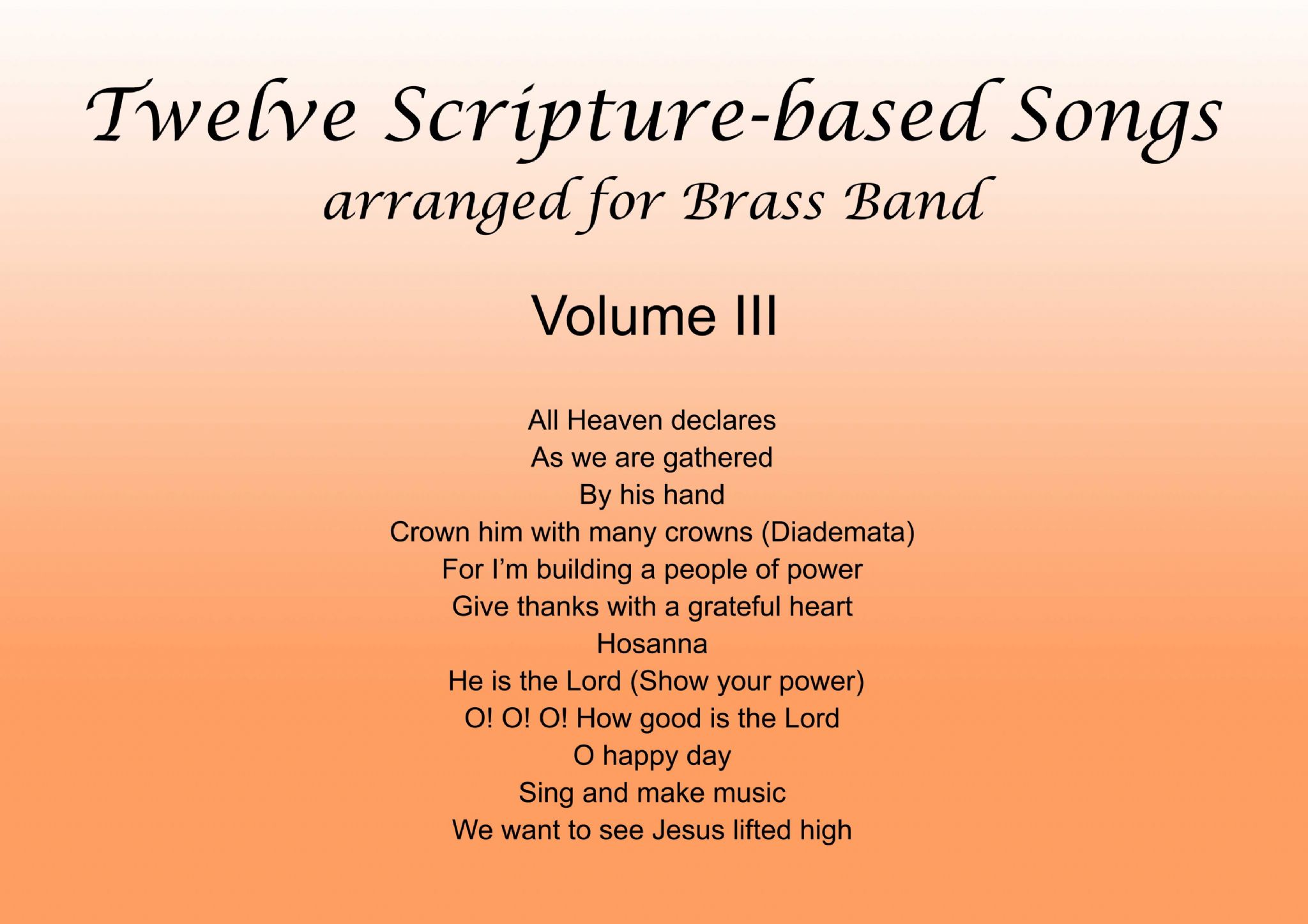
Twelve Scripture-Based Songs Volume III
Twelve scripture-Based Songs arranged for Brass Band (Volume III) are packaged and marketed in complete sets which include a full score and a set of master parts. It is intended that these parts be used as 'masters', for the purpose of photocopying a quantity of parts to accommodate the precise instrumentation needs of the band for which this has been purchased. All Heaven declaresAs we are gatheredBy his handCrown him with many crowns (Diademata)For I'm building a people of powerGive thanks with a grateful heartHosanna He is the Lord (Show your power)O! O! O! How good is the LordO happy daySing and make musicWe want to see Jesus lifted high
Estimated dispatch 7-14 working days
-
 £30.00
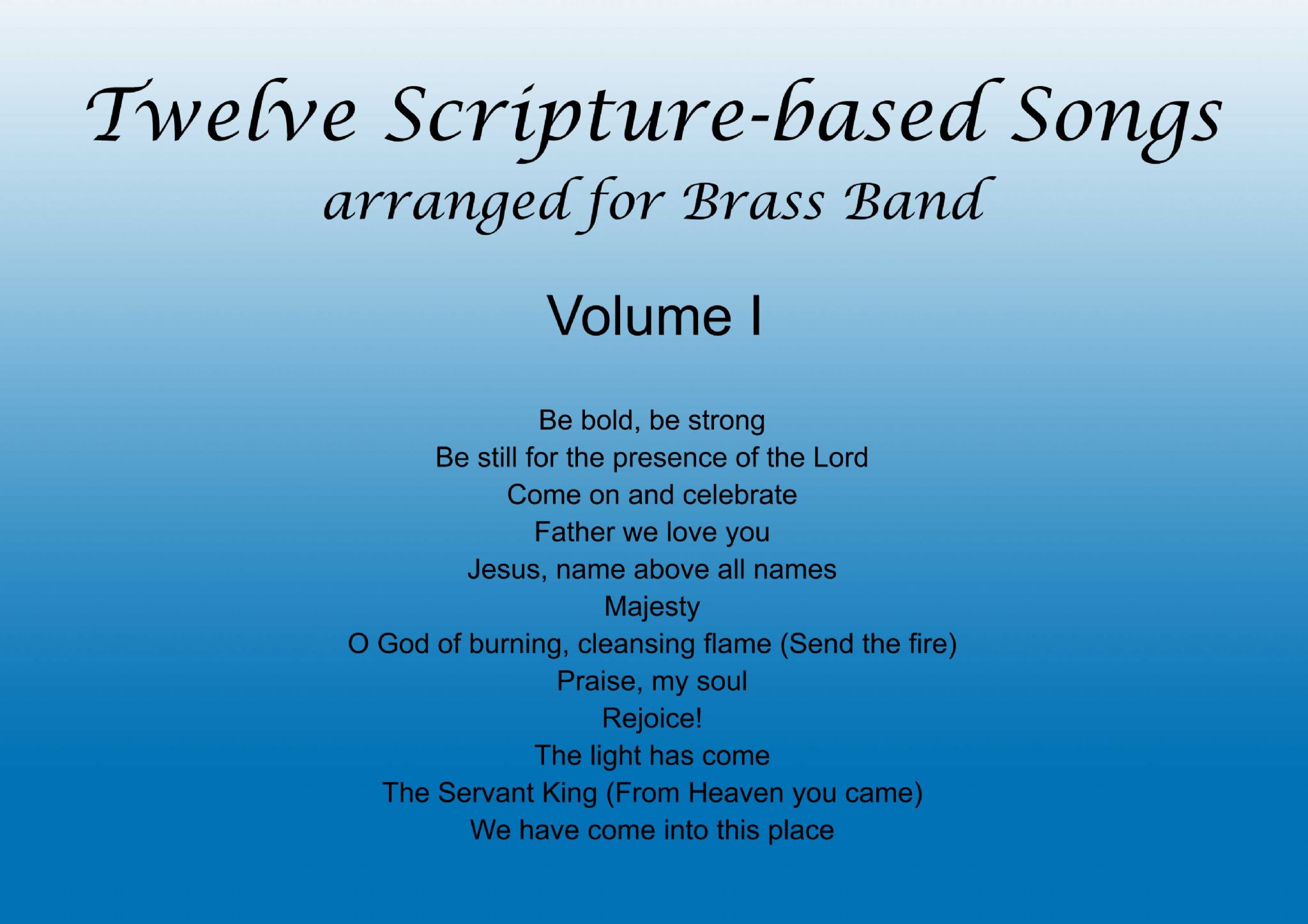
Twelve Scripture-Based Songs Volume I
Twelve scripture-Based Songs arranged for Brass Band (Volume I) are packaged and marketed in complete sets which include a full score and a set of master parts. It is intended that these parts be used as 'masters', for the purpose of photocopying a quantity of parts to accommodate the precise instrumentation needs of the band for which this has been purchased. Be bold, be strongBe still for the presence of the LordCome on and celebrateFather we love youJesus, name above all namesMajestyO God of burning, cleansing flame (Send the fire)Praise, my soulRejoice!The light has comeThe Servant King (From Heaven you came)We have come into this place
Estimated dispatch 7-14 working days
-
 £59.50
El Camino Real (A Latin Fantasy)
El Camino Real (literally "The Royal Road" or "The King's Highway") was commissioned by, and is dedicated to, the 581st Air Force Band (AFRES) and its Commander, Lt. Col. Ray E. Toler. Composed during the latter half of 1984 and completed in early '85, it bears the subtitle: "A Latin Fantasy."The music is based on a series of chord progressions common to countless generations of Spanish flamenco (and other) guitarists, whose fiery style and brilliant playing have captivated millions of music lovers throughout the world. These progressions and the resulting key relationships have become practically synonymous with what we feel to be the true Spanish idiom. Together with the folk melodies they have underscored, in part derived by a procedure known to musicians as the "melodizing of harmony," they have created a vast body of what most people would consider authentic Spanish music.The first section of the music is based upon the dance form known as the Jota, while the second, contrasting section is derived from the Fandango, but here altered considerably in both time and tempo from its usual form. Overall, the music follows a traditional three-part pattern: fast-slow-fast.The first public performance of El Camino Real took place on April 15th, 1985 in Sarasota, Florida, with the 581st Air Force Band under the direction of Lt. Col. Ray E. Toler.This arrangement for brass band has been made by Frode Rydland.
Estimated dispatch 7-14 working days
-
 £19.50
El Camino Real (Score Only)
El Camino Real (literally "The Royal Road" or "The King's Highway") was commissioned by, and is dedicated to, the 581st Air Force Band (AFRES) and its Commander, Lt. Col. Ray E. Toler. Composed during the latter half of 1984 and completed in early '85, it bears the subtitle: "A Latin Fantasy."The music is based on a series of chord progressions common to countless generations of Spanish flamenco (and other) guitarists, whose fiery style and brilliant playing have captivated millions of music lovers throughout the world. These progressions and the resulting key relationships have become practically synonymous with what we feel to be the true Spanish idiom. Together with the folk melodies they have underscored, in part derived by a procedure known to musicians as the "melodizing of harmony," they have created a vast body of what most people would consider authentic Spanish music.The first section of the music is based upon the dance form known as the Jota, while the second, contrasting section is derived from the Fandango, but here altered considerably in both time and tempo from its usual form. Overall, the music follows a traditional three-part pattern: fast-slow-fast.The first public performance of El Camino Real took place on April 15th, 1985 in Sarasota, Florida, with the 581st Air Force Band under the direction of Lt. Col. Ray E. Toler.This arrangement for brass band has been made by Frode Rydland.
Estimated dispatch 7-14 working days
-
 £44.95
Funk Engine (Brass Band - Score and Parts)
'Funk Engine' was commissioned by Brass Bands England for the 2016 National Youth Brass Band Championships of Great Britain. What Ryan says about the piece:"When I was commissioned to write a piece for the Championships I decided that I wanted to create something a bit different to standard brass band repertoire. I decided that the best way to do this was to go a bit out of my comfort zone and explore some styles of music that I have yet to experiment with. I have always been a great lover of jazz, funk and big band music and the sounds associated with them. In 'Funk Engine' I have tried to capture some of these sounds, however I am a brass-bander at heart and as such I've tried to create a fusion of styles that hopefully combines the best of brass band and jazz into one piece.'Funk Engine' runs continuously, but is divided into three broad sections - fast, slow, fast. The opening is in driving big band style, which segues into a smoother lyrical section; the pace then picks up into a jazz inspired scherzo. After a delicate transition from the basses and trombones the euphonium plays a soaring scale - bringing us into the central movement - which begins with a series of languid solos before descending into a darker interlude. A flugel solo lightens the mood and the music gains momentum leading into a brief cornet chorale before a euphonium solo leads into a percussive climactic passage for full band. As this section winds down to settle on an open fifth, the Hi-hat and Bass section punctuate the texture with the first notes of the final section."The final section of the piece is in similar big band style to the opening and develops material from the first two movements. The percussion feature heavily at this stage and the tension builds towards a final statement, with the piece concluding with a bang!"
Estimated dispatch 7-14 working days