
Results
-
 £50.90
WILD MOUNTAIN THYME (Flugel Horn Solo with Brass Band) - Fernie, Alan
Traditional Scottish Air. Grade: Medium.
Estimated dispatch 7-14 working days
-
 £80.00
St. Magnus - Kenneth Downie
Dedicated to Alastair Massey, an inspirational music teacher. Commissioned by the Scottish Brass Band Association for the 2004 European Brass Band Championships in Glasgow. This music is a set of variations on the tune known as St Magnus, which is attributed to Jeremiah Clarke. Most people will associate it with Thomas Kelly's hymn which begins: "The Head that once was crowned with thorns is crowned with glory now". The tune is very simple, consisting of just two, four-bar phrases. Neither is there much in the way of rhythmic variety, every note being a crotchet with the exception of two quavers, and the last note in each phrase. Within such a simple structure, however, lies considerable strength. THEME The listener is given the opportunity of hearing it twice, in full, at the beginning, starting with one player but soon taken up by the full ensemble. It returns in the middle of the music and is stated again near the end. This has been done quite deliberately in the hope that there will be an appreciation of what material is being developed, by the listener as well as by those with access to the score, who are able to see the visual connections. VARIATION 1 This takes the rhythm of the last part of the theme and also uses the shape of the opening as a recurring figure. The mood is whimsical and skittish, with short, teasing rhythmic figures tossed around the band, and quick interplay with percussion, at a fast tempo. An energetic flourish finishes this variation before the Andante espress. VARIATION 2 This commences with chords related to the opening of Variation 1. The cantabile on solo comets establishes a new, lyrical mood and there is scope for expressive playing in a series of short solo passages. The theme works its way unobtrusively into the texture before a reprise of the solo cornet melody and some more lyrical interchanges between Eb bass, euphonium, flugel horn and comets. The variation ends serenely with clear references to the last phrase of the theme. VARIATION 3 The first idea to dominate is clearly linked to the shape of the theme's first phrase. There is a frenetic feel to much of this variation, with considerable energy and instability created by extensive use of cross-rhythms. A thinning-out of the score marks a clear change to development of the start of the second phrase of the theme. This proves to be short-lived however, and the opening material returns leading to a restatement of the theme, "Maestoso," after which a euphonium cadenza links to Variation 4. VARIATION 4 Here we have some solos for euphonium, cornet, trombone and Eb bass set against a background of horns and baritones presenting a pensive statement of the theme's opening. VARIATION 5 This commences Allegro, with lively work for cornet and euphonium spreading to the whole band before attention focuses on the beginning of the second phrase of the theme which is initially presented in diminution, then in regular rhythm, then in inversion. An increase in tempo coupled with a decrease in volume, requires dexterity and control, with several metrical challenges thrown in for good measure. The same fragment of phrase becomes an ostinato which generates a frenzied climax, punctuated by short, dramatic silence, before the opening figure returns and the music gradually winds down. The tubular bells herald the final return of the theme, in augmentation, marking the start of the Finale. FINALE This features the running semiquavers of the previous variation sounding in counterpoint. A fast, furious coda speeds the work to a conclusion while references to the opening of the theme are still trying to break into the texture of the music. Kenneth Downie
Estimated dispatch 5-14 working days
-
 £87.99
Moon Song, Sun Dance - Philip Sparke
Moon Song, Sun Dance was commissioned by Flugel Horn virtuoso, Claude Romailler, and premiered by him at the Swiss National Solo and Quartet Championships in April 2012. As the title implies, the work is in two contrasting movements, which can be performed separately or together.Moon Song opens with a flowing modal theme, which the soloist embellishes before the band takes centre stage. A central section brightens the mood with a new melody over the lightest of accompaniments; this is once again developed by the soloist until the original theme reappears, played by the band. This introduces a cadenza for the soloist which either closes the movement, or canbe extended to link directly to the second movement.Sun Dance is a vivace 6/8 scherzo which opens with a flourish from the band. The soloist then introduces the main theme, which in turn is taken up by the band. A short bridge passage heralds a change of key and a new melody from the soloist. A brief central interlude then introduces a change of meter and recalls the main melody of Moon Song, before a recapitulation leads to a florid coda, which brings the work to a close.
Estimated dispatch 5-14 working days
-
 £183.99
Perihelion: Closer to the Sun - Philip Sparke
Perihelion was commissioned by the Cory Band as their own-choice piece for the 2013 European Brass Band Championships, held in Oslo, Norway. Winning the set piece section of the contest and coming second to Eikanger-Bjorsvik Musikklag with their own choice selection, Cory went on to become European Champions for the fifth time.Cory MD Philip Harper had asked for a 'Concerto for Band' to fully exploit his outstanding band of virtuosi, and composer Philip Sparke created a one-movement work with contiguous sections, first featuring horns and flugel, then trombones followed by cornets and a slower central section for percussion and baritones, euphonium andbasses.The piece is abstract in nature, without a specific programme, and the title merely reflects the fact that the piece was begun on January 2nd 2013, the day of Earth's perihelion - the point in its orbit when it is closest to the sun. It could also be argued that the piece weaves between moments of brilliant optimism and dark shadow, both of which can be the result of bright sunshine.
Estimated dispatch 5-14 working days
-
 £154.99
A Road Less Travelled By - Philip Sparke
A Road Less Travelled By was commissioned by Palangos Orkestras for the Championship Section of the 2020 European Brass Band Championships held in Palanga, Lithuania. The title alludes to a poem by American author, Robert Frost, which appeared in his 1916 collection, Mountain Intervals. In common with most of the composer's larger works, the piece is not programmatic, but purely abstract. The choice of title shares Sparke's view of how composers can often develop. There can be no 'destination' in a composer's career, but rather a continuing journey to an unknown place. Set in three movements, which play without a break, A Road Less Travelled By opens with a Moto Perpetuo firmly rooted in classical language, form and syntax. A continuous river of semiquavers, veering from melody to accompaniment and back again, adds drive, energy and motion. The second movement, Nocturne, is in the form of a free fantasia; solos for vibraphone, flugel horn and euphonium set the stage for a central cornet solo, quietly echoed by the full band. A triumphal climax is reached before the movement dissolves into a Scherzo Finale. A brief coda based on earlier material drives the piece to a close.
Estimated dispatch 5-14 working days
-
 £74.99
Dreamsong - Philip Sparke
Dreamsong was commissioned by Geir Ulseth and the Nidaros Brass Band from Trondheim, Norway. After a short introduction, the soloist introduces a rather nostalgic melody, accompanied by the lower brass parts. A fast central section is then played by the band, which leads to a climax. Eventually, the main melody played by the solo Cornet and Flugel Horn returns, overlaid with an ornamented counter-melody from the soloist, who then closes the piece with a short cadenza.
Estimated dispatch 5-14 working days
-
 £125.00
Dark Arteries - Gavin Higgins
Dark Arteries was commissioned by Rambert Dance Company and first performed in May 2015 with the Tredegar Town Band sharing the stage with Rambert dancers. Dark Arteries is a personal and at times highly wrought response to the Miners' Strike and its aftermath. It is in three movements, the first and last are expansive, with widely contrasting sound worlds, from dark, brooding melodies and the haunting sounds of solo flugel horn to wild syncopations on cornets, suggestive of an imposing, but often bleak mining landscape.In 2016 Higgins re-worked Dark Arteries into a virtuoso concert suite, which captures the essence of the work in three connected movements.Dark Arteries Suite was premiered by the National Youth Brass Band of Great Britain, conducted by Bramwell Tovey at the Barbican Centre, London, 22 April 2017.
Estimated dispatch 5-14 working days
-
 £125.00
As Swiftly As She Destroy, Trample - Gavin Higgins
Destroy, Trample, As Swiftly As She, was commissioned by the Tredegar Town Brass Band. This dramatic, virtuoso score contrasts episodes of visceral energy of pounding rhythms and wild flutter tonguing andbrassy angular themes with the ominous stillness of calmer moments suffused with the unique sound of four flugel horns. Brass Band Grade 6: Championship Duration: 18 minutes
Estimated dispatch 5-14 working days
-
 £49.99
Grant Us Peace - Etienne Crausaz
Composer Etienne Crausaz has created an attractive brass band orchestration of his own work Grant Us Peace, which was originally written for mixed choir. It offers various readings of a single phrase that is found at the end of the Agnus Dei: "Dona nobis pacem" (Grant Us Peace). This request is musically expressed in a manner which is by turns soft, naive, powerful, imploring and trustful. Two soloists (cornet and flugel horn) are highlighted in a short duet at the beginning of the piece. This music is conducive to contemplation and meditation, while also seeking to arouse emotions.
Estimated dispatch 5-14 working days
-
 £54.99
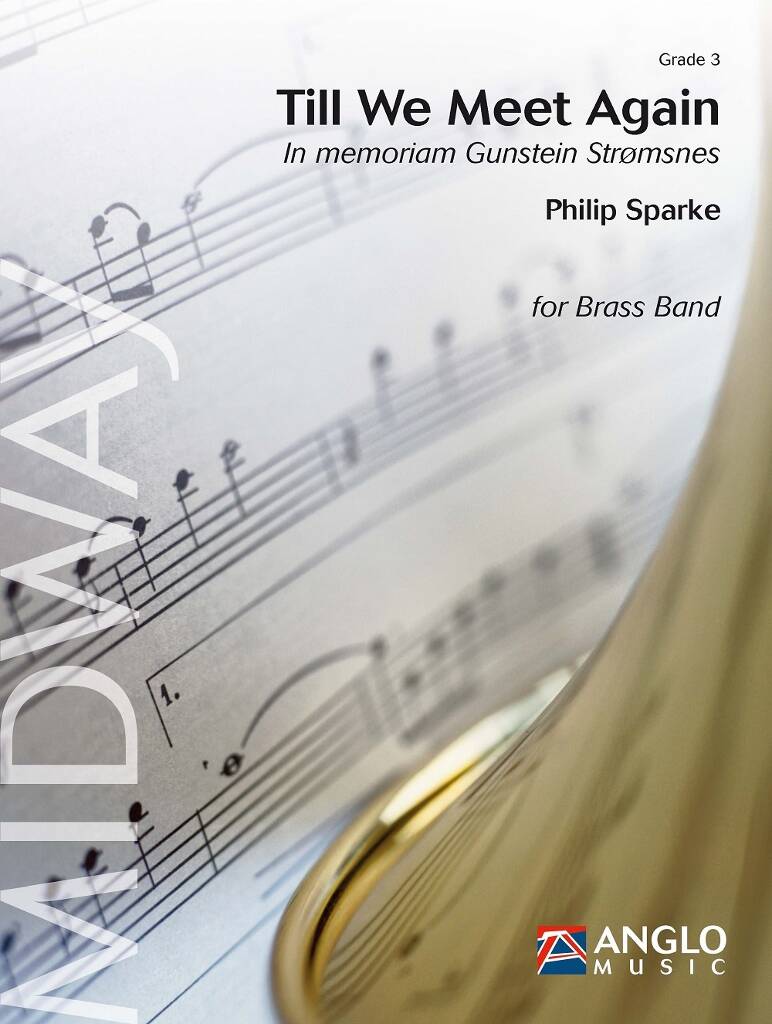
Till We Meet Again - Philip Sparke
Till We Meet Again was commissioned by Floraskulen Brassband, Floro, Norway, as a tribute to their former tuba player, Gunstein Stromsnes, who died tragically young in a traffic accident in 2017. They gave the premiere in December 2018. After a short introduction, a solo euphonium intones a modal, folk-like melody. This is taken up by the flugel horn and leads to a series of short solos which build to a majestic chorale for the full band. The mood subsides to reintroduce the modal melody before hints of the introduction and a short euphonium cadenza bring the work peacefully to a close.
Estimated dispatch 5-14 working days
 View Music