Results
-
£95.00
Torsion (Score & Parts) - Simon Dobson
Torsion was commissioned by the Leyland Band and first performed on 23 January 2010 at the Royal Northern College of Music Festival of Brass, Manchester, by Leyland Band conducted by Jason Katsikaris. This colourful and dynamic work is the most personal and ambitious that Simon Dobson composed during his residency with the Lancashire brass band. The dictionary defines torsion as the state of being twisted and the composer interprets this as the imagined dis-torsions and con-torsions of Time, Light and Sound in three contrasting movements. Simon Dobson fuses the traditional brass band sound with drive and energy of pop and funk jazz with optional digitally distorted 'echoes' providing added aural confusion at the points of climax. Although composed as a substantial concert work, Torsion would also make a challenging test-piece for contesting brass bands in the elite divisions.
In Stock: Estimated dispatch 1-3 working days
-
 £30.00
Apres un Reve - Euphonium & Brass Band Sheet Music Full Score & Parts - LM563
COMPOSER: Gabriel FaureARRANGER: Stuart J. RogersTrois melodiesis a set ofmelodiesfor solo voice and piano, byGabriel Faure.It consists of "Apres un reve" (Op. 7, No. 1), one of Faure's most popular vocal pieces,"Hymne" (Op. 7, No. 2), and "Barcarolle" (Op. 7, No. 3).The songs were written between 1870 and 1877, and published in 1878.They were not, however, originally conceived together as a set of three;theopus number7 was imposed on them retrospectively in the 1890s,almost 20 years after their first publications.In "Apres un Reve" (After a Dream),a dream of romantic flight with a lover,away from the earth and "towards the light", is described.However, upon awakening,the dreamer longs to return to the "mysterious night"and the ecstatic falsehood of his dream.LM563 - ISMN : 9790570005635
In Stock: Estimated dispatch 3-5 working days
-
 £69.00
Jodrell Bank - P. Yorke/J. B Ham
The title refers to the big radio telescope at Jodrell Bank in England. This composition is not exactly a symphonic poem, although it tries to give a musical portrait of eternity and infinity. 'Jodrell Bank' is a real classic of the brass band repertoire with its romantic style, its impressive climaxes alternating with quiet pauses and its sparkling finale. Peter York was above all a composer of film and theatre music and was very active in the world of entertainment and light music. Yet he had one musical hobby: composing for brass band even if he had no links at all with the brass band world. At first, he signed his brass band compositions with the pen name Ivor Gould but later used his own name. Among his most important compositions are The Shipbuilders Suite, Gallions Reach and Jodrell Bank.
Estimated dispatch 10-14 working days
-
 £64.95
Concertino for Euphonium - Rodney Newton
Concertino for solo euphonium and brass band was written in August 2004 for Robert Childs. The work is of a light nature and is in four movements, the last two joined by a cadenza for the solo euphonium. The first...
Estimated dispatch 5-7 working days
-
 £34.95
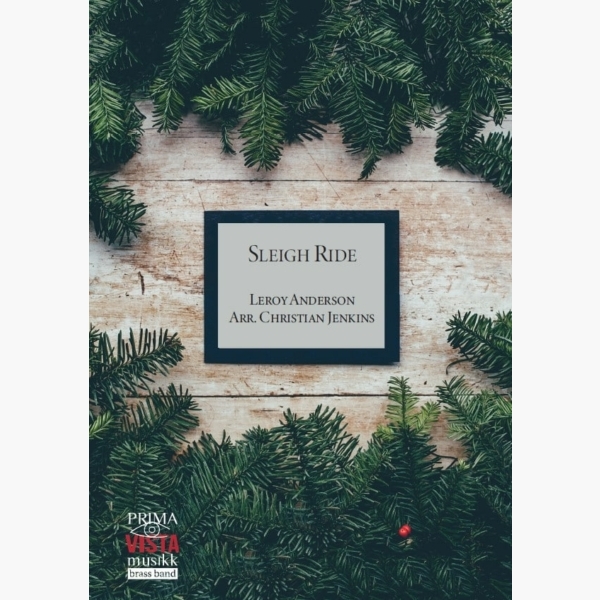
Sleigh Ride - Leroy Anderson - Christian Jenkins
Sleigh Ride was first conceived by composer Leroy Anderson during a heat wave in July 1946 and was completed in February 1948. Since its composition, it has become a standard of the light orchestral repertoire and is closely associated with...
Estimated dispatch 5-7 working days
-
 £42.00
Prisms (Score only) - Peter Graham
Dating from 1986 Prisms (Symphonic Study No. 2 for Brass band) was extensively revised in 1988 to form the preent work. Though not programmatic as such, the work has its roots in traditional brass band music, being strongly melodic and adopting a broad ternary form. The main themes call all be traced to the fourth-based first subject, these offshoots drawing a parallel with light refraction - Prisms. As well as the lyrical sections, much of the music is highly rhythmic, with a busy percussion section, and accesible and enjoyable to all. Duration: 13:00
Estimated dispatch 7-9 working days
-
 £52.00
Prisms (Parts only) - Peter Graham
Dating from 1986 Prisms (Symphonic Study No. 2 for Brass band) was extensively revised in 1988 to form the preent work. Though not programmatic as such, the work has its roots in traditional brass band music, being strongly melodic and adopting a broad ternary form. The main themes call all be traced to the fourth-based first subject, these offshoots drawing a parallel with light refraction - Prisms. As well as the lyrical sections, much of the music is highly rhythmic, with a busy percussion section, and accesible and enjoyable to all. Duration: 13:00
Estimated dispatch 7-9 working days
-
 £24.95
Lloyd (Brass Band - Score and Parts) - Howard, Cuthbert - Coles, Bramwell
The first presentation of the theme can be used for the purpose of accompanying congregational singing. At Section A the second presentation of the tune appears in the key of the dominant, the melody being given throughout to Solo Horn, with First Horn, First Trombone, Soprano and Flugel reinforcing the melody in the various phrases. Incidentally, see that the players do not break these phrases; it should be possible to take the four bars in one breath quite easily. Take due care of the light and shade which should be delicately applied. In the last bar the music gathers strength as we pass back into the original key for the last verse; pay particular attention to the part allotted to Second Baritone and Euphonium which needs to be slightly stressed. For the last appearance of the tune at Section B the full Band is used, apart from the third phrase which is given solo by Solo Comet with a light accompaniment above a bass pedal. Notice the rit. operating from the end of the eleventh bar and also the short swell effect on the fourth beat of the fourteenth bar.
Estimated dispatch 7-14 working days
-
£12.50
Lloyd (Brass Band - Score only) - Howard, Cuthbert - Coles, Bramwell
The first presentation of the theme can be used for the purpose of accompanying congregational singing. At Section A the second presentation of the tune appears in the key of the dominant, the melody being given throughout to Solo Horn, with First Horn, First Trombone, Soprano and Flugel reinforcing the melody in the various phrases. Incidentally, see that the players do not break these phrases; it should be possible to take the four bars in one breath quite easily. Take due care of the light and shade which should be delicately applied. In the last bar the music gathers strength as we pass back into the original key for the last verse; pay particular attention to the part allotted to Second Baritone and Euphonium which needs to be slightly stressed. For the last appearance of the tune at Section B the full Band is used, apart from the third phrase which is given solo by Solo Comet with a light accompaniment above a bass pedal. Notice the rit. operating from the end of the eleventh bar and also the short swell effect on the fourth beat of the fourteenth bar.
Estimated dispatch 7-14 working days
-
£89.95
TUBA CONCERTO (Gregson) (Tuba Solo with Brass Band - Score and Parts) - Gregson, Edward
This work was commissioned by the Besses o' th' Barn Band with funds provided by the Arts Council of Great Britain. It was written for, and is dedicated to, John Fletcher, who gave the first performance in Middleton Civic Hall, near Manchester, on 24 April, 1976, with Besses o' th' Barn Band conducted by the composer. Another interesting feature about the premire was that it was recorded by BBC Television for an Omnibus programme with Andr Previn as presenter. The concerto exists in four versions: with brass band (1976), orchestra (1978), wind band (1984) and piano reduction.The concerto is in three movements, following the usual, quick-slow-quick pattern: Allegro deciso,Lento e mesto, Allegro giocoso. The first movement has a sonata form shell with two contrasting themes, the first one being rhythmic in character, the second lyrical. There is a reference made in passing to the Vaughan Williams Tuba Concerto, but this merges into the other material in the development section.The second movement begins with a chorale, but after the entry of the tuba it leads to a cantabile theme, softly unfolded by the soloist. The opening chorale passage returns, this time briefly on muted brass, and leads to a middle section which is more chromatic in style and soon builds to a powerful climax, where the opening cantabile theme triumphantly returns. The music subsides, returning to the opening chorale and ending peacefully.The finale is light and breezy in style, and is cast in rondo form. After a brief introduction the tuba announces the main rondo theme, which is dance-like and a little jaunty. There are two episodes: the first a broad sweeping tune, the second a slowish waltz and a little jazz-like. After a virtuoso cadenza reference is made to the very opening of the concerto before the work ends with a triumphal flourish.The Tuba Concerto has established itself as one of the main works in the solo tuba repertoire. It has been performed and broadcast in over 40 countries all over the world. There are currently six commercial recordings of the concerto in its various versions.resolution in C major, pointed by a simple but expansive melody towards which the piece has been heading, and ending in a blaze of joyful colour.Duration: 18 mins
Estimated dispatch 7-14 working days