
Results
-
 £3.95
£3.95On the Face! (F Horn)
On the Face is a complete repertoire (warm-ups and 23 pieces) for beginner brass ensemble. Perfect material for school assemblies and music centres, it includes folk songs, famous classical themes, and exciting new jazz and pop numbers. Each piece is score for a basic trio of two trumpets/cornets and one trombone/euphonium (TC or BC). However, optional independent parts can also be added for horn in E flat or F; high trombone or euphonium (tenor part); tuba; and drum kit. The pieces work equally well either with one player to a part, or in larger group settings. With its appealing variety of musical styles and textures, On the Face is sure to make the young brass player's first experience of group playing both rewarding and fun.
Estimated dispatch 7-14 working days
-
£40.00
Don't Stop Me Now - Mercury, F - Harper, P
This prize-winning arrangement of the Queen track from the 1978 album Jazz begins with a deliciously harmonized flugel solo before exploding into life. The song is one of Queen's most popular and, with Philip Harper's usual recipe of no nonsense scoring with added showmanship, is guaranteed to bring the house down at any concert.3rd section +Listen here - Courtesy of Cory Band
In Stock: Estimated dispatch 1-3 working days
-
£50.00
Tribute to Kenton - Glorieux, F - Stobart, J
Stan Kenton was known as one of the most innovative and ground-breaking bandleaders of the 20th Century. This original composition from 1984 is a dynamic pastiche of Kenton's work and features many impressive 'jazz-break' solos, fresh harmonies, and toe-tapping but complex rhythms. Definitely an eye-opener!Championship sectionDuration 8 mins
In Stock: Estimated dispatch 1-3 working days
-
 £150.00
Brass Quintet Collection - Various - Lawrence Killian
20 Titles for Brass Quintet with Optional AugmentationFeaturing stylish arrangements using a flexible format for a minimum of five brass players, this set of music for small ensemble covers a wide range of composers and styles. The collection includes music by Purcell, Bach, Verdi, Gounod, Sousa, Joplin, Botsford, Elgar, Gershwin, and others.Using a unique approach to the scoring, the basic setup is for five players: two cornets/ trumpets, one horn, one trombone, and one bass tuba. Two optional "augment" players can be added using the "flugelhorn", and/ or the "Euphonium" parts. Further expansion of the ensemble is possible by adding multiple players to each part.Twelve parts are provided in total: 1st Bb Cornet, 2nd Bb Cornet, Eb Tenor Horn, French Horn in F, Bb Trombone or Baritone in treble clef, C Trombone in bass clef, EEb Bass, BBb Bass, C Tuba in bass clef, Bb Flugelhorn or Cornet (augment part 1), Bb Euphonium or Baritone (augment part 2), C Euphonium or Trombone in bass clef (augment part 2).A Full score is available seperately at a cost of �35.00. Please contact [email protected] to order. NOTE: Individual books are priced at �20.00 each. Please email [email protected] to order individual books. Videos of these works being performed are available below:- Asturias (Leyenda) from Suite Espanola No.1, Isaac AlbenizBerceuse from "Jocelyn", Benjamin Godard TITLES INCLUDED:- 1. Asturias (Leyenda) from Suite Espanola No.1, Isaac Albeniz 2. Bist du bei mir (Be Thou with Me), J. S. Bach3. Chatterbox Rag, George Botsford4. Grizzly Bear Rag, George Botsford5. Jubilee Fantasy on God Save the King, Bernhard Brahmig 6. Chanson de Matin, Sir Edward Elgar 7. Pomp and Circumstance March No. 4, Sir Edward Elgar 8. But Not For Me, George Gershwin 9. By Strauss, George Gershwin10. They All Laughed, George Gershwin11. Berceuse from "Jocelyn", Benjamin Godard12. JUDEX - from "Mors et Vita", Charles Gounod 13. The Entertainer (Rag), Scott Joplin14. Intermezzo No.2, Vasily Sergeyevich Kalinnikov 15. Berliner Luft, Paul Lincke 16. Sound the Trumpet, from "Come Ye Sons of Art", Henry Purcell 17. Gymnopedie No.1, Erik Satie 18. The Liberty Bell March, John Philip Sousa 19. Tritsch-Tratsch Polka, Johann Strauss II 20. Grand March from the opera Aida, Giuseppe Verdi
In Stock: Estimated dispatch 1-3 working days
-
£37.50
Brass Monkey's Occasions - Gavin Somerset
Never be caught out again on a concert with this selection that caters for just about every occasion. Your training band will be prepared to perform anything from a Fanfare to the National Anthem and even 'He's A Jolly Good Fellow'. The music included in this publication is used all over the world, all year around. "Land Of Hope & Glory" is also included, in the same key as the popular senior band arrangement (by J. Ord Hume) so your training band can join in with the senor band in a proms concert finale. This release puts well-known, often requested tunes in one publication letting your training band shine, whatever the occasion. Music included isaAFANFARENATIONAL ANTHEM (God Save The Queen/King)ROYAL NAVY HYMN (Melita)HARVEST HYMN (St. George's Windsor)ONWARD CHRISTIAN SOLDIERS (St. Gertrude)DANNY BOY (Londonderry Air)HE'S A JOLLY GOOD FELLOWF.A. CUP THEME (Eventide)LAND OF HOPE & GLORY (Pomp & Circumstance March No.1)
In Stock: Estimated dispatch 1-3 working days
-
£37.50
Polish Adventures - Gavin Somerset
Composed for the All Saints Wind Band, Sheffield after their trip to Poland in the summer of 2003. This work reflects the different parts of the tour in four continuous movements... PROGRAM NOTES AS THEY APPREAR ON SCORE COVER I don't wish to ramble on with the program notes, do I do believe that if you know the story behind a piece of music, it just puts that extra something into the players performance. In 2002, the All Saints Wind Band, Sheffield, embarked on a 10 day tour of Poland. The group spent 28hrs on a couch packed with instruments, only to arrive finding Poland experiencing its worst summer in 70 years. In 2003, they decided to go back for another go! This time, luxury all the way, no 28hr coach journey, just a 1 1/2hr flight. This piece tells the story of the 2nd tour of Poland in four continuous movements... First the introduction. Early one morning, prepared for the drive to the airport, everyone tired, but excited. A day prior to this, some parents of the children set off in a van driving the instruments to the hotel, some 300 miles away. Bar 13 introduces the "Van" theme. Once arriving at the airport, the movements begin... 1. MORNING FLIGHT A very self explanatory part of the piece, and impressionist in its writing. Flying high over England and the channel, giving a sense of speed we were travelling at (compared to the poor lads in the van somewhere below us!) The Largo before F tells of the short coach journey to the hotel, and settling into what was our new home for 10 days. 2. IN THE STORM The weather was definitely an improvement on last year. So much so, that it became a regular event of the day to go and play rounders in a nearby field. This particular day however, with everyone concentrating hard on the game, it escaped everyone's attention that there was a very large storm creeping over the high mountain range near us. As the title of the movement suggests, the scene involved 25 of us running as fast as we could back to the hotel. Unfortunately, the heavy rain ran faster than us. 3. LAST MEMORIES As most of the people in the band were 18 this year, it was apparent that this would be their last event with the band. Many of the group had grown up together for the last 7 years and so, as the tour came to a close, there was a sense of sadness in the air, but everyone would always have the memories. 4. FINALE & HOME The van and the brave volunteers that went with it, set off the day before the rest of us flew home. This last movement reflect the whole tour, bringing back all the main themes from the different movements before arriving back at the school, just in time to see the van pull up. The "Van" theme makes its presence heard again towards the end. This piece was performed by the Wind Band at the leaving concert of many of the players in the band. I dedicate this piece to the band which is still functioning with new players, and to all those who took part on this tour.
In Stock: Estimated dispatch 1-3 working days
-
 £85.00
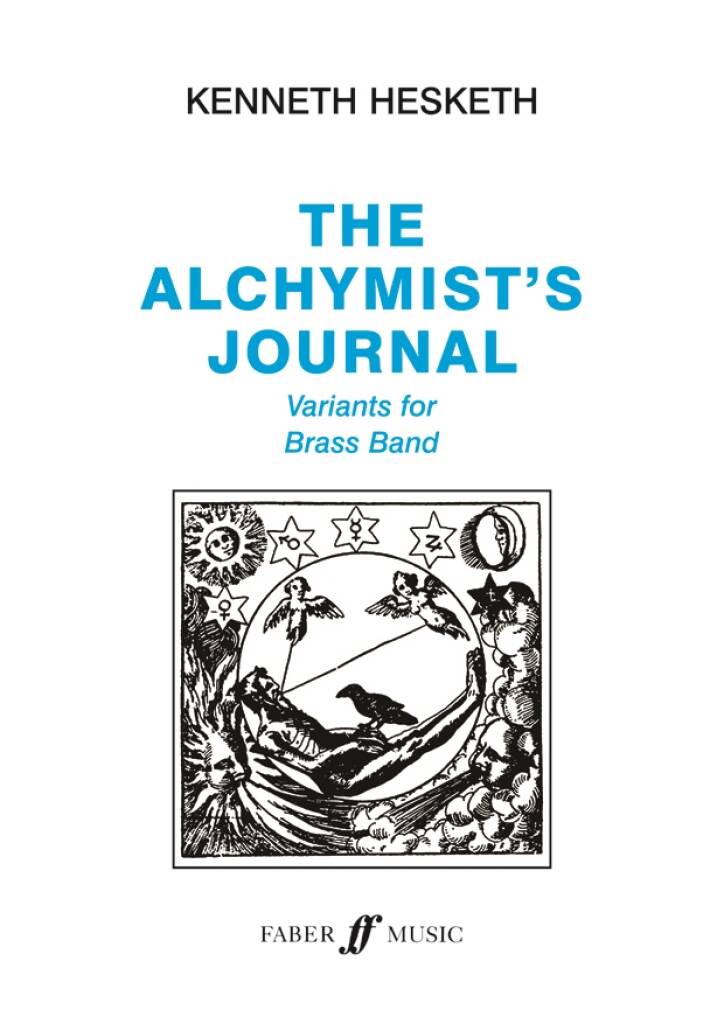
Alchymist's Journal. - Kenneth Hesketh
'The Alchymist's Journal' gets its title from the book of the same name by American author Evan S. Connell. The book fictionalises a number of famous Alchemist's writings, each one developing another's thoughts thuscontinuing one idea but changing it subtly to provide a new view point or way of thinking. This process is, in fact, alchemical as one idea transmutes into another. This idea is parallel to the processes at work within thesevariants. The whole work is constructed from 6 notes (C, A, B flat, E flat, F sharp, E) and is presented in nine different sections, each individual in mood but still based upon the original pitches. This is not a thematic setofvariations, as the themes are developed one at a time from small segments of the six notes. For example, the opening theme is the complete number of pitches, the second theme uses three notes transposed then repeated at theoriginal level, and so on. Harmonically, the six notes can be divided into two triads, A minor and E flat minor - each key beginning and ending the piece respectively. Whilst this is essentially abstract music with noprogramme there is an introduction, menacing scherzo, slow reflective section followed by a recap of the scherzo and final coda. 'The Alchymist's Journal' was commissioned by the Brass Band Heritage Trust at the suggestionof Paul Hindmarsh, to whom the work is dedicated.
Estimated dispatch 5-14 working days
-
 £115.60
Run Away - Hans Offerdal
This piece is about running away. First there is restlessness, then the escape begins. But what are we running away from? That is for you to find out!Playing time: appx. 4:30 To the conductor:There are challenges in the use of dynamics and rhythm. It is important that energy and pace is upheld all the way up until the next to last page. Dissonances are present several places, but the voice leading is diatonic within the given scale.The whole piece is based on one single scale: F melodic minor with lowered second degree. It is notated as a concert F major scale with two accidentals. Feel free to use it during warm-ups!
Estimated dispatch 5-14 working days
-
 £84.99
Christmas Brass - Richard Peaslee
Christmas Brass is a fantasy on six carols, originally commissioned by Mark Freeh for the Manhattan Brass Choir. Duration: 16:30The well-known tune, O Come, O Come Emmanuel, a hymn originally based on a plainsong melody, is here set in 5/4 meter. Modal harmonies are combined with big band style as the piece gains momentum, greatly accentuating the mood of the words, "Rejoice! Rejoice! Emmanuel." The opening 5/4 statement of the theme returns, and the piece ends quietly.In Beautiful Savior (also known by the title Fairest Lord Jesus), a hushed beginning featuring horns, euphoniums, and a muted trumpet, leads through a key change to a satisfying, chorale-likeclosing passage.In Away in a Manger, Peaslee sets two tunes, Cradle Song and Away in a Manger. Following a straightforward presentation of each melody, Peaslee plays them against one another. The music swells to a full climax followed by a hushed ending.Peaslee employs a gentle hand in It Came Upon a Midnight Clear, using flugelhorn solos and duets in a jazz-waltz style.In Silent Night, the traditional carol gets an untraditional harmonization, propelled forward by give-and-take between the two groups of brass instruments in the brass choir: trumpets and trombones versus horns, euphoniums, and tuba.Hark! The Herald Angels Sing begins with a humorous blast of discordant harmonies as multiple carols are sounded at the same time. An up-tempo 4/4 announcement of the melody in the trombone is followed by a metrical modulation in 6/8-3/4 time. An additional metrical modulation bring the music back into 4/4, but at a slower tempo and in a pronounced jazz style. Tempo I returns, and the set of six pieces closes with a big ending.Instrumentation: 4 Trumpets, 2 Horns in F, 4 Trombones, 2 Euphoniums, Tuba, Guitar, Bass, Percussion
Estimated dispatch 5-14 working days
-
 £33.62
Les Chasseresses from 'Sylvia' (Brass Band) Delibes arr. Rob Bushnell
Clement Philibert Leo Delibes was a French composer, best known for his ballets and operas, including works such as Lakme (with its famous "Flower Duet"), Coppelia and Sylvia (both key works in the development of modern ballet). The latter started as a play, Aminta, by the Italian poet Torquato Tasso, which Delibes set to music. It was then adapted for the Paris Opera with rehearsals starting in August 1875. The premiere took place on 14 June 1876 and was the first ballet to be shown at the newly-built Opera Garnier. Whilst the scenery and costumes were created by top artists and designers (Cheret and Lacoste), it was Delibes's music that shown thrown, being said to have saved the production, preventing the ballet from drifting into obscurity.Sylvia is said to be one of the first modern ballets, with Tchaikovsky remarking to composer Sergei Taneyev upon its ingenuity: "... the first ballet, where the music constitutes not only the main, but the only interest. What charm, what elegance, what richness of melody, rhythm, harmony." Although Swan Lake, a contemporary to Sylvia, is considered one of the best ballets there is, Tchaikovsky preferred Sylvia to his own work, saying Swan Lake was "poor stuff in comparison". Tchaikovsky said to Taneyev, "I was ashamed. If I had known this music early then, of course, I would not have written Swan Lake". The music to Sylvia, rather than setting only the mood, also sets the action and is noted for its use of leitmotifs - Delibes was an admirer of Wagner - and more dominant use of brass and wind. The most famous piece from this ballet is the Pizzicati in the third act.Act I of the ballet takes place in sacred wood, where creatures are worshipping before Eros when Sylvia arrives with her huntresses to mock the god of love. Aminta, a lowly shepherd and infatuated with Sylvia, protects the deity and Sylvia is wounded by Eros's arrow. The hunter Orion kidnaps Sylvia, whilst Eros revives Aminta. Act II takes place in Orion's Island cave, where Sylvia tries to bribe Orion with jewels and wine. Unsuccessful, she appeals to Eros for help, who arrives and takes her to the temple of Diana (where the final act takes place). Orion and Aminta fight, Sylvia and Orion cause the goddess of the hunt, Diana, to be outraged, smiting Orion and denying the love of Aminta and Sylvia. Eros shows Diana a vision, which changes her mind and the couple finally come together.This brilliant and lively fanfare that introduces the huntresses in the first act is arranged here for the UK-style brass band, with alternative parts for horns in F and bass-clef lower brass. The piece has been lowered by a tone compared to the original. A recording of the original composition can be found here https://youtu.be/6yoGrUH38PI?si=0L0bFa1qXnYNvkR3 Duration: Approx. 3.10 minutes Difficulty Level: 1st Section + This PDF download includes the full score and parts. Includes alternative parts for soloist in Eb, horns in F and lower brass in bass clef. Sheet music available at www.brassband.co.uk (UK) or https://satradecentral.org (USA) Instrumentation: Soprano Cornet Eb Solo Cornet Bb Repiano Cornet Bb 2nd Cornet Bb 3rd Cornet Bb Flugel Horn Bb Solo Horn Eb 1st Horn Eb 2nd Horn Eb 1st Baritone Bb 2nd Baritone Bb 1st Trombone Bb 2nd Trombone Bb Bass Trombone Euphonium Bb Bass Eb Bass Bb Timpani Percussion - Triangle, Cymbal & Bass Drum
In Stock: Estimated dispatch 1-3 working days
 View Music