
Results
-
 £33.89
Auld Lang Syne (Brass Band) Traditional arr. Steven Ponsford
Steven Ponsford's vibrant arrangement of Auld Lang Syne offers an upbeat take on the traditional New Year's anthem made famous by Scottish poet Robert Burns in the 18th century.The piece begins mysteriously over a Celtic percussion beat. In these opening moments, the euphonium solo - later joined by the flugelhorn - may be placed offstage or near the back of the performance area to create an ethereal, distant atmosphere, though conductors are encouraged to adapt the staging to suit their venue.A solid, driving rhythm builds as the full band joins for the second verse, leading into a key change for a triumphant third verse characterized by a rich, warm full-band sound. Majestic chords transition into the final bars, where a feature in the percussion brings the arrangement to a energetic, rhythmic conclusion.Bright and celebration-ready, this arrangement serves as an ideal light concert closer or festive encore.To view a rolling score video please visit https://www.youtube.com/watch?v=Qe3fuJ6_EQUDuration: Approx. 2.45 minutesDifficulty Level: 4th Section +This PDF download includes the full score and parts.Sheet music available at www.brassband.co.uk (UK) or https://satradecentral.org (USA)Instrumentation:Soprano Cornet EbSolo Cornet BbRepiano Cornet Bb2nd Cornet Bb3rd Cornet BbSolo Horn Eb1st Horn Eb2nd Horn Eb1st Baritone Bb2nd Baritone Bb1st Trombone Bb2nd Trombone BbBass TromboneEuphonium BbBass EbBass BbTimpaniPercussion 1-2
In Stock: Estimated dispatch 1-3 working days
-
 £69.99
Berceuse - O. Olsen - Tom Brevik
Ole Olsen (4 July 1850 - 4 November 1927) was a Norwegian organist, composer, conductor and military musician. Originally written for piano, this lovely, tender lullaby has been arranged by Tom Brevik for brassband and four solo instruments: Cornet, Flugel, Tenor Horn and Euphonium. Ole Olsen (4 juli 1850 - 4 november 1927) was een Noors componist, organist, dirigent en militaire muzikant. Oorspronkelijk geschreven voor piano,werd dit mooie, tedere slaapliedje gearrangeerd door Tom Brevik voor brassband en 4 solo instrumenten: Cornet, Flugel, Hoorn en Euphonium.
Estimated dispatch 5-14 working days
-
£54.99
O My Beloved Father - Giacomo Puccini - Georges Moreau
This splendid solo, the aria "O, Mio Babbino Caro" from Puccini's opera "Gianni Schicchi", was arranged by Georges Moreau for Ben Haemhouts, who for many years has been the principal euphonium with the Belgian band "Brassband Midden Brabant". This solo is quite simple and is a real enrichment of the euphonium repertoire. Also for saxophone solos or horn solos.
Estimated dispatch 5-14 working days
-
 £54.99
Till We Meet Again - Philip Sparke
Till We Meet Again was commissioned by Floraskulen Brassband, Floro, Norway, as a tribute to their former tuba player, Gunstein Stromsnes, who died tragically young in a traffic accident in 2017. They gave the premiere in December 2018. After a short introduction, a solo euphonium intones a modal, folk-like melody. This is taken up by the flugel horn and leads to a series of short solos which build to a majestic chorale for the full band. The mood subsides to reintroduce the modal melody before hints of the introduction and a short euphonium cadenza bring the work peacefully to a close.
Estimated dispatch 5-14 working days
-
 £37.65
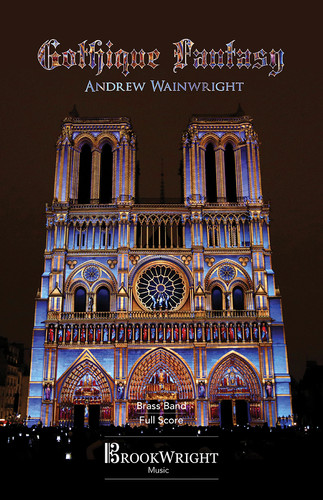
Gothique Fantasy - On a theme by Boellmann (Brass Band Score) Andrew Wainwright
This magnificent work was commissioned by The Illinois Brass Band for the 2024 North American Brass Band Championships. It is also the title track of the 2026 CD by Black Dyke Band, featuring the music of Andrew Wainwright. Please note this PDF download is for the full score. The full set can be purchased here.Based on Leon Boellmann's epic organ work Suite Gothique, the 3rd movement of which is entitled Priere a Notre-Dame (A Prayer for Notre Dame), it pays tribute to the nearly 700-year-old Notre-Dame de Paris after the fire which did so much damage to this iconic building.Notre-Dame stands out for its three pipe organs (one historic) and its immense church bells, which are referenced at various times in Gothique Fantasy. Two of the other movements from Boellmann's work also provide inspiration for the piece, firstly the Introduction - Choral, and the famous Toccata, snippets of which appear at various times in the piece.Gothique Fantasy opens with the Choral, a solo offstage cornet sounding the opening statement. A quintet, stood to the side of the stage, takes up the Choral, while the rest of the band enters on held muted notes, creating a sustained effect evoking the harmonies spreading across the vast cathedral. Colossal organ-like sounds announce themselves as the full band takes on the theme.A lively Animato follows. Here there are continued references to the Choral, while the famous Toccata motif starts to appear.A Misterioso section ensues, which leads into a poignant Prayer for Notre Dame featuring a euphonium duet, where the music reflects upon the devasting fire and centuries of history and artefacts that were lost. A lone euphonium the sounds, representing the remaining remnants of the cathedral.A chaotic and rhythmic Presto, based on the Toccata, then follows and tests the technique of the band from top to bottom, whilst moving through various time signatures, the pulse lacking any sense of stability. A return to the Choral theme leads into a further reflective section, this time featuring the secondary theme from the Toccata with a flugel and solo horn duet.Next the music arrives at an aleatory section (Senza Misura), which depicts the remnants of the fire, followed by the grand cathedral emerging out of the ashes. Various motifs from earlier in the piece are heard across the band. At this point, various parts enter at different times on the conductor's signal, before building towards a 6/8 Presto. Here the music gathers momentum as it leads to a Grandioso finale featuring the Choral in all its glory. However, to conclude the work, the final strains of the Toccata sound, bringing the work to a glorious conclusion as Notre-Dame rises again!To view a video of The Illinois Brass Band performing the work please visit www.youtube.com/watch?v=xG3JB6Ye5aUDuration: 15.00 minutes approx.Difficulty Level: Championship SectionSheet music available from www.brassband.co.ukInstrumentation:Soprano Cornet EbSolo Cornet BbRepiano Cornet Bb2nd Cornet Bb3rd Cornet BbFlugel Horn BbSolo Horn Eb1st Horn Eb2nd Horn Eb1st Baritone Bb2nd Baritone Bb1st Trombone Bb2nd Trombone BbBass TromboneEuphonium BbBass EbBass BbPercussion 1-4
In Stock: Estimated dispatch 1-3 working days
-
 £75.31
Gothique Fantasy - On a theme by Boellmann (Brass Band) Andrew Wainwright
This magnificent work was commissioned by The Illinois Brass Band for the 2024 North American Brass Band Championships. It is also the title track of the 2026 CD by Black Dyke Band, featuring the music of Andrew Wainwright.Based on Leon Boellmann's epic organ work Suite Gothique, the 3rd movement of which is entitled Priere a Notre-Dame (A Prayer for Notre Dame), it pays tribute to the nearly 700-year-old Notre-Dame de Paris after the fire which did so much damage to this iconic building.Notre-Dame stands out for its three pipe organs (one historic) and its immense church bells, which are referenced at various times in Gothique Fantasy. Two of the other movements from Boellmann's work also provide inspiration for the piece, firstly the Introduction - Choral, and the famous Toccata, snippets of which appear at various times in the piece.Gothique Fantasy opens with the Choral, a solo offstage cornet sounding the opening statement. A quintet, stood to the side of the stage, takes up the Choral, while the rest of the band enters on held muted notes, creating a sustained effect evoking the harmonies spreading across the vast cathedral. Colossal organ-like sounds announce themselves as the full band takes on the theme.A lively Animato follows. Here there are continued references to the Choral, while the famous Toccata motif starts to appear.A Misterioso section ensues, which leads into a poignant Prayer for Notre Dame featuring a euphonium duet, where the music reflects upon the devasting fire and centuries of history and artefacts that were lost. A lone euphonium the sounds, representing the remaining remnants of the cathedral.A chaotic and rhythmic Presto, based on the Toccata, then follows and tests the technique of the band from top to bottom, whilst moving through various time signatures, the pulse lacking any sense of stability. A return to the Choral theme leads into a further reflective section, this time featuring the secondary theme from the Toccata with a flugel and solo horn duet.Next the music arrives at an aleatory section (Senza Misura), which depicts the remnants of the fire, followed by the grand cathedral emerging out of the ashes. Various motifs from earlier in the piece are heard across the band. At this point, various parts enter at different times on the conductor's signal, before building towards a 6/8 Presto. Here the music gathers momentum as it leads to a Grandioso finale featuring the Choral in all its glory. However, to conclude the work, the final strains of the Toccata sound, bringing the work to a glorious conclusion as Notre-Dame rises again!To view a video of The Illinois Brass Band performing the work please visit www.youtube.com/watch?v=xG3JB6Ye5aUDuration: 15.00 minutes approx.Difficulty Level: Championship SectionThis PDF download includes parts and score.Sheet music available from www.brassband.co.ukInstrumentation:Soprano Cornet EbSolo Cornet BbRepiano Cornet Bb2nd Cornet Bb3rd Cornet BbFlugel Horn BbSolo Horn Eb1st Horn Eb2nd Horn Eb1st Baritone Bb2nd Baritone Bb1st Trombone Bb2nd Trombone BbBass TromboneEuphonium BbBass EbBass BbPercussion 1-4
In Stock: Estimated dispatch 1-3 working days
-
 £82.85
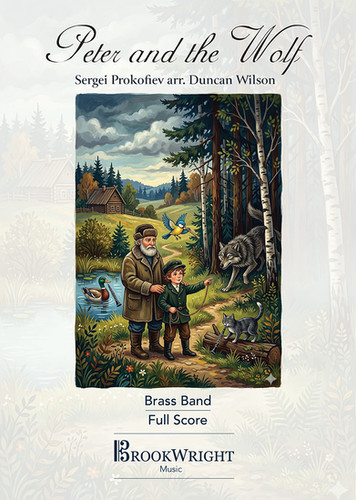
Peter and the Wolf (Brass Band, Narrator & Soloist) Prokofiev arr. Duncan Wilson
In 1936, Sergei Prokofiev was commissioned by Natalya Sats and the Central Children's Theatre in Moscow to write a musical symphony for children. Drawing from various sources, he created Peter and the Wolf, a work designed to introduce young audiences to the instruments of the orchestra. Prokofiev conducted both the Moscow premiere in May 1936 and the first English-language performance in Boston in 1938.In this adaptation for brass band, Duncan Wilson has abridged the original 25-minute score into a concert-friendly 18-minute version. All core material and principal themes remain intact.While the full band represents the character of Peter, the arrangement suggests seating the four other main characters (Bird, Duck, Cat, and Grandfather) slightly apart from the main ensemble. To enhance the performance, players may choose to develop their characters using costumes and accessories.To view a rolling score video please visit https://youtu.be/l8aXh-LiWb4Duration: approx. 18 minutesDifficulty Level: 2nd Section +This PDF download includes the full score and parts.Sheet music available at www.brassband.co.uk (UK) or https://satradecentral.org (USA)Instrumentation NotesThe Cat: Written for baritone, though bands may substitute a euphonium if preferred. If this substitution is made, the 1st baritone player should read the euphonium part.Instrumentation:NarratorThe Bird (Soprano Cornet Eb)The Duck (Flugel Horn Bb)The Cat (Baritone Bb)Grandfather (Bass Eb)Solo Cornet 1&2 BbSolo Cornet 3&4 BbRepiano Cornet Bb2nd Cornet Bb3rd Cornet BbSolo Horn Eb1st Horn Eb2nd Horn Eb2nd Baritone Bb1st Trombone Bb2nd Trombone BbBass TromboneEuphonium Bb2nd Bass EbBass BbTimpaniPercussion (2 players): Snare Drum, Bass Drum, Cymbals (clash and suspended), Woodblock, Triangle, Whip, Mark Tree, Glockenspiel, Xylophone & Tubular Bells
In Stock: Estimated dispatch 1-3 working days
-
 £33.89
A Christmas Canon (Brass Band) Traditional arr. William Gordon
Seamlessly merging the traditional English carol The First Nowell with Johann Pachelbel's beloved Canon in D, A Christmas Canon is a captivating arrangement designed to bring rich texture and emotional depth to your band's winter concert repertoire.Suitable for intermediate to advanced bands, the piece opens Adagio sostenuto with a gently rolling, scalic ostinato in the euphonium and lower brass, establishing the unmistakable harmonic ground bass of Pachelbel's masterpiece. Over this foundation, expressive solo lines in the flugel and horns gracefully weave the familiar melody of The First Nowell into the texture.As the arrangement unfolds, the scoring gradually builds density and counterpoint. Intricate muted cornet passages give way to flowing arpeggios, bell-like glockenspiel accents, and cascading lines across the band, driving a gradual crescendo into a rich, full-ensemble statement of the carol theme.The work reaches its dramatic climax at an expanded Allargando section, where the full band, supported by percussion, delivers a majestic, fortissimo declaration of the melody before resolving into a warm, lingering final chord.To view a rolling score video of the Amsterdam Staff Band performing this piece please visit: www.youtube.com/watch?v=dr9hMLhAvRMDifficulty Level: 3rd Section +Duration: 3.30 minutesThis PDF download includes the full score and parts.Sheet music available at www.brassband.co.uk (UK) or https://satradecentral.org (USA)Instrumentation:Soprano Cornet EbSolo Cornet Bb1st Cornet Bb2nd Cornet BbFlugel Horn BbSolo Horn Eb1st Horn Eb2nd Horn Eb1st Baritone Bb2nd Baritone Bb1st Trombone Bb2nd Trombone BbBass TromboneEuphonium BbBass EbBass BbTimpaniPercussion 1-2
In Stock: Estimated dispatch 1-3 working days
-
 £33.89
All Your Anxiety (Brass Band) Edward Joy arr. Jonathan Rowsell
All Your Anxiety is a reflective and expressive work for brass band inspired by Edward Joy's sacred song of the same name. Drawing deeply from the hymn's text and message, the piece explores the tension between human unease and the promise of peace found in faith.The work opens with a distinctive eighth-note figure in the euphonium that immediately establishes an unsettled character. Wide intervallic leaps and atypical slur groupings evoke a sense of fragility and uncertainty, musically portraying the weight of sorrow and care described in the opening verse of the hymn. This motivic material becomes the foundation of the entire arrangement, reappearing in varied forms as counter-melody, accompaniment, and featured solo lines across the ensemble.As the piece unfolds, the music gradually broadens and warms, reflecting the invitation of the text to "come to the cross" and leave one's burdens behind. Moments of lyricism and calm contrast with the earlier unease, leading toward a more settled and hopeful conclusion that mirrors the refrain's assurance: "Never a burden He cannot bear, never a friend like Jesus."To view a video of the Canadian Staff Band playing the piece please visit https://www.youtube.com/watch?v=5Ms8ubug4yASheet music available from www.brassband.co.uk or https://satradecentral.orgDifficulty Level: 3rd Section +Length: 3.30 minutesInstrumentation:Soprano Cornet EbSolo Cornet Bb1st Cornet Bb2nd Cornet BbFlugel Horn BbSolo Horn Eb1st Horn Eb2nd Horn Eb1st Baritone Bb2nd Baritone Bb1st Trombone Bb2nd Trombone BbBass TromboneEuphonium BbBass EbBass BbTimpaniPercussion
In Stock: Estimated dispatch 1-3 working days
-
 £33.89
Libera Me from 'Requiem' (Brass Band) Faure arr. Rob Bushnell
Composed between 1887 and 1890, Gabriel Faure's Requiem is not only one of his best-known works but one of the most popular piece of choral music in the Classical repertoire, coming 23rd in the Classic FM's Hall of Fame 2024. Believed to be a tribute to his father (who died in 1885), Faure himself said "My Requiem wasn't written for anything - for pleasure, if I may call it that!" It started life as a five-movement work but was later expanded to be the final seven-movement work we know today. The first version (which Faure called "un petit Requiem") was first performed on 16 January 1888, with Faure conducting, a second version premiered on 21 January 1893 before the final version (reworked for full orchestra) was played on 12 July 1900; the Requiem was performed at the composer's own funeral in 1924.The Libera Me, or Deliver Me, was actually written in 1877 and is the sixth part of the Requiem.Faure once said of the work, "Everything I managed to entertain by way of religious illusion I put into my Requiem, which moreover is dominated from beginning to end by a very human feeling of faith in eternal rest." Upon interview, he also said, "It has been said that my Requiem does not express the fear of death and someone has called it a lullaby of death. But it is thus that I see death: as a happy deliverance, an aspiration towards happiness above, rather than as a painful experience. The music of Gounod has been criticised for its inclination towards human tenderness. But his nature predisposed him to feel this way: religious emotion took this form inside him. Is it not necessary to accept the artist's nature? As to my Requiem, perhaps I have also instinctively sought to escape from what is thought right and proper, after all the years of accompanying burial services on the organ! I know it all by heart. I wanted to write something different."This arrangement is for the British-style brass band, with alternative parts for horns in F and bass-clef lower brass. The tenor solo is featured on the euphonium.A recording of the original composition can be found here: www.youtube.com/watch?v=fXwFNoBHCf0Duration: 4.20 minutes approx.Difficulty Level: 4th Section +PDF download includes parts and score.Sheet music available from www.brassband.co.ukInstrumentation:Soprano Cornet EbSolo Cornet BbRepiano Cornet Bb2nd Cornet Bb3rd Cornet BbFlugel Horn BbSolo Horn Eb1st Horn Eb2nd Horn Eb1st Baritone Bb2nd Baritone Bb1st Trombone Bb2nd Trombone BbBass TromboneEuphonium BbBass EbBass BbTimpani
In Stock: Estimated dispatch 1-3 working days
 View Music