
Results
-
 £154.99
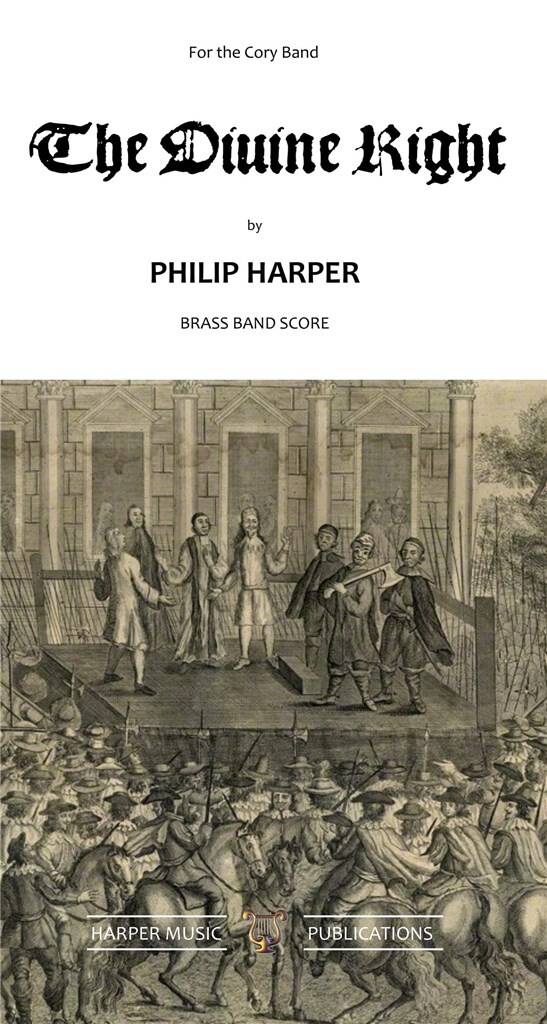
The Divine Right - Philip Harper
At the time of composing this piece, the Arab Spring was sweeping through the Middle East. It seemed that almost every week a new countrys people had risen up against the regimes and dictatorships which had prevailed for generations, leaving manynations at a defining crossroads in their history. There were so many possible ways ahead: so many hopes, yet so many uncertainties.My music is a depiction of these revolutionary times, and several musical themes are in turn presented, discussed, considered, fought over, altered, rejected or accepted. Most nations have had, or probably will have, their own Arab Spring, including my own, the United Kingdom. Events of 17th Century Britain provide the context for this piece, particularly those following the execution of the tyrant King Charles I on30 January 1649. The regicide was in part due to Charless steadfast belief in the Divine Right of Kings, and led to a tumultuous interregnum, where England stood at its own defining crossroads.The music begins turbulently, before King Charles appears and is led to the gallows outside Banqueting House in central London where he is brutally decapitated. From the assembled crowd rose, according to one observer, a moan as I never heard before and desire I may never hear again.The music descends to emptiness. The musical argument which follows is not strictly programmatic, but a number of musical themes are all thrown into the melting pot, representing ideas such as: religion; military force; reasoned Parliamentary debate; and the chattering,irrepressible voice of the people. Additionally, there are some quotations from the music of royalist composer Thomas Tomkins (1572-1656), who was often in tune with the feeling of the times. This defining episode in Englands history was brought to a close with the Restoration of the monarchy in 1660, and as the exiled King Charles II rode back into London the diarist John Evelyn wrote: Never was so joyful a day seen in this nation. I stood in the Strand and beheld it, and blessed God.At the end of the piece the bells ring out, and the musical appearance of the King has transformed from turbulent to triumphant. Philip Harper, 2013
Estimated dispatch 5-14 working days
-
 £89.95
Cambridge Variations - Philip Sparke
Cambridge Variations was commissioned by Philip Biggs and Richard Franklin with funds provided by All England Masters Brass Band Championship Ltd for their 1992 contest. The basis of the variations are the six musical notes in the word"Cambridge", (CABDGE), used mostly in reverse. The work falls into five sections (variations), which are all (to some extent) derived from the six-note row.
Estimated dispatch 5-14 working days
-
 £54.99
Away in a Manger - Andrew R. Mackereth
In English-speaking countries 'Away in a Manger' is one of the first Christmas songs to be taught to little children. It is a moving song with simple words, which makes it easy to understand. The song is also known as 'Luther's Cradle Hymn'. This suggests that Martin Luther was the author of the lyrics. According to researchers, however, this is a misconception the author is unknown. In England 'Away in a Manger' is sung to a different melody than in the USA, for example. The 'English' melody was composed by W.J. Kirkpatrick. Andrew Mackereth made a touching arrangement of the 'English' melody, which suits the tender lyrics perfectly.
Estimated dispatch 5-14 working days
-
 £54.99
Onward! - Gawan Roberts
A brief history: Pentecost Monday was a special day for schools in Yorkshire (England). There were a variety of activities. The pupils of Sabine Baring-Gould would meet with the children of a nearby village. It seemed like a good idea that during the walk would be sung. But she could not find a suitable song and decided to write one by herself. "Onward Christian Soldiers" was the result. It soon became very popular, though she herself was not entirely satisfied with the rhyme scheme. The melody used (St. Gertrude) was by the famous English composer Sir Arthur S. Sullivan. Back to now: Gawan Roberts, has given the hymn a proper update. He gave the still popularsong a solid rock beat and added daring harmonies. So it's popular, for current generations, again for years. Onward!
Estimated dispatch 5-14 working days
-
 £68.90
Jodrell Bank - P. Yorke - J.B. Ham
The title refers to the big radio telescope at Jodrell Bank in England. This composition is not exactly a symphonic poem, although it tries to give a musical portrait of eternity and infinity. 'Jodrell Bank' is a real classic of the brass band repertoire with its romantic style, its impressive climaxes alternating with quiet pauses and its sparkling finale. Peter York was above all a composer of film and theatre music and was very active in the world of entertainment and light music. Yet he had one musical hobby: composing for brass band even if he had no links at all with the brass band world. At first, he signed his brass band compositions with the pen name Ivor Gould but later used his own name. Among his most important compositions are The Shipbuilders Suite, Gallions Reach and Jodrell Bank.
Estimated dispatch 5-14 working days
-
£39.99
English Carol Fantasy - James Curnow
Contrasting colors and varied orchestration techniques make this majestic setting of OH LITTLE TOWN OF BETHLEHEM come alive for Christmas. Of the three different tunes that are commonly associated with the original carol text, this arrangement uses the melody that's best known in England. ENGLISH CAROL FANTASY remains entirely accessible to bands at this level and plenty of cueing makes sure it's useful for ensembles of all shapes and sizes. Feature your deserving young cornet section leader on the easy solo, or let the entire first cornet section play it soli. The low brass also get some "well doubled" exposure, so playing this one will be fun for all.Try it!
Estimated dispatch 5-14 working days
-
 £59.95
Bonnie Northumbria - Brass Band - LM786
COMPOSER: Laurie JohnstonProgramme NotesNorthumberland, or Northumbria as it is also known, is the most northern county in England and has magnificent and stunning landscapes just waiting to be explored. Filled with mystical castles, atmospheric ruins and historical sites and edged by spectacular coastal scenery, there is something wonderful to see at every turn. The Devils Causeway passes through Northumbria and reaches Berwick upon Tweed at the coast. Walkers and cyclists can also take the Coast and Castles Cycle Route or the North Sea Trail which journey through some of the most beautiful scenery along the way.The Blaydon Races is aGeordiefolk songwritten in the 19th century byGeordie Ridley, in a style deriving frommusic hall. It is regarded by many as the unofficialanthemofTynesideand is frequentlysungby supporters ofNewcastle United Football ClubandNewcastle Falconsrugby club.Blaydonis a small town inGateshead, situated about 4 miles (6.4km) fromNewcastle upon Tyne, inNorth East England. The race used to take place on the Stella Haugh 1 mile (1.6km) west of Blaydon.Stella South Power Station(demolished in 1995) was built on the site of the track in the early 1950s, after the races had stopped taking place in 1916.Water of Tyne (sometimes rendered as The Waters of Tyne) is a folk song (Roud number1364) from the north-east of England. The song is sung by a girl or woman lamenting the fact that her paramour is on the opposite bank of theRiver Tyne. Sleeve notes to Michael Hunt's recording of Tyneside songs states that "the ferry is believed to be that atHaughton Castleon theNorth Tyne". Alternatively the "rough river" in the last line may indicate a point further downstream, possiblyTynemouth.The song was collected byJohn Bellin 1810 and published two years later inRhymes of Northern Bards.The Keel Row is a traditional Tyneside folk song evoking the life and work of thekeelmenofNewcastle upon Tyne. A closely related song was first published in aScottishcollection of the 1770s, but may be considerably older, and it is unclear whether the tune is Scottish or English in origin.The opening lines of the song set it inSandgate, that part of the quayside overlooking the River Tyne to the east of the city centre where the keelmen lived and which is still overlooked by theKeelmen's Hospital.Versions of the song appear in both England and Scotland, with Scottish versions referring tothe Canongaterather than Sandgate. The earliest printing was in the 1770s inEdinburghin A Collection of Favourite Scots Tunes, edited by Charles Maclean, though the tune was also found in several late eighteenth-century English manuscript collections. As the term "keel" was used both sides of the border, it has not been determined which version was the original, althoughFrank Kidsonsurmised that like many other songs collected by Maclean it may originally have been aJacobiteair from the time of the1745 rebellion. Some versions of the song make reference to a "blue bonnet[...] with a snowy rose upon it", a clear attempt to evoke Jacobite symbolism, whether dating from 1745 or not.Kidson, however, also noted that he had found the tune of The Keel Row associated with an early dance called "The Yorkshire Lad" as early as 1748.By the 19th century the tune was well associated with the River Tyne; a few years before the 1850s the keelmen had met yearly to celebrate the founding of the Keelmen's Hospital, perambulating the town to the accompaniment of bands playing The Keel Row.Dance To Thy Daddyis a traditional Englishfolksong, originating inNorth East England. An early source for the lyrics, Joseph Robson's "Songs of the bards of the Tyne", published 1849, can be found on the Farne archive. In Farne's notes to the song, it is stated that these lyrics were written by William Watson around 1826.
In Stock: Estimated dispatch 3-5 working days
-
 £34.00
Meditation: It is Well With My Soul
ABOUT THIS PIECE: Cantatio are pleased to release this hymn meditation on the much-loved hymn by Adam D J Taylor. Commissioned by the world famous Wingates Band, this arrangement became a centrepiece of the band's online presence during the COVID pandemic. Story time... Horatio Spafford was a successful attorney and real estate investor who lost a fortune in the great Chicago fire of 1871. Around the same time, his beloved four-year-old son died of scarlet fever. Thinking a vacation would do his family some good, he sent his wife and four daughters on a ship to England, planning to join them after he finished some pressing business at home. However, while crossing the Atlantic Ocean, the ship was involved in a terrible collision and sunk. More than 200 people lost their lives, including all four of Horatio Spafford's precious daughters. His wife, Anna, survived the tragedy. Upon arriving in England, she sent a telegram to her husband that began: "Saved alone. What shall I do?" Horatio immediately set sail for England. At one point during his voyage, the captain of the ship, aware of the tragedy that had struck the Spafford family, summoned Horatio to tell him that they were now passing over the spot where the shipwreck had occurred. As Horatio thought about his daughters, words of comfort and hope filled his heart and mind. He wrote them down, and they have since become a well-beloved hymn: When peace like a river, attendeth my way, When sorrows like sea billows roll-- Whatever my lot, thou hast taught me to say It is well, it is well with my soul. ENSEMBLE: Standard British Brass Band WHEN YOU BUY THIS PRODUCT, YOU GET: High-quality printed score and parts LEVEL: 2 - 3 LISTEN: DURATION: c. 7-minutes, 30-seconds EXAMPLE SCORE: Click here LEVEL GUIDE: Level 1- Accessible to all Level 2 - c. UK third section and higher Level 3 - c. UK second section and higher Level 4 - c. UK first section and higher Level 5 - c. UK championship section level
Estimated dispatch 5-7 working days
-
 £30.00
Amazing Grace (W. Walker arr. by Paul Pennicotte-Henrie) - Brass Band Sheet Music Full Score and Parts - LM642
COMPOSER: W. WalkerARRANGER: Paul Pennicotte-Henrie"Amazing Grace" is a Christian hymn published in 1779 by English Anglican clergyman, abolitionist, and poet John Newton. It is possibly the most sung and most recorded hymn in the world and is especially popular in the United States, where it is used for both religious and secular purposes. Newton wrote the words from personal experience; he grew up without any particular religious conviction, but his life's path was formed by a variety of twists and coincidences that were often put into motion by others' reactions to what they took as his recalcitrant insubordination. He was pressed into service with the Royal Navy, and after leaving the service, he became involved in the Atlantic slave trade.In 1748, a violent storm battered his vessel off the coast of County Donegal, Ireland, so severely that he called out to God for mercy. While this moment marked his spiritual conversion, he continued slave trading until 1754 or 1755, when he ended his seafaring altogether. Newton began studying Christian theology and later became an abolitionist.Ordained in the Church of England in 1764, Newton became the curate of Olney, Buckinghamshire, where he began to write hymns with poet William Cowper. "Amazing Grace" was written to illustrate a sermon on New Year's Day of 1773. It is unknown if there was any music accompanying the verses; it may have been chanted by the congregation. It debuted in print in 1779 in Newton's and Cowper's Olney Hymns, but settled into relative obscurity in England. In the United States, "Amazing Grace" became a popular song used by Baptist and Methodist preachers as part of their evangelizing, especially in the American South, during the Second Great Awakening of the early 19th century. It has been associated with more than 20 melodies. In 1835, American composer William Walker set it to the tune known as "New Britain" in a shape note format; this is the version most frequently sung today.
In Stock: Estimated dispatch 3-5 working days
-
 £40.00
Reflections of Tyne - Matthew Hall
Reflections of Tyne was commissioned by the NASUWT Riverside Band for their 2019 performance at Brass in Concert at The Sage in Gateshead.Reflections of Tyne combines two traditional songs from the North East of England into a rumbustious concert or contest finisher full of flair and excitement.The Waters of Tyne and The Cliffs of Old Tynemouth blend in the opening reflection of the stillness of the River Tyne before the industrial heritage of North East England is forces its way on to the landscape as the pace and intensity doubles almost instantaneously. A calmer, contemplative, solo passage precedes the final energetic climax in a vibrant musical rendition of the North East as we know it today, with the Tyne as important now as it ever has been.
Estimated dispatch 5-7 working days
 View Music
