
Results
-
 £21.95
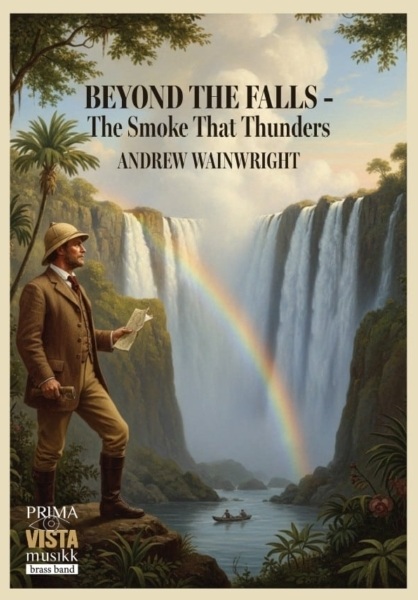
Beyond the Falls - The Smoke That Thunders (Brass Band - Study Score) - Wainwright, Andrew
David Livingstone was a renowned Scottish missionary and explorer whose legendary expeditions from 1841 until his death in 1873 took him deep into the interior of central and southern Africa. While his initial aim was to spread Christianity and commerce, his legacy became defined by his relentless spirit of discovery.This work captures the harrowing and ultimately triumphant journey that led to his discovery of Victoria Falls. Originally composed for the GUS Band's performance at the 2012 Brass in Concert Championships, the work was expanded in 2026 for the Black Dyke Band's recording, Gothique Fantasy - The Music of Andrew Wainwright.The music opens with an air of trepidation, reflecting the weight of the mission ahead. This tension soon gives way to a more optimistic section featuring the Scottish folk song A Man's a Man for a' That. Livingstone reportedly hummed this Rabbie Burns tune to bolster his spirits while travelling. The score then depicts the immense hardships of the expedition (letters F to L), illustrating skirmishes with suspicious local tribes, wild animal attacks, and bouts of African fever.Following these trials, a more reflective, emotive movement (Letters L to R) explores Livingstone's internal struggle and his doubts about continuing. This emotional core is built upon the hymn Lord, Send Me Anywhere, a melody composed by Livingstone himself. Emerging from this prayer with renewed purpose, the final section (Letter R to the end) follows his path along the Zambezi River. The music builds to a triumphant climax, capturing his elation at seeing the magnificent Victoria Falls - known locally as 'Mosi-oa-Tunya' (The Smoke that Thunders).Duration: 13.30
Estimated dispatch 7-14 working days
-
 £59.99
Cavatina for Cornet (Cornet Solo with Brass Band - Score and Parts) - Sparke, Philip
In this solo work - a commission for an 18th birthday present - the opening mood of a brooding modal blues gives way momentarily to a more optimistic central section. Following an emotional climax and reflective cadenza, the opening material returns, but now tying in with the central section, and the piece finally ends in a more positive mood.Duration: 4:45
Estimated dispatch 7-14 working days
-
 £87.99
Hail the Dragon! (Brass Band - Score and Parts) - Sparke, Philip
Its title, Hail the Dragon!, references a work Philip Sparke wrote in 1984, The Year of the Dragon. The piece opens with a lively and energetic fanfare. The mood becomes more subdued in the centre section as the cornet introduces a new theme that builds to an emotional climax. This leads into a recap of the opening fanfare which acts as a type of descant to short quotations from the last movement of The Year of the Dragon before reaching a thunderous finale.Duration: 4:45
Estimated dispatch 7-14 working days
-
 £74.99
Letter from Home (Brass Band - Score and Parts) - Sparke, Philip
In Letter from Home Philip Sparke portrays the many feelings and emotions that a letter from home can evoke. This intimate works opens with a gentle melody, which gradually becomes more confused as new emotions are introduced. Finally resignation sets in, but a sense of peace and balance is restored with the final chorale. In this emotional work Philip Sparke truly captures the highs and lows of being away from home.Duration: 7:15
Estimated dispatch 7-14 working days
-
 £44.95
Princethorpe Variations (Brass Band - Score and Parts) - Downie, Kenneth
Colourful harmony, rhythmic flair and melodic invention are the hallmarks of this excellent set of variations by Kenneth Downie, based on the well known church tune, Princethorpe.This major work demonstrates the well-known characteristics of the composer: colourful harmony, rhythmic flair and melodic invention, all encapsulated in scoring which is engulfing both to players and listeners alike. Following a presentation of the theme there are five variations culminating in what can be described as either a finale or coda.Theme. The composer shows his originality in the harmonic sense of this introduction. Perhaps it could be suggested that over-indulgence of rubato may be a temptation to be avoided.Sections A to F. Relentless rhythmic drive is of paramount importance in this first variation. Conscientious observance of dynamics is of course an essential requirement in conveying the exciting quality of the music; there are moments of sudden contrast of which all will need to be aware. Moving between the time-signatures of 5/4 and 6/4 these sections are built from strong easily-identifiable fragments of the theme. These is a significant increase in temp at letter F which will further the exciting impact of the music.Sections G & H. In a pastorale style this short, gentle variation affords a contrast in style between the previous and succeeding ones. The gentle undulating character of the melodic lines is governed by the Allegretto grazioso directive.Sections I to M. Commencing two bars before letter I the music is now exuberant and the tempo and style is that of a march in compound time. In this exhilarating movement there are moments of contrast and indeed of delicacy which are a foil to the more energetic moments. Rhythmic control will be essential to maintain a consistent tempo. As elsewhere in the work, the percussion section will contribute much to the success of the performance there are bars where this section alone is heard and there are important entries for glockenspiel.Sections N & O. With emotional content this Adagio variation has the first two notes of the melody as its melodic impetus. Apart from just over two bars at O (where there is an interpolatory phrase from Cornets and Trombones), the melodic line is entrusted to the plaintive sounds of the horn section. Cornets and Trombones provide a change of tone colour at the beginning of section O. Under a poco rall, this very expressive variation is concluded; there is an important link supplied by Eb Bass.Sections P & Q. A lively march-tempo is launched immediately and these sections are in the nature of an introduction to the final variations. There is a quickening of pace at Q which assists the generation of excitement which should be an essential part of the performance. Solo Cornets introduce a melodic line at Q which anticipates the compound time of the following section.Sections R & S. The Solo Cornet theme of the previous section is now a contrapuntal line accompanying the theme tune. With an elongation of the notes in the melody, the conductor will need to call on the sustaining powers of the band and at no time should the interesting accompanying lines be allowed to detract from the sonorous presentation of the basic theme.Sections T, U & V. Following a poco rit, the finale begins at letter T with the directive, molto vivace. There is much detail to be rehearsed, not least being the dynamic contrasts which are encountered. As throughout the work, the listener should have no difficulty in identifying the thematic sources of the composer's music.
Estimated dispatch 7-14 working days
-
£22.50
Princethorpe Variations (Brass Band - Score only) - Downie, Kenneth
Colourful harmony, rhythmic flair and melodic invention are the hallmarks of this excellent set of variations by Kenneth Downie, based on the well known church tune, Princethorpe.This major work demonstrates the well-known characteristics of the composer: colourful harmony, rhythmic flair and melodic invention, all encapsulated in scoring which is engulfing both to players and listeners alike. Following a presentation of the theme there are five variations culminating in what can be described as either a finale or coda.Theme. The composer shows his originality in the harmonic sense of this introduction. Perhaps it could be suggested that over-indulgence of rubato may be a temptation to be avoided.Sections A to F. Relentless rhythmic drive is of paramount importance in this first variation. Conscientious observance of dynamics is of course an essential requirement in conveying the exciting quality of the music; there are moments of sudden contrast of which all will need to be aware. Moving between the time-signatures of 5/4 and 6/4 these sections are built from strong easily-identifiable fragments of the theme. These is a significant increase in temp at letter F which will further the exciting impact of the music.Sections G & H. In a pastorale style this short, gentle variation affords a contrast in style between the previous and succeeding ones. The gentle undulating character of the melodic lines is governed by the Allegretto grazioso directive.Sections I to M. Commencing two bars before letter I the music is now exuberant and the tempo and style is that of a march in compound time. In this exhilarating movement there are moments of contrast and indeed of delicacy which are a foil to the more energetic moments. Rhythmic control will be essential to maintain a consistent tempo. As elsewhere in the work, the percussion section will contribute much to the success of the performance there are bars where this section alone is heard and there are important entries for glockenspiel.Sections N & O. With emotional content this Adagio variation has the first two notes of the melody as its melodic impetus. Apart from just over two bars at O (where there is an interpolatory phrase from Cornets and Trombones), the melodic line is entrusted to the plaintive sounds of the horn section. Cornets and Trombones provide a change of tone colour at the beginning of section O. Under a poco rall, this very expressive variation is concluded; there is an important link supplied by Eb Bass.Sections P & Q. A lively march-tempo is launched immediately and these sections are in the nature of an introduction to the final variations. There is a quickening of pace at Q which assists the generation of excitement which should be an essential part of the performance. Solo Cornets introduce a melodic line at Q which anticipates the compound time of the following section.Sections R & S. The Solo Cornet theme of the previous section is now a contrapuntal line accompanying the theme tune. With an elongation of the notes in the melody, the conductor will need to call on the sustaining powers of the band and at no time should the interesting accompanying lines be allowed to detract from the sonorous presentation of the basic theme.Sections T, U & V. Following a poco rit, the finale begins at letter T with the directive, molto vivace. There is much detail to be rehearsed, not least being the dynamic contrasts which are encountered. As throughout the work, the listener should have no difficulty in identifying the thematic sources of the composer's music.
Estimated dispatch 7-14 working days
-
 £69.99
Hymn to the Fallen (Brass Band - Score and Parts) - Williams, John - Sparke, Philip
Saving Private Ryan is certainly one of Steven Spielberg's most powerful films. The brilliant John Williams score creates part of this power. Hymn to the Fallen one of the most powerful and emotional melodies which appears during the closing credits, evokes a feeling of hope and strength amid the overall tone of reverence. Philip Sparke has transcribed this moving work for brass band using John Williams original orchestral score as the source.Duration: 6:00American Grade 4Recorded on Anglo AR 015-3 The Bandwagon
Estimated dispatch 7-14 working days
-
 £119.95
Harrison's Dream (Brass Band - Score and Parts) - Graham, Peter
At 8.00pm on the 22nd of October 1707, the Association, flagship of the Royal Navy, struck rocks off the Scilly Isles with the loss of the entire crew. Throughout the rest of the evening the remaining three ships in the fleet suffered the same fate. Only 26 of the original 1,647 crew members survived. This disaster was a direct result of an inability to calculate longitude, the most pressing scientific problem of the time. It pushed the longitude question to the forefront of the national consciousness and precipitated the Longitude Act. Parliament funded a prize of �20,000 to anyone whose method or device would solve the dilemma.For carpenter and self-taught clockmaker John Harrison, this was the beginning of a 40 year obsession. To calculate longitude it is necessary to know the time aboard ship and at the home port or place of known longitude, at precisely the same moment. Harrison's dream was to build a clock so accurate that this calculation could be made, an audacious feat of engineering.This work reflects on aspects of this epic tale, brilliantly brought to life in Dava Sobel's book Longitude. Much of the music is mechanistic in tone and is constructed along precise mathematical and metrical lines. The heart of the work however is human - the attraction of the �20,000 prize is often cited as Harrison's motivation. However, the realisation that countless lives depended on a solution was one which haunted Harrison. The emotional core of the music reflects on this, and in particular the evening of 22ndOctober 1707.- Peter GrahamJuly 2000 Recorded on Polyphonic QPRL219D Master Brass (Volume Fifteen). Duration: 14'30"
Estimated dispatch 7-14 working days
-
£44.95
Harrison's Dream (Brass Band - Score only) - Graham, Peter
At 8.00pm on the 22nd of October 1707, the Association, flagship of the Royal Navy, struck rocks off the Scilly Isles with the loss of the entire crew. Throughout the rest of the evening the remaining three ships in the fleet suffered the same fate. Only 26 of the original 1,647 crew members survived. This disaster was a direct result of an inability to calculate longitude, the most pressing scientific problem of the time. It pushed the longitude question to the forefront of the national consciousness and precipitated the Longitude Act. Parliament funded a prize of �20,000 to anyone whose method or device would solve the dilemma.For carpenter and self-taught clockmaker John Harrison, this was the beginning of a 40 year obsession. To calculate longitude it is necessary to know the time aboard ship and at the home port or place of known longitude, at precisely the same moment. Harrison's dream was to build a clock so accurate that this calculation could be made, an audacious feat of engineering.This work reflects on aspects of this epic tale, brilliantly brought to life in Dava Sobel's book Longitude. Much of the music is mechanistic in tone and is constructed along precise mathematical and metrical lines. The heart of the work however is human - the attraction of the �20,000 prize is often cited as Harrison's motivation. However, the realisation that countless lives depended on a solution was one which haunted Harrison. The emotional core of the music reflects on this, and in particular the evening of 22ndOctober 1707.- Peter GrahamJuly 2000 Recorded on Polyphonic QPRL219D Master Brass (Volume Fifteen). Duration: 14'30"
Estimated dispatch 7-14 working days
-
 £37.95
Pantomime (Euphonium Solo with Brass Band - Score and Parts) - Sparke, Philip
Pantomime was commissioned by euphonium virtuoso Nick Childs in 1986. Designed to show off both the lyrical and technical prowess of the instrument, the piece draws on the varied characters of the Italian Commedia dell'Arte tradition for its wide emotional range.Recorded on Polyphonic QPRL056D National Brass Band Championships of Great Britain and Gala Concert - 1992Recorded on Polyphonic QPRL045D Making Tracks
Estimated dispatch 7-14 working days
 View Music