
Results
-
 £33.35
Fanfare Prelude - Now thank we all our God (Brass Band & Organ) arr. Downie
This rousing fanfare prelude for Brass Band and optional Organ by Kenneth Downie is based on the monumental hymn Now thank we all our God, which dates from 17th century Germany. The arrangement is featured on the CD Classic Hymns for Orchestra - The Symphonic Music of Kenneth Downie (available here) as a symphonic brass setting. The arranger writes: 'The depth of the words is underpinned by the grandeur of the music, so I have tried to reflect the same regal approach in my setting for brass band.' This arrangement will be an ideal opener or prelude for concerts or church services. To view a rolling score video of the work please visit www.youtube.com/watch?v=olrdFskDfac PDF download includes score and parts. Additional parts for Horns in F, and Baritone, Trombone, Euphonium and Tuba in bass clef are available here. Sheet music available from: UK - www.brassband.co.uk USA - www.cimarronmusic.com Difficulty Level: 2nd Section + Length: 3.15 minutes Instrumentation: Soprano Cornet Eb Solo Cornet Bb 1st Cornet Bb 2nd Cornet Bb Flugel Horn Bb Solo Horn Eb 1st Horn Eb 2nd Horn Eb 1st Baritone Bb 2nd Baritone Bb 1st Trombone Bb 2nd Trombone Bb Bass Trombone Euphonium Bb Bass Eb Bass Bb Timpani Percussion 1-3 Organ (optional)
In Stock: Estimated dispatch 1-3 working days
-
 £33.35
Finale - Suite No.3 (Brass Band) Tchaikovsky arr. Ruben Schmidt
This arrangement by Ruben Schmidt is the exciting polonaise finale from the last movement of Tchaikovsky's thrilling Suite No.3 in G Major for Orchestra. This was first performed in Saint Petersburg on January 12th, 1885, at the fifth symphony concert of the Russian Musical Society, conducted by Hans von Bulow. The suite also was Tchaikovsky's first American success when it was performed by the New York Symphony Society at Carnegie Hall on May 7,1891. First intended as its own symphony, it became the most played and most successful of Tchaikovsky's four suites. The finale of the last movement is an invigorating polonaise dance to finish the suite. Tchaikovsky often enjoyed conducting this final movement as an independent work himself. To view a rolling score video of the work please visit www.youtube.com/watch?v=M-Ht80Lnk-c Duration: 4.00 minutes Difficulty Level: 1st Section + PDF download includes parts and score. Sheet music available here. Instrumentation: Soprano Cornet Eb Solo Cornet Bb Repiano Cornet Bb 2nd Cornet Bb 3rd Cornet Bb Flugel Horn Bb Solo Horn Eb 1st Horn Eb 2nd Horn Eb 1st Baritone Bb 2nd Baritone Bb 1st Trombone Bb 2nd Trombone Bb Bass Trombone Euphonium Bb Bass Eb Bass BbTimpani Percussion (Tambourine, Suspended Cymbal & Bass Drum)
In Stock: Estimated dispatch 1-3 working days
-
 £48.18
Finale from Symphony No.3 (Organ Symphony) (Brass Band) Saint-Saens arr. Norbury
Saint-Saens' magnificent Finale from Symphony No.3 (widely known as the 'Organ Symphony') has here been arranged for brass band with optional organ by Kevin Norbury. It was recorded by The International Staff Band on its CD Manuscripts, although this version has been revised in places. Saint-Saens decided to add the organ and piano to his 3rd symphony as a pragmatic orchestration innovation. The composition of this symphony was probably started in 1885 and a first draft was completed in Prague in 1886. Saint-Saens later recalled its eventful genesis: 'The Symphony in C was three-quarters sketched out when I found it impossible to write the finale. I did not know how to resolve this situation, until one night I suddenly woke up and, in a sort of hallucination, I heard the whole finale, which I hastily wrote down in outline, knowing that if I went back to sleep without having put anything on paper, I would have forgotten it all the next day.' The symphony was first performed under the composer's direction at Saint James's Hall in London on May 19, 1886. This arrangement by Kevin Norbury can both function as a stand-alone brass band piece, and be performed with an organ by omitting the notes found in square brackets in the parts and score. To view a rolling score video please visit www.youtube.com/watch?v=OlUd_FppBY8 PDF download includes score and parts. Additional parts (Horn in F and Baritone, Trombone, Euphonium & Tuba in Bass Clef) available here. Sheet music available from: UK - www.brassband.co.uk USA - www.cimarronmusic.com Difficulty Level: 1st Section + Length: 8.30 minutes Instrumentation: Soprano Cornet Eb Solo Cornet Bb Repiano Cornet Bb 2nd Cornet Bb 3rd Cornet Bb Flugel Horn Bb Solo Horn Eb 1st Horn Eb 2nd Horn Eb 1st Baritone Bb 2nd Baritone Bb 1st Trombone Bb 2nd Trombone Bb Bass Trombone Euphonium Bb Bass Eb Bass Bb Timpani Glockenspiel Percussion Organ (optional)
In Stock: Estimated dispatch 1-3 working days
-
 £33.35
March - Helping Hands (Rob Bushnell) Brass Band
Helping Hands was written for the British Bandsman March Composition Contest, entered into category 2 (marches for 3rd/4th section bands). The piece is loosely programmatic in nature: The introductio is fanfare-like, announcing the date of the next Whit Friday Contests and the bands' anticipation of and preparation for the event. The first section is the march of the volunteers, as they descend upon the many venues, ready to run the contests. The second section (bars 35 to 52) sees the contests start. The bands strike up, march, finish and go from place to place, whilst the volunteers manage them, the audiences, and all manner of issues and problems thrown at them. The third section (bars 53 to 69) represents the bad weather which has, at times, presented itself on that particular Friday. But everyone carries on (possibly the sun comes out) and we enjoy the day. The trio uses the hymn St. Vincent by Sigismund Neukomm: St. Vincent de Paul is the patron saint of charities and volunteering, hence its use here. The piece is influenced by marches that are commonly heard during the Whit Friday March Contests, using motifs, rhythms and harmonic progressions (sparingly) throughout the piece. March-card sized parts included, with alternatives for horns in F and lower brass in bass clef. To view a rolling score video of the piece please visit www.youtube.com/watch?v=diqDoe0XpcA PDF download includes score and parts. Sheet music available from: UK - www.brassband.co.uk USA - www.cimarronmusic.com Difficulty Level: 3rd Section + Length: 3.50 minutes Instrumentation: Soprano Cornet Eb Solo Cornet Bb Repiano Cornet Bb 2nd Cornet Bb 3rd Cornet Bb Flugel Horn Bb Solo Horn Eb 1st Horn Eb 2nd Horn Eb 1st Baritone Bb 2nd Baritone Bb 1st Trombone Bb 2nd Trombone Bb Bass Trombone Euphonium Bb Bass Eb Bass Bb Drums
In Stock: Estimated dispatch 1-3 working days
-
 £29.64
March - His Royal Banner (Brass Band) Jonathan Mead
This upbeat, foot-tapping march by Welsh composer Jonathan Mead features the two well known Welsh tunes of Aberystwyth and God Bless The Prince of Wales. Aberystwyth is set as a big bold bass solo and careful attention will need to be paid to make sure that it sounds clean and together. God Bless The Prince of Wales first appears as a traditional hymn tune, before returning in a more vibrant, lively style, with florid scalic passages for the solo cornets and euphoniums. The march was written with St David's Day in mind, although will be an appropriate addition to concert programme throughout the year as either an opener or finisher. Difficulty Level: 3rd Section + Sheet music available from: UK - www.brassband.co.uk USA - www.solidbrassmusic.com Instrumentation: Soprano Cornet Eb Solo Cornet Bb Repiano Cornet Bb 2nd Cornet Bb 3rd Cornet Bb Flugel Horn Bb Solo Horn Eb 1st Horn Eb 2nd Horn Eb 1st Baritone Bb 2nd Baritone Bb 1st Trombone Bb 2nd Trombone Bb Bass Trombone Euphonium Bb Bass Eb Bass Bb Percussion Clash Cymbals Glockenspiel
In Stock: Estimated dispatch 1-3 working days
-
 £48.15
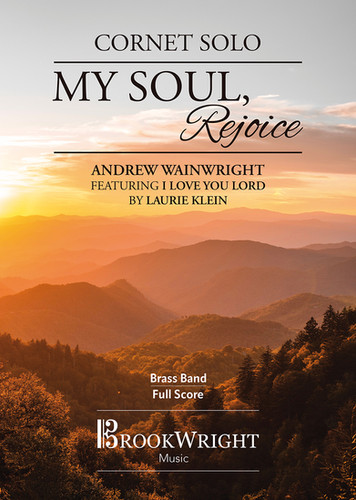
My soul, rejoice (Cornet Solo with Brass Band) Andrew Wainwright
My soul, rejoice (Andrew Wainwright) was commissioned in 2022 by Elizabeth Malovance, principal cornet of the Chicago Staff Band. A spirited and celebratory work, it is designed to showcase the dual nature of the cornet: its sparkling technical agility and its rich, vocal lyricism. The music begins in meditative fashion before transitioning into a joyful caprice featuring playful syncopations which are handed around the band. This is followed by a reflective section based on the much-loved worship song I love you Lord by Laurie Klein. The work concludes with a reprise of the original theme, building in momentum and intensity. Through a series of brilliant runs and virtuosic flourishes, the soloist leads the charge toward a majestic and triumphant finale, bringing the work to a ringing, glorious close. The solo was recorded by Richard Marshall on the 2026 CD Gothique Fantasy - The Music of Andrew Wainwright, which was his last solo recording of his 20-year tenure as principal cornet of Black Dyke Band. Technical Requirements & Electroacoustic Integration This work features an optional digital delay effect for the soloist, indicated in the score by "pedal on" and "pedal off" markings. If the required equipment is unavailable, the piece can be performed entirely acoustically. To listen to Beth Malovance performing the work with the Chicago Staff Band please visit https://on.soundcloud.com/c8IoU3CF3srTD4z0wX Duration: approx. 8 minutes Difficulty Level (Band): 2nd Section + Soloist: Advanced This PDF download includes the full score and parts. Sheet music available at www.brassband.co.uk (UK) or satradecentral.org (USA) Instrumentation: Soprano Cornet Eb Solo Cornet Bb 1st Cornet Bb 2nd Cornet Bb Flugel Horn Bb Solo Horn Eb 1st Horn Eb 2nd Horn Eb 1st Baritone Bb 2nd Baritone Bb 1st Trombone Bb 2nd Trombone Bb Bass Trombone Euphonium Bb Bass Eb Bass Bb Timpani & Bass Drum Percussion 1-3
In Stock: Estimated dispatch 1-3 working days
-
 £33.33
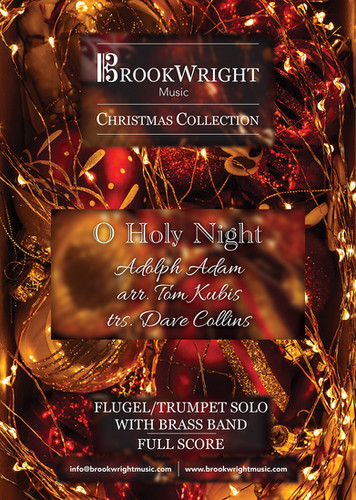
O Holy Night (Flugel/Trumpet Solo with Band) arr. Tom Kubis trs. Dave Collins
This stunning arrangement of O Holy Night, showcases the lyrical and expressive potential of the Flugel Horn or Trumpet, arranged by acclaimed jazz composer Tom Kubis and transcribed by Dave Collins. Originally made famous by the legendary Wayne Bergeron with the Tom Kubis Big Band, this arrangement has since become a favourite among brass soloists worldwide. It received its concert premiere with the North York Temple Band (Canada) under Bandmaster Glenn Barlow, featuring the virtuosic talents of Marcus and Harrington Venables. The piece was later recorded by the International Staff Band, conducted by Dr. Stephen Cobb, on their 2016 album Celebrate the Season. The featured soloist on that recording was the world-renowned Philip Cobb. This arrangement offers flexible performance options - it can be presented as a solo feature or as a duet for Flugel Horn and Soprano Cornet (cued into the parts), making it ideal for both concert settings and festive performances. To view a video of Philip Cobb performing the solo with the International Staff Band, please visit www.youtube.com/watch?v=1x_hjZyDjrA&list=RD1x_hjZyDjrA&start_radio=1 Duration: approx. 3.45 minutes Difficulty Level: 3rd Section + PDF download includes parts and score. Sheet music available at www.brassband.co.uk (UK) or www.cimarronmusic.com (USA) Instrumentation: Flugel Horn/Trumpet Soloist Bb Soprano Cornet Eb Solo Cornet Bb Repiano Cornet Bb 2nd Cornet Bb 3rd Cornet Bb Flugel Horn Bb Solo Horn Eb 1st Horn Eb 2nd Horn Eb 1st Baritone Bb 2nd Baritone Bb 1st Trombone Bb 2nd Trombone Bb Bass Trombone Euphonium Bb Bass Eb Bass Bb Bass Drum Percussion 1-3
In Stock: Estimated dispatch 1-3 working days
-
 £33.35
O Little One Sweet (Brass Band) J.S Bach arr. Andrew Wainwright
This delightful German lullaby-carol first appeared in print in Samuel Scheidt's Tablaturbuch of 1650, though it may have been written before then, either by Scheidt himself or by an unknown author. J. S. Bach's version (in the form of a melody and figured bass) was included in Schemelli's Gesangbuch of 1736, and it is that which this arrangement for brass band by Andrew Wainwright is based on. This setting includes all four verses. To view a rolling score video of the work please visit https://www.youtube.com/watch?v=YryayLe_uJo Duration: Approx. 3.45 minutes Difficulty Level: 4th Section + PDF download includes parts and score. Sheet music available from www.brassband.co.uk (UK) or www.cimarronmusic.com (USA) Instrumentation: Soprano Cornet Eb Solo Cornet Bb Repiano Cornet Bb 2nd Cornet Bb 3rd Cornet Bb Flugel Horn Bb Solo Horn Eb 1st Horn Eb 2nd Horn Eb 1st Baritone Bb 2nd Baritone Bb 1st Trombone Bb 2nd Trombone Bb Bass Trombone Euphonium Bb Bass Eb Bass BbTimpani
In Stock: Estimated dispatch 1-3 working days
-
 £33.35
Polka from 'The Bartered Bride' (Brass Band) Smetana arr. Rob Bushnell
Considered a major contribution to the develop of Czech music, The Bartered Bride by Bedrich Smetana is a comic opera in three acts that premiered, in its final version, in 1870; having not been a great success when the original two-act version premiered at the Provisional Theatre, Prague on 30 May 1866. The opera was part of Smetana's aim to create a native Czech music after the conductor Johann von Herbeck commented that Czechs were incapable of making music of their own. Whilst he avoided the direct use of folksongs, Smetana did use numerous traditional Bohemian dance forms, such as the furiant and the polka, leading to music that was Czech in spirit. 'Sold Bride', a more accurate translation of the original Czech title (Prodana nevesta), tells the story of two lovers (Marenka and Jenik) who want to marry despite Marenka's father's obligations for his daughter to marry the son of a wealthy landowner, Micha. Scheming, condition proposals and secret identities leads to a happy ending. The polka was not in the original 1866 version. A revision in October 1866 saw the addition of a gypsy dance near the start of act 2. But by the next performance in January 1869, this had been replaced by a polka. In June 1869, a new polka replaced the January version's (as well as being moved to the end of act 1) and this is the one that we know and love today. This arrangement is for British-style brass band, with *alternative parts for horns in F and bass-clef lower brass. Instrumentation: Soprano Cornet Eb Solo Cornet Bb Repiano Cornet Bb 2nd Cornet Bb 3rd Cornet Bb Flugel Horn Bb Solo Horn Eb* 1st Horn Eb* 2nd Horn Eb* 1st Baritone Bb* 2nd Baritone Bb* 1st Trombone Bb* 2nd Trombone Bb* Bass Trombone Euphonium Bb* Bass Eb* Bass Bb* Timpani Percussion (Triangle, Cymbal(s) & Bass Drum)
In Stock: Estimated dispatch 1-3 working days
-
 £37.06
Polonaise from 'Scenes de Ballet' (Brass Band) Glazunov arr. Rob Bushnell
Alexander Glazunov was a Russian composer who was a gifted musician from childhood. He was seen as the natural heir to the nationalist revolution that had started with the Mighty Handful. Despite quickly turning from this to absolute forms of music, taking a keen interest in ballet music, his compositions still alludes to Russian folk tunes. He wrote four dance compositions, of which Scenes de Ballet was the first in 1894. The suite Scenes de Ballet, opus 52 has eight movements and was dedicated to the orchestra of the Russian Opera, St Petersburg. First performed in 1895 at a concert of the Imperial Music Society with Glazunov conducting. This arrangement of the final movement is for the British-style brass band, with alternative parts for horns in F and bass-clef lower brass. A recording of the original composition can be found here: https://www.youtube.com/watch?v=BS-Yx-bmxPg Duration: approx. 5.20 minutes Difficulty Level: 2nd Section + PDF download includes parts and score. Sheet music available at www.brassband.co.uk (UK) or www.cimarronmusic.com (USA) Instrumentation: Soprano Cornet Eb Solo Cornet Bb Repiano Cornet Bb 2nd Cornet Bb 3rd Cornet Bb Flugel Horn Bb Solo Horn Eb 1st Horn Eb 2nd Horn Eb 1st Baritone Bb 2nd Baritone Bb 1st Trombone Bb 2nd Trombone Bb Bass Trombone Euphonium Bb Bass Eb Bass Bb Timpani Percussion 1 - Snare Percussion 2 - Triangle, Cymbal & Bass Drum
In Stock: Estimated dispatch 1-3 working days
 Watch video