
Results
-
 £7.47
£7.47The Lord Bless You and Keep You (Brass Band - Additional Parts) John Rutter
John Rutter's popular choral benediction is based on Numbers 6:24-26, and has here been arranged for brass band by Andrew Wainwright. It is a setting of a biblical benediction, followed by an extended 'Amen'. Rutter originally scored the piece for four vocal parts (SATB) and organ. He composed it in 1981 for the memorial service of Edward T. Chapman, the director of music at Highgate School, London, with whom he had studied when he attended the school. To view a rolling score video with Wellington Brass performing the work please visit www.youtube.com/watch?v=ijJ2Nir3wRQ PDF download includes additional parts as listed below. Full set including score available here. Sheet music available from: UK - www.brassband.co.uk USA - https://satradecentral.org Difficulty Level: 4th Section + Alternative Parts included in this download: Solo Horn F 1st Horn F 2nd Horn F 1st Baritone B.C. 2nd Baritone B.C. 1st Trombone B.C. 2nd Trombone B.C. Euphonium B.C. Tuba 1 B.C. Tuba 2 B.C.
In Stock: Estimated dispatch 1-3 working days
-
 £49.95
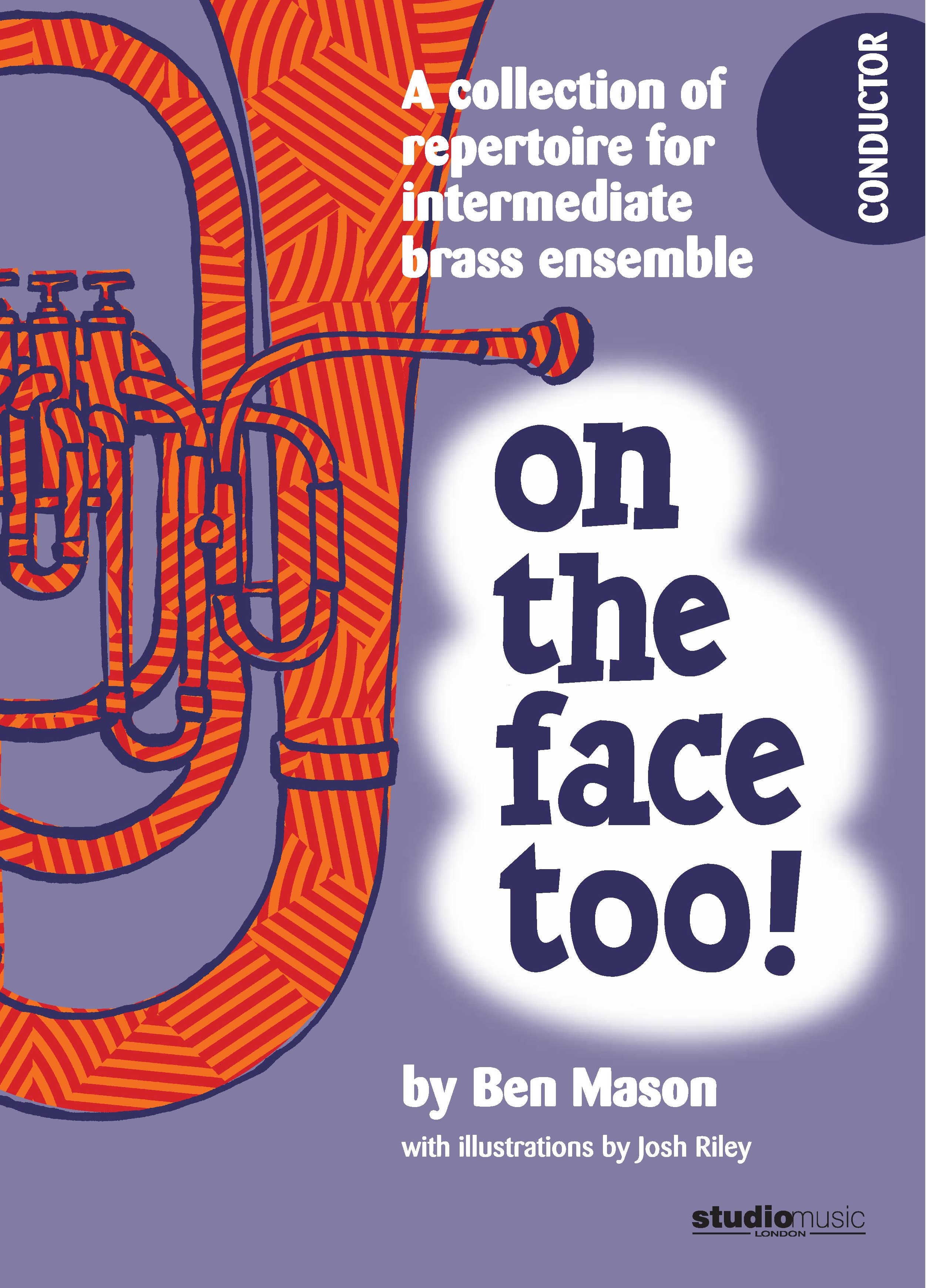
On the Face Too! (Value Set)
Value Set includes: a score and one of each part:Part A: Trumpet 1 in BbPart B: Trumpet 2 in BbPart C: Horn in EbPart C: Horn in FPart C: Trombone/Euphonium TCPart C: Trombone/Euphonium BCPart D: Trombone TCPart D: Trombone BCPart D: Bass in EbPart D: Tuba BDPercussionAdditional score and parts are also available individually.On the Face Too! is to the secondary school brass teacher as On the Face! is to the primary: namely a collection of pieces for intermediate brass ensemble in various jazz and popular styles, aiming to give a ready supply of material for concerts and assemblies, which nevertheless still allows for the developing technique of the young players to whom it is addressed.Generally speaking, the technical difficulty of the material here goes no further than grade 4 or 5 (even the first trumpet part never goes higher than a written G), though some pieces will offer considerable rhythmic challenges.
Estimated dispatch 7-14 working days
-
 £48.56
Finale from Symphony No.3 (Organ Symphony) (Brass Band) Saint-Saens arr. Norbury
Saint-Saens' magnificent Finale from Symphony No.3 (widely known as the 'Organ Symphony') has here been arranged for brass band with optional organ by Kevin Norbury. It was recorded by The International Staff Band on its CD Manuscripts, although this version has been revised in places. Saint-Saens decided to add the organ and piano to his 3rd symphony as a pragmatic orchestration innovation. The composition of this symphony was probably started in 1885 and a first draft was completed in Prague in 1886. Saint-Saens later recalled its eventful genesis: 'The Symphony in C was three-quarters sketched out when I found it impossible to write the finale. I did not know how to resolve this situation, until one night I suddenly woke up and, in a sort of hallucination, I heard the whole finale, which I hastily wrote down in outline, knowing that if I went back to sleep without having put anything on paper, I would have forgotten it all the next day.' The symphony was first performed under the composer's direction at Saint James's Hall in London on May 19, 1886. This arrangement by Kevin Norbury can both function as a stand-alone brass band piece, and be performed with an organ by omitting the notes found in square brackets in the parts and score. To view a rolling score video please visit www.youtube.com/watch?v=OlUd_FppBY8 PDF download includes score and parts. Additional parts (Horn in F and Baritone, Trombone, Euphonium & Tuba in Bass Clef) available here. Sheet music available from: UK - www.brassband.co.uk USA - https://satradecentral.org Difficulty Level: 1st Section + Length: 8.30 minutes Instrumentation: Soprano Cornet Eb Solo Cornet Bb Repiano Cornet Bb 2nd Cornet Bb 3rd Cornet Bb Flugel Horn Bb Solo Horn Eb 1st Horn Eb 2nd Horn Eb 1st Baritone Bb 2nd Baritone Bb 1st Trombone Bb 2nd Trombone Bb Bass Trombone Euphonium Bb Bass Eb Bass Bb Timpani Glockenspiel Percussion Organ (optional)
In Stock: Estimated dispatch 1-3 working days
-
 £67.24
Letters from Flanders (Brass Band) Andrew Batterham
This descriptive work by Australian composer Andrew Batterham portrays the experiences of his maternal grandfather, Corporal Reginald Littlejohns, (4th Australian Machine Gun Battalion) in the First World War. Reginald left Melbourne for Europe in May 1916 then served in Flanders through to the end of the war. He returned in April 1919, having sent hundreds of letters home during his service. His honest, articulate, and highly descriptive prose served as inspiration for this piece. Each of the 5 movements portrays a different aspect of Reginald's war, with a quote from his letters included. The first movement was premiered by the Box Hill City Band, conducted by Matt van Emmerik, in Melbourne. Daniel van Bergen conducted Booroondara Brass performing most of the work in April 2019, and Box Hill premiered the complete version in November 2019 conducted by Simon Brown. The work is comprised of the following movements: i. The World at War ii. Over the Sea iii. Passchendaele iv. Homecoming Parade v. Elegy Length: c.12.00 minutes PDF download includes score and parts. Sheet music available from www.brassband.co.uk Difficulty Level: 1st Section + Instrumentation: Soprano Cornet Eb Solo Cornet Bb Repiano Cornet Bb 2nd Cornet Bb 3rd Cornet Bb Flugel Horn Bb Solo Horn Eb 1st Horn Eb 2nd Horn Eb 1st Baritone Bb 2nd Baritone Bb 1st Trombone Bb 2nd Trombone Bb Bass Trombone Euphonium Bb Bass Eb Bass Bb Percussion 1-3
In Stock: Estimated dispatch 1-3 working days
-
 £29.95
Cafe 1719 - Jonathan Bates
DURATION: 2'30". DIFFICULTY: 1st Section+. 'Caf 1719' was composed for the Wantage Silver Band as part of their entertainment contest sets based on the music of Johann Sebastian Bach in 2019. This particular short, jazz-inspired work is composed in tribute to the great French Pianist Jacques Loussier (1934-2019) who received global acclaim for his jazz interpretations of Bach's music, along with many other classical composers. Despite being born in the same year and living in the same country, Bach and Handel never actually met, but what if they had? Cafe 1917 acts as a musical meeting point - in a fictional Jazz Cafe by the Rhine, with the tenor horn section performing a 'Loussier-esque' version of Bach's 'Prelude No.2 in C Minor' whilst on the other side of the cafe, the trombone section follow suit with their take on Handel's 'Bourree from Music for the Royal Fireworks'. Eventually the two meet, share ideas and incorporate them into each other's melodies. Amongst the 2 main featured works by Bach and Handel, the tutti interludes are constructed on music from Bach's 'Toccata and Fugue in D Minor'. .
In Stock: Estimated dispatch 1-3 working days
-
 £24.95
The Pilgrim's Prayer (Brass Band - Score and Parts) - Rouse, Sydney - Ball, Eric
Introduction - This could hardly be more simple. Inexperienced players may have some little difficulty in intonation, especially as they are starting 'cold', but a useful lesson can be learned in this connection when rehearsing these two bars. Section A - The music is hymn tune-like in character, but it should not become stilted. Close intonation is still a point to study, especially in view of the chromatic nature of some of the harmony. Section B - Aim to secure just balance in the accompanying parts, especially in the second phrase, where the 1st comets may be inclined to treat their moving part as an independent melody rather than part of the 'colour' background. Section C -This is a reprise of the first theme, with a different arrangement. The same comments apply, however. Section D - Here the music becomes more song-like in style, and provides an interesting contrast. The scoring, too, is more varied, and there are a number of points that call for attention. Note that the 1st and 2nd comets and 2nd trombone work as a team throughout; see that the pulsating, syncopated background adds to the movement of the music without giving a jerky effect; the new entries in the fourth and twelfth bars are to be made quite smoothly; and do not allow the texture of the music, especially in the last eight bars of the section, to overshadow the simplicity of the main tune. Section E - Here the first subject appears again. In the arrangement the colour contrasts are quite clear-cut. In order to secure true balance in the fifth and sixth bars, it may be necessary to adjust the amount of tone given by the bass trombone, as this part is not doubled as are the other parts. Section F -This section forms a simple but expressive coda.
Estimated dispatch 7-14 working days
-
£12.50
The Pilgrim's Prayer (Brass Band - Score only) - Rouse, Sydney - Ball, Eric
Introduction - This could hardly be more simple. Inexperienced players may have some little difficulty in intonation, especially as they are starting 'cold', but a useful lesson can be learned in this connection when rehearsing these two bars. Section A - The music is hymn tune-like in character, but it should not become stilted. Close intonation is still a point to study, especially in view of the chromatic nature of some of the harmony. Section B - Aim to secure just balance in the accompanying parts, especially in the second phrase, where the 1st comets may be inclined to treat their moving part as an independent melody rather than part of the 'colour' background. Section C -This is a reprise of the first theme, with a different arrangement. The same comments apply, however. Section D - Here the music becomes more song-like in style, and provides an interesting contrast. The scoring, too, is more varied, and there are a number of points that call for attention. Note that the 1st and 2nd comets and 2nd trombone work as a team throughout; see that the pulsating, syncopated background adds to the movement of the music without giving a jerky effect; the new entries in the fourth and twelfth bars are to be made quite smoothly; and do not allow the texture of the music, especially in the last eight bars of the section, to overshadow the simplicity of the main tune. Section E - Here the first subject appears again. In the arrangement the colour contrasts are quite clear-cut. In order to secure true balance in the fifth and sixth bars, it may be necessary to adjust the amount of tone given by the bass trombone, as this part is not doubled as are the other parts. Section F -This section forms a simple but expressive coda.
Estimated dispatch 7-14 working days