
Results
-
 £12.50
Lloyd (Brass Band - Score only) - Howard, Cuthbert - Coles, Bramwell
The first presentation of the theme can be used for the purpose of accompanying congregational singing. At Section A the second presentation of the tune appears in the key of the dominant, the melody being given throughout to Solo Horn, with First Horn, First Trombone, Soprano and Flugel reinforcing the melody in the various phrases. Incidentally, see that the players do not break these phrases; it should be possible to take the four bars in one breath quite easily. Take due care of the light and shade which should be delicately applied. In the last bar the music gathers strength as we pass back into the original key for the last verse; pay particular attention to the part allotted to Second Baritone and Euphonium which needs to be slightly stressed. For the last appearance of the tune at Section B the full Band is used, apart from the third phrase which is given solo by Solo Comet with a light accompaniment above a bass pedal. Notice the rit. operating from the end of the eleventh bar and also the short swell effect on the fourth beat of the fourteenth bar.
Estimated dispatch 7-14 working days
-
£44.95
None Other Name (Brass Band - Score and Parts) - Leidzen, Erik
None Other Name was written for the 1960 tour of England by the New York Staff Band of The Salvation Army and can justifiably be termed a classic of brass band repertoire. It is best described as a symphonic medley of six songs focused on the name of Christ; The Saviour's Name; Jesus is the Sweetest Name I know; There's a Wonderful Name, 'tis Jesus; He's the Lily of the Valley; Jesus, the Very Thought of Thee (St. Agnes); All Hal the Power of Jesus' Name (Diadem).
Estimated dispatch 7-14 working days
-
£22.50
None Other Name (Brass Band - Score only) - Leidzen, Erik
None Other Name was written for the 1960 tour of England by the New York Staff Band of The Salvation Army and can justifiably be termed a classic of brass band repertoire. It is best described as a symphonic medley of six songs focused on the name of Christ; The Saviour's Name; Jesus is the Sweetest Name I know; There's a Wonderful Name, 'tis Jesus; He's the Lily of the Valley; Jesus, the Very Thought of Thee (St. Agnes); All Hal the Power of Jesus' Name (Diadem).
Estimated dispatch 7-14 working days
-
 £44.95
Princethorpe Variations (Brass Band - Score and Parts) - Downie, Kenneth
Colourful harmony, rhythmic flair and melodic invention are the hallmarks of this excellent set of variations by Kenneth Downie, based on the well known church tune, Princethorpe.This major work demonstrates the well-known characteristics of the composer: colourful harmony, rhythmic flair and melodic invention, all encapsulated in scoring which is engulfing both to players and listeners alike. Following a presentation of the theme there are five variations culminating in what can be described as either a finale or coda.Theme. The composer shows his originality in the harmonic sense of this introduction. Perhaps it could be suggested that over-indulgence of rubato may be a temptation to be avoided.Sections A to F. Relentless rhythmic drive is of paramount importance in this first variation. Conscientious observance of dynamics is of course an essential requirement in conveying the exciting quality of the music; there are moments of sudden contrast of which all will need to be aware. Moving between the time-signatures of 5/4 and 6/4 these sections are built from strong easily-identifiable fragments of the theme. These is a significant increase in temp at letter F which will further the exciting impact of the music.Sections G & H. In a pastorale style this short, gentle variation affords a contrast in style between the previous and succeeding ones. The gentle undulating character of the melodic lines is governed by the Allegretto grazioso directive.Sections I to M. Commencing two bars before letter I the music is now exuberant and the tempo and style is that of a march in compound time. In this exhilarating movement there are moments of contrast and indeed of delicacy which are a foil to the more energetic moments. Rhythmic control will be essential to maintain a consistent tempo. As elsewhere in the work, the percussion section will contribute much to the success of the performance there are bars where this section alone is heard and there are important entries for glockenspiel.Sections N & O. With emotional content this Adagio variation has the first two notes of the melody as its melodic impetus. Apart from just over two bars at O (where there is an interpolatory phrase from Cornets and Trombones), the melodic line is entrusted to the plaintive sounds of the horn section. Cornets and Trombones provide a change of tone colour at the beginning of section O. Under a poco rall, this very expressive variation is concluded; there is an important link supplied by Eb Bass.Sections P & Q. A lively march-tempo is launched immediately and these sections are in the nature of an introduction to the final variations. There is a quickening of pace at Q which assists the generation of excitement which should be an essential part of the performance. Solo Cornets introduce a melodic line at Q which anticipates the compound time of the following section.Sections R & S. The Solo Cornet theme of the previous section is now a contrapuntal line accompanying the theme tune. With an elongation of the notes in the melody, the conductor will need to call on the sustaining powers of the band and at no time should the interesting accompanying lines be allowed to detract from the sonorous presentation of the basic theme.Sections T, U & V. Following a poco rit, the finale begins at letter T with the directive, molto vivace. There is much detail to be rehearsed, not least being the dynamic contrasts which are encountered. As throughout the work, the listener should have no difficulty in identifying the thematic sources of the composer's music.
Estimated dispatch 7-14 working days
-
£22.50
Princethorpe Variations (Brass Band - Score only) - Downie, Kenneth
Colourful harmony, rhythmic flair and melodic invention are the hallmarks of this excellent set of variations by Kenneth Downie, based on the well known church tune, Princethorpe.This major work demonstrates the well-known characteristics of the composer: colourful harmony, rhythmic flair and melodic invention, all encapsulated in scoring which is engulfing both to players and listeners alike. Following a presentation of the theme there are five variations culminating in what can be described as either a finale or coda.Theme. The composer shows his originality in the harmonic sense of this introduction. Perhaps it could be suggested that over-indulgence of rubato may be a temptation to be avoided.Sections A to F. Relentless rhythmic drive is of paramount importance in this first variation. Conscientious observance of dynamics is of course an essential requirement in conveying the exciting quality of the music; there are moments of sudden contrast of which all will need to be aware. Moving between the time-signatures of 5/4 and 6/4 these sections are built from strong easily-identifiable fragments of the theme. These is a significant increase in temp at letter F which will further the exciting impact of the music.Sections G & H. In a pastorale style this short, gentle variation affords a contrast in style between the previous and succeeding ones. The gentle undulating character of the melodic lines is governed by the Allegretto grazioso directive.Sections I to M. Commencing two bars before letter I the music is now exuberant and the tempo and style is that of a march in compound time. In this exhilarating movement there are moments of contrast and indeed of delicacy which are a foil to the more energetic moments. Rhythmic control will be essential to maintain a consistent tempo. As elsewhere in the work, the percussion section will contribute much to the success of the performance there are bars where this section alone is heard and there are important entries for glockenspiel.Sections N & O. With emotional content this Adagio variation has the first two notes of the melody as its melodic impetus. Apart from just over two bars at O (where there is an interpolatory phrase from Cornets and Trombones), the melodic line is entrusted to the plaintive sounds of the horn section. Cornets and Trombones provide a change of tone colour at the beginning of section O. Under a poco rall, this very expressive variation is concluded; there is an important link supplied by Eb Bass.Sections P & Q. A lively march-tempo is launched immediately and these sections are in the nature of an introduction to the final variations. There is a quickening of pace at Q which assists the generation of excitement which should be an essential part of the performance. Solo Cornets introduce a melodic line at Q which anticipates the compound time of the following section.Sections R & S. The Solo Cornet theme of the previous section is now a contrapuntal line accompanying the theme tune. With an elongation of the notes in the melody, the conductor will need to call on the sustaining powers of the band and at no time should the interesting accompanying lines be allowed to detract from the sonorous presentation of the basic theme.Sections T, U & V. Following a poco rit, the finale begins at letter T with the directive, molto vivace. There is much detail to be rehearsed, not least being the dynamic contrasts which are encountered. As throughout the work, the listener should have no difficulty in identifying the thematic sources of the composer's music.
Estimated dispatch 7-14 working days
-
£59.95
The Lord is King (Brass Band - Score and Parts) - Steadman-Allen, Ray
Ray Steadman-Allen was for many years the driving force in Salvation Army music. His publication list of both brass and vocal works can be measured literally by the hundred. 'The Lord is King' is arguably his crowning achievement of over twenty major works for brass band. Although described as a suite, the work is more symphonic in conception and scale as well as being formidable to perform. The work is based on the Welsh hymn tune 'Llangollen' to which the hymn 'The Lord is King, I own His power' are associated. The three movements derive inspiration from the lines 'My joy, my toil, my craftman's skill, all have their place, and serve His will' found in verse five of the hymn.
Estimated dispatch 7-14 working days
-
£29.95
The Lord is King (Brass Band - Score only) - Steadman-Allen, Ray
Ray Steadman-Allen was for many years the driving force in Salvation Army music. His publication list of both brass and vocal works can be measured literally by the hundred. 'The Lord is King' is arguably his crowning achievement of over twenty major works for brass band. Although described as a suite, the work is more symphonic in conception and scale as well as being formidable to perform. The work is based on the Welsh hymn tune 'Llangollen' to which the hymn 'The Lord is King, I own His power' are associated. The three movements derive inspiration from the lines 'My joy, my toil, my craftman's skill, all have their place, and serve His will' found in verse five of the hymn.
Estimated dispatch 7-14 working days
-
£24.95
The Pilgrim's Prayer (Brass Band - Score and Parts) - Rouse, Sydney - Ball, Eric
Introduction - This could hardly be more simple. Inexperienced players may have some little difficulty in intonation, especially as they are starting 'cold', but a useful lesson can be learned in this connection when rehearsing these two bars. Section A - The music is hymn tune-like in character, but it should not become stilted. Close intonation is still a point to study, especially in view of the chromatic nature of some of the harmony. Section B - Aim to secure just balance in the accompanying parts, especially in the second phrase, where the 1st comets may be inclined to treat their moving part as an independent melody rather than part of the 'colour' background. Section C -This is a reprise of the first theme, with a different arrangement. The same comments apply, however. Section D - Here the music becomes more song-like in style, and provides an interesting contrast. The scoring, too, is more varied, and there are a number of points that call for attention. Note that the 1st and 2nd comets and 2nd trombone work as a team throughout; see that the pulsating, syncopated background adds to the movement of the music without giving a jerky effect; the new entries in the fourth and twelfth bars are to be made quite smoothly; and do not allow the texture of the music, especially in the last eight bars of the section, to overshadow the simplicity of the main tune. Section E - Here the first subject appears again. In the arrangement the colour contrasts are quite clear-cut. In order to secure true balance in the fifth and sixth bars, it may be necessary to adjust the amount of tone given by the bass trombone, as this part is not doubled as are the other parts. Section F -This section forms a simple but expressive coda.
Estimated dispatch 7-14 working days
-
£12.50
The Pilgrim's Prayer (Brass Band - Score only) - Rouse, Sydney - Ball, Eric
Introduction - This could hardly be more simple. Inexperienced players may have some little difficulty in intonation, especially as they are starting 'cold', but a useful lesson can be learned in this connection when rehearsing these two bars. Section A - The music is hymn tune-like in character, but it should not become stilted. Close intonation is still a point to study, especially in view of the chromatic nature of some of the harmony. Section B - Aim to secure just balance in the accompanying parts, especially in the second phrase, where the 1st comets may be inclined to treat their moving part as an independent melody rather than part of the 'colour' background. Section C -This is a reprise of the first theme, with a different arrangement. The same comments apply, however. Section D - Here the music becomes more song-like in style, and provides an interesting contrast. The scoring, too, is more varied, and there are a number of points that call for attention. Note that the 1st and 2nd comets and 2nd trombone work as a team throughout; see that the pulsating, syncopated background adds to the movement of the music without giving a jerky effect; the new entries in the fourth and twelfth bars are to be made quite smoothly; and do not allow the texture of the music, especially in the last eight bars of the section, to overshadow the simplicity of the main tune. Section E - Here the first subject appears again. In the arrangement the colour contrasts are quite clear-cut. In order to secure true balance in the fifth and sixth bars, it may be necessary to adjust the amount of tone given by the bass trombone, as this part is not doubled as are the other parts. Section F -This section forms a simple but expressive coda.
Estimated dispatch 7-14 working days
-
 £60.99
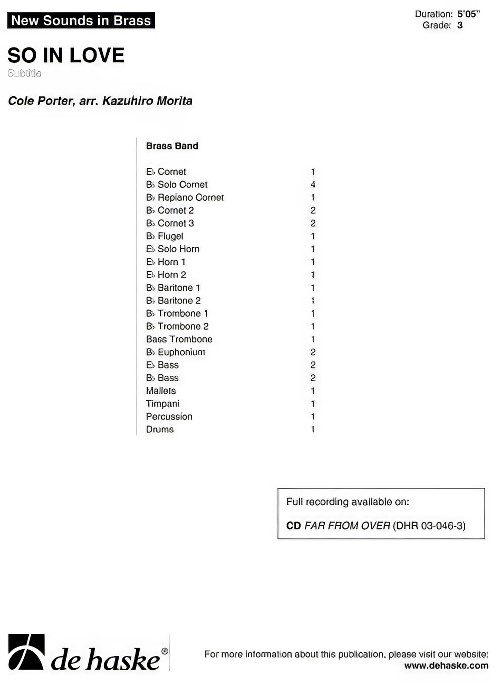
So in Love (Brass Band - Score and Parts) - Porter, Cole - Morita, Kazuhiro
Cole Porter was one of the great masters of Broadway musicals during the thirties, forties and fifties, with So in Love, from the musical Kiss Me Kate, being one of his best loved works. It has been recorded by many artists including Bing Crosby, Lulu, Shirley Bassey and Julie Andrews, however it is the Ella Fitzgerald version that is best known. This jazzy musical classic can now be enjoyed by your brass band with this excellent new arrangement.Duration: 5:00
Estimated dispatch 7-14 working days
 View Music