
Results
-
 £33.62
Fanfare Prelude - Now thank we all our God (Brass Band & Organ) arr. Downie
This rousing fanfare prelude for Brass Band and optional Organ by Kenneth Downie is based on the monumental hymn Now thank we all our God, which dates from 17th century Germany. The arrangement is featured on the CD Classic Hymns for Orchestra - The Symphonic Music of Kenneth Downie (available here) as a symphonic brass setting. The arranger writes: 'The depth of the words is underpinned by the grandeur of the music, so I have tried to reflect the same regal approach in my setting for brass band.' This arrangement will be an ideal opener or prelude for concerts or church services. To view a rolling score video of the work please visit www.youtube.com/watch?v=olrdFskDfac PDF download includes score and parts. Additional parts for Horns in F, and Baritone, Trombone, Euphonium and Tuba in bass clef are available here. Sheet music available from: UK - www.brassband.co.uk USA - https://satradecentral.org Difficulty Level: 2nd Section + Length: 3.15 minutes Instrumentation: Soprano Cornet Eb Solo Cornet Bb 1st Cornet Bb 2nd Cornet Bb Flugel Horn Bb Solo Horn Eb 1st Horn Eb 2nd Horn Eb 1st Baritone Bb 2nd Baritone Bb 1st Trombone Bb 2nd Trombone Bb Bass Trombone Euphonium Bb Bass Eb Bass Bb Timpani Percussion 1-3 Organ (optional)
In Stock: Estimated dispatch 1-3 working days
-
 £7.47
£7.47Fanfare Prelude - Now thank we all our God arr. Downie (Additional Parts)
This rousing fanfare prelude for Brass Band and optional Organ by Kenneth Downie is based on the monumental hymn Now thank we all our God, which dates from 17th century Germany. The arrangement is featured on the CD Classic Hymns for Orchestra - The Symphonic Music of Kenneth Downie (available here) as a symphonic brass setting. The arranger writes: 'The depth of the words is underpinned by the grandeur of the music, so I have tried to reflect the same regal approach in my setting for brass band.' This arrangement will be an ideal opener or prelude for concerts or church services. To view a rolling score video of the work please visit https://www.youtube.com/watch?v=olrdFskDfac PDF download includes score and parts. Sheet music available from: UK - www.brassband.co.uk USA - https://satradecentral.org Difficulty Level: 2nd Section + Length: 3.15 minutes PDF download includes additional parts as listed below. Full set including score available here. Alternative Parts included in this download: Solo Horn F 1st Horn F 2nd Horn F 1st Baritone B.C. 2nd Baritone B.C. 1st Trombone B.C. 2nd Trombone B.C. Euphonium B.C. Tuba 1 B.C. Tuba 2 B.C.
In Stock: Estimated dispatch 1-3 working days
-
 £33.62
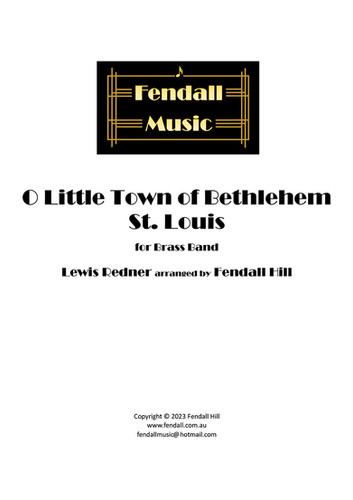
O Little Town (St Louis) (Brass Band) Redner arr. Fendall Hill
This arrangement of O Little Town of Bethlehem is based on the beloved carol text by Phillips Brooks (1835-1893), set to the familiar St. Louis tune composed by Lewis Redner in 1868. Originally written for a Christmas Sunday school service, the melody famously came to Redner in a dream the night before it was needed - an origin story that mirrors the spontaneous inspiration behind this brass band setting. Fendall Hill's arrangement was prepared for Sovereign Brass (Wednesbury, England) and included in their 2023 Christmas CD. Lyrical and reverent, this version captures the timeless beauty of the carol while offering a fresh voice for modern brass ensembles. To view a rolling score video featuring Sovereign Brass's CD recording please visit: https://www.youtube.com/watch?v=HaMTVQl57ug Difficulty Level: 4th Section + PDF download includes parts and score. Sheet music available at www.brassband.co.uk (UK) or https://satradecentral.org (USA) Instrumentation: Soprano Cornet Eb Solo Cornet Bb Repiano Cornet Bb 2nd Cornet Bb 3rd Cornet Bb Flugel Horn Bb Solo Horn Eb 1st Horn Eb 2nd Horn Eb 1st Baritone Bb 2nd Baritone Bb 1st Trombone Bb 2nd Trombone Bb Bass Trombone Euphonium Bb Bass Eb Bass Bb Percussion 1-2
In Stock: Estimated dispatch 1-3 working days
-
 £29.88
Sweet Hour of Prayer (Brass Band) William Bradbury arr. Kenneth Downie
Arranged with sensitivity and reverence, this beautiful brass band setting by Kenneth Downie of Sweet Hour of Prayer captures the gentle, reflective spirit of William Bradbury's beloved hymn. Inspired by the heartfelt lyrics of William W. Walford's original text, the arrangement seeks to emulate its winsome quality - offering performers and audiences alike a moment of calm, spiritual reassurance. Set for a medium sized band, this arrangement will be accessible to bands with as few as 16 players, but equally as effective for full band. To view a rolling score video of the piece please visit https://www.youtube.com/watch?v=jLsVMW4E7LM Difficulty Level: 4th Section + PDF download includes parts and score. Sheet music available at www.brassband.co.uk (UK) or https://satradecentral.org (USA) Instrumentation: Soprano Cornet Eb 1st Cornet Bb 2nd Cornet Bb Flugel Horn Bb 1st Horn Eb 2nd Horn Eb 1st Baritone Bb 2nd Baritone Bb 1st Trombone Bb 2nd Trombone Bb Bass Trombone Euphonium Bb Bass Eb Bass Bb (Percussion Tacet)
In Stock: Estimated dispatch 1-3 working days
-
 £33.62
The Wexford Carol (Brass Band) Irish Trad. arr. Andrew Wainwright
This stunning arrangement for brass band by Andrew Wainwright of the beautiful Irish carol depicts perfectly the wintery moods and landscapes evocative of the Irish countryside. The Wexford Carol is a traditional Irish Christmas carol that originated in County Wexford in the 19th century. The carol tells the story of the birth of Jesus Christ and the journey of the Magi to Bethlehem. It is written in a simple and elegant style, and its melody is both beautiful and haunting. This arrangement is a lush and evocative setting of the traditional carol. The arrangement features a rich tapestry of textures and gradually builds in intensity as the carol progresses, before fading out to a quiet, haunting conclusion. PDF download includes score and parts. Sheet music available from: UK - www.brassband.co.uk USA - www.solidbrassmusic.com Difficulty Level: 3rd Section + Instrumentation: Soprano Cornet Eb Solo Cornet Bb Repiano Cornet Bb 2nd Cornet Bb 3rd Cornet Bb Flugel Horn Bb Solo Horn Eb 1st Horn Eb 2nd Horn Eb 1st Baritone Bb 2nd Baritone Bb 1st Trombone Bb 2nd Trombone Bb Bass Trombone Euphonium Bb Bass Eb Bass Bb Timpani Cymbals Tam-Tam Tuned Percussion
In Stock: Estimated dispatch 1-3 working days
-
 £59.99
Don't Stop Me Now - Christopher Bond
Although this tune by iconic band Queen met with a rather cool reception when it was first released in 1979, over the years it has become one of the bands most popular songs thanks in part to frequent use in advertising, television and film. Featuring trademark tight harmonies and a dramatic style shift from moderate ballad to double rock time, this arrangement will sound terrific even with young players. Note: whilst the demo video demonstrates the concert band arrangement, the version available to purchase on this website is the brass band transcription by Christopher Bond.
Estimated dispatch 10-14 working days
-
 £59.99
Moon River - Christopher Bond
Moon River is the title song of the famous 1961 motion picture Breakfast at Tiffany's. Over the years the song was covered by many major stars, turning it into an absolute evergreen around the world. The beauty of the melody is also suited for mellow sounding instruments like the Eb horn; a great reason to make this version for brass band and horn. This arrangement of Moon River received its premiere as part of Tongwynlais Temperance Band's winning 2017 Welsh Open programme, with soloist Emily Evans winning the soloist prize. The arrangement was since featured on Cory Band's CD release 'Destination Moon', recorded by Ailsa Russell.
Estimated dispatch 10-14 working days
-
 £45.00
Believe (From 'The Polar Express')
ABOUT THIS PIECE: Capture the magic and wonder of Christmas with this beautiful arrangement of Believe, from the beloved film The Polar Express. Composed by the award-winning songwriter Glen Ballard and legendary film composer Alan Silvestri, Believe is a heartwarming ballad that celebrates the themes of faith, hope, and the spirit of Christmas. Originally performed by Josh Groban, the song earned an Academy Award nomination and has become a seasonal favourite around the world. This arrangement brings the enchanting melody and emotional depth of the original to life, making it a perfect choice for Christmas concerts. Believe offers a wonderful opportunity for your band to connect with audiences and celebrate the magic of the holiday season. ENSEMBLE: Standard British Brass Band WHEN YOU BUY THIS PRODUCT, YOU GET: High-quality printed score and parts LEVEL: 1 LISTEN: DURATION: 4-minutes 40-seconds EXAMPLE SCORE: Click here LEVEL GUIDE: Level 1- Accessible to all Level 2 - c. UK third section and higher Level 3 - c. UK second section and higher Level 4 - c. UK first section and higher Level 5 - c. UK championship section level
Estimated dispatch 5-7 working days
-
 £39.99
Who Wants to Live Forever
ABOUT THIS PIECE: A stunning arrangement of Who Wants to Live Forever, originally performed by Freddie Mercury and Queen. Composed by Brian May for the iconic 1986 film Highlander, the song is renowned for its haunting melody and powerful lyrics, exploring themes of love, loss, and immortality. Mercury's emotive vocals and the song's orchestral grandeur have made it a timeless classic. This arrangement captures the depth and drama of the original while building to a bold and triumphant finale, making it an ideal choice as a closing piece for a half or full concert. Its dynamic range and emotional intensity provide a fantastic opportunity to showcase the band's expressive abilities. ENSEMBLE: Standard British Brass Band WHEN YOU BUY THIS PRODUCT, YOU GET: High-quality printed score and parts LEVEL: 2 LISTEN: Click here DURATION: 5-minutes EXAMPLE SCORE: Click here LEVEL GUIDE: Level 1- Accessible to all Level 2 - c. UK third section and higher Level 3 - c. UK second section and higher Level 4 - c. UK first section and higher Level 5 - c. UK championship section level
Estimated dispatch 5-7 working days
-
 £55.00
Italia
ABOUT THIS PIECE: Romance. Elegance. This is an exquisite arrangement of the song originally performed by Chris Botti and Andrea Bocelli: Italia. Composed by Chris Botti and David Foster, Italia is a heartfelt tribute to the beauty and passion of Italy, blending lush melodies with a sense of timeless sophistication. The original, featuring Botti's soaring trumpet lines and Bocelli's rich tenor voice, is celebrated for its emotional depth and breathtaking lyricism. This arrangement adapts those qualities for solo cornet, solo trombone, and brass band, offering a wonderful opportunity to explore the piece's expressive range and captivating musicality. ENSEMBLE: Cornet and Trombone with British Brass Band Accompaniment WHEN YOU BUY THIS PRODUCT, YOU GET: High-quality printed score and parts - DUE TO COPYRIGHT LAW THIS WORK IS ONLY AVAILABLE IN THE UK AND EUROPE LEVEL: 2 LISTEN: DURATION: 3-minutesEXAMPLE SCORE: Click here LEVEL GUIDE: Level 1- Accessible to all Level 2 - c. UK third section and higher Level 3 - c. UK second section and higher Level 4 - c. UK first section and higher Level 5 - c. UK championship section level
Estimated dispatch 5-7 working days
 Watch video