
Results
-
£29.95
INVINCIBLE ARMY, The (Brass Band Set) - Erik Leidzen
When the New York Staff Band toured England in 1960 they featured much new music written for them by Erik Leidzen, including this march. The trio section is in the unusual key (brass band pitch) of Db major, a major third away from the opening key of F major, rather than the more predictable subdominant of Bb major. This presents a technical and mental challenge to the players but provides a particularly brilliant sonority when played in tune!
Estimated dispatch 7-14 working days
-
£29.95
WADE IN THE WATER (Brass Band Set) - Leonard Ballantine
Wade in the Water is a Negro Spiritual made popular in 1962 by the Ramsey Lewis Trio. Further versions followed in 1968 by Big Mama Thornton and in 1997 by Eva Cassidy. The song is thought to be a coded message for slaves escaping to freedom and tells the fugitive to walk in the water, instead of on the land, where tracking dogs cannot follow human scent. This version for brass band is in swing style.
Estimated dispatch 7-14 working days
-
£34.95
JOYOUS CARILLON (Brass Band Set) - Norman Bearcroft
This music takes the form of a double trio (cornets and trombones) with full brass band accompaniment and is based on the composer's own Christmas song for female voices, 'Carol of the Bells'.
Estimated dispatch 7-14 working days
-
 £30.00
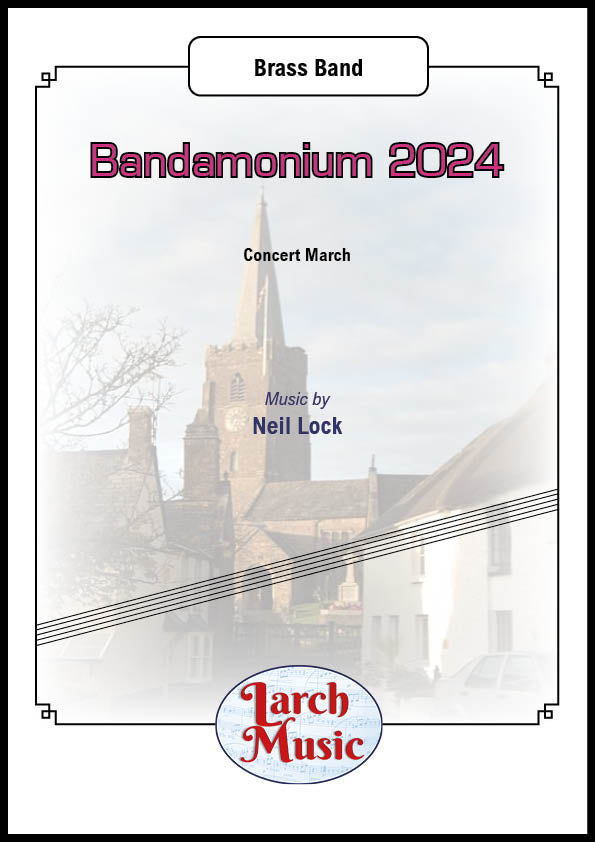
Bandamonium 2024 (Neil Lock) - Brass Band Sheet Music Full Score & Parts - LM541
COMPOSER: Neil LockThis march was submitted to the march composers' competition for "Bandamonium 3"in Hatherleigh, Devon in July 2024. The winning march was played by massed bands at the conclusion of the celebrations on Saturday 27th July 2024. Unfortunately, this march took second place in the competition, behind the march of Paul Pennicotte-Henrie, conductor of Okehampton Silver Band.The march can be played with or without the singing. (Even at the Whit Friday marches, begad!) I suggest that it should be introduced by 3-beat rolls.When played with singing, the "Bandamonium" lyrics (bars 10-13 and 56-57) are to be sung by all players, keeping to their own parts, with appropriate octave adjustment for their individual singing voices. Conductor and percussionists should sing with the main theme (Db and C at bars 10-13, F at 56-57). Listen to the 3rd cornet players!There is an additional part for Singers, in which the trio melody (bars 58 onwards) can be sung by Soprano and Tenor singers at a moderate choir standard. An octave-down option is also provided in the higher bars. This part can be given to "spare" singers within the band, or to singers external to the band if opportunity permits. The lyrics are:We are in Devon,We're in Hatherleigh,Whit Friday heaven,But we're marching free!Now it's past seven,Time to party,At BandamoniumIn Hatherleigh!LM541 - ISMN : 9790570005413
In Stock: Estimated dispatch 3-5 working days
-
£44.95
VICTOR, The (Brass Band Set) - Kenneth Downie
Written for the Melbourne Staff Band, this march features the hymn tune, 'Millennium'. While the origins of the tune are unclear, it has a distinct character; from the opening rising fourth interval through to its conclusion, it embodies strength and vigour. The composer has hinted at the style brilliantly employed by the great Australian march writer, Arthur Gullidge, by opting for a minor key in the first section offset by a melodious trio section in a major key.
Estimated dispatch 7-14 working days
-
£34.95
CANADIAN, The (Brass Band Set) - James Merritt
The centrepiece of this decidedly patriotic and stately march is the Canadian anthem 'O Canada' although the original score (1932) refers to a different set of words ('O Canaan'). The anthem is presented in successively more ornate fashion in the trio section, the musical drama building like a Sousa march so that a da capo is not required. While now considered to be bit of a 'war horse', the march remains great fun to play.
Estimated dispatch 7-14 working days
-
£34.95
MONTCLAIR CITADEL (Brass Band Set) - Stephen Bulla
Stephen Bulla is a former member of Monclair Citadel Band and gladly supplied Bandmaster Charles Baker with this fine march for a recording made by the band in 2001. The tune 'Onward Christian Soldiers' forms the bulk of the trio, first being tossed around in various registers and then, just the chorus, in the festive ending.
Estimated dispatch 7-14 working days
-
£34.95
CHOOSE FREEDOM (Brass Band Set) - Kenneth Downie
Choose Freedom is largely derived from the composers' own setting of Richard Slater's words, 'Yes, there flows a wondrous river' for SATB choir which was published in The Salvation Army's Choral Festival Series under the title 'The mighty river'.After many allusions to the song, it is eventually stated in full in the trio section. Downie's effective use of varying harmonic colours, unusual instrumental voicings and modal harmonies stand out in this rhythmically diverse march. There are quite a few loud passages in the march so conductors should savour the quieter ones!
Estimated dispatch 7-14 working days
-
£34.95
KINGS OF SWING (Brass Band Set) - Kevin Larsson
The opening features a cornet, trombone and tuba trio, intended to be the three kings, as they swing their way to Bethlehem using the classic Christmas carol, 'We three kings of Orient are'.
Estimated dispatch 7-14 working days
-
£29.95
WELLINGTONIAN, The (Brass Band Set) - Harold Scotney
Scotney immortalised his native town and corps in this march and also in 'Wellington Citadel'. In a departure from normal process, Scotney uses a Salvation Army song, 'A robe of white' in the first strain while the hymn-like trio section has no associated text.
Estimated dispatch 7-14 working days
