
Results
-
 £82.95
Occasion (Brass Band - Score and Parts)
Occasion was published especially for the National Youth Brass Band Championship of Great Britain, held at the Royal Albert Hall, London, on 4th October, 1986.Occasion for Brass Band is in four movements: Fanfare, Festivities, Elegy and Dance. The opening Fanfare was originally written as a Wedding Fanfare for Paul and Hazel Patterson in 1981, while the Elegy and Dance were commissioned as a test-piece for the first Westsound/Ayrshire Invitation Contest in 1982 for the leading bands in Scotland. Festivities was therefore written last, to complete the work and give it its essentially 'festive' character. Except for the Elegy, which is contemplative, the music throughout is extrovert and joyful. The opeing Fanfare may be performed separately - of the Fanfare may be ledt out entirely, making the work a three movement Suite.Duration: 11 minutes
Estimated dispatch 7-14 working days
-
£37.95
Occasion (Brass Band - Score Only)
Occasion was published especially for the National Youth Brass Band Championship of Great Britain, held at the Royal Albert Hall, London, on 4th October, 1986.Occasion for Brass Band is in four movements: Fanfare, Festivities, Elegy and Dance. The opening Fanfare was originally written as a Wedding Fanfare for Paul and Hazel Patterson in 1981, while the Elegy and Dance were commissioned as a test-piece for the first Westsound/Ayrshire Invitation Contest in 1982 for the leading bands in Scotland. Festivities was therefore written last, to complete the work and give it its essentially 'festive' character. Except for the Elegy, which is contemplative, the music throughout is extrovert and joyful. The opeing Fanfare may be performed separately - of the Fanfare may be ledt out entirely, making the work a three movement Suite.Duration: 11 minutes
Estimated dispatch 7-14 working days
-
 £34.95
A New Dawn (Tenor Horn Solo with Brass Band - Score and Parts)
Tenor Horn Solo with Brass BandA New Dawn (2013) was commissioned by and written for British tenor horn virtuoso Owen Farr in late 2013, to provide the title track of his new CD album. With a specific brief, the work was to include a bold ear-catching fanfare-esque opening to bring maximum impact to the opening of the album, before settling in a rhythmic groove which allows the new tempo and reduced texture to settle before the entry of the tenor horn, who's initial four bar motif is what forms the basis of much of the work. Following this, structurally, the work follows with a set of variations, carefully demonstrating the capabilities of the instrument and indeed the player. Bar 90 sees the return of the bold opening gestures, this time followed with a harmonic transformation, before a recapitulation at bar 120 which sees a return to the original tenor horn material and an increase in intensity, volume and virtuosity through to the close.A New Dawn was premiered by Owen Farr and the Cornwall Youth Brass Band on 30th December 2013, and was recorded by Owen and the Cory Band in March 2014, featuring as the title track on his CD release of the same name.
Estimated dispatch 7-14 working days
-
£29.95
Trevithick (Brass Band - Score and Parts)
Trevithick (2013) is a march for brass band, written on the occasion of Camborne's 30th Trevithick Day celebration which saw six Cornish brass bands parade through the streets one after the other, performing the work. Structured as any traditional march is with the bass solo forming the central section, the work is formed from both existing Cornish tunes such as Trelawny and Camborne Hill, as well as original material.
Estimated dispatch 7-14 working days
-
 £42.95
Dunlaps Creek (Brass Band - Score and Parts)
Robert Bernat was commissioned in 1976by Elgar Howarth to write his first brassband composition, Dunlaps Creek, forGrimethorpe Colliery Band. He chose to usean old hymn tune of the same name usuallyassociated with the words We walk by faithand not by sight. Composing Dunlaps Creekinspired Bernat to learn more about brassbands and in 1978 he moved to Sheffieldfor about a year. He was so impressed bywhat he saw in terms of musical virtuosityand accessibility that he made his mind upto establish a brass band movement in theUS and in 1981 the River City Brass Bandgave its debut performance. Bernat servedas the bands conductor, artistic director andpresident until his death in 1994.
Estimated dispatch 7-14 working days
-
 £34.95
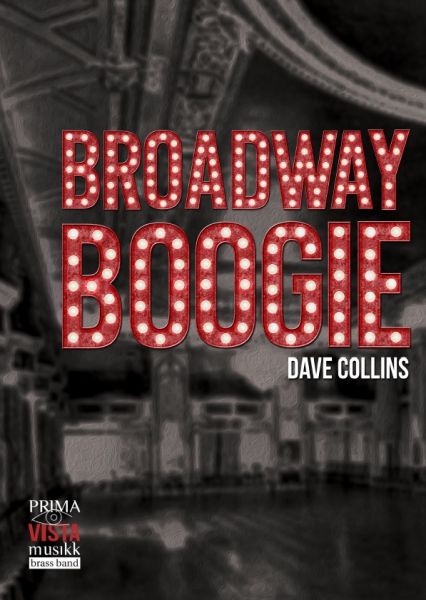
Broadway Boogie (Brass Band - Score and Parts)
Broadway Boogie was commissioned by Leigh Baker and was premiered by the Carlton Main Frickley Colliery Brass Band as part of their 2014 Brass in Concert programme at the Sage, Gateshead.The work is inspired by Piet Mondriaan's Broadway Boogie
Estimated dispatch 7-14 working days
-
£74.95
Sinfonietta for Brass Band (Score and Parts)
Sinfonietta was written in 1970, published the following year, and used as test piece for the National Brass Band Suitable for Championship section bandss in 1972. It was his first work for Brass Band, and he later rescored it for orchestra: 'legitimat
Estimated dispatch 7-14 working days
-
£37.95
Sinfonietta for Brass Band (Score Only)
Sinfonietta was written in 1970, published the following year, and used as test piece for the National Brass Band Suitable for Championship section bandss in 1972. It was his first work for Brass Band, and he later rescored it for orchestra: 'legitimat
Estimated dispatch 7-14 working days
-
 £9.95
£9.95First Quartet (Brass Quartet - Score and Parts)
My first Brass Quartet was written in 1968, immediately after I finished my studies at the Royal Academy of Music, and was in response to a request from my then publisher, R Smith & Co, to write some chamber music for brass band instruments. It is scored for two cornets, horn and euphonium. In the same year I also wrote another quartet (No. 2) which is scored for the more unusual combination of two horns, baritone, and tuba. The First Quartet is really a miniature in terms of length, lasting less than six minutes. However, it packs a lot of punch in its two connected movements, a Prelude and a Capriccio. The Prelude is lyrical in style and opens with a rising figure (covering a major seventh) on euphonium answered by muted cornets. These ideas form the material for the movement which is arch shape in structure. The opening returns, immediately followed by a transition passage which leads directly into the turbulent Capriccio. This is rather Bartokian in style (I was very influenced by Bartok in my student days and had closely studied his six string quartets), in the manner of a Hungarian dance in 5/8 time. The constantly changing metric patterns give the music a rather disruptive quality, but also an opportunity for the players to show their virtuoso abilities. - Edward Gregson
Estimated dispatch 7-14 working days
-
 £29.95
Soliloquy II (Euphonium Solo with Brass Band - Score and Parts)
A few years ago, I wrote a Soliloquy based on a Salvation Army song by George Marshall called Soliloquy (In the Stillness), since published in the General Series. This solo follows up the form of that previous work, though it is quite different in emotional content, and was a commission during Covid lockdown from Euphonium player Micah Dominic Parsons.The main inspiration is the tune Cross of Jesus by John Stainer as well as a motif from some older Euphonium Studies from the Royal Military School of Music, Kneller Hall, that Micah had discovered. The tune is used in a chorale form and, after an introduction, the very first section is a reversal of the chorale that appears in the second half of the work. The Euphonium exclamations are all derived from the main tune and the study motif. The work begins in quite a dark reflective manner, representing those aspects of the song, without being too specific. The second half reflects the more positive characteristics and finds a triumphal nature in its conclusion. The soloist lines throughout have a very declamatory style and can have a freedom in performance.There is one new element in the coda, where the triplet motif (bars 87-89) is a direct quotation from Romans 8 - A brass celebration by Ray Steadman-Allen. RSA was a good friend, mentor and encourager to me. The glorious climax of Romans 8 is his presentation of the same tune (Cross of Jesus) used in this work. And so the piece ends with a final and personal reference to RSA!- Howard Evans
Estimated dispatch 7-14 working days