
Results
-
 £119.99
The Lonesome Knight - Saskia Apon
The composition the Lonesome Knight was based on a fairytale. The piece was written by Saskia Apon for the National Brass Band Championships 2001. Once upon a time there was a knight who went to fight and defeat the dragon that had beenkilling the people of his town. There is a short but intense battle between the two and the knight is triumphant. However whilst persuing the dragon the knight has travelled far away from his home and now is lost. He roames around trying to findhis way home, but exhausted and weary he falls to the ground. He awakens startled by a Giant and a group of Goblins who are celebrating the death of the dragon. The knight joins in the festivities but after a long evening is once more leftalone. The sun rises the following morning and he sees a castle on the horizon. He enthousiastcally ventures towards the castle in the hope of meeting other people. However he becomes greatly disillusioned when there is none to be found. Inhis desperation the knight climbs the tower ready to jump off. Suddenly he hears a heavenly voice. Right before him is the most beautiful princess he has ever seen. She graciously thanks him for killing the dragon, a spark ingnites between themand they build a life together and.... live happily ever after! Saskia Apon studied harp at Rotterdam School of music. With this instrument she rounded of her studies by passing with credit, however it was her love of composition thatremained her focus. Self-taught, she began composing at the age of nine. Since then she has written pieces for The Dutch Brass Quintet, The Dutch Brass Ensemble, The Rotterdam Trombone Quartet and the brass band quintet Brass Ability. Atpresent she is the in-house arranger for The Rotterdam Philarmonic Brass Ensemble. Besides the customary attention for the real splashworks she endeavours to add value to the melodic function of the brass wind instruments in her music. Hercompositions and arrangements can be found on many diverse Cds.The composition the Lonesome Knight was based on a fairytale. The piece was written by Saskia Apon for the National Brass Band Championships 2001. Once upon a time there was aknight who went to fight and defeat the dragon that had been killing the people of his town. There is a short but intense battle between the two and the knight is triumphant. However whilst persuing the dragon the knight has travelled far awayfrom his home and now is lost. He roames around trying to find his way home, but exhausted and weary he falls to the ground. He awakens startled by a Giant and a group of Goblins who are celebrating the death of the dragon. The knight joins inthe festivities but after a long evening is once more left alone. The sun rises the following morning and he sees a castle on the horizon. He enthousiastcally ventures towards the castle in the hope of meeting other people. However he becomesgreatly disillusioned when there is none to be found. In his desperation the knight climbs the tower ready to jump off. Suddenly he hears a heavenly voice. Right before him is the most beautiful princess he has ever seen. She graciously thankshim for killing the dragon, a spark ingnites between them and they build a life together and.... live happily ever after! Saskia Apon studied harp at Rotterdam School of music. With this instrument she rounded of her studies by passing withcredit, however it was her love of composition that remained her focus. Self-taught, she began composing at the age of nine. Since then she has written pieces for The Dutch Brass Quintet, The Dutch Brass Ensemble, The Rotterdam Trombone Quartetand the brass band quintet Brass Ability. At present she is the in-house arranger for The Rotterdam Philarmonic Brass Ensemble. Besides the customary attention for the real splashworks she endeavours to add value to the melodic functionof the brass wind instruments in her music. Her compositions and arrangements can be found on many diverse Cds.
Estimated dispatch 5-14 working days
-
 £102.99
Gemini Concerto - Philip Sparke
Gemini Concerto was commissioned by and written for Ryukoku University (Japan), Andre Henry and Shoichiro Hokazono. Set in three movements, the concerto aims to explore the close relationship, as solo instruments, between the cornet and euphonium, exploiting the many common factors between the two as well as the subtly different characteristics they possess in terms of both lyrical and rhythmic playing. The first movement is a bustling toccata and the second movement is lyrical and improvisatory in nature. A fantastic piece and a great addition to the repertoire!
Estimated dispatch 5-14 working days
-
 £76.99
Tango for Joe - Philip Sparke
Gemini Concerto was commissioned by and written for Ryukoku University (Japan), Andre Henry and Shoichiro Hokazono. Set in three movements, the concerto aims to explore the close relationship, as solo instruments, between the cornet and euphonium, exploiting the many common factors between the two as well as the subtly different characteristics they possess in terms of both lyrical and rhythmic playing. The first movement is a bustling toccata and the second movement is lyrical and improvisatory in nature. A fantastic piece and a great addition to the repertoire!
Estimated dispatch 5-14 working days
-
 £115.60
Valdresmarsj - Johannes Hanssen - John Philip Hannevik
Valdres is a mountain region that lies between Oslo and Bergen. Johannes Hanssen (1874-1967) composed the march for the Valdres Battalion between 1901 and 1904, using the Battalions horn-signal combined with a traditional style folk-tune. The march has been named "one of the greatest marches in the world" on many occasions, and it is a firm favourite with it's national flavor and unusual style. This version is similar to Johannes Hanssens revised version for Wind Band from 1954. However, it is interesting to notice that in Hanssens very first version of the march half a century earlier, the first theme was played by the Eb-Cornet, just like in this arrangement for brassband.
Estimated dispatch 5-14 working days
-
 £119.99
The Binding of the Wolf - Torstein Aagaard-Nilsen
This piece was commissioned by Nordhordland Brass Seminar in 1990 and written for a youth band. The title referes to a story from norse mythology. "The Binding of the Wolf" is not a programmatic piece of music, but I felt that there was a kind of coherence between the music and the dramatic story: "...The wolf Fenrir was one of the demonic offspring of Loki, and as he grew up in Asgard among the gods, he became so huge and fierce that only Tyr was willing to feed him. It was decided that he must be bound, and Odin in his wisdom caused the cunning dwarfs to forge a chain which could not be broken. It was made from the invisible and yet potent powers ofthe world, such as the roots of a mountain, the noise of a moving cat, the breath of a fish. When completed, this chain seemed to be no more than a silken cord, but the wolf refused to let it be laid upon him unless one of the gods would put a hand between his jaws as a pledge that it was harmless. Only Tyr was prepared to do this, and when the wolf found that the chain was unbreakable, the gods rejoiced, but Tyr lost his hand. The binding of the wolf may be seen as a means of protecting the world of men, as well as that of the gods, from destruction. The story of the god losing his hand appears to be one of the fundamental myths of nothern Europe..."
Estimated dispatch 5-14 working days
-
 £115.60
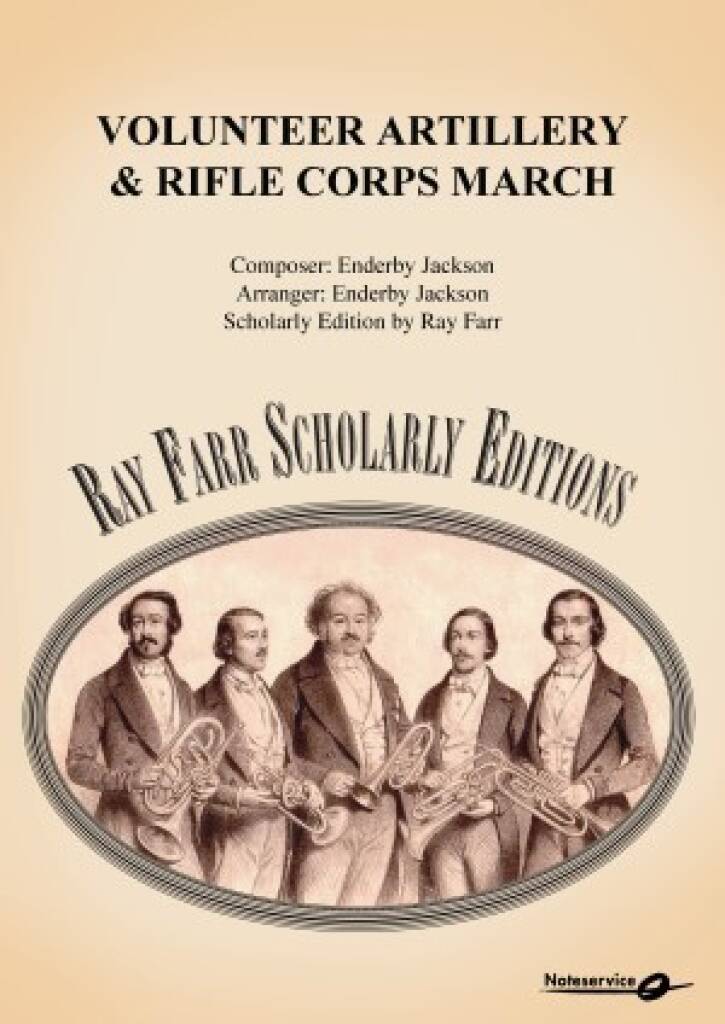
Voluntary Artillery & Rifle Corps March - Endeerby Jackson - Ray Farr
The march was written by Enderby Jackson and performed during a series of brass band events which took place at the Crystal Palace, London 1860 - 1863. Enderby Jackson was the organiser of these historically important events, and also conducted the massed band concerts. The Volunteer Force was a part-time, citizen army created in May 1859 by the British government as a result of increasing tensions between Britain and France. By 1862 more than 200,000 men had enlisted and were paid when on duty however, each member of the corps had to provide his own weapon and equipment.Some of the volunteer corps had bands which normally numbered between six and twelve players plus percussion1 and these bands became an important stimulant to the development of brass band.2 The corps were heavily subsidised by the government and considerable funding was spent on the bands3 which were often local brass bands. These bands were often provided with rehearsal rooms, instruments and uniforms,4 furthermore, the volunteer movement created and saved many brass bands.5Most of the musicians performing at the Crystal Palace Contests were affiliated to the Volunteer Force.
Estimated dispatch 5-14 working days
-
 £105.20
Under manen (Fra Den unge Fleksnes) - Christian Engebretsen - Bjorn Morten Kjaernes
This has become a Christmas song that has its roots in a love duet between the young Fleksnes and classmate Victoria. The class will be competing with a duet in a song competition. The text gives hope of love and links it to Christmas traditions. "A Dream of Christmas, About Love" is the first line of the text. "The Young Fleksnes" runned as advent calender on TV Norge in 2010. This arrangement feature an flugelhorn soloist and a euphonium soloist. Please be aware of the dynamics between soloists and accompaniment. Adjust the dynamics according to the musicians in the ensemble.
Estimated dispatch 5-14 working days
-
 £122.10
Den store dagen - Benny Borg - Bjørn Morten Kjærnes
This beautiful song contains a huge contrast between the hopeful and the disappointing. A mother has her birthday and is waiting her children to celebrate it. Each verse starts optimistically, but the short chorus is characterized by the disappointment, that everyone calls, and cannot come. This has been tried recreated musically, mostly in the last two choruses, as it dawns on her that she will not receive a visit. It's a beautiful tune, but with a serious message that it's easy to take someone for granted.One of the elements Hjorring Brass Band (DK) came up with after rehearsal, was that they really liked the change between the ballad parts with even eights and the swing parts. This also gives the piece a sense of "parlando" character, which tells a story, and is therefore important to focus. It is not quite simple, as the melody also in those parts with even eights has some triplet rhythms. Therefore, this is a topic you can work on very consciously.If you have heard the Wind Band version, you can notice that both keys and modulation are different in the Brass Band arrangement to sound better for this instrumentation.Regarding instrumentation, Flugelhorn, Solo Horn and Euphonium have important roles, in addition to Solo Cornet.It is also possible to use a vocal soloist, but then you have to soften the melody voices, especially, where small variations in the melody have been made for the wind instruments.
Estimated dispatch 5-14 working days
-
 £54.99
The Irish Dancemaster - William Vean
During the eighteenth century a person called 'the Dance Master' made his appearance in Ireland. He was a travelling dance-teacher, who moved from one village to another to teach the people there how to dance. They were often flamboyant personalities, gorgeously dressed and holding a staff in one hand. In order to teach their pupils the difference between their right and left leg, the dance master used to tie a small bunch of straw or hay to their leg and then would order them to either lift their 'hay-leg' or their 'straw-leg'. The dancing masters used to stay in one particular village for about six weeks (if they were not claimed by a neighbouringvillage), after which they continued their journey. Having a famous dance master gave a village a certain distinction and did not seldom lead to boasting and pride. Also on account of the popularity of Celtic music in general at the moment, William Vean was inspired to writing 'The Irish Dance Master'. He 'teaches' you two dances, the Reel and the Jig. In between these two dances there is a short breathing space, during which a traditional Irish rhythm can be enjoyed.
Estimated dispatch 5-14 working days
-
 £63.50
Spiral - Marc Jeanbourquin
Marc Jeanbourquin composed 'Spiral' during a music camp, for himself and 9 other fellow musicians. Due to the success of this piece, some years later, he has taken the main theme and developed it, with a kind of tribute to Camille Saint-Saens, one of his favourite composers. The constant changes between the minor and major keys, and between the often changing 2 and 3 feeling, with the occasional 2/4 bar thrown in, do not disrupt the flow of the piece in the slightest; in fact it is what has inspired the title. A percussion interlude, which is broken up by the unregularly occurring meter, brings the piece to a restatement of the original theme, which then ends in a large crescendo. Spiral is perfectly suited to either the opening or the close of any concert.
Estimated dispatch 5-14 working days
 View Music