
Results
-
 £66.42
Dreams of America (Brass Band) Derek Jenkins
Dreams of America was commissioned by the National Youth Brass Band of America. The concept of the 'American Dream' is an indelible part of the American psyche. Over time, notions of success, fame, and fortune have become synonymous with this idea. Some have achieved their personal 'American Dreams', and yet for others they often remain only a dream. Dreams of America takes a look at certain, generalised aspects of the 'American Dream' and pits them against the harsh realities faced by many, both in the past and present. To heighten these dichotomies, each movement is accompanied by a slideshow of historic and modern images related to the issues at hand. Movement 1: Yearning to Breathe Free explores the anger, fear, and subjugation that seems rampant in recent years, but has been present throughout the country's founding. Movement 2: Take my Stand looks at the role that change, protest, and equality has had and continues to have in our society. Movement 3: It Beckons and Beckons examines the beauty of nature and our role in preserving and protecting this country's natural wonders while illustrating the ease of which our environment can be ruined and destroyed. Movement 4: Sweet Land of Liberty reflects onthe composer's interpretation at what truly makes the United States of America a great country - the people who call this place home. The patriotic tune America the Beautiful has been woven throughout, in part for its poetic depiction of the American landscape and its call for "brotherhood from sea to shining sea!" Sheet music available from: UK - www.brassband.co.uk USA - www.solidbrassmusic.com Difficulty Level: 1st Section + Instrumentation: 1 Soprano Cornet (Eb) 9 Cornets (Bb) 1 Flugelhorn 3 Tenor Horns (Eb) 2 Baritones (Bb) 2 Trombones (Bb) 1 Bass Trombone 2 Euphoniums (Bb) 2 Basses (Eb) 2 Basses (Bb) 4 Percussion
In Stock: Estimated dispatch 1-3 working days
-
 £33.20
Miserere mei, Deus (Brass Band) Gregorio Allegri arr. Espen Haukas
Miserere mei, Deus was composed by the Italian composer Gregorio Allegri (1582-1652) during the 1630s for use in the Sistine Chapel during matins, as part of the exclusive Tenebrae service on Wednesday and Friday of the Holy Week. The Miserere is written for two choirs, one of five and one of four voices, and is generally accepted to be one of the finest examples of Renaissance polyphony to survive to the present day. Tutti choirs sing a simple version of the original Miserere chant; one voice then, spatially separated, sings an ornamented "commentary" on this. The comment-part is left out in this arrangement due to its meaning with text, though monotonous in tune. The introduction is added by the arranger to set the right atmosphere before the original chant is played. The brass choirs are meant to be placed opposite each other in a church or large hall. To view a video of Norges Nasjonale Brassband performing the piece please visit www.youtube.com/watch?v=YrJU3lwYD9U PDF download includes score and parts. Sheet music available from: UK - www.brassband.co.uk USA - www.solidbrassmusic.com Difficulty Level: 4th Section + Instrumentation: Brass Choir 1: Solo Cornets (incl. Repiano) Horn in Eb Tenor Trombones in Bb Euphoniums Basses in Bb Timpani Brass Choir 2: Soprano Cornet in Eb 2nd Cornets in Bb 3rd Cornets in Bb Flugelhorn Horns in Eb Baritones Bass Trombone Basses in Eb
In Stock: Estimated dispatch 1-3 working days
-
 £19.99
Dear Friends
ABOUT THIS PIECE: Introduce a heartfelt and reflective moment to your next programme with this beautiful arrangement of Dear Friends, originally performed by Freddie Mercury and Queen. Written by Mercury and featured on their 1974 album Sheer Heart Attack, this gentle ballad stands out for its simplicity and emotional sincerity, offering a tender message of gratitude and friendship. This arrangement, crafted for a sextet with band accompaniment, preserves the intimacy of the original. It provides a brief, but soulful showcase for smaller ensemble playing within the band, supported by a sensitive muted accompaniment (this piece can also be played as a simple sextet without the band accompaniment). ENSEMBLE: Sextet (recommended cornet, horn, baritone, trombone, euphonium and Eb bass) with Band accompaniment WHEN YOU BUY THIS PRODUCT, YOU GET: High-quality printed score and parts LEVEL: 1 LISTEN: Click here DURATION: 1-minute 10 secondsEXAMPLE SCORE: Click here LEVEL GUIDE: Level 1- Accessible to all Level 2 - c. UK third section and higher Level 3 - c. UK second section and higher Level 4 - c. UK first section and higher Level 5 - c. UK championship section level
Estimated dispatch 5-7 working days
-
 £51.00
A Christmas Trifle by Andrew Duncan
A Christmas Trifle is a fantasy for brass band based on the famous English Carol, God Rest Ye Merry Gentlemen. The piece begins very lively before changing to a more jazzy style with a walking bass. This is followed by a jazz-waltz in 5/4 with solos for flugal, euphonium and soprano cornet which leads into a slow chorale section, gradually building from p to fff . This is followed by the final section which begins with a simple sleigh bell pulse over which the Tchaikovsky Christmas favourite, Trepak from the Nutcracker Suite is merged with the God Rest Ye Merry Gentlemen theme bringing A Christmas Trifle to a rousing close. To listen to a sound file of A Christmas Trifle scroll down on this page.
-
 £42.00
The Golden Carol. Arranged for brass band by Lynda Nicholson
Arranged for brass band by by Lynda Nicholson The Golden Carol is a traditional Old English Christmas Carol. The words tell of the Three Kings following the Star to Bethlehem to see Jesus on Christmas morning. The tune is anonymous, but has a medieval feel, similar to other carols, such as I Saw three Ships. The Golden Carol begins in a 5/4 jazz waltz rhythm with a solo Eb Bass being joined a few bars later by by a solo trombone then a solo horn, before more instruments (including percussion) are added and the tune plays out in the cornets and soprano cornet. The second section goes into 4/4 with a strong Rock/Big Band feel driven along rhythmically by the kit drummer. This section then leads to a rousing close for the full band. The Golden Carol is part of the Lynda Nicolson Collection . To hear a sound recording of The Golden Carol scroll down.
-
 £30.00
A Short Ride in a Brass Machine
DescriptionA Short Ride in a Brass Machine was written in 2006 to mark the 140th anniversary of the Brighouse and Rastrick Band and first performed in the Central Methodist Church in Brighouse by Brighouse and Rastrick conducted by James Gourlay. The title refers to the orchestral composition A Short Ride in A Fast Machine by the American composer John Adams which provided some of the inspiration for the work. The music is a simple celebratory prelude consisting of two main ideas, an expansive melody full of open fifths (giving the music a slightly "American" feel) and a short fanfare figure. After these are both heard for the first time a brief development of the fanfare material leads to a broader, warm harmonisation of the opening melody and the pulse relaxes a little before tension builds to a reiteration of the fanfare and a final triumphant version of the opening theme.Performance Notes:Percussion instruments required are 4 Timpani, Snare Drum, Bass Drum, 3 Tom-toms, 3 Wood Blocks, Suspended Cymbal, Clash Cymbals, Tubular Bells, Glockenspiel, Tam-tam.Soprano, repiano, 2nd solo cornet, 2nd and 3rd cornets will require metal straight mutes; 2nd and 3rd cornets will require harmon mutes with the tubes removed (indicated by 'TR').Duration approximately 3'30"Follow the score in the preview video below!
Estimated dispatch 7-14 working days
-
 £20.00
Pioneers (Ensemble) - Steve Robson
The 19th Century was a time of great pioneering spirit, where developments in industry, and transport were to begin a process, which was to transform societies around the world beyond recognition.In the vast, so-called "New World" of America these changes were exemplified as the railways spread out to reach hitherto remote and largely unexplored expanses.Steve Robson has written Pioneers as a three movement piece for brass and percussion ensemble (and also now available as a full brass band version), written in the spirit of John Philip Sousa (1854 - 1932), Stephen Foster (1826 - 1864) and Scott Joplin (1868 - 1917).The three movements have been written for the following instrumentation:2 x Bb cornet1 x flugelhorn1 x Eb Tenor Horn1 x tenor trombone1 x euphonium1 x Eb Bassdrumkit and percussionand consist of:March - The US Marine Band (1880)Spiritual - I'm Lookin' Up To HeavenRagtime - Canonball RagAlso available for brass band.
In Stock: Estimated dispatch 3-5 working days
-
£40.00
Blue Sleeve Step - Harper, P
This is a big band style number which is modelled on Barrie Gott's brilliant Lightwalk. It begins with a walking bass before horns state the highly whistleable tune for the first time. The full band quickly joins and there is an extended solo break for cornet. A tiptoeing tuba solo precedes the final key change which propels the piece to its infectiously foot-tapping conclusion.2nd section +
In Stock: Estimated dispatch 1-3 working days
-
 £19.95
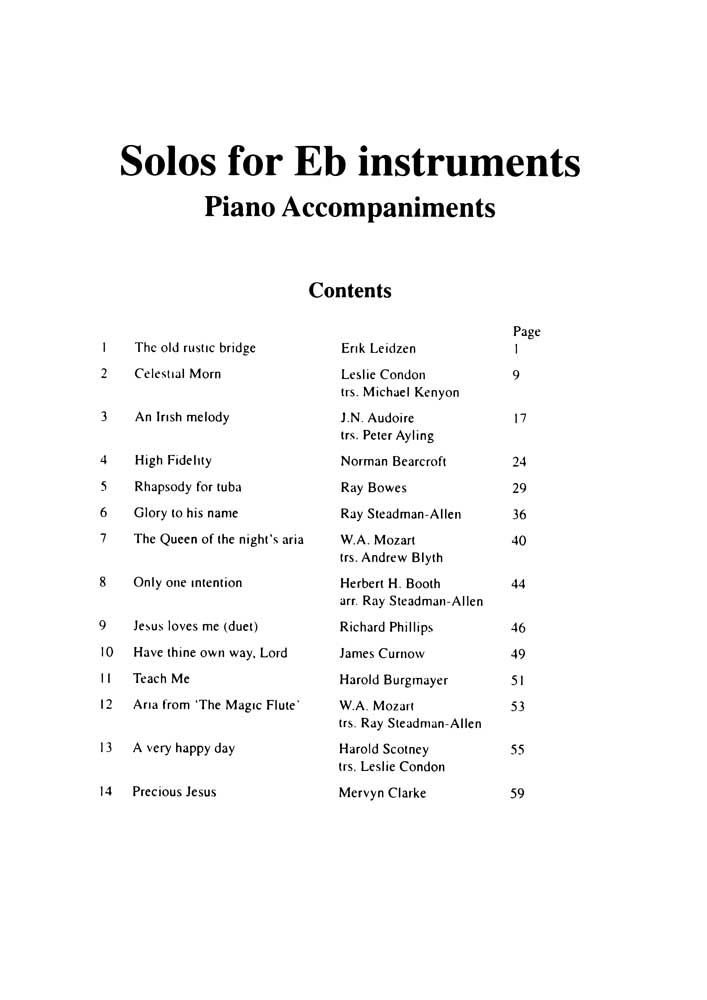
Eb Solos Album
Includes: The old rustic bridge; Celestial Morn; An Irish melody; High Fidelity; Rhapsody for tuba; Glory to his name; The Queen of the night's aria; Only one intention; Jesus loves me (duet); Have thine own way, Lord; Teach me; Aria from 'The Magic Flute'; A very happy day; Precious JesusInstrumentation: Solos for Eb Soprano Cornet, Eb Tenor Horn & Eb Bass with Piano Accompaniment
Estimated dispatch 7-14 working days
-
 £49.99
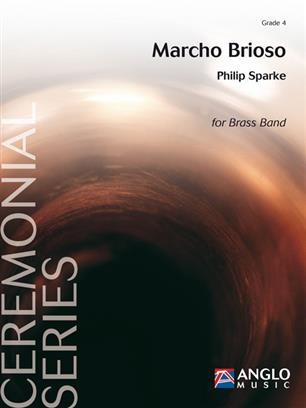
Marcho Brioso (Brass Band - Score and Parts)
Marcho Brioso was commissioned by The Brioso Brass, a British-style brass band from Hokkaido, Japan. They gave the first performance in January 2012.The commission was for a bright and breezy march that the band could use as their theme tune, so Marcho Brioso falls into the composer's series of Broadway-style marches, which includes Slipstream, The Bandwagon and Jubiloso. After a short introduction a solo cornet plays the main theme, accompanied by a euphonium counter-melody. A secondary phrase from the horns and baritones leads to a tutti version of the main theme which is followed by the traditional 'bass' strain. A change of key heralds the trio section, which features a cantabile melody on euphonium; this is then taken up by the full band after a short bridge passage and further change of key.This takes us back to the home key which sees a quiet staccato version of the main theme lead to a recapitulation and a short coda which brings the march to a close.Duration: 3:40
Estimated dispatch 7-14 working days
 View Music