
Results
-
 £33.62
Fanfare of Joy - Brass Band (Andrew Wainwright)
Fanfare of Joy was commissioned by the Burbage Band (Buxton) and its conductor Steven Critchlow in 2017. Based on Joy to the World and The First Nowell, this spectacular work opens with a majestic brass fanfare, before breaking in a Celtic-style dance which builds to a dramatic conclusion. The fanfare opening serves to announce the arrival of something special. In this case, the fanfare announces the arrival of Christmas, a time of joy and celebration. The Celtic-style dance is a lively and energetic movement that captures the spirit of Christmas. The music is full of syncopated rhythms and intricate melodies, driven by percussion. The final movement of the piece is a dramatic conclusion that brings the work to a rousing finish. The music is full of excitement and energy, and a fitting celebration of the Christmas season. To view a video of Dallas Brass Band performing the work please visit https://www.youtube.com/watch?v=CHl_oj1A-E8 PDF download includes score and full set of parts. Additional transposing parts for Horns in F, and Baritones, Trombones, Euphonium and Tubas in Bass Clef are available here. Sheet music available exclusively from World of Brass - www.worldofbrass.com Difficulty Level: 1st Section + Instrumentation: Soprano Cornet Eb Solo Cornet Bb Repiano Cornet Bb 2nd Cornet Bb 3rd Cornet Bb Flugel Horn Bb Solo Horn Eb 1st Horn Eb 2nd Horn Eb 1st Baritone Bb 2nd Baritone Bb 1st Trombone Bb 2nd Trombone Bb Bass Trombone Euphonium Bb Bass Eb Bass Bb Timpani Percussion 1-3
In Stock: Estimated dispatch 1-3 working days
-
 £11.20
I was glad (Brass Band with Organ - Additional Parts) Parry trs. Wainwright
I was glad was originally a choral introit which is a popular piece in the musical repertoire of the Anglican church. It is traditionally sung in the Church of England as an anthem at the coronation of the British monarch, most recently that of King Charles III in May 2023. This transcription for brass band combines the choral and accompaniment parts meaning it is playable as a standalone arrangement. An optional organ part is included to augment the brass. The cornet section is divided into two choirs to create an antiphonal effect. The 'Vivats' are included in this transcription but an optional cut is provided for that section. To view a follow-the-score video please visit www.youtube.com/watch?v=Vx95uSp1yU8 PDF download includes additional parts. Purchase the full score and brass band parts here. Sheet music available from: UK - www.brassband.co.uk USA - www.solidbrassmusic.com Difficulty Level: 2nd Section + Parts included in this download: Solo Horn F 1st Horn F 2nd Horn F 1st Baritone Bass Clef 2nd Baritone Bass Clef 1st Trombone Bass Clef 2nd Trombone Bass Clef Euphonium Bass Clef Tuba 1 Bass Clef (Bass Eb equivalent) Tuba 2 Bass Clef (Bass Bb equivalent)
In Stock: Estimated dispatch 1-3 working days
-
 £33.62
Instant Christmas Concert (Brass Band) Phil Lawrence
VIEW SCORE PDF This pot pourri of 58 tunes will provide something completely different to your Christmas concert! With snippets of Christmas carols and songs juxtaposed with famous classic excerpts all crammed into 3.20 minutes of action, this is sure to be an audience pleaser, even giving your percussion section the opportunity to exercise their vocal cords! Sheet music available from: UK - www.brassband.co.uk USA - www.solidbrassmusic.com Difficulty Level: 2nd Section + Instrumentation: Soprano Cornet Eb Solo Cornet Bb Repiano Cornet Bb 2nd Cornet Bb 3rd Cornet Bb Flugel Horn Bb Solo Horn Eb 1st Horn Eb 2nd Horn Eb 1st Baritone Bb 2nd Baritone Bb 1st Trombone Bb 2nd Trombone Bb Bass Trombone Euphonium Bb Bass Eb Bass Bb Percussion 1-3
In Stock: Estimated dispatch 1-3 working days
-
 £33.62
Jingle Bells Forever (Brass Band) Pierpont/Sousa/Smith arr. Lythaby
Jingle Bells Forever is a setting of two American favourites that weaves the melodic line from Pierpont's Jingle Bells with Sousa's umistakable march style. Drawn from The Stars and Stripes Forever, Sousa's immortal march that has become the official national march of the United States of America, the familiar strains provide the perfect accompaniment for the most festive of Christmas melodies. Sousa's famous grandioso with the piccolo descant (here scored for soprano cornet) and trombone countermelody draw this festive standard to a rousing conclusion. PDF download includes score and parts. Sheet music available from: UK - www.brassband.co.uk USA - www.solidbrassmusic.com Difficulty Level: 4th Section + Instrumentation: Soprano Cornet Eb Solo Cornet Bb Repiano Cornet Bb 2nd Cornet Bb 3rd Cornet Bb Flugel Horn Bb Solo Horn Eb 1st Horn Eb 2nd Horn Eb 1st Baritone Bb 2nd Baritone Bb 1st Trombone Bb 2nd Trombone Bb Bass Trombone Euphonium Bb Bass Eb Bass Bb Timpani Drum Set Cymbals Sleigh Bells Glockenspiel
In Stock: Estimated dispatch 1-3 working days
-
 £33.62
Menuet (Brass Band) Ravel arr. Rob Bushnell
Le Tombeau de Couperin (The Grave of Couperin) was written by Maurice Ravel between 1914 and 1917, originally a suite of piece for solo piano. Based on what was considered a traditional Baroque suite, Ravel wanted to pay homage to Baroque French keyboard music, whilst retaining his 20th-century chromaticism, making the work neoclassicist. Each movement is dedicated to the memory of a friend of the composer who died fighting in World War I. Ravel produced an orchestral version in 1919, omitting two of the original six movements. The Menuet was written in memory of Jean Dreyfus; Ravel had recuperated at his home. This arrangement is for the British-style brass band, with alternative parts for horns in F and bass-clef lower brass. A recording of the original composition can be found here: www.youtube.com/watch?v=jnNwEcBTSmk. Duration: Approx. 4 minutes Difficulty Level: 2nd Section + Duration: 4 minutes (depending on tempo and without any cuts) PDF download includes parts and score. Sheet music available at www.brassband.co.uk (UK) or https://satradecentral.org (USA) Instrumentation: Soprano Cornet Eb Solo Cornet Bb Repiano Cornet Bb 2nd Cornet Bb 3rd Cornet Bb Flugel Horn Bb Solo Horn Eb 1st Horn Eb 2nd Horn Eb 1st Baritone Bb 2nd Baritone Bb 1st Trombone Bb 2nd Trombone Bb Bass Trombone Euphonium Bb Bass Eb Bass Bb Timpani Percussion - Vibraphone & Glockenspiel
In Stock: Estimated dispatch 1-3 working days
-
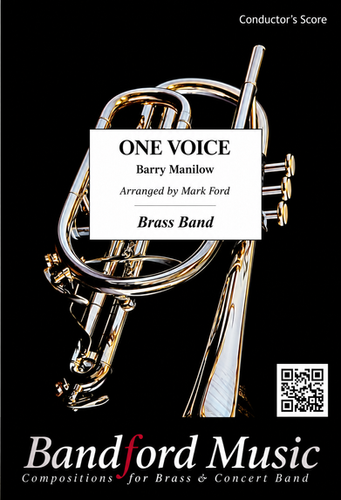 £33.62
One Voice (Brass Band) Barry Manilow arr. Mark Ford
Originally released in 1979 as the title track of Barry Manilow's sixth studio album, One Voice has become an enduring anthem for unity and social courage. It is a stirring ballad that reminds us how a single, brave voice can ignite a chorus of solidarity and lead the way toward positive change. Expertly crafted for brass band by Mark Ford, this setting captures the intimate, soaring spirit of the original while leveraging the unique textures of the brass band. The piece begins with a delicate, lyrical flugel horn solo, representing the 'single voice' of the title. As the arrangement progresses, the rest of the ensemble joins in, building from a gentle accompaniment into a magnificent, wall-of-sound finale that is sure to leave your audience inspired. To view a rolling score video of the work please visit https://youtu.be/RcQ5xbnyNjs Duration: Approx. 3.15 minutes Difficulty Level: 4th Section + This PDF download includes the full score and parts. Sheet music available at www.brassband.co.uk (UK) or https://satradecentral.org (USA) Instrumentation: Soprano Cornet Eb Solo Cornet Bb Repiano Cornet Bb 2nd Cornet Bb 3rd Cornet Bb Flugel Horn Bb Solo Horn Eb 1st Horn Eb 2nd Horn Eb 1st Baritone Bb 2nd Baritone Bb 1st Trombone Bb 2nd Trombone Bb Bass Trombone Euphonium Bb Bass Eb Bass Bb Timpani Glockenspiel Percussion
In Stock: Estimated dispatch 1-3 working days
-
 £33.62
Prelude in C-sharp Minor (Brass Band) Rachmaninoff arr. Rob Bushnell
One of Sergei Rachmaninoff's most famous compositions, Prelude in C-sharp minor (Op. 3, No. 2) is part of a set of five pieces entitled Morceaux de fantaisie. It was written when Rachmaninoff was only 19 years old and was first performance by the composer on 26 September 1892 at a festival called the Moscow Electrical Exhibition. This arrangement is for the UK-style brass band, with alternative parts for horns in F and bass-clef lower brass. The piece has been transposed from the original (for piano) of C-sharp minor to A minor, which better suits a brass band. There is another arrangement of this piece by Sandy Smith (published by Obrasso) which is designed for more advanced ensembles. A recording of the original composition can be found here: www.youtube.com/watch?v=mXGSfJn3nKQ Duration: Approx. 3.40 minutes Difficulty Level: 3rd Section + PDF download includes parts and score. Also includes alternative parts for horns in F and lower brass in bass clef. Sheet music available from www.brassband.co.uk Instrumentation: Soprano Cornet Eb Solo Cornet Bb Repiano Cornet Bb 2nd Cornet Bb 3rd Cornet Bb Flugel Horn Bb Solo Horn Eb 1st Horn Eb 2nd Horn Eb 1st Baritone Bb 2nd Baritone Bb 1st Trombone Bb 2nd Trombone Bb Bass Trombone Euphonium Bb Bass Eb Bass Bb Percussion 1-3
In Stock: Estimated dispatch 1-3 working days
-
 £29.88
Still, Still, Still (Horn Section Feature with Brass Band) arr. Stephen Tighe
Still, still, still is an Austrian Christmas carol and lullaby. The melody is a folk tune from the Salzburg area and the tune appeared for the first time in 1865 in a folksong collection. The words describe the peace of the infant Jesus and his mother as the baby is sung to sleep. They have changed slightly over the years, but the modern standard German version was established in the mid-19th century. This arrangement by Stephen Tighe features the flugelhorn and horn section with brass band. PDF download includes score and parts. Sheet music available from: UK - www.brassband.co.uk USA - www.solidbrassmusic.com Difficulty Level: 4th Section + Instrumentation: Soprano Cornet Eb Solo Cornet Bb Repiano Cornet Bb 2nd Cornet Bb 3rd Cornet Bb Flugel Horn Bb Solo Horn Eb 1st Horn Eb 2nd Horn Eb 1st Baritone Bb 2nd Baritone Bb 1st Trombone Bb 2nd Trombone Bb Bass Trombone Euphonium Bb Bass Eb Bass Bb Timpani Sleigh Bells Drum Kit Glockenspiel
In Stock: Estimated dispatch 1-3 working days
-
 £37.35
The Vow (Brass Band) Andrew Wainwright
VIEW SCORE PDF A majestic processional in the spirit of Elsa's Procession to the Cathedral, this powerful work blends the heartfelt beauty of William Himes' worship song All That I Am with an original theme by Andrew Wainwright. The piece was originally written for the composer's wedding. The piece features expressive interplay between solo lines and rich accompaniment, offering performers a dynamic canvas to shape and build the music. Gradually expanding in depth and intensity, it culminates in a stirring and triumphant conclusion - ideal for sacred ceremonies, concert halls, or moments of solemn celebration. PDF download includes score and full set of parts. Sheet music available from: UK - www.brassband.co.uk USA - www.solidbrassmusic.com To view a video of the Southern Territorial Band performing the work please visit: www.youtube.com/watch?v=h2VUSKHMbho Difficulty Level: Second Section + Instrumentation: Soprano Cornet Eb Solo Cornet Bb 1st Cornet Bb 2nd Cornet Bb Flugel Horn Bb Solo Horn Eb 1st Horn Eb 2nd Horn Eb 1st Baritone Bb 2nd Baritone Bb 1st Trombone Bb 2nd Trombone Bb Bass Trombone 1st Euphonium Bb 2nd Euphonium Bb Bass Eb Bass Bb Timpani Percussion 1-3
In Stock: Estimated dispatch 1-3 working days
-
 £33.62
Vivace from Piano Sonata No.2 (Brass Band) Prokofiev arr. Yasuaki Fukuhara
Bristling with energy and vitality, this is a terrific arrangement of the fourth and final movement from Piano Sonata No. 2, which is Sergei Prokofiev's celebrated piano solo piece composed in 1912. The arranger writes: 'Whilst I have endeavoured to maintain the characteristics and flavours of the original piece, I altered and added dynamics and musical notations in a few cases where they seemed to fit the medium of the brass band and to reflect a general performance manner of this piece on a piano. I also added percussion parts which provide additional colour. After careful consideration, I decided to keep to the original key in order to maintain the brightness and clarity of the original work.' PDF download includes score and full set of parts. To view a rolling score video please visit www.youtube.com/watch?v=X3GUHQI3u7E Sheet music available from: UK - www.brassband.co.uk USA - www.solidbrassmusic.com Difficulty Level: 1st Section + Instrumentation: Soprano Cornet Eb Solo Cornet Bb Repiano Cornet Bb 2nd Cornet Bb 3rd Cornet Bb Flugel Horn Bb Solo Horn Eb 1st Horn Eb 2nd Horn Eb 1st Baritone Bb 2nd Baritone Bb 1st Trombone Bb 2nd Trombone Bb Bass Trombone Euphonium Bb Bass Eb Bass Bb Timpani Percussion 1-2
In Stock: Estimated dispatch 1-3 working days
 Watch video