
Results
-
 £39.95
Judd: Music of Thanksgiving
This is an extensive work consisting of a theme, five variations and a finale. The theme is the hymn tune 'Whitechapel' whose former title 'Death is coming' did little to encourage its use! A wide range of moods are covered, from the delicate and tender to the robust and jubilant. The music was originally written for the London Citadel Band (Ontario, Canada).
Estimated dispatch 7-14 working days
-
 £24.95
Music from Kantara (Score Only)
4th Section Test Piece 2016 National Finals of the British Brass Band Championship. Music from Kantara was written in 1994 and was first performed by Watership Brass, a band based near Newbury. The title comes from the name of the former home of the composer, in Winchester, a name which was inherited from the previous owners, and which presumably comes from the ruined castle of that name on the Northern coast of Cyprus. The music is not programmatic: it does not tell a story. It is a three-movement suite of absolute music, in a tuneful and straightforward idiom. The slow, central movement calls for playing of a sensitive, vocal nature.
Estimated dispatch 7-14 working days
-
 £10.00
Swedish Festival Music (Study Score)
This three-movement suite was commissioned by the Swedish Brass Band Association as the test piece for the Championship Section of their 2008 National Contest. The first movement is inspired by the magnificent Swedish hymn 'How Great Thou Art'. Indeed the influence of that hymn can be traced in all three movements. The declamatory style of the opening gives way to other, more reflective expressions of awe and wonder. A more animated section develops before a final, triumphant statement of the 'How Great' idea returns to finish the movement. The slow second movement features another much-loved Swedish hymn. The music provides plenty of scope for expressive playing, and a feeling of intimacy should be created by the use of several short solo passages. The third movement Allegro brings a totally different, dance-like mood with frequent references to a reel from the region of Uppland. This eventually brings a return to the opening subject and a final, triumphant reference to 'How Great Thou Art'.
Estimated dispatch 7-14 working days
-
 £79.95
Indian Summer (Fantasy) (Brass Band - Score and Parts)
The 'Indian Summer' is that of North America, and the music, entertaining but more than half serious, will perhaps evoke memories of tales of Native Americans.There are four movements:The Great Chief SpeaksBy the Cool WatersTotem DanceHymn to the Great SpiritProgramme Notes:This Fantasy is in the form of a Suite, although there should be no long break between each movement. The composer sometimes concocts a little story to illustrate the music, somewhat as follows:"The Great Chief Speaks": the warmth of Autumn's "Indian Summer" will soon be a memory, and hard Winter will set in; so the Chief must hold a great Powwow with his people"By the Coll Waters": a little girl, not interested in grown-up solemnities, slips away to a nearby lake. She gazes at her reflection in the water; executes a little dance, then falls to dreaming."Totem Dance": this will be exciting - the little girl goes running to see! The dancing becomes wilder, then rhythm more insistent, then suddenly silence."Hymn to the Great Spirit": the Powwow closes with a majestic utterance by the Great Chief. A hymn is sung to the "Great White Spirit", and the people turn their thoughts to preparations for the coming Winter.
Estimated dispatch 7-14 working days
-
£39.95
Indian Summer (Fantasy) (Brass Band - Score only)
The 'Indian Summer' is that of North America, and the music, entertaining but more than half serious, will perhaps evoke memories of tales of Native Americans.There are four movements:The Great Chief SpeaksBy the Cool WatersTotem DanceHymn to the Great SpiritProgramme Notes:This Fantasy is in the form of a Suite, although there should be no long break between each movement. The composer sometimes concocts a little story to illustrate the music, somewhat as follows:"The Great Chief Speaks": the warmth of Autumn's "Indian Summer" will soon be a memory, and hard Winter will set in; so the Chief must hold a great Powwow with his people"By the Coll Waters": a little girl, not interested in grown-up solemnities, slips away to a nearby lake. She gazes at her reflection in the water; executes a little dance, then falls to dreaming."Totem Dance": this will be exciting - the little girl goes running to see! The dancing becomes wilder, then rhythm more insistent, then suddenly silence."Hymn to the Great Spirit": the Powwow closes with a majestic utterance by the Great Chief. A hymn is sung to the "Great White Spirit", and the people turn their thoughts to preparations for the coming Winter.
Estimated dispatch 7-14 working days
-
£35.00
Climb Ev'ry Mountain from Sound of Music - Rodgers & Hammerstein - Harper, P
Hit from The Sound of Music, features for solo horn, euphonium (or vocal line - words included) and optionally soprano cornet with 'McArthur Park' style end. Starts quietly with a single voice (horn) and grows in power throughout.3rd section +Duration 4 minsListen to Cory BandCourtesy of World of Brass
In Stock: Estimated dispatch 1-3 working days
-
 £77.00
General Series Brass Band Journal, Numbers 2250 - 2253, December 2024
2250: Prelude on 'Rhosymedre' (Ralph Vaughan Williams trs. Douglas Engle)The English composer Ralph Vaughan Williams' work Three Preludes (founded on Welsh Hymn Tunes) was published for the organ in 1920. This is a transcription of the second movement of that work. The words associated with the hymn tune are by Samuel Crossman, My song is love unknown (S.A.S.B. 149), and vividly depict the events of Holy Week. The music is gentle and solemn and would be appropriate for a Good Friday service or as a moment of repose in a concert. 2251: Hosanna Shuffle (Sam Creamer)The half-time shuffle groove is a popular feel developed by alternative rock/pop bands of the 1980s. It marries elements of rock and swing styles together to form a new and infectious feel - Hosannah Shuffle being written as a tribute to this fusion of musical styles. Contrary to a swing style, shuffle brings the pulse back onto the beat while maintaining the swung quaver rhythms to create a rock-type rhythmic drive. 2252: Everlasting Love (Keith Manners)This piece was written for the London North East Music School in 2004. The theme of the week was 'Making a stand for Christ', reminding the school that it only takes one person to make such a stand before others follow. The music starts with a lone Solo Cornet playing the melody of Graham Kendrick's song Such Love (S.A.S.B. 199). One by one, other parts join in with the theme.2253: Festival March (Michael Cooper)This piece represents the first published brass composition of Bandmaster Michael Cooper, who is the Bandmaster at Brisbane City Temple Corps. This imposing festival march features the tunes I want to be a soldier (T.B. 683), Lift up the banner (T.B. 90) and My Jesus, I love thee (T.B. 506). These tunes depict the idea that spiritual warfare is an essential component of one's faith, success of which is articulated in the final verse of My Jesus, I love thee (S.A.S.B. 878).
Estimated dispatch 7-14 working days
-
 £55.00
Triumph Series Brass Band Journal, Numbers 1367 - 1370, November 2024
1367: March - Risen, conquering Son (Noel Jones)Two uplifting Easter songs are featured in this march; Low in the grave he lay (S.A.S.B. 228) with words and music written by Robert Lowry, and Thine is the glory (S.A.S.B. 276) with words by Edmond L. Budry and music by George F. Handel. Both serve as a powerful reminder of the resurrection of Jesus.1368: Horn Solo - O how much he cared for me (Keith Wilkinson)This solo was originally penned for Bandsman Frank Taylor, who plays Solo Horn at Stapleford Citadel Corps. As its basis, it uses the popular hymn No one ever cared for me like Jesus by Charles F. Weigle, a Baptist evangelist who wrote more than a thousand hymns.1369: My Redeemer lives (Olaf Ritman)This arrangement of Reuben Morgan's well-known worship song (S.A.S.B. 223) was first written as an accompaniment for congregational singing and can still be used in that way. It was inspired by the American R&B group Tower of Power and is meant to sound soulful and funky.1370: Selection - With life anew (Mervyn Clarke)This selection features music associated with two hymns; Blessd Saviour, now behold me (S.A.S.B. 575) by William Baugh and Breathe on me, breath of God (S.A.S.B. 294) by Edwin Hatch. Although Edwin Hatch's hymn-writing output was very small, this hymn has seen numerous settings and melodies associated with the words from which the piece takes its title; two of these melodies are featured here in Trentham and Carlisle.
Estimated dispatch 7-14 working days
-
 £87.40
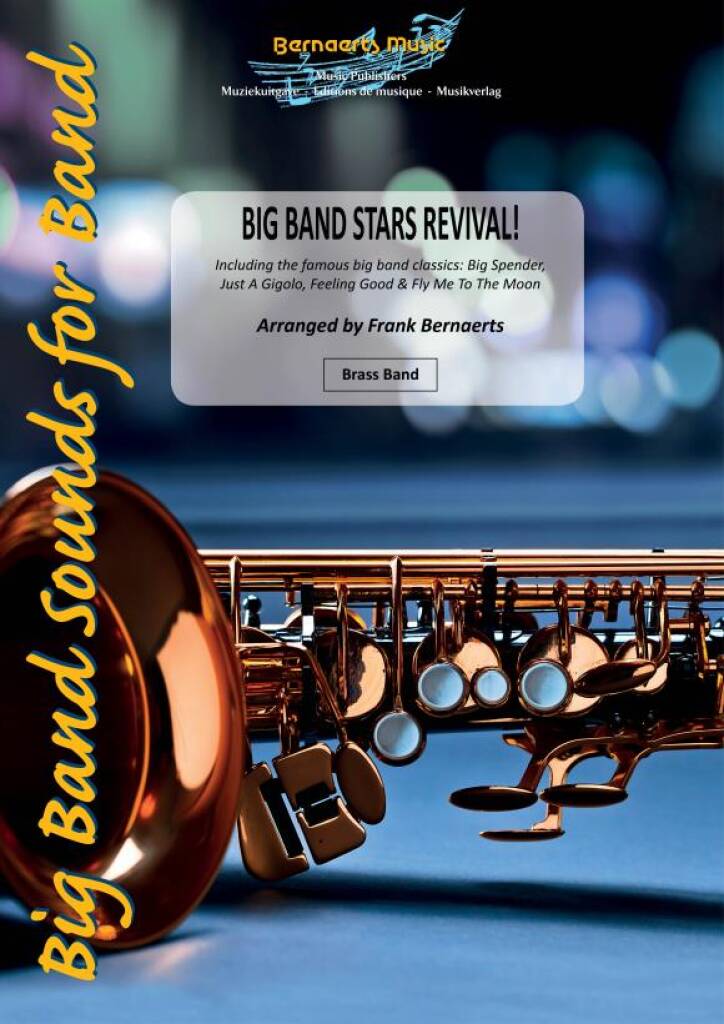
Big Band Stars Revival! - Frank Bernaerts
Estimated dispatch 5-14 working days
-
£60.99
Intrada Festiva (Brass Band) - Stephan Jaeggi - Leuthold
Estimated dispatch 5-14 working days
 View Music