
Results
-
 £45.00
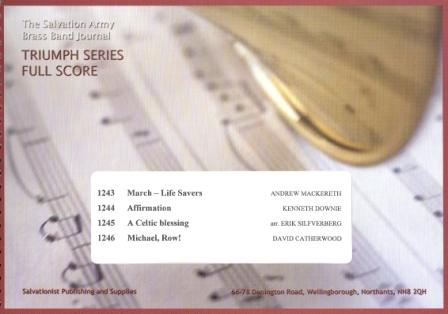
Triumph Series Band Journal November 2013 Numbers 1243-1246
No. 1243 March - Life Savers (Andrew Mackareth)This march was written for the band weekend at Belfast Citadel and incorporates the tune Jesus Saves (T.B. 703)No. 1244 Affirmation (Kenneth Downie)The title comes from the affirming tone of the chorus on which the music is built, He is the Lord, which itself is inspired by Phillippians, chapter 2. The chorus does not appear in its entirety at any point, but is obvious to a greater or lesser extent, in the texture of the music.No. 1245 A Celtic Blessing (arr. Erik Silfverberg)This is a simple arrangement of c Celtic traditional tune used to the lyrics of the familiar blessing:May the road rise to meet you,May the wind be always at your back,May the sun shine warm upon your face,The rain fall soft upon your fields,Until we meet again,May God hold you in the palm of his hand.No. 1246 Michael, Row! (David Catherwood)This arrangement of the traditional chous, 'Michael, row the boat ashore' (T.B. 285), is in a light swing style and also incorporates the tunes, 'Love lifted me' (T.B. 725) and 'Will uour anchor hold?' (T.B. 60).
Estimated dispatch 7-14 working days
-
 £34.95
Excelsior - Fanfare and Theme (Brass Band - Score and Parts)
The New Mills Old Prize Band is the inheritor of a proud tradition going back 200 years. Its origin lies in a brass and reed band formed in 1812 by Timothy Beard and it is one of the oldest brass bands in continuous existence in the UK.The New Mills Old Prize Band is inextricably linked to the Beard family. Timothy Beard the founder of the band, was one of five children and two of his brothers, John and Stephen, were to join him in the band.Excelsior is based on the hymn tune 'Ransom' believed to have been composed in 1838 by Timothy's brother Stephen Beard. I have taken this hymn tune and composed a concert fanfare utilising the main melodic material from the original hymn tune.The title of the piece comes from the bands original motto "Excelsior!"Paul Lovatt-Cooper
Estimated dispatch 7-14 working days
-
 £30.00
La Perla Negra - Colin Skinner
For this brooding piece the composer has used the following storyline. "A sad elderly man sits alone in a bar whilst an accordionist plays a slowtango. A beautiful woman walks in wearing a single black pearl necklace and proceeds to dance with the old man. Gradually the music becomesmore and more spirited and the dance faster as the old man becomes youthful again. With a passionate kiss he passes out in thegirl's arms and when he awakens he is back in the bar alone save for the accordionist. As he contemplates his dream he notices a single black pearlleft behind on the bar. The sombre mood is lightened in the middle section by a deliberately trite and stylised trumpet duet, but we soon returnto the opening material for a slow fade-out"
-
 £96.99
Purcellian Fantasia (Brass Band - Score and Parts)
This composition is based on the march from Henry Purcells Music for the funeral of Queen Mary II, a work written in 1694. In this fantasia, various movements flow from one to the next following the main theme; these movements not only elaborate on the theme, but also contrast with it. At times, the thematic material diverges so much, that the work acquires a character of its own; however, the composer often refers back to fragments of the theme. This work was test piece in the 4th division of the Dutch National Brass Band Championships (NBK) in 2017. Duration: 10.30
Estimated dispatch 7-14 working days
-
 £185.00
E.T. - John Williams/Ton van Grevenbroek
Steven Spielberg made this big box office success film 'E.T.', telling the story of a boy, named Eliot, and his friendship with a fascinating little alien 'E.T.'. The film score, written by the internationally famous composer and conductor John Williams, brings their 'adventures on earth' back to life. This science fiction fantasy appeals to the imagination of both young and older people. Ton van Grevenbroek signs this fine orchestration for symphonic band.
Estimated dispatch 10-14 working days
-
£40.00
Harlequin Dances
Harlequin dances is a stunning original composition showcasing a variety of dance styles. The piece starts with a mambo-like section, then moves into a more romantic ballad-type movement. This then winds up into a Viennese waltz which uses cheeky glissandi, then onto a very clever tempo shift and back to a recap of the mambo music which races along to a thrilling climax.
-
 £29.95
Aria for Philip (Brass Quintet - Score and Parts)
Instrumentation:2 Trumpets in CHorn in FTromboneTubaWritten in memory of Philip Jones, this short work was first performed at his memorial concert held at the Royal Northern College of Music in 2000. Scored for Brass Quintet, it was performed by former members of the Philip Jones Brass Ensemble.My friendship with Philip Jones stretched back to my student days, when my Quintet for Brass was performed during my final year at the Royal Academy of Music. Philip was present at that premiere in 1967, and soon after that his ensemble performed and broadcast the Quintet on a UK Tour, including a performance in the finals of the BBC Young Composer's Competition. I owe him a huge debt of gratitude for promoting a work by a then unknown young composer.I use a brief quote from the opening of my 1967 Brass Quintet in this work, which is generally rather sombre in character, except for the sudden change of mood and tempo in the short final section, when the clouds suddenly lift and the sun shines through.- Edward GregsonDuration: 5.00
Estimated dispatch 7-14 working days
-
 £69.00
For Fans Only - Piet Daalhuizen/W Kalischnig
Piet Daalhuisen (Hilversum, 1939) was already known in the world of wind bands because of his medleys 'With a smile to the classics' and 'Pop for the People' (both in splendid wind band arrangements by Marcel Peeters). Here is a new medley For Fans Only, consisting of a series of stirring tunes, arranged for wind band by Walter Kalischnig, a Slovenian musician who settled in The Netherlands back in 1953 and wrote several fine compositions and wind band arrangements.
Estimated dispatch 10-14 working days
-
Kinderwalzer - Len Jenkins - Len Jenkins
The title originally began as 'kind of a waltz', but the music, in typical bier-keller fast-waltz style, progresses to be more representative of a children's nursery with fun and laughter all the way. That is, until the grotesque element appears and makes you wonder what it was that you glimpsed at the back of the wardrobe? Fortunately, all is resolved before bedtime and jollity returns. Sweet dreams!
-
£60.00
Antiphonary - Lane, L
The Berkeley Family antiphonary is a beautiful book of texts and chants dating back to 1457, and this piece traces an historical timeline of Berkeley Castle's history, incorporating Vivaldi arias from an opera discovered at the castle in 2002. The music has moments of hymn-like reflection as well as great triumph and features the flugel horn.1st section + Duration 6 mins This piece exists in three other formats - Symphonic brass, Brass ensemble, and Wind dectet and piano. For details of these orchestrations please visit Composers Edition
In Stock: Estimated dispatch 1-3 working days
 View Music