
Results
-
 £37.95
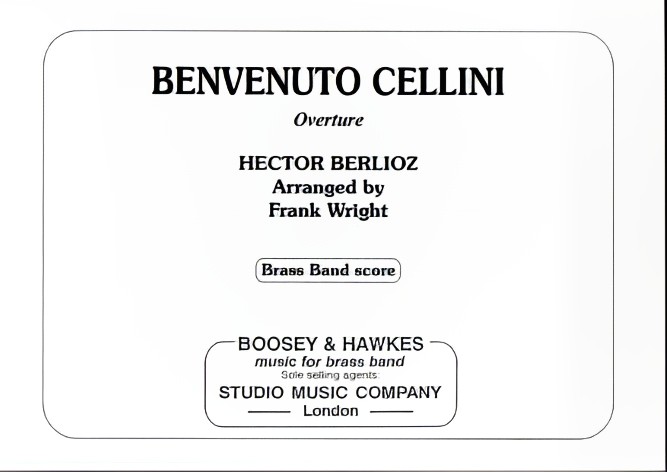
Benvenuto Cellini (Brass Band - Score only) - Berlioz, Hector - Wright, Frank
Berlioz's opera Benvenuto Cellini was first produced in Paris in 1838 but was withdrawn as a failure, and it was not until the production in Dresden in 1888 that it was finally acclaimed by the Germans as a triumph. Adapted from certain episodes recorded in the memoirs of Benvenuto Cellini, Tuscan sculptor and goldsmith, the story, laid in Rome during the mid-sixteenth century, is not strictly historical. The short opening Allegro, marked deciso con impeto, is conceived in the most brilliant Berlioz manner, utilising full instrumentation. In the Larghetto we meet at once the first of the opera themes - the Cardinal's aria (from the last act) introduced in the bass, quasi pizzicato. A second melody leads to a resumption of the Allegro, the contrasting second subject in the tenor horns being an adaptation of Teresa's aria (Act I). Towards the end the Cardinal theme is re-introduced by trombones, fortissimo against an energetic cornet and euphonium passage (senza stringendo - without hurry, says the score). After a unison passage storming skywards, there is a sudden, dramatic three-bar silent pause broken by Eb basses alone, again stating the Cardinal theme. A simple molto crescendo on the dominant, begun piano, leads to the long, resounding chord.
Estimated dispatch 7-14 working days
-
 £82.95
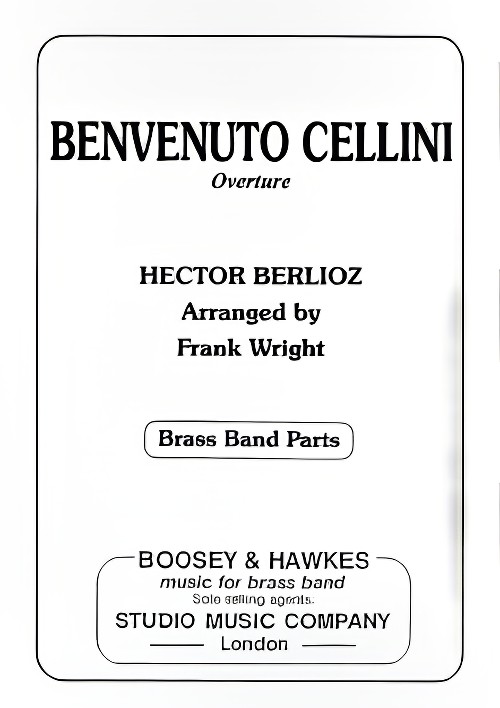
Benvenuto Cellini (Brass Band - Score and Parts) - Berlioz, Hector - Wright, Frank
Berlioz's opera Benvenuto Cellini was first produced in Paris in 1838 but was withdrawn as a failure, and it was not until the production in Dresden in 1888 that it was finally acclaimed by the Germans as a triumph. Adapted from certain episodes recorded in the memoirs of Benvenuto Cellini, Tuscan sculptor and goldsmith, the story, laid in Rome during the mid-sixteenth century, is not strictly historical. The short opening Allegro, marked deciso con impeto, is conceived in the most brilliant Berlioz manner, utilising full instrumentation. In the Larghetto we meet at once the first of the opera themes - the Cardinal's aria (from the last act) introduced in the bass, quasi pizzicato. A second melody leads to a resumption of the Allegro, the contrasting second subject in the tenor horns being an adaptation of Teresa's aria (Act I). Towards the end the Cardinal theme is re-introduced by trombones, fortissimo against an energetic cornet and euphonium passage (senza stringendo - without hurry, says the score). After a unison passage storming skywards, there is a sudden, dramatic three-bar silent pause broken by Eb basses alone, again stating the Cardinal theme. A simple molto crescendo on the dominant, begun piano, leads to the long, resounding chord.
Estimated dispatch 7-14 working days
-
 £45.00
Cuban Overture (Brass Band - Score and Parts) - Gershwin, George - Littlemore, Phillip
Originally entitled Rumba, the?Cuban Overture?was a was written some time following a two-week holiday which Gershwin took in Havana in February 1932. The overture is dominated by Caribbean rhythms and Cuban native percussion, with a wide spectrum of instrumental colour and technique. It is a rich and exciting work with complexity and sophistication, illustrating the influence of Cuban music and dance. Although it received it's premi?re under the title Rumba, it was renamed Cuban Overture three months later at a benefit concert conducted by Gershwin at the Metropolitan Opera to avoid giving audience the idea that it was simply a novelty item. The new title provided, as the composer stated, "a more just idea of the character and intent of the music". Duration: 6:20
Estimated dispatch 7-14 working days
-
 £60.99
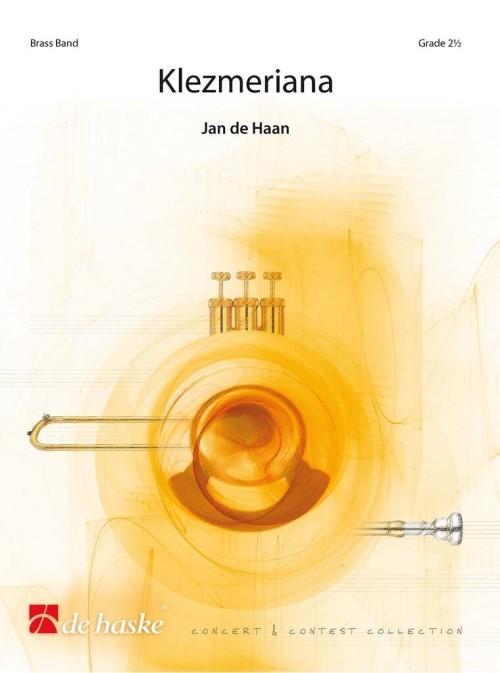
Klezmeriana (Brass Band - Score and Parts) - De Haan, Jan
The instrumental music of the Yiddish-speaking Jews, especially those of Eastern Europe, is known as klezmer. This terminology was originally used in Jewish cultural life as the name of a musician who played at weddings. At Jewish weddings, which usually last several days, klezmer musicians played not only dance music but also ceremonial music - for example during the wedding ceremony, and also music that was listened to during the wedding feast. Originally, there was no special term for this style of music. It was simply referred to as 'Jewish wedding music'. In the 1970s, the music - which is actually a fusion of different influences - enjoyed a resurgence in popularity and came to be known as klezmer. This music contains not only the sounds of the Balkans, but also influences of oriental and gypsy music too. Jan de Haan used no original klezmer melodies for Klezmeriana, but composed a series of sound-alike in an instrumentation for brass band.Duration: 6.00
Estimated dispatch 7-14 working days
-
 £50.00
Firefly (Brass Band - Score and Parts) - Dobson, Simon
Firefly was composed by award-winning composer Simon Dobson (b.1981) to provide an entertaining up-tempo concert work for community and youth bands. Composed in funk-rock style, and is based on the groove beat with which it opens. Dobson says, "Firefly was written as a break from my more serious music and as a 'hat tip' to the various types of beat orientated music I listen to." It was first performed by Oslofjord Brass in Norway and in its wind version by Harmonie Shostakovich, Switzerland. Duration: 5-6 minutes.
Estimated dispatch 7-14 working days
-
 £44.00
The Liberty Bell (Brass Band - Score and Parts) - Sousa, John Philip - Wilkinson, Keith M.
This march, written in 1893, was originally destined for inclusion in an operetta but after the composer had witnessed a spectacle called "America" in Chicago, which had as its backdrop a huge painting of the Liberty Bell, it was given the name by which it has become famous. Further recognition has come in more recent years by the adoption of the march as the signature tune for the popular TV programme, Monty Python.The arrangement includes several solos for a large unpitched bell which add aural (and visual) interest. It has been recorded by Brass Band of the Western Reserve, musical director Keith M Wilkinson, on the CD Slides Rule.
Estimated dispatch 7-14 working days
-
 £124.95
Hyperlink (Brass Band - Score and Parts) - Graham, Peter
Hyperlink was commissioned by the National Youth Brass Band of Great Britain (funded by Arts Council England and the Department for Education) for its 70th Anniversary Year. Since the anniversary coincided with other significant celebrations in 2022 (including the Royal Albert Hall/Ralph Vaughan Williams 150th and the Platinum Jubilee of Elizabeth II) it was requested that these also be recognised in some way.Where better to begin this challenging brief but with a computer search for the NYBBGB founder Dr Denis Wright (coincidently born in Kensington, home of the RAH). The subsequent rabbit warren of hyperlinks led me to structure the work through a series of associations:Movement I - The Voice of Jupiter. Alongside the discovery that Denis Wright had been a church organist was the realisation that while the RAH has hosted thousands of musical events the fabric of the building actually incorporates a musical instrument, the famous Henry Wills organ (aka The Voice of Jupiter). Organ and J S Bach are synonymous (e.g. Toccata in D min) and so both become fundamental to the content of the movement. An opening 7 note quote from the Toccata leads to a mammoth sound cluster, as if every note on the huge RAH organ is sustained. The material which follows is based upon the notes BACH (in German notation). The notes are manipulated in various ways in a 12 tone matrix; reversed, inverted and so on. Other techniques employed in the movement are ones of which Bach was master, including ground bass and fugue.Movement II - Remember Me. The lives of Salvationist composer Ray Steadman-Allen (born 1922) and Ralph Vaughan Williams are remembered here, with RSA in musical notation and fragments of RVWs famous Tuba Concerto providing the source material. While writing the movement my father passed away and to close his funeral service the family chose the uplifting Robert Lowry hymn They'll sing a welcome home. It seemed fitting to conclude the movement with a reflective setting of the chorus, the repeated phrase 'Welcome, welcome home' eventually disappearing into the ether.Movement III - Vivat. The finale takes the form of a short fantasy upon Hubert Parry's marvellous coronation anthem I Was Glad, truly a celebratory note with which to conclude. The first performance of Hyperlink was given by the NYBBGB conducted by Martyn Brabbins at the Royal College of Music, London on August 6th 2022.- Peter Graham
Estimated dispatch 7-14 working days
-
£44.95
Hyperlink (Brass Band - Score only) - Graham, Peter
Hyperlink was commissioned by the National Youth Brass Band of Great Britain (funded by Arts Council England and the Department for Education) for its 70th Anniversary Year. Since the anniversary coincided with other significant celebrations in 2022 (including the Royal Albert Hall/Ralph Vaughan Williams 150th and the Platinum Jubilee of Elizabeth II) it was requested that these also be recognised in some way.Where better to begin this challenging brief but with a computer search for the NYBBGB founder Dr Denis Wright (coincidently born in Kensington, home of the RAH). The subsequent rabbit warren of hyperlinks led me to structure the work through a series of associations:Movement I - The Voice of Jupiter. Alongside the discovery that Denis Wright had been a church organist was the realisation that while the RAH has hosted thousands of musical events the fabric of the building actually incorporates a musical instrument, the famous Henry Wills organ (aka The Voice of Jupiter). Organ and J S Bach are synonymous (e.g. Toccata in D min) and so both become fundamental to the content of the movement. An opening 7 note quote from the Toccata leads to a mammoth sound cluster, as if every note on the huge RAH organ is sustained. The material which follows is based upon the notes BACH (in German notation). The notes are manipulated in various ways in a 12 tone matrix; reversed, inverted and so on. Other techniques employed in the movement are ones of which Bach was master, including ground bass and fugue.Movement II - Remember Me. The lives of Salvationist composer Ray Steadman-Allen (born 1922) and Ralph Vaughan Williams are remembered here, with RSA in musical notation and fragments of RVWs famous Tuba Concerto providing the source material. While writing the movement my father passed away and to close his funeral service the family chose the uplifting Robert Lowry hymn They'll sing a welcome home. It seemed fitting to conclude the movement with a reflective setting of the chorus, the repeated phrase 'Welcome, welcome home' eventually disappearing into the ether.Movement III - Vivat. The finale takes the form of a short fantasy upon Hubert Parry's marvellous coronation anthem I Was Glad, truly a celebratory note with which to conclude. The first performance of Hyperlink was given by the NYBBGB conducted by Martyn Brabbins at the Royal College of Music, London on August 6th 2022.- Peter Graham
Estimated dispatch 7-14 working days
-
 £100.00
Handel in the Band (Brass Band - Score and Parts) - Downie, Kenneth
Handel in the Band is a virtuoso set of symphonic variations on one of Handel's best known keyboard dances, the Sarabande from his Suite in D minor, HWV 437, based on the Spanish traditional dance La Folia. Kenneth Downie's work was commissioned by Brass Band Treize Etoiles, for performance at the 2013 Swiss National Brass Band Championships, where it was conducted by James Gourlay. The title is a reference to Percy Grainger's popular Handel in the Strand, and is indicative of the witty and theatrical nature of the music, which is more playful than conventional competition pieces and as such offers different challenges to brass bands as well as being thoroughly entertaining for audiences.Kenneth Downie is one of the most respected and experienced brass band composers. His music has been widely performed and published throughout the brass band world since the 1960s.Handel in the Band was selected as the set work for the Championship Section final of the 2018 National Brass Band Championships of Great Britain, which took place at the Royal Albert Hall, London, on 6th October 2018.Duration: 15.00
Estimated dispatch 7-14 working days
-
£19.99
Handel in the Band (Brass Band - Score only) - Downie, Kenneth
Handel in the Band is a virtuoso set of symphonic variations on one of Handel's best known keyboard dances, the Sarabande from his Suite in D minor, HWV 437, based on the Spanish traditional dance La Folia. Kenneth Downie's work was commissioned by Brass Band Treize Etoiles, for performance at the 2013 Swiss National Brass Band Championships, where it was conducted by James Gourlay. The title is a reference to Percy Grainger's popular Handel in the Strand, and is indicative of the witty and theatrical nature of the music, which is more playful than conventional competition pieces and as such offers different challenges to brass bands as well as being thoroughly entertaining for audiences.Kenneth Downie is one of the most respected and experienced brass band composers. His music has been widely performed and published throughout the brass band world since the 1960s.Handel in the Band was selected as the set work for the Championship Section final of the 2018 National Brass Band Championships of Great Britain, which took place at the Royal Albert Hall, London, on 6th October 2018.
Estimated dispatch 7-14 working days
 View Music