Results
-
 £59.77
The Glory of Colour (Brass Band) Ivan G. Andrews
This work by Ivan Andrews was inspired by the large Baptistry window of the new Coventry Cathedral and will be suitable both as a contest or concert work. The window was conceIved and designed by Basil Spence and was intended to be a worldwide experience. When installed it was claimed to be "the single largest window in stained glass that hitherto had ever been contemplated and brought into existance." The stained glass design was done by artist John Piper and when completed was described by Bishop Bardsley as a "triumphant expression of faith, a faith encapsulated in the 'glory of colour'".* Hence the title for the piece. The composer writes: 'When thinking of this music the traditional tune now often called Monks Gate kept coming to me. The words often sung to this tune were penned by John Bunyan and each stansa ends with the words "To be a pilgrim". The Cathedral in Coventry, although a Christian Church, is designed to bring all faiths together in Unity - there is a "Unity Chapel" opposite the Baptistry window so the concept of pilgrimage seemed perfectly apt to me. The music is therefore designed to reflect many colours as there are many expressions of faith. Single fragments of the Monks Gate tune are used as a basis for what might be deemed 'variations'. The tune is heard in full towards the end of the piece and then the music rises to a climax of bright brilliant white light. The colours of the window are darker on the outer edges but they all circulate towards the brilliant white at the centre - representing the source of all faith.' To view a rolling score video of the work please visit https://www.youtube.com/watch?v=zPN_EhhMDAE Duration: Approx. 11.30 minutes Difficulty Level: 2nd Section + PDF download includes parts and score. Sheet music available from www.brassband.co.uk Instrumentation: Soprano Cornet Eb Solo Cornet Bb Repiano Cornet Bb 2nd Cornet Bb 3rd Cornet Bb Flugel Horn Bb Solo Horn Eb 1st Horn Eb 2nd Horn Eb 1st Baritone Bb 2nd Baritone Bb 1st Trombone Bb 2nd Trombone Bb Bass Trombone Euphonium Bb Bass Eb Bass BbTimpani Percussion 1-2
In Stock: Estimated dispatch 1-3 working days
-
 £41.09
Verklarte Nacht (Brass Band) Arnold Schoenberg arr. Rob Bushnell
Composed in just three weeks in 1899, Verklarte Nacht (Transfigured Night) is a string sextet in one movement by Arnold Schoenberg. Whilst known better for tone rows, his dodecaphonic music and the Second Viennese School, Schoenberg was a master of harmony (writing a number of books on the subject) and, in his early life, was inspired by the music of Brahms and Wagner. This is his best-known tonal work. Its description as a tone poem is not surprising given it takes its inspiration from Richard Dehmel's poem of the same name, as well as Schoenberg's strong feelings towards his future wife, Mathilde Zemlinsky, sister of his teacher, Alexander von Zemlinsky. The work is said to have five sections, one for each of the stanzas in the poem. The poem, from 1896, describes a man and woman walking through a dark forest on a moonlit night. The woman shares a secret with him, that she is pregnant but not with his child. The man reflects upon this before warmly accepting (and forgiving) the news. The work premiered on 18 March 1902 in the Vienna Musikverein by the Rose Quartet. As was normal at the time, Schoenberg produced a string orchestra version that was premiered on 29 November 1916 in Prague, conducted by Zemlinsky, which was later revised in 1943 to better support the soloists, also adding more articulation and tempo markings. Whilst the piece was controversial at the time, both musically and due to the poem's "inappropriate" subject matter, Richard Dehmel himself was impressed, writing "I had intended to follow the motives of my text in your composition, but soon forgot to do so, I was so enthralled by the music." This arrangement is for the British-style brass band, with alternative parts for horns in F and bass-clef lower brass. To view a recording of the original composition please visit www.youtube.com/watch?v=vqODySSxYpc. Difficulty Level: 2nd Section + Duration: approx. 6.40 minutes Sheet music available from www.brassband.co.uk Instrumentation: Soprano Cornet Eb Solo Cornet Bb Repiano Cornet Bb 2nd Cornet Bb 3rd Cornet Bb Flugel Horn Bb Solo Horn Eb 1st Horn Eb 2nd Horn Eb 1st Baritone Bb 2nd Baritone Bb 1st Trombone Bb 2nd Trombone Bb Bass Trombone Euphonium Bb Bass Eb Bass BbTimpani Percussion 1-3
In Stock: Estimated dispatch 1-3 working days
-
 £34.95
Time Eternal - Christopher Bond
Time Eternal (2011) was written as a showcase for band in the form of a seven-minute journey which demonstrates the ability of the band and its soloists. As the title suggests, the idea of time is important in the work, with bell-like gestures forming the opening and closing sections. Rhythmic material is heard, often juxtaposing more lyrical passages, sometimes with dramatic percussion or semiquaver running accompaniments in the cornets.A slow and expressive middle section hears soloistic contributions from the flugel horn and euphoniums, as well as fuller tutti passages, before a return to the energetic tempo of the opening where material is heard again, often presented in different ways with a real sense of drive through to the close.
Estimated dispatch 10-14 working days
-
 £29.95
Trevithick - Christopher Bond
Trevithick (2013) is a march for brass band, written on the occasion of Camborne's 30th Trevithick Day celebration which saw six Cornish brass bands parade through the streets one after the other, performing the work. Structured as any traditional march is with the bass solo forming the central section, the work is formed from both existing Cornish tunes such as Trelawny and Camborne Hill, as well as original material.
Estimated dispatch 10-14 working days
-
 £45.00
God Put a Smile Upon Your Face
ABOUT THIS PIECE: 'God Put a Smile Upon Your Face' was written by all members of the band Coldplay for their second studio album 'A Rush of Blood to the Head'. Coldplay vocalist Chris Martin said: "The song came out of playing live and wanting to have something with a bit more bounce". The chart was originally released in 2003 to critical acclaim. In 2007 Mark Ronson covered the song on his album 'Version' - it is this version this arrangement is based upon. The following arrangement was devised as a concert opener - written as such to allow different sections of the band to make their way to the stage one at a time. The suggested stage entry directions for this arrangement are: Percussion > Basses > Trombones > Horns & Baritones > Cornets & Euphonium. Kit and percussion parts are written as a guide - please feel free to add and subtract as the MD sees fit. DUE TO COPYRIGHT LAW THIS WORK IS NOT AVAILABLE IN AUSTRALIA OR NEW ZEALAND ENSEMBLE: Standard British Brass Band WHEN YOU BUY THIS PRODUCT, YOU GET: High-quality printed score and parts LEVEL: 2 LISTEN: Click here DURATION: 3-mins 30 secondEXAMPLE SCORE: Click here LEVEL GUIDE: Level 1- Accessible to all Level 2 - c. UK third section and higher Level 3 - c. UK second section and higher Level 4 - c. UK first section and higher Level 5 - c. UK championship section level
Estimated dispatch 5-7 working days
-
£105.00
Handel in the Band - Kenneth Downie
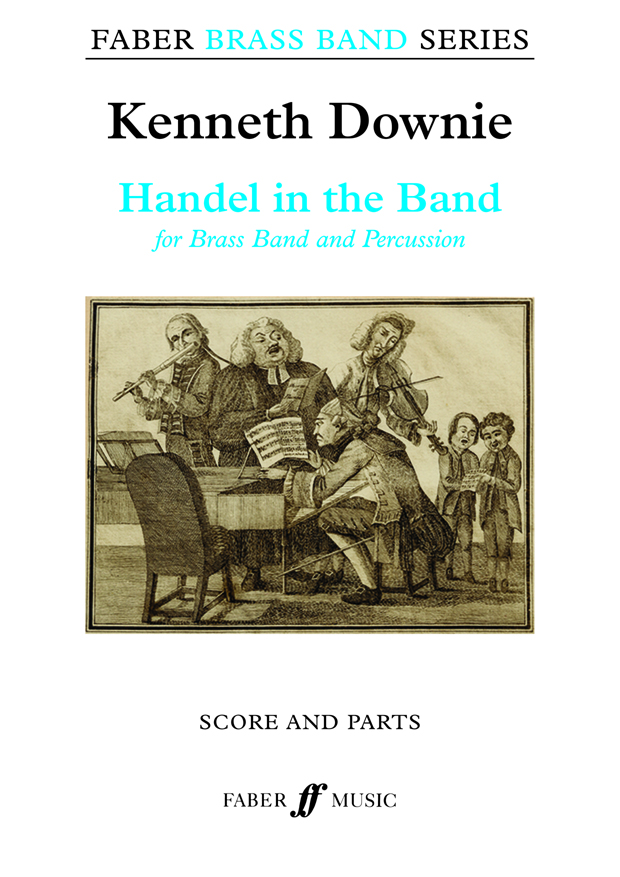
Handel in the Band is a virtuoso set of symphonic variations on one of Handel's best known keyboard dances, the Sarabande from his Suite in D minor, HWV 437, based on the Spanish traditional dance La Folia. Kenneth Downie's work was commissioned by Brass Band Treize Etoiles, for performance at the 2013 Swiss National Brass Band Championships, where it was conducted by James Gourlay. The title is a reference to Percy Grainger's popular Handel in the Strand, and is indicative of the witty and theatrical nature of the music, which is more playful than conventional competition pieces and as such offers different challenges to brass bands as well as being thoroughly entertaining for audiences. Kenneth Downie is one of the most respected and experienced brass band composers. His music has been widely performed and published throughout the brass band world since the 1960s. Handel in the Band has been selected as the set work for the Championship Section final of this year's National Brass Band Championships of Great Britain, which takes place at the Royal Albert Hall, London, on 6th October 2018.
In Stock: Estimated dispatch 1-3 working days
-
£100.00
Journey of the Lone Wolf (score & parts) - Simon Dobson
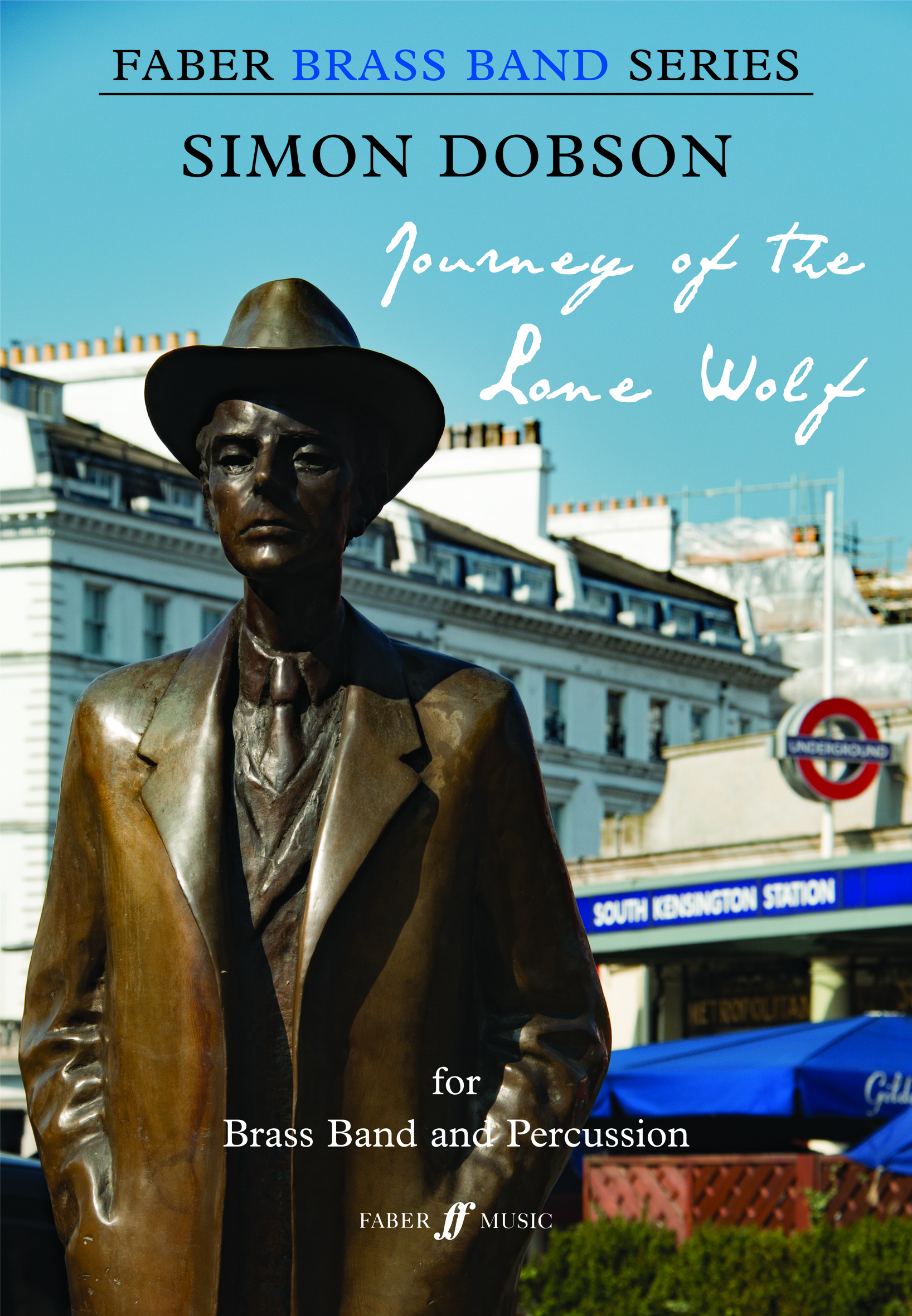
Journey of the Lone Wolf tells the story of the hungarian composer Bla Bartk. It was commissioned by Dr. Nicholas Childs for Black Dyke Band, who gave the first performance on Sunday 26 January 2014 at the Bridgewater Hall, Manchester as part of the Royal Northern College of Music Festival of Brass.The composer's programme notes for each movement: 1. Capturing the Peasants' SongAfter the upheaval of moving to Budapest the young Bla Bartk meets Zoltn Kodly and the pair embark on summertime adventures throughout the Hungarian countryside to collect and catalogue the astonishing variety (both harmonically and rhythmically) of gypsy and folk music heard in the Balkans. The arrival of WW1 plunges Bartk's beloved Hungary into chaos.2. Night MusicBartk was at times a cold man, aloof and lonely. The odd moments of tenderness he showed are portrayed here in a series of evocative solos. His brief but intense affairs speak of a love he could only long for. Jazz is my night music and here there are hints of what Bartk may have heard in the USA later in his life.3. Flight and FightHaving been forced by the world's evils to leave his homeland of Hungary for America, Bartk, the anti-fascist, felt isolated and angry. In this movement we hear his longing for a simpler time of gypsy folk dances as well as his maturity and depth as a composer finally exploring deeper colours and darker themes. Duration: 15 minutes.Level: Championship
In Stock: Estimated dispatch 1-3 working days
-
£50.00
Malaguena (Score & Parts) - Ernesto Lecuona
A 'Malaguena' is a woman living in the Spanish port city of Malaga, on the southern coast of Spain, in the province of Andalucia. Lecuona's Malaguena was originally the sixth movement of his Suite Andalucia and has been performed in many versions by artists such as Connie Francis, Stan Kenton's Orchestra and Bill Haley and the Comets as well as featuring as part of the Broadway musical entitled Blast! This brass band arrangement has been made by Mark Freeh. Brass Band Grade 3: Youth and 4th Section Duration: 6 minutes
In Stock: Estimated dispatch 1-3 working days
-
 £74.99
Cornet Concerto No.1 - Jonathan Bates
My 'Cornet Concerto No.1' was composed for Lode Violet and Brass Band Willebroek in 2018 and features 2 movements, entitled 'Dystopia' and 'Utopia'. . The nature of the music in the opening section, 'Dystopia', is very jagged, disjointed and unsettling, as the soloist almost battles against the constant churning of the mechanical accompaniment, trying to persevere with it's own ideas and styles without being dragged into conforming to it's surroundings. The movement is based largely on the 3 note interval heard right at the outset of the piece (C, D & G#, a series of notes that lends itself so well to different modes, scales, harmonies and intervals) and this forms much of the rhythmic and harmonic structure of the opening section.Whilst this movement acts as a virtuoso feature to demonstrate the extended capabilities of both the soloist and instrument, I feel the accompanying ensemble plays an equal role in the narrative of 'dystopia', and features a number of demanding and prominent episodes for soloists within the accompanying band. A short and heavy coda concludes the movement, with a sense of real pain and sorrowfulness as the music fades away into darkness. . 'Utopia' opens in an instantly more hopeful nature, with the soloist introducing the first real 'theme' of the movement, taken up shortly by the accompaniment. Throughout this movement, there are a number of timbral and melodic references back to the darkness of 'dystopia', but transformed into a much more positive outlook and soundworld. There is a moment of quiet reflect (using the initial 3 note cell as a basis) before flying head first into a frenzied wild 'tarantella' like section, full of joy and energy which tests the dexterity and light-natured approach to virtuosity (much unlike the heavier material in the 1st movement) of the soloist. Primarily, the concept of this finale is fun - joy, happiness, and freedom from restraint, so the addition of a quirky 'tongue-in-cheek' habanera section offers a brief moment of respite from the craziness of the tarantella. To conclude the work, there is an extended cadenza for the soloist which is built on several motifs heard throughout the concerto, which leads the band into a dramatic and energetic final few bars.. Jonathan Bates. (2018). .
In Stock: Estimated dispatch 1-3 working days
-
 £30.00
92 Squadron - Brass Band Sheet Music Full Score & Parts - LM372
COMPOSER: Alex McGeeA concert march for brass band dedicated to 92 SquadronNumber 92 Squadron, also known asNo. 92 (East India) Squadronand currently asNo. 92 Tactics and Training Squadron, of theRoyal Air Forceis a test and evaluation squadron based atRAF Waddington,Lincolnshire. It was formed as part of theRoyal Flying CorpsatLondon Colneyas a fighter squadron on 1 September 1917. It deployed to France in July 1918 and saw action for just four months, until the end of the war. During the conflict it flew both air superiority and direct ground support missions. It was disbanded atEilon 7 August 1919. Reformed on 10 October 1939,at Tangmere Airfield, the unit was supposed to be equipped with medium bombers but in the spring of 1940 it became one of the first RAF units to receive theSupermarine Spitfire, going on to fight in theBattle of Britain.LM372 - ISMN : 9790570003723
In Stock: Estimated dispatch 3-5 working days