
Results
-
 £40.00
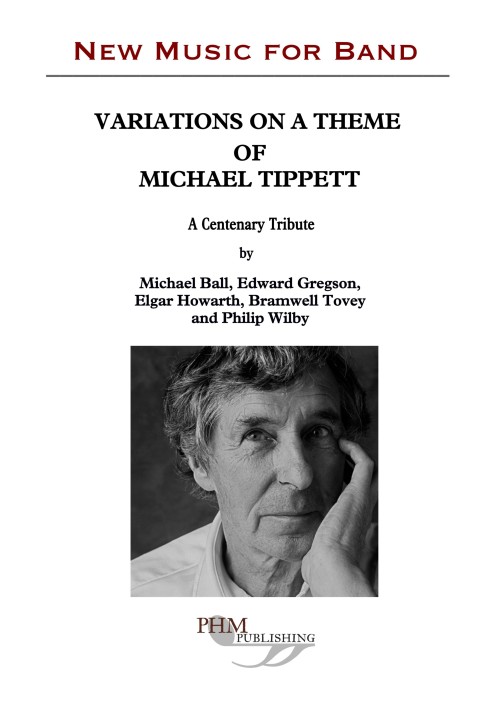
Variations on a Theme of Michael Tippett (Brass Band - Score only) - Hindmarsh, Paul
A Centenary Tribute by Michael Ball, Edward Gregson, Elgar Howarth, Bramwell Tovey and Philip WilbyThis unique 'pice d'occasion' arose out of a telephone conversation in 2004 with Alan Wycherley, who was the soprano cornet player of the Foden's Richardson Band at the time. He indicated that the band would like to include an original birthday tribute for Edward Gregson (60) and Elgar Howarth (70) in its concert at the 2005 RNCM Festival of Brass in Manchester. I have been Artistic Director of Manchester's Festival of Brass since it was established in 1990 as a BBC Radio 3 series, As the centenary of the birth of Sir Michael Tippett fell on 5 January 2005, I devised this collective work as a way of embracing all three anniversaries in a novel way.The idea of joint compositions is not a new one in the classical music world. In the 1860s, Verdi was joined by a number of his contemporaries in a Requiem Mass for Rossini. In this country there have been a number of orchestral examples over the past fifty years, but never before for the brass band. Although Tippett composed only one work for brass band, Festal Brass with Blues, his orchestral works and operas are full of idiomatic brass writing. The theme I chose for this celebration is one of Tippet's most memorable miniatures featuring wind and brass. In the opera Midsummer Marriage it marks the entry of the Ancients. It is also included in the orchestral Suite in D (1948), for the Birthday of Prince Charles.I invited five of the leading contemporary voices in brass band music to add their own creative perspectives to the little Tippett theme, with it's characteristic rhythms, embellishments and modality - the Lydian mode. Each contribution was designed to fit into a tonal and formal template to give the whole work a flow and continuity. In Danse des Amis, Bramwell Tovey has composed a jazzy, humorous variation. Inspiration came from Tippett's love of jazz and, more personally, from the characteristically syncopated gait of the distinguished music critic John Amis, who Tovey once observed leaving a performance of Tippett's opera King Priam before the end. Incidentally, that performance was conducted by Elgar Howarth.We hear Edward Gregson in lyrical mode. His Midsummer Song is redolent of the sound world of Tippett's opera A Midsummer Marriage and it ends with a brief reference to a favourite of Gregson's, Tippett's Concerto for Orchestra. Michael Ball provides a brief moment of light, airy activity bringing to mind perhaps Tippett's love of Shakespearian fantasy, especially The Tempest. Elgar Howarth juxtaposes a slowed down version of the processional theme with distant recollections of fanfares from King Priam. Philip Wilby has rounded the tribute off with a spectacular fugue. During its inexorable progress Wilby ingeniously introduces the two other birthday references - the three-note musical signature that Elgar Howarth includes in much of his music and the characteristic theme which begins Edward Gregson's substantial work for brass an organ The Trumpets of the Angels. An elaborated reprise of Tippett's little theme is followed by a dynamic coda.- Paul HindmarshDuration: 13.00
Estimated dispatch 7-14 working days
-
 £44.95
Deus Invictus - God Unconquered (Brass Band - Score and Parts) - Mackereth, Andrew
Deus Invictus draws its inspiration from well-known words from Romans 8: 38-39; 'For I am convinced that neither death nor life, neither angels nor demons, neither the present nor the future, nor any owers, neither height nor depth, nor anything else in all creation, can separate us from the love of God'. The music reflects the confidence and certainty of the scripture text while, as in everyday life, trials and tests come along which are reflected in a sequence of musical skirmishes. The work introduces the 19th century hymn 'St Albinus' to a wider audience and also includes references to the tunes 'St Margaret' and 'Rachie'. A setting of the Easter Hymn, 'Christ the Lord is risen today!', is heard followed by a final reprise of 'St Albinus'.
Estimated dispatch 7-14 working days
-
£22.50
Deus Invictus - God Unconquered (Brass Band - Score only) - Mackereth, Andrew
Deus Invictus draws its inspiration from well-known words from Romans 8: 38-39; 'For I am convinced that neither death nor life, neither angels nor demons, neither the present nor the future, nor any owers, neither height nor depth, nor anything else in all creation, can separate us from the love of God'. The music reflects the confidence and certainty of the scripture text while, as in everyday life, trials and tests come along which are reflected in a sequence of musical skirmishes. The work introduces the 19th century hymn 'St Albinus' to a wider audience and also includes references to the tunes 'St Margaret' and 'Rachie'. A setting of the Easter Hymn, 'Christ the Lord is risen today!', is heard followed by a final reprise of 'St Albinus'.
Estimated dispatch 7-14 working days
-
 £47.50
Christmas Fancies (Brass Band - Score and Parts) - Curnow, James
Combine holiday favorites with just a touch of Eurpean flair! Including the songs: Christ Is Born (Il Est Ne); Fum Fum Fum and Hark The Herald Angels Sing, you can't help but capture the joy these carols bring! Richly varied and full sounding, it will appeal to all!
Estimated dispatch 7-14 working days
-
 £59.99
A Christmas Herald (Brass Band - Score and Parts) - Sparke, Philip
Designed to open a Christmas concert, A Christmas Herald starts with a fanfare that introduces a lyrical theme, which eventually turns out to be a descant to Hark, the Herald Angels Sing, which is subsequently introduced by trombones and euphoniums. The famous carol then gradually transforms back into the fanfare, which closes the work as it began.Duration: 2:30
Estimated dispatch 7-14 working days
-
£29.95
Carolcade (Brass Band - Score and Parts) - Davis, Trevor
An 'easy-listening' arrangement for brass band (in the 'hooked on' style) of several Christmas carols and songs including 'Good King Wenceslas', 'O little town of Bethlehem', 'Ding dong merrily on high', 'Angels from the realms of Glory' and 'We wish you a merry Christmas'.
Estimated dispatch 7-14 working days
-
£14.95
Carolcade (Brass Band - Score only) - Davis, Trevor
An 'easy-listening' arrangement for brass band (in the 'hooked on' style) of several Christmas carols and songs including 'Good King Wenceslas', 'O little town of Bethlehem', 'Ding dong merrily on high', 'Angels from the realms of Glory' and 'We wish you a merry Christmas'.
Estimated dispatch 7-14 working days
-
 £87.99
An English Christmas (Brass Band - Score and Parts) - Sparke, Philip
Christmas as celebrated in England is a relatively new tradition dating from the time of Queen Victoria. Her husband Prince Albert was from Germany and he brought many German Christmas traditions with him, including the Christmas tree and Christmas cards, and even carols such as Hark, the Herald Angels Sing. Philip Sparke has however used a varied selection of English melodies to arrange into his Festival of Carols.The choir parts are seperately available (order no. AMP 227-050 or AMP 227-250 for a single copy).Duration: 9:30
Estimated dispatch 7-14 working days
-
 £54.99
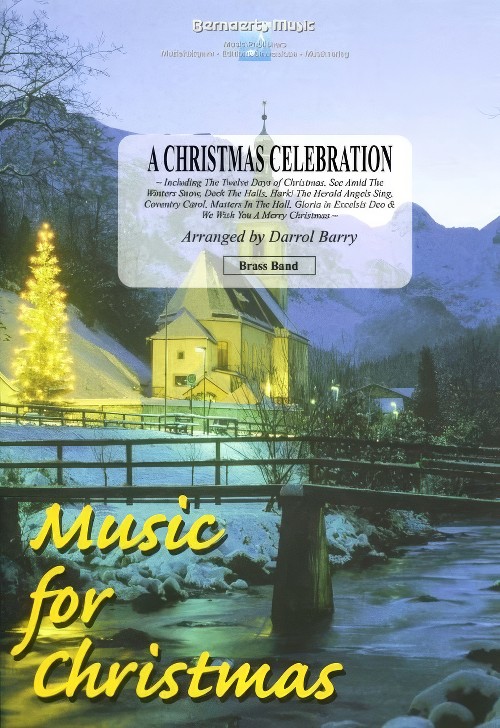
A Christmas Celebration (Brass Band - Score and Parts) - Barry, Darrol
Includes: The Twelve Days of Christmas; See Amid the Winters Snow; Deck the Halls; Hark! The Herald Angels Sing; Coventry Carol; Masters in the Hall; Gloria in Excelsis Deo; We Wish You a Merry Christmas. Duration: 3.30
Estimated dispatch 7-14 working days
-
 £84.99
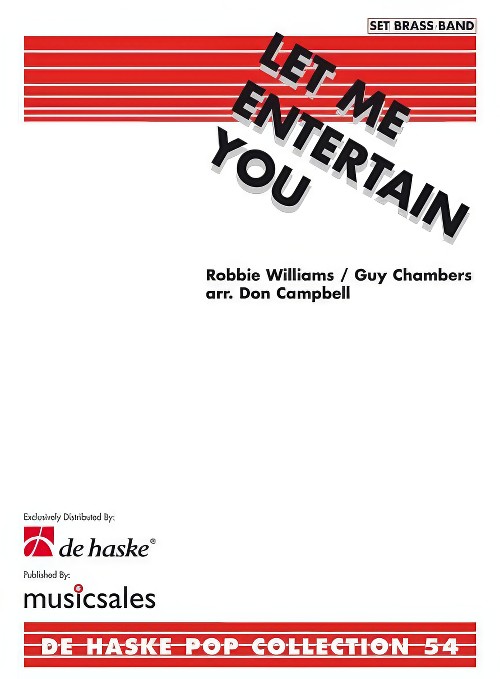
Let Me Entertain You (Brass Band - Score and Parts) - Chambers & Williams - Campbell, Don
This is a must-play item for any light concert programme. Robbie Williams is currently considered to be the king of pop, with his massive hit Angels being voted the number one song in many charts of all time greatest pop songs. He appeals to an extremely diverse audience ensuring every person at your concert will leave singing the songs from this superb work. Duration: 9.15
Estimated dispatch 7-14 working days
 View Music