
Results
-
 £189.95
'The New Christmas Collection' - Full Set March Card Size
The new Christmas Collection carol books contain all the traditional Christmas Carols, with some new 'pop' music arrangements included to add more variety to your carolling this year.
* Note, these are not compatible with the New Christmas Praise books.
Full list of works in The Christmas Collection:-
• A child this day is born
Estimated dispatch 7-14 working days
• A Christmas lullaby
• A great and mighty wonder
• All I want for Christmas is you
• All my heart this night rejoices
• Angels, from the realms of Glory (Come and worship)
• Angels, from the realms of Glory (Iris)
• Angels we have heard on high
• A starry night
• As with gladness men of old
• Auld lang syne
• A virgin most pure
• Away in a manger (The manger scene)
• Away in a manger (Traditional)
• A winter’s tale
• Bethlehem
• Brightest and best (Spean)
• Brightest and best (Traditional)
• Calypso Carol
• Carol for the Nativity
• Carol of the bells
• Carol of the drum
• Child of Mary
• Christians Awake!
• Christ is born (Il est né)
• Christ was born on Christmas Day
• Come and join the celebration
• Come, children, come quickly
• Coventry Carol
• Deck the hall
• Ding dong! merrily on high
• Do you hear what I hear?
• Frosty the snowman
• Gabriel’s Message
• Gaudete
• Glory in the highest
• Glory in the highest Heaven
• God of God, the uncreated
• God rest you merry, gentlemen
• Good Christian men, rejoice
• Good King Wenceslas
• Go, tell it on the mountain!
• Happy Christmas (War is over)
• Hark the glad sound!
• Hark! the herald angels sing
• Have yourself a merry little Christmas
• Here we come a-wassailing
• How far is it to Bethlehem?
• Huron Carol
• Infant Holy
• In the bleak midwinter (Cranham)
• In the bleak midwinter (Darke)
• I saw mommy kissing Santa Claus
• I saw three ships come sailing in
• It came upon a midnight clear (Traditional)
• It came upon a midnight clear (Willis)
• It’s beginning to look a lot like Christmas
• It’s the most wonderful time of the year
• I wish it could be Christmas everyday
• I wonder as I wander
• Jesus, good above all other
• Jingle Bells
• Jingle bell rock
• Joy to the world!
• Last Christmas
• Let it snow!
• Little baby Jesus
• Little children, wake and listen
• Little Donkey
• Little Jesus, sweetly sleep
• Lo! he comes with clouds descending
• Long, long ago
• Love came down at Christmas
• Mary’s boy child
• Mary’s Child
• Masters in this hall
• Merry Christmas everyone
• Mistletoe and wine
• Noel
• O Christmas tree
• O come, all ye faithful
• O come, Immanuel
• O Heaven-sent King
• O holy night!
• O little town of Bethlehem (Christmas Carol)
• O little town of Bethlehem (Forest Green)
• O little town of Bethlehem (St Louis)
• Once in royal David’s city
• Past three o’clock
• Patapan
• Personent Hodie
• Praise ye the Lord
• Ring the bells
• Rise up, shepherd!
• Rockin’ around the Christmas tree
• Rudolph, the red-nosed reindeer
• Sans day carol
• Santa Claus is comin’ to town
• Saviour’s Day
• See, amid the winter’s snow
• Silent Night!
• Sleigh Ride
• Softly the night is sleeping
• So here it is, merry Christmas
• Stars are shining
• Still, still, still
• Stop the cavalry
• Sussex Carol
• Sweet chiming bells
• Sweet chiming Christmas bells
• The candle song
• The cherry tree carol
• The Christmas song
• The first Nowell
• The holly and the ivy
• The infant King
• The light has come
• The shepherds’ farewell
• The stable door
• The star in the east
• The twelve days of Christmas
• The virgin Mary had a baby boy
• They all were looking for a king
• Thou didst leave thy throne
• Three kings’ march
• Unto us a boy is born
• Walking in the air
• We gather round the manger-bed
• We three kings of Orient are
• We wish you a merry Christmas
• What child is this?
• When a child is born
• When Santa got stuck up the chimney
• Whence is that goodly fragrance flowing?
• When wise men came seeking
• While shepherds watched (Cranbrook)
• While shepherds watched (Handel)
• While shepherds watched (Winchester Old)
• White Christmas
• Who is he?
• Winter Wonderland
• Worldwide Christmas message
• Zither Carol
• A starry night
• Christmas Joy
• Christmas Praise
• Coventry Carol
• Infant Holy
• Mid-winter
• Rudolph, the red-nosed reindeer
• The everlasting light
• To celebrate his birth
• Yuletide Rag
-
 £34.95
Carol of the Bells (Brass Band - Score and Parts)
Christmas time is my favourite time of year. I love the festive spirit and all the Christmas music both traditional and modern.This piece is based on the traditional Ukrainian Bell Carol that was composed by the Ukrainian composer Mykola Dmytrovych Leontovych. Throughout the piece you hear a four note ostinato that is the backbone to the music. I have taken those ideas and motifs and have mixed them with some of my own to create this piece of Christmas music.For something different I have given this piece two endings for the conductor to choose. The first ending is at bar 189 (page 18 in the score) where there is the repeated four bar ostinato section in the solo cornets and percussion that is marked "Keep repeating and fade to nothing". This is so the piece can either fade to nothing or for a bit of originality the piece can fade into the next piece during a concert programme.For ending number two you need to cut from bar 189 to 193 (bypassing ending one). And continue to the end. The choice of endings should bring some interesting performances of this wonderful traditional Christmas piece.Paul Lovatt-Cooper
Estimated dispatch 7-14 working days
-
 £79.95
Lost Village of Imber, The - Christopher Bond
The village of Imber on Salisbury Plain had been inhabited for over one thousand years when it was evacuated in 1943 to make way for military training in the Second World War. At the time, with preparations for the Allied invasion of Europe underway, most villagers put up no resistance, despite being upset, with the belief that they'd return once the war had concluded. To this day, Imber and its surrounding land remain a military training ground. The villagers never returned, and just the shell of what was once a community remains. Structured in three movements, it is on this very real story that the work is based, setting out the series of events of 1943 in chronological order. The first movement, On Imber Downe, portrays a sense of jollity and cohesiveness - a community of individuals living and working together before news of the evacuation had broken. Sounds of the village are heard throughout, not least in a series of percussive effects - the anvil of the blacksmith; the cowbell of the cattle and the bells of the church. The second movement, The Church of St. Giles, begins mysteriously and this sonorous, atmospheric opening depicts Imber in its desolate state and the apprehension of residents as they learn they have to leave their homes. Amidst this is the Church, a symbol of hope for villagers who one day wish to return, portrayed with a sweeping melodic passage before the music returns to the apprehension of villagers facing eviction around their sadness at losing their rural way of life. In complete contrast, the third movement, Imemerie Aeternum, portrays the arrival of the military, complete with the sounds of the ammunition, firing and tanks - sounds which were all too familiar to those living in the surround areas. To close, the Church of St. Giles theme returns in a triumphant style, representing the idea that the church has always been, even to this day, a beacon of hope for the villagers and local community - both the centrepiece and pinnacle of a very real story. The work was commissioned by Bratton Silver Band in celebration of the band's 160th Anniversary, with funding from the Arts Council National Lottery Project Grants Fund and the Brass Bands England Norman Jones Trust Fund.
Estimated dispatch 10-14 working days
-
 £35.00
Music Through The Ages - Steve Robson
A fun and educational collection of 7 pieces created by Steve Robson, with optional narration, providing a time-travelling journey through the history of 2000 years of music to the present time.Originally written for Stanhope Youth Band, the piece has now been well received by other youth bands far and wide. The complete work offers great flexibility too, as te movements can be used as stand-alone items or as a full concert performance, offering players and audiences an insight to the evolving styles of Music Through The Ages.Movements include:FanfareThe Passing of the VIth Legion A Patrol - Imagining the sound of the Roman Legion at Vindolanda (AD84)The Journey of St Cuthbert - A Plainchant (995)The Honorable Robert Shafto MP - Late Baroque Style (1749)The Very Capable Mr Mozart Classical Style - Rondo (1786)Sans Pareil March - Tribute to Timothy Hackworth and George Allan (1913)The Angel of the North - Contemporary composition (Present day)Watch a full performance below of the pieces, including narration. This was a collaborative performance project, presented by members of different youth bands from across the North East on Saturday 13 November 2018 in the Theatre at Ushaw College, Durham.(NB: The piece Galliard, performed at 12mins 22secs into the video, was specially written for the concert and is not included in this collection.)Look and Listen (with thanks to all participating youth bands and supporting players):Set includes score (with narration), separately bound narration (enable a choice of either compere/conductor presentation) and parts including:Cornet 1Cornet 2Corent 3FlugelhornEb Tenor Horn 1Eb Tenor Horn 2Baritone 1Baritone 2Trombone 1Trombone 2Bass TromboneEuphoniumEb BassBb BassTimpaniPercussionAdditional world parts also provided include F Horn 1, F Horn 2, Trombone 1 in Bass Clef, Trombone 2 in Bass Clef.
In Stock: Estimated dispatch 3-5 working days
-
 £159.99
Time Machine - Thomas Doss
Time Machine is a journey through time that begins in the Stone Age. Evolution and the coming of man take place. The journey takes us into the present, in which disorientation and chaos abound. We travel further into the future. An unfamiliar, quiet and surreal landscape lies before us and we wander through it, bewildered as we become aware of the destruction of the environment. Suddenly, and for no reason, memories from our childhood are awoken. Cultures have become completely mixed into one and the evolution of man has run its course. We realise that there is no "afterwards" as before us lies the Stone Age once again... The wheel of time spins blindly on and all isrepeated.
Estimated dispatch 5-14 working days
-
 £154.99
Tracing Time - Oliver Waespi
Tracing Time was commissioned by the WMC Kerkrade Foundation in cooperation with the Foundation of Friends of WMC for the 2017 World Championships in Kerkrade, the Netherlands. The musical material of this piece takes the form of a timeline on an imaginary mental map. This unbroken thread runs through the entire work, continually transformed through numerous sound colours and rhythms. At the same time, the piece takes the shape of a symphonic structure, based on three uninterrupted, linked movements. This work meets all standards of a high quality contest or concert work. It is challenging, spectacular, innovative and overwhelming.
Estimated dispatch 5-14 working days
-
 £77.20
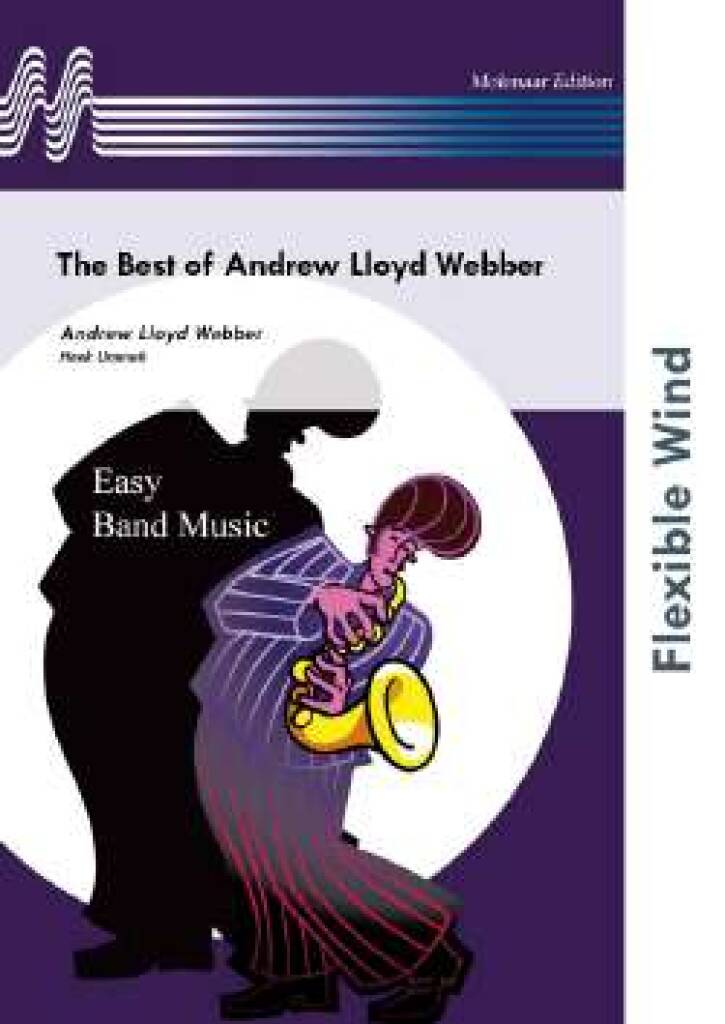
The Best of Andrew Lloyd Webber - Andrew Lloyd Webber - Henk Ummels
Once again Henk Ummels has succeeded to make a rich and full arrangement using only 5 voices. This time an arrangement of highlights from the biggest musical hits from the most well known musical composer of all time. It has been arranged for beginner bands, but also very suitable for lower level bands who want something fun and entertaining. Includes music from: The Phantom of the Opera, Jesus Christ Superstar, Cats, and Joseph and the Amazing Technicolour Dreamcoat.
Estimated dispatch 5-14 working days
-
£76.99
The Universal Band Collection - Jacob de Haan
A collection of 5 short works in pop style which can be performed by any kind of compilation. The titles can be presented on the programme as separate works but the Universal Band Collection can also be performed as a complete suite. From a didactic point of view it is a suitable work to teach musicians something about the structure in music. For this purpose not only the big structure but also the small structure was kept very clear.Western Girl : A girl from the west of the USA rides her horse across the prairie, dreaming of her future. The rough structure: introduction - theme in a blues scale - the same thing in a different instrumentation - finale.Just a ballad : A balladin pop style with a rough A-B-A form. First there is the introduction of the main theme (A), then follows a tenor melody in minor with a rhythmical reference to the main theme (B). Finally there is the main melody, performed tutti with a different rhythm in the drums (A').Play the Game : An English saying meaning: play fairly. Playful music in up-tempo with a wink to China, where almost all games are manufactured nowadays. Once again an A-B-A structure here.San Diego : A Mexican fugitive enjoys his freedom in America but also remembers his place of birth with melancholy. A sad minor melody with a straight trendy beat appears twice. The second time it has a slightly different instrumentation, in which the muted trumpets represent the Mexican feeling.Final Dance : Eventually there is a dance with an introduction in renaissance style, followed by a fast dance in rock style. All this composed in a classical song structure: introduction, verse, bridge, chorus, shortened verse, bridge, chorus, chorus.
Estimated dispatch 5-14 working days
-
 £52.70
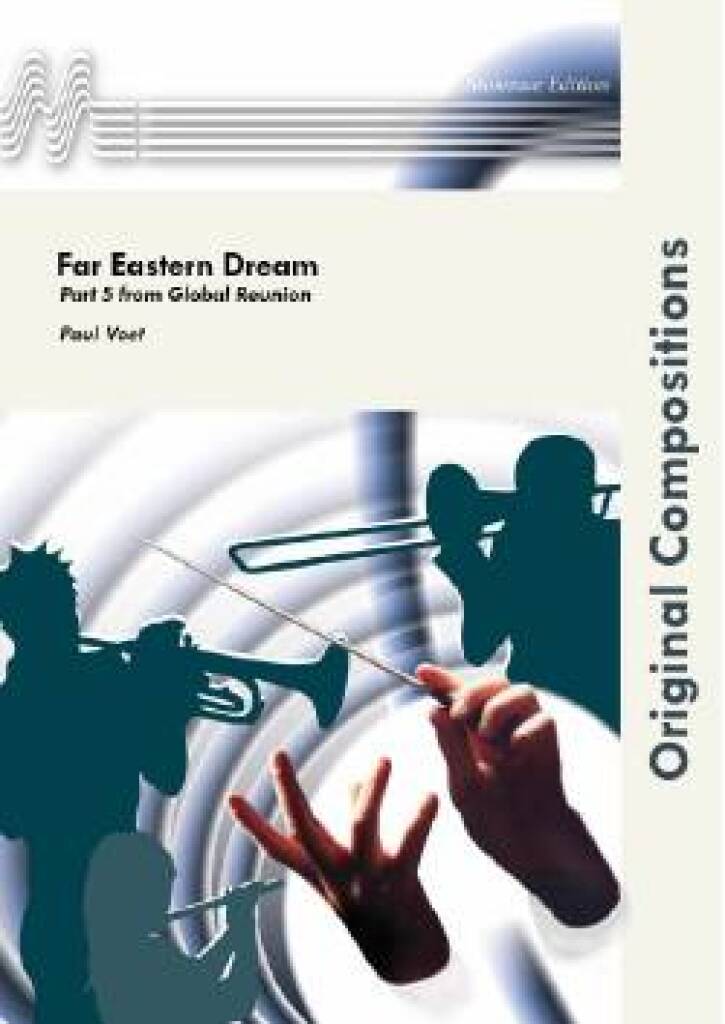
Far Eastern Dream - Paul Voet
The longest trip we make is to the Far East. Japan, China, Tibet,... all countries with an enormous cultural background and history. Percussion is very important here to give a rich dimension to this Japanese 'Black Bamboo' theme. Tam-tam, Chinese cymbals, Tibetan gong and a kododrum (if not possible, large floor tom) together with marimba and glockenspiel are used all the time in a carefulway. A solo cornet presents the main theme that is answered by the whole lower brass section. While this theme develops now and then the sounds of the impressive 'dung' is heard. (dung is the Tibetan very large trumpet-like instrument with loud and very deep sounds) In a quicker tempo Eb bass, euphonium and solo cornet start with the theme and even the counter theme. The whole group joins the party but everything ends very silently with mute.
Estimated dispatch 5-14 working days
-
£59.99
All Cried Out - Peter Kleine Schaars
At the beginning of the 1980s Alison Moyet was discovered by Vince Clarke, who - in search of greater independence - had left the successful band Depeche Mode. The soulful singing style of Moyet and the electronic, innovative pop that Clarke made melded well together in the group Yazoo with hits such as Only You and Don't Go. However, after a number of years Moyet went her own way and forged a solo career, during which she demonstrated a somewhat more traditional sound. She recorded several covers (such as The First Time I Ever Saw Your Face and That Ole Devil Called Love) but she also wrote fine songs herself, such as Love Resurrection and, of course, the expressive song AllCried Out. This arrangement by Peter Kleine Schaars does justice to the atmosphere of the original song.
Estimated dispatch 5-14 working days
 View Music