
Results
-
 £54.99
Joyful March (Brass Band - Score and Parts)
As the title implies, this piece is all joy and cheerfulness. In Joyful March, the themes have been combined to make a spirited work that can give each concert an elated touch. From the opening vivid melody to the softer and colourful themes of the trio, Joyful March is full of joie de vivre. Its fairly simple structure makes it accessible to all brass bands. 03:30
Estimated dispatch 7-14 working days
-
 £79.99
Valerius Variations (Brass Band - Score and Parts) - Sparke, Philip
Dutch composer, artist and poet Adriaen Valerius is mostly remembered today for his collection of 79 songs for voice and lute or cittern, published posthumously in 1626. Philip Sparke has taken one melody from this collection that tells of the War of Independence with Spain. The beautiful slow melody is followed by a series of lively variations to form an extremely entertaining piece that will bring great joy to all who perform and listen to it.Duration: 9:00
Estimated dispatch 7-14 working days
-
 £59.99
David of the White Rock (Brass Band - Score and Parts) - Sparke, Philip
This is an ancient Welsh air that was first published in Relics of the Welsh Bards in 1794. Dafydd (David) Owain was a famous Welsh bard who lived on a farm called Gareg Wen (The White Rock) in Eifionydd, Carnarnvonshire, North Wales. Tradition has it that on his deathbed he called for his harp and composed this lovely melody, requesting that it be played at his funeral. Accordingly, it was later played at the parish church of Ynys-Cynhaiarn. Lyrics were later added by Ceiriog Hughes, which describe the melody's inspiration. This version for brass band retains all the beauty and simplicity of the original.Duration: 2:45
Estimated dispatch 7-14 working days
-
 £15.00
Symphony in Two Movements (Brass Band - Study Score) - Gregson, Edward
Selected as the Championship Section test piece for the National Brass Band Championships of Great Britain 2025This work was jointly commissioned by the National Youth Brass Band of Great Britain (NYBBGB) and the National Youth Brass Band of Wales (NYBBW), the latter with funding from T Cerdd (Music Centre Wales), to celebrate their 60th and 30th anniversaries respectively. The first performances were given at Cadogan Hall, London, in April 2012, by the NYBBGB, conducted by Bramwell Tovey; and at the Great Hall, Aberystwyth University, in July 2012, by the NYBBW, conducted by Nicholas Childs.When I was approached about a joint commission to write a new work to celebrate the anniversaries of these two outstanding youth bands I was delighted to accept, and decided to respond by writing a work apposite for the magnitude of these special occasions, namely a 'symphony for brass'.Through a long journey of writing music for brass band, which commenced with Connotations (1977), and continued with Dances and Arias (1984), Of Men and Mountains (1991), The Trumpets of the Angels (2000) and Rococo Variations (2008), I arrived at what I regard as the most important work of the cycle to date, combining as it does serious musical intent with considerable technical demands. It is perhaps my most abstract work for brass band, avoiding any programmatic content.The symphony lasts for some 19 minutes and is structured in two linked movements. The form is based on that used by Beethoven in his final piano sonata (Op.111), which is in two movements only: a compact sonata-form allegro, followed by a more expansive theme and four variations. Prokofiev also adopted this model in his 2nd Symphony of 1925.The opening Toccata of this Symphony is highly dramatic but compact, whilst still retaining the 'traditional' structural elements of exposition, development and recapitulation; indeed, it also has the 'traditional' element of a contrasting second subject - a gentle, lyrical modal melody first heard on solo cornets.In contrast, the longer and more substantial second movement Variations is built around a theme and four variations. The slowly unfolding chorale-like theme accumulates both added note harmony and increasing instrumentation, whilst the four variations which follow are by turn mercurial (fast, starting with all the instruments muted), march-like (menacing, with short rhythmic articulations underpinning an extended atonal melody), serene (a series of 'romances' for solo instruments alongside echoes of the chorale) with an emerging theme eventually bursting into a climax of passionate intent; whilst the final variation is a dynamic scherzo (concertante-like in its series of rapid-fire solos, duets, trios and quartets) with the music gradually incorporating elements of the main ideas from the first movement, thus acting as a recapitulation for the whole work. It reaches its peroration with a return to the very opening of the symphony, now in the 'home' tonality of F, and thus creating a truly symphonic dimension to the music.Most of the melodic material of the symphony is derived from the opening eleven-note 'row', which contains various intervallic sets, and although the work is not serially conceived it does use some typical quasi-serial procedures, such as canons, inversions, and retrogrades. The symphony uses somewhat limited percussion, in line with a 'classical' approach to the sound world of the brass band, alongside a use of multi-divisi instrumentation, whereby each player has an individual part rather than the traditional doubling within certain sections of the band.- Edward GregsonDuration: 19.00
Estimated dispatch 7-14 working days
-
 £104.99
The Baltic Way (Brass Band - Score and Parts) - De Haan, Jan
In 1989, the demonstration named the Baltic Way also known as the Baltic Chain-- was held in the Baltic states of Estonia, Latvia and Lithuania by its citizens in a call for independence from the Soviet Union. On 23rd August 1989, some two million participants formed a human chain, hand-in-hand all the way from the Estonian capital of Tallinn its Latvian counterpart, Riga, through to the Lithuanian capital of Vilnius - six hundred kilometres long. It became the longest human chain ever created and turned out to be the final push needed for much sought-after independence. This historic event became the source of inspiration for this composition. The introduction of thefirst movement, 'Struggle for Independence', is based on a nocturne for piano by the renowned Lithuanian composer and painter Mikalojus Konstantinas iurlionis (1875-1911), thematic material from which has been incorporated throughout the whole composition. The melancholic beginning is followed by a powerful theme which reflects the resolve of the Baltic people. The sudden aggressive, dissonant chords and a dominant and--in rhythmic terms--contrary bass drum announce that the resistance is not going smoothly. Just for a moment, we hear the anthem of the Soviet Union in the lower brass, but this is relentlessly pushed to the background by the rest of the band playing the Lithuanian national anthem, 'Tautika giesm ' (Lithuania, our homeland). The second movement, 'Decades of Suffering', echoes life under the Soviet Union's thumb. In the pursuit of independence, a peaceful protest is planned in which a human chain is formed across the Baltic states of Estonia, Latvia and Lithuania. This 'Chain of Freedom' is depicted in the final movement of the work. Duration: 10.30
Estimated dispatch 7-14 working days
-
 £107.95
Symphony in Two Movements (Brass Band - Score and Parts) - Gregson, Edward
Selected as the Championship Section test piece for the National Brass Band Championships of Great Britain 2025This work was jointly commissioned by the National Youth Brass Band of Great Britain (NYBBGB) and the National Youth Brass Band of Wales (NYBBW), the latter with funding from T Cerdd (Music Centre Wales), to celebrate their 60th and 30th anniversaries respectively. The first performances were given at Cadogan Hall, London, in April 2012, by the NYBBGB, conducted by Bramwell Tovey; and at the Great Hall, Aberystwyth University, in July 2012, by the NYBBW, conducted by Nicholas Childs.When I was approached about a joint commission to write a new work to celebrate the anniversaries of these two outstanding youth bands I was delighted to accept, and decided to respond by writing a work apposite for the magnitude of these special occasions, namely a 'symphony for brass'.Through a long journey of writing music for brass band, which commenced with Connotations (1977), and continued with Dances and Arias (1984), Of Men and Mountains (1991), The Trumpets of the Angels (2000) and Rococo Variations (2008), I arrived at what I regard as the most important work of the cycle to date, combining as it does serious musical intent with considerable technical demands. It is perhaps my most abstract work for brass band, avoiding any programmatic content.The symphony lasts for some 19 minutes and is structured in two linked movements. The form is based on that used by Beethoven in his final piano sonata (Op.111), which is in two movements only: a compact sonata-form allegro, followed by a more expansive theme and four variations. Prokofiev also adopted this model in his 2nd Symphony of 1925.The opening Toccata of this Symphony is highly dramatic but compact, whilst still retaining the 'traditional' structural elements of exposition, development and recapitulation; indeed, it also has the 'traditional' element of a contrasting second subject - a gentle, lyrical modal melody first heard on solo cornets.In contrast, the longer and more substantial second movement Variations is built around a theme and four variations. The slowly unfolding chorale-like theme accumulates both added note harmony and increasing instrumentation, whilst the four variations which follow are by turn mercurial (fast, starting with all the instruments muted), march-like (menacing, with short rhythmic articulations underpinning an extended atonal melody), serene (a series of 'romances' for solo instruments alongside echoes of the chorale) with an emerging theme eventually bursting into a climax of passionate intent; whilst the final variation is a dynamic scherzo (concertante-like in its series of rapid-fire solos, duets, trios and quartets) with the music gradually incorporating elements of the main ideas from the first movement, thus acting as a recapitulation for the whole work. It reaches its peroration with a return to the very opening of the symphony, now in the 'home' tonality of F, and thus creating a truly symphonic dimension to the music.Most of the melodic material of the symphony is derived from the opening eleven-note 'row', which contains various intervallic sets, and although the work is not serially conceived it does use some typical quasi-serial procedures, such as canons, inversions, and retrogrades. The symphony uses somewhat limited percussion, in line with a 'classical' approach to the sound world of the brass band, alongside a use of multi-divisi instrumentation, whereby each player has an individual part rather than the traditional doubling within certain sections of the band.- Edward GregsonDuration: 19.00
Estimated dispatch 7-14 working days
-
 £57.95
Symphony in Two Movements (Brass Band - Score only) - Gregson, Edward
Selected as the Championship Section test piece for the National Brass Band Championships of Great Britain 2025This work was jointly commissioned by the National Youth Brass Band of Great Britain (NYBBGB) and the National Youth Brass Band of Wales (NYBBW), the latter with funding from T Cerdd (Music Centre Wales), to celebrate their 60th and 30th anniversaries respectively. The first performances were given at Cadogan Hall, London, in April 2012, by the NYBBGB, conducted by Bramwell Tovey; and at the Great Hall, Aberystwyth University, in July 2012, by the NYBBW, conducted by Nicholas Childs.When I was approached about a joint commission to write a new work to celebrate the anniversaries of these two outstanding youth bands I was delighted to accept, and decided to respond by writing a work apposite for the magnitude of these special occasions, namely a 'symphony for brass'.Through a long journey of writing music for brass band, which commenced with Connotations (1977), and continued with Dances and Arias (1984), Of Men and Mountains (1991), The Trumpets of the Angels (2000) and Rococo Variations (2008), I arrived at what I regard as the most important work of the cycle to date, combining as it does serious musical intent with considerable technical demands. It is perhaps my most abstract work for brass band, avoiding any programmatic content.The symphony lasts for some 19 minutes and is structured in two linked movements. The form is based on that used by Beethoven in his final piano sonata (Op.111), which is in two movements only: a compact sonata-form allegro, followed by a more expansive theme and four variations. Prokofiev also adopted this model in his 2nd Symphony of 1925.The opening Toccata of this Symphony is highly dramatic but compact, whilst still retaining the 'traditional' structural elements of exposition, development and recapitulation; indeed, it also has the 'traditional' element of a contrasting second subject - a gentle, lyrical modal melody first heard on solo cornets.In contrast, the longer and more substantial second movement Variations is built around a theme and four variations. The slowly unfolding chorale-like theme accumulates both added note harmony and increasing instrumentation, whilst the four variations which follow are by turn mercurial (fast, starting with all the instruments muted), march-like (menacing, with short rhythmic articulations underpinning an extended atonal melody), serene (a series of 'romances' for solo instruments alongside echoes of the chorale) with an emerging theme eventually bursting into a climax of passionate intent; whilst the final variation is a dynamic scherzo (concertante-like in its series of rapid-fire solos, duets, trios and quartets) with the music gradually incorporating elements of the main ideas from the first movement, thus acting as a recapitulation for the whole work. It reaches its peroration with a return to the very opening of the symphony, now in the 'home' tonality of F, and thus creating a truly symphonic dimension to the music.Most of the melodic material of the symphony is derived from the opening eleven-note 'row', which contains various intervallic sets, and although the work is not serially conceived it does use some typical quasi-serial procedures, such as canons, inversions, and retrogrades. The symphony uses somewhat limited percussion, in line with a 'classical' approach to the sound world of the brass band, alongside a use of multi-divisi instrumentation, whereby each player has an individual part rather than the traditional doubling within certain sections of the band.- Edward GregsonDuration: 19.00
Estimated dispatch 7-14 working days
-
 £29.95
Dalaro (Brass Band - Score and Parts) - Gregson, Edward
The name of Edward Gregson is well known in Salvationist circles as well as in the wider music world, his music receiving performances and being recorded and published regularly. This music is individual and of high worth with an assured technique. It is always a pleasurable task for the musician to handle music with these qualities, whether one is editor, conductor or player.Written in connection with the International Salvation Army Students' Fellowship Conference held in Dalaro, Sweden in 1964, this is a 'festival' rather than processional march. Section C is a tune from the Swedish Tune Book (No. 303 in the 1945 edition), Jag gar till det land dar ovan (I go to that Land above). There is a slight divergence from the tune book version (labelled, by the way, as an English tune); this could well be the manner in which the tune is sung - we are all aware of the way in which congregations modify tunes.
Estimated dispatch 7-14 working days
-
 £104.99
Variations on a Chord (Brass Band - Score and Parts) - De Haan, Jan
Variations on a Chord was composed on the occasion of the second lustrum of the Dutch Brass Band Championships celebrated in 1990. The piece is the immediate sequel to Contrasten a piece which was composed in 1986, and which is performed all over the world. Not only was the final chord of this previous work used as a starting point for the new composition, but Variations on a Chord is also the first concert piece for brass band composed by Jan de Haan since then. The several variations are based on a solemn theme. The so-called minor-major seventh chord is easily detectable. The structure of the piece is such that the lyrical theme is preceded by a majestic introduction, and is followed by eight variations each strongly contrasting in character. The piece finishes in a short but extremely spectacular coda.Duration: 11:45
Estimated dispatch 7-14 working days
-
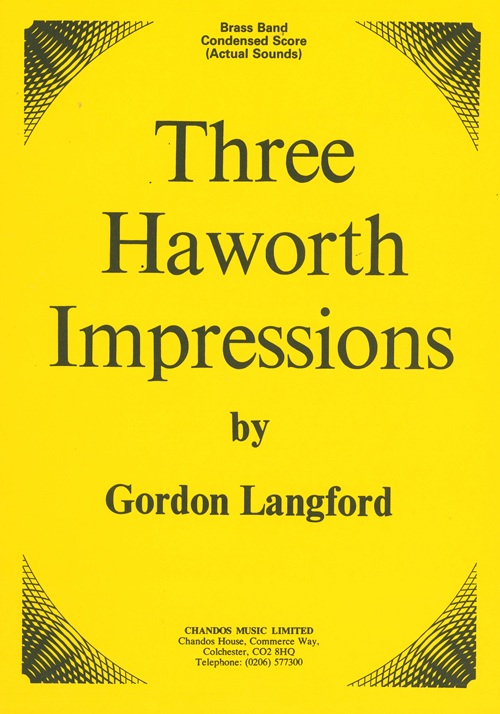 £85.00
Three Haworth Impressions (Brass Band - Score and Parts) - Langford, Gordon
A wonderful three movement suite which conjures up fabulous musical imagery of the lands of northern England. Well worth including as a concert item in your next programme, but this great original composition should really should be set again as a test-piece soon - rewarding musically for audience and bandsmen alike.Includes:TOP WITHENS - A GENERAL EVOCATION OF THE ATMOSPHERE OF WUTHERING HEIGHTS The sinister opening motif symbolises the influence of the evil Heathcliffe, Soon this motif experiences several changes of character in order to portray emotions other than those of hatred and jealousy. The overall mood is, however, one of gloom and foreboding.THE THREE BELLS This is a reference to the pseudonyms adopted by Ann, Charlotte and Emily Bronte. The music begins with three "bell"-notes; Ab for Acton Bell, Cb for Currer Bell and Eb for Ellis Bell, and these three notes form the basis of a wistful waltz tune. Again the mood is rather sombre -- save for a brighter middle section -- and the opening motif from "Top Withens" is to be heard, again symbolising the frustrations and ill-fortune by which their lives were plagued.THE WORTH VALLEY RAILWAY The Brontes were not the only people in Haworth and not all is desperation and gloom. The third impression is a celebration of the victory of the people of Haworth in their fight to retain their railway. The nine-eight rhythm of a slow train is prominent, and our once-sombre motif is transformed into a triumphant fanfare.Duration: 12.00Please note that there are only 3 solo cornet parts included in this set
Estimated dispatch 7-14 working days
 View Music