
Results
-
 £42.00
The Very Best Time of Year (Euphonium Solo with Brass Band - Score and Parts)
This new arrangement for Solo Euphonium & brass band by David Griffiths, truly evokes that feeling of nostalgia and longing anticipation of the joyous season and is a true celebration of all that we love about Christmas time! Suitable for 4th Section Bands and above
Estimated dispatch 7-14 working days
-
 £34.95
The Twelve Days of Christmas (Brass Band - Score and Parts)
This arrangement of 'The Twelve Days of Christmas' features all twelve verses and will work well either as a standalone brass band piece, or with audience participation.
Estimated dispatch 7-14 working days
-
 £34.95
Song for the Skies (Eb Bass Solo with Brass Band - Score and Parts)
Song for the Skies was commissioned by Tuba virtuoso Les Neish and was given its world premier on the December 9th 2010 with the James Madison University Brass Band in Harrisonburg, Virginia, USA.Les asked me to compose a slow melody that highlights the wonderful sonorous sound of the Tuba. I am a big fan of Les and of the instrument and knowing the capabilities of Les as a soloist I wanted to experiment with the range and colour of the instrument in this solo.After a warm introduction from the ensemble the soloist enters almost timeless over the muted cornets. The melody when it is first heard has a somewhat haunting Celtic feel to it. It is intentionally marked as con rubato so that the soloist can really put their own musical stamp on the music. As the haunting melody repeats again this time in a change of key the accompaniment takes more of a role within the piece of music performing counter melodies within this second section.The middle of the piece introduces a new secondary melodic device that serves as an introduction to the original melody played in all its glory by the ensemble. This dies away to leave the second half of the melody in the euphoniums and baritones as the soloist plays a soaring counter melody in the highest register of the instrument.The piece starts to return home with a recapitulation of the introduction followed by the second part of the original melody by the soloist. After a momentary reflective solo from the soloist the introduction is used for a final time before the tuba guides us home to conclude.For the soloist, there are a number of occasions where the opportunity to play in the upper register of the instrument arises. However, I have also given the opportunity for the soloist to play various passages down the octave so it suits the performers playing style and range.Song for the Skies is very simple yet beautiful and I feel it suits the playing of the Eb Tuba perfectly. I hope you enjoy performing it.Paul Lovatt-Cooper
Estimated dispatch 7-14 working days
-
 £59.95
Swedish Festival Music (Brass Band - Score and Parts)
This three-movement suite was commissioned by the Swedish Brass Band Association as the test piece for the Championship Section of their 2008 National Contest. The first movement is inspired by the magnificent Swedish hymn 'How Great Thou Art'. Indeed the influence of that hymn can be traced in all three movements. The declamatory style of the opening gives way to other, more reflective expressions of awe and wonder. A more animated section develops before a final, triumphant statement of the 'How Great' idea returns to finish the movement. The slow second movement features another much-loved Swedish hymn. The music provides plenty of scope for expressive playing, and a feeling of intimacy should be created by the use of several short solo passages. The third movement Allegro brings a totally different, dance-like mood with frequent references to a reel from the region of Uppland. This eventually brings a return to the opening subject and a final, triumphant reference to 'How Great Thou Art'.
Estimated dispatch 7-14 working days
-
 £104.99
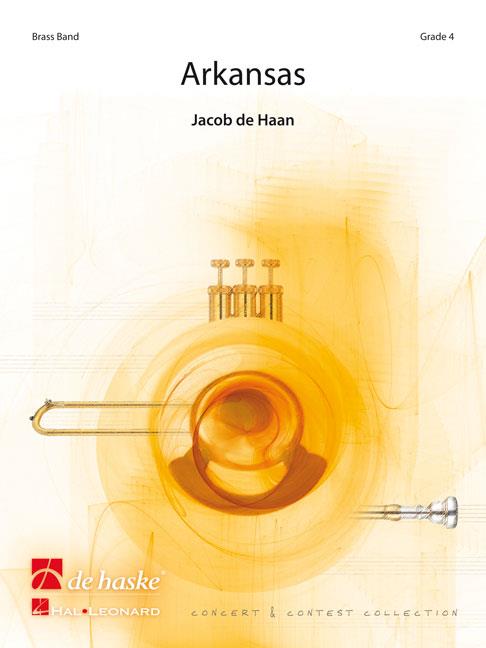
Arkansas (Brass Band - Score and Parts)
This concert work, the latest of Jacob de Haan works based on American states, is a suite in three movements, based on a well-known folk tune from Arkansas. In the course of this varied work the folk song appears in its complete form and in fragments, in major and in minor, as a ballad in a lyrical orchestration, as a blues, accompanied by a jazzy rhythm and at the end again in its pure form. In the process, all instrumental groups of the brass band get their chance to shine!Duration: 9:30
Estimated dispatch 7-14 working days
-
 £27.00
Auld Lang Syne (Brass Band - Score and Parts)
It is a tradition in most English-speaking countries to sing this song at the stroke of midnight on New Year's Eve to usher in the New Year. The words are at least partially written by Robert Burns and the words "Auld Lang Syne" literally mean "old long ago" or "the good old days", providing a moment of reflection before moving forwards into the New Year.The tubular bells, although pitched, sound midnight when they enter at bar 10.This arrangement was prepared for Brass Band of the Western Reserve, musical director Keith M Wilkinson, to perform at First Night, Akron, Ohio, December 31st, 2007. The following choreography is suggested:Commence the performance with all the cornets scattered around the auditorium.At the end of bar 18 invite the audience to sing along with the band.At bar 27 the cornets move to stand in front of the other members of the band to lead to the stirring conclusion. Should auld acquaintance be forgot and never brought to mind?Should auld acquaintance be forgot and days of auld lang syne?For auld lang syne, my dear, for auld lang syne,We'll take a cup of kindness yet, for auld lang syne.
Estimated dispatch 7-14 working days
-
 £94.95
Dances and Arias (Brass Band - Score and Parts)
This work was commissioned by Boosey & Hawkes Band Festivals (with funds provided by the Arts Council of Great Britain) for the National Brass Band Championships of Great Britain, held at the Royal Albert Hall, London, on 7th October 1984.Dances and Arias is in one continuous movement, but as the title suggests is a series of alternating fast and slow sections as follows: Dance - Aria I - Dance (scherzo) - Aria II - Dance. The opening dance is energetic and introduces a four-note motif (on trombones) which is the basis for much of the melodic material in the work. Throughout, there is a continuous process of thematic cross-reference and transformation.The first aria unfolds a long melody on solo cornet, eventually continued by all the solo cornets, and dissolving into a shimmering harmonic background (muted cornets, horns and baritones) over which is heard a brief self-quotation on solo tuba. This leads into the second dance, a frenetic scherzo, followed by the second aria, in the style of a lament (solo euphonium, followed by two flugel horns). This builds to a powerful climax which subsides, leaving the percussion to introduce the final toccata-like dance. It transforms material from the opening before a coda brings the music to a triumphant close. The large percussion section is an integral part in the work and uses a wide variety of instruments including timpani, glockenspiel, vibraphone, xylophone, tubular bells, tom-toms, snare drum, bongos and tam-tam.
Estimated dispatch 7-14 working days
-
 £34.95
Sprites and Flares (Brass Band - Score and Parts)
Sprites and Flares (2015), refers to the uncertain activities of sprites (upper atmospheric lightening) and solar flares (solar activity from the sun which cannot penetrate the earth's atmosphere) and uses these two ideas as a basis for the kind of musical material heard within the work - dramatic, swirling motifs, often of a virtuosic nature.The work's dramatic opening ensures the first thirty seconds are high in energy and full of impact. Following this, the music dies down and presents an ethereal atmospheric section, perhaps reflecting the calm before the storm. Before long, the music takes a turn for dramatic, fast, virtuosic playing, all reflecting the theme of the work, and indeed remains in this style through to the close, gaining momentum and becoming ever- more triumphant as the work reaches its close. A huge ending is heard, full of excitement and drama, but more importantly grandeur and rich harmonic-chords.The work was commissioned by and written for Leyland Band and its conductor, Thomas Wyss, as the finale to its 2015 Brass in Concert programme, premiered at The Sage, Gateshead, on 15th November 2015.
Estimated dispatch 7-14 working days
-
£89.95
Cambridge Variations (Brass Band - Score and Parts)
Written in 1992, commissioned by Philip Biggs & Richard Franklin for the All England Brass Band Championships. The work falls into five sections (variations) which are performed continuously. 1. The introductory first section contains a chorale, which sta
Estimated dispatch 7-14 working days
-
 £32.95
Variations for Brass Band (Score Only)
The great British brass band tradition has been fostered since 1860 by an annual competition for bands. Held in the Crystal Palace until that edifice burned in the 1930s, it is a major event at the Royal Albert Hall in London. Each year there is a new test piece, required of all bands and in 1957, Ralph Vaughan Williams (by then a revered, grandfatherly figure in British music) was finally persuaded to write a composition for that purpose.The 12-minute composition comprises a theme and 11 variations. The brief variations are in a variety of moods and styles, including a waltz, a polonaise, a chorale, a canon, an arabesque, and a fugue. It tests ensemble coordination, command of and flexibility concerning styles, and richness of sound.
Estimated dispatch 7-14 working days