
Results
-
 £89.99
Ross Roy - Jacob de Haan
In this composition, Jacob de Haan sees the "Ross Roy" as a metaphor for the years spent at school (a monument in time), where one's personality is formed. So, the opening theme the artist calls the Ross Roy theme initially has monumental characteristics.The rhythmic motion, which strides along in the lower register and percussion at the beginning of the next section is typical of "Tempo di Marcia". This movement, accompanied by repetitions of sound, is a metaphor for the structure and discipline in school. This is the introduction to a march theme, symbolic of "passing through" the classes up to the final examinations.Then, the Ross Roy theme is dealt with again, now in aplayful, humorous variation. As if the composer is saying there should also be time for a smile in school. The same theme can be heard in major key and a slower tempo in the following section, expressing pride and self-confidence. This is also the introduction to the expressive middle section that represents love, friendship and understanding.We then return to the march theme in a slightly altered construction. The oriental sounds, constituting the modulation to the final theme, are symbols of the diversity of cultures in the school. The characteristic final theme first sounds solemn, but turns into a festive apotheosis. It is no coincidence that the final cadence is reminiscent of the close to a traditional overture, for the school years can be considered the "overture" to the rest of one's life.
Estimated dispatch 5-14 working days
-
£54.99
American Pie - Don McLean - Ron Sebregts
Don McLean's success is largely due to the remarkable song American Pie released in 1971. In 2000 American Pie topped the charts again, this time recorded by Madonna when her version achieved number 1 status almost everywhere in the world.
Estimated dispatch 5-14 working days
-
 £54.99
Amazing Grace - Traditional - Jacob de Haan
Jacob de Haan arranged the famous piece Amazing Grace for four-part variable ensemble, which may be complemented with percussion. With this intrumentation, it is possible to play the piece with almost any combination of instruments.The piece opens with the song theme, which after a modulation, flows into an intermezzo, characterized by a free interpretation of the theme. The interlude reaches a climax introducing the finale where the melody can be heard once again in all its beauty.
Estimated dispatch 5-14 working days
-
 £84.99
The Saint and the City - Jacob de Haan
This work is based on a well-known myth about the city of Zwolle in the Netherlands. In the waters surrounding Zwolle lived a dragon that regularly emerged. Time and time again he threatened to destroy the city with his fiery breath if he was not given a living sacrifice. The archangel, Michael, who manifested himself as a young knight, saved the city. In a fight he beheaded the monster with his sword. Later, Saint Michael fighting the dragon, which was a symbol of evil and injustice, acquired a permanent place on the city coat of arms. For this composition, the hymn tune Laudate Dominum has been chosen as a central musical theme for the archangel. The dragon isreflected in a series of chords that evoke a somewhat ominous association.
Estimated dispatch 5-14 working days
-
 £60.99
Artemis - Jan Van der Roost
Artemis is the Greek goddess of hunting and forests. In western art she is often pictured with deer, lions or bears with a bow in her hand. The tempo of this march is stately and the themes are "concertante" in character making Artemis best suited as a concert march rather than a street march. Technically this march is not too difficult although at times some dexterous fingering is necessary. The trio melody is especially lyrical and offers various sections within the band the possibility to show off their skill in playing the expressive melody. This excellent new concert march is sure to become a classic and be performed time and time again.
Estimated dispatch 5-14 working days
-
 £54.99
The Dance Club - Peter Kleine Schaars
After the success of Dance Starters, a follow-up in the Flexible 4 Series was a must. Again, Peter Kleine Schaars composed four dances, in which he, by means of refreshing chords, uncomplicated rhythms and simple melody lines, takes youthful musicians to The Dance Club. There, they learn the cha-cha-cha, the rumba, disco dancing and an actual Oriental belly dance. Great fun for everyone.
Estimated dispatch 5-14 working days
-
 £69.99
Trumpeter's Lullaby - Leroy Anderson - Naohiro Iwai
Leroy Anderson is part of American cultural heritage and he is often compared to such masters as Gershwin and Copland. Trumpeter's Lullaby was written for The Boston Pops Orchestra of which he was the conductor. This new arrangement for brass band gives your three cornet soloists a chance to 'take to the fore' in a variety of up-tempo jazz styles. Once performed this item will become a favourite that you will use time and time again.
Estimated dispatch 5-14 working days
-
 £54.99
Ding Dong it's Christmas - Bruce Fraser
In 'Ding Dong it's Christmas' Scottish composer Bruce Fraser makes a sport of misleading his audience time and again. The title already indicates that this piece has been based on the well-known Carol 'Ding Dong Merrily on High', even if the melody makes a somewhat halting start. When it gathers pace, however, also due to the percussion section, suddenly various other carols may be recognized. Peace and quiet reign in the middle part, during which we can enjoy Bach's charming 'O Jesulein suss'. 'Ding Dong it's Christmas' ends in the same way it began, even if more and more Carols put in an appearance. Merry Christmas!
Estimated dispatch 5-14 working days
-
 £104.99
Scottish Dances - Peter Martin - Menno Haantjes
Scottish Dances is based on three Scottish traditionals: Cock of the North, The Bonnie Bank's O'Loch Lomond and Marie's Wedding. I. Cock of the North's name is used for multiple things or events. For example for a locomotive to a famous, it seems, delicious liqueur, and rallies to snowboard competitions. Furthermore is "Cock O' the North " a nickname of a famous Duke. (The 4th Duke of Gordon). In this composition Cock of the North (a Jig) is a traditional Scottish bagpipe tune, regularly played on tattoos by Pipe Bands. Not infrequently the drummers sing the text. Auntie Mary, had a canary, Up the leg of her trousers While she was sleeping Iwas peeping Up the leg of her trousers. II. " The Bonnie Bank's O'Loch Lomond " is about a sad story that took place during an revolt against the British. In 1745 Bonnie Prince Charlie had to retreat. Two of his men were captured. One was convicted and executed, while the other was released. The spirit of the executed soldier would arrive in Scotland via the 'low road' (underworld) before his companion, who had still a long way to go. You'll take the high road And I'll take the low road And I'll be in Scotland afore ye But me and my true love will never meet again On the Bonnie Bonnie Banks of Loch Lomond III. In a Scottish wedding, after the official ceremonies, there is often danced. This is called a ceilidh. For this we use traditional Scottish music such as "Marie's Wedding '. Mid dance we go back to the church, where a lovely song in honor of the couple sounds. Marie's Wedding has been recorded by Van Morrison (among many others). Step we gaely, on we go, heel for heel and toe for toe Arm and arm and on we go, all for Marie's wedding
Estimated dispatch 5-14 working days
-
 £74.99
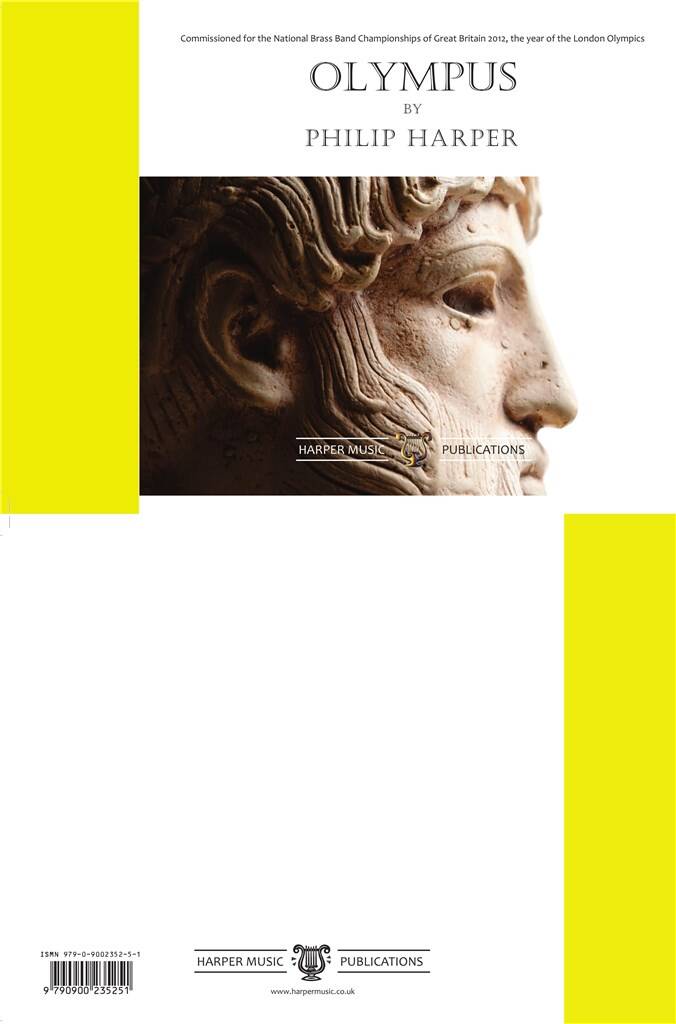
Olympus - Philip Harper
Selected as the test-piece for the 3rd Section Regional contests of the National Brass Band Championships 2012The music begins with a depiction of the exciting Opening Ceremony where noisy fanfares and sudden swells add to the cosmopolitan flag-waving clamour. Without a break the music leads to The Chariot Race, a fast compound-time gallop withthundering hooves in the basses and percussion, and a heroic melody introduced by the tenor horns. Chariot racing was the main equestrian event in the Ancient Greek Games, which were founded in memory of King Oenomaus. In the Greek legend he suffereddefeat in a chariot race to his son-in-law and Zeus' grandson, Pelops, but much of the music is bitter-sweet to symbolise the fact that Pelops had to cheat to win drawing parallels with some of the issues still facing modern-day athletics. A slow, mystical passage follows, describing The Temple of Zeus at Olympia. The statue of Zeus, who was honoured throughout the Ancient Games' history, was housed inside the temple and was one of the Seven Wonders of the Ancient World. Themusic depicts this period of the dawn of one of mankind's most ancient civilisations and there is a series of solo passages above a drone. The next section is called The Olympic Flame and a broad and lyrical anthem-like melody develops slowly in the euphoniums, which gradually ascends until the horns can take it over before passing upwards again to the cornets (Higher). The musicbursts into bright life at the lighting of the flame and the regular rhythmic pattern which has been established goes through an accelerando (Faster). The final section is called The Olympic Truce and aims to capture the cooperative spirit of the ancient practice of ending wars for the duration of the games. The anthem-like melody makes an affirmatory return (Stronger) and the work ends asit began with a blaze of colour and a real sense of optimism and global celebration. "Citius, Altius, Fortius" (Faster, Higher, Stonger)NOTES ON PERFORMANCEPercussion requirements: 1 to 3 players (3 Timpani, Snare Drum, Tenor Drum, Cymbals, Glockenspiel, Triangle)
Estimated dispatch 5-14 working days
 View Music