
Results
-
 £29.50
Jingle Bell Swing - James Pierpoint - Gavin Somerset
Get your audience on their feet in this ultimate Christmas Concert finale. Jingle Bells gets the Michael Buble Big Band treatment in this arrangement which will appeal to bands of all levels. There is plenty for every player to enjoy and there is no doubt that this finger clicking good piece will leave your audiences cheering for more. A must for all bands wanting to give their audience something different this Christmas season.
In Stock: Estimated dispatch 1-3 working days
-
£24.50
Song Without Words - Max Stannard
This sublimely simple piece is the perfect choice of solo for bands looking to add a special moment to their concerts. With parts not too demanding, this solo would suit up and coming cornet players that would like the chance to fulfil their moment in the spotlight. The gentle ballad flow of the work would work well at any concert occasion and is open to youth bands as well as more seasoned senior bands.
In Stock: Estimated dispatch 1-3 working days
-
 £80.00
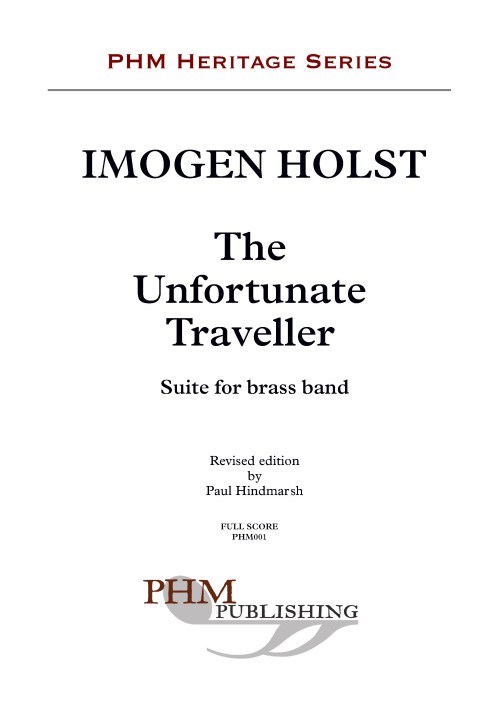
The Unfortunate Traveller (Brass Band - Score and Parts) - Holst, Imogen - Hindmarsh, Paul
Imogen Holst (1907-1984) submitted The Unfortunate Traveller (1929) as her final work as a student portfolio at the Royal College of Music, where her composition teacher was Gordon Jacob. The title was taken from Thomas Nashe's famous 1594 picaresque novel of the same title. The Suite was first performed on 12 February 1933 at her Majesty's Theatre, Carlisle, by the St. Stephen's Band, with the composer conducting. Te concert was given in memory of Holst's uncle, Dr. H.A. Lediard. Holst had been impressed with the band's performance of his A Moorside Suite at the 1928 National Brass Band Championships (The Crystal Palace, South London) and was keen to work with them. Writing in Imogen Holst, a life in music, Christopher Grogan indicates that it was Gustav Holst's suggestion to include his daughter's work in the programme, quoting Imogen Holst's remarks made in interview to The Daily Mail as follows: "....it is the first time, so far as I know, that a woman has conducted a brass band at a public concert....It has been a delight to rehearse the St. Stephen's Band. It was their performance at the Crystal Palace Festival that inspired me to write this Suite, which I have dedicated to them."Imogen Holst accompanied her father to the Crystal Palace in 1928 to hear the performances of A Moorside Suite, and was so excited by the played and, audibly, by her father's music that she decided to write a brass band piece for her final examination. Te result was The Unfortunate Traveller (1929). However, it was not possible for her to present a brass band work for examination. She arranged it for string orchestra so that it could be played before she left the RCM in July 1930. Following the premiere of the original in 1933, the manuscripts did not resurface until 1969 Imogen found them among her late mother's effects. Although she requested score and parts be destroyed, they ended up in the possession of Manchester composer John Golland, who marked up the score presumably with the intention of creating a new performing edition. The original scoring reveals a lack of experience with what can be a tricky medium.With the agreement of the Holst Foundation, a revised edition, with additional percussion, was prepared in 2011 since when the work has been fortunate to travel round the world as a concert and contest piece. The original includes drums in the March only. The title was taken from Tomas Nashe's famous 1594 picaresque novel of the same title. Several Morris Dance tunes are introduced during the course of the four short movements, including Bonnie Green Garters, Shepherd's Hey, The Rose and The Wind Blaws Cauld. Quirky twists and turns of harmony and spirited rhythms that remind us how much Imogen Holst loved tradition English dance music.In September 2025, I made a performing edition of the composer's arrangement for string orchestra. The manuscript lacks the final movement, which I arranged in a similar style, ie. without extending the upper ranges. Making this edition raised some issues regarding the accuracy of my band version and some of the solutions I used to smooth out the voicing. I have used the composer's second thoughts to refine my performing edition and to correct a textual errors.- Paul HindmarshDuration: 10.00
Estimated dispatch 7-14 working days
-
£40.00
The Unfortunate Traveller (Brass Band - Score only) - Holst, Imogen - Hindmarsh, Paul
Imogen Holst (1907-1984) submitted The Unfortunate Traveller (1929) as her final work as a student portfolio at the Royal College of Music, where her composition teacher was Gordon Jacob. The title was taken from Thomas Nashe's famous 1594 picaresque novel of the same title. The Suite was first performed on 12 February 1933 at her Majesty's Theatre, Carlisle, by the St. Stephen's Band, with the composer conducting. Te concert was given in memory of Holst's uncle, Dr. H.A. Lediard. Holst had been impressed with the band's performance of his A Moorside Suite at the 1928 National Brass Band Championships (The Crystal Palace, South London) and was keen to work with them. Writing in Imogen Holst, a life in music, Christopher Grogan indicates that it was Gustav Holst's suggestion to include his daughter's work in the programme, quoting Imogen Holst's remarks made in interview to The Daily Mail as follows: "....it is the first time, so far as I know, that a woman has conducted a brass band at a public concert....It has been a delight to rehearse the St. Stephen's Band. It was their performance at the Crystal Palace Festival that inspired me to write this Suite, which I have dedicated to them."Imogen Holst accompanied her father to the Crystal Palace in 1928 to hear the performances of A Moorside Suite, and was so excited by the played and, audibly, by her father's music that she decided to write a brass band piece for her final examination. Te result was The Unfortunate Traveller (1929). However, it was not possible for her to present a brass band work for examination. She arranged it for string orchestra so that it could be played before she left the RCM in July 1930. Following the premiere of the original in 1933, the manuscripts did not resurface until 1969 Imogen found them among her late mother's effects. Although she requested score and parts be destroyed, they ended up in the possession of Manchester composer John Golland, who marked up the score presumably with the intention of creating a new performing edition. The original scoring reveals a lack of experience with what can be a tricky medium.With the agreement of the Holst Foundation, a revised edition, with additional percussion, was prepared in 2011 since when the work has been fortunate to travel round the world as a concert and contest piece. The original includes drums in the March only. The title was taken from Tomas Nashe's famous 1594 picaresque novel of the same title. Several Morris Dance tunes are introduced during the course of the four short movements, including Bonnie Green Garters, Shepherd's Hey, The Rose and The Wind Blaws Cauld. Quirky twists and turns of harmony and spirited rhythms that remind us how much Imogen Holst loved tradition English dance music.In September 2025, I made a performing edition of the composer's arrangement for string orchestra. The manuscript lacks the final movement, which I arranged in a similar style, ie. without extending the upper ranges. Making this edition raised some issues regarding the accuracy of my band version and some of the solutions I used to smooth out the voicing. I have used the composer's second thoughts to refine my performing edition and to correct a textual errors.- Paul HindmarshDuration: 10.00
Estimated dispatch 7-14 working days
-
 £68.80
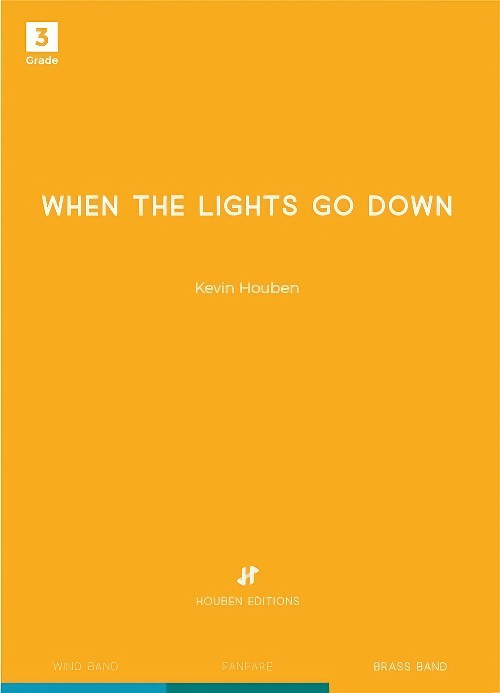
When the Lights Go Down (Brass Band - Score and Parts) - Houben, Kevin
Kevin Houben created with When the Lights Go Down, a wonderful chorale that can be a moment of reflection in any concert program. The resigned, magnificent melodies at the beginning of this composition slowly build up to a highlight with an increasing orchestration. The piece starts with a suggestive Adagio Meditativo, after which the main theme is immediately announced. A central bridge section takes the listener along through the different spheres at which the melodic and rhythmic drums embellish the chorale melodies. Thematic elements from the introduction brings the piece to a quiet and peaceful end. The sheer simplicity with which this work is written, makes it a resplendent, magnificent concert piece. 'When the Lights Go Down', refers to a moment when time stand still for a while, stillness within and around yourself.Duration: 9.00
Estimated dispatch 7-14 working days
-
 £87.99
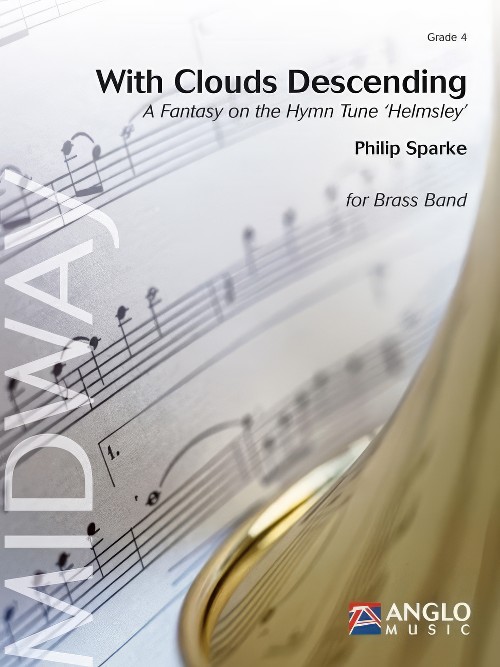
With Clouds Descending (Brass Band - Score and Parts) - Sparke, Philip
A Fantasy on the Hymn Tune HelmsleyWith Clouds Descending is a fantasy on the powerful Advent hymn Helmsley which is long associated with another Advent hymn - Wesley's Lo! He Comes with Clouds Descending. The hymn tune is divided into an introduction and three complete verses of Helmsley, which surround a slower central section, whose melody is derived from the last line of the hymn tune. Philip Sparke's grade 4 arrangement of this majestic piece for Brass Band is equally suitable as a concert opener or a main concert piece.Duration: 6:30
Estimated dispatch 7-14 working days
-
 £59.99
Almshouse Street Blues (Brass Band - Score and Parts) - Sparke, Philip
In 2007 Philip Sparke was appointed composer-in-residence to Monmouth School, situated on the Welsh/English border. The school, which has a venerable history dating back to 1614, has a thriving music department which boasts two concert bands, in co-operation with the nearby Haberdashers' Monmouth School for Girls, and a brass band.This exciting and innovative appointment involved three visits by the composer during the year as well as the commissioning of a new piece for each of the bands, all of which were premiered in a concert at the end of the year.Almshouse Street Blues was written for the brass band, whose members were allowed to vote for which type of piece they would get! Monmouth School is based in Almshouse Street and the town has a thriving summer festival which, alongside blues bands, features a wide variety of music including jazz, soul, rock and bangra.Duration: 4.45
Estimated dispatch 7-14 working days
-
 £35.00
Postcard to Grimethorpe (Brass Band - Score and Parts) - Gregson, Edward
I composed the original version of Postcard to Grimethorpe in 1993 at the request of Elgar Howarth, for a concert at the Queen Elizabeth Hall, London, given by the Grimethorpe Colliery Band. This was at a time when after the Grimethorpe Colliery pit closed the future of the band was in severe jeopardy. The concert was given in aid of the band, both through publicity and funding.Then in late 2022 Jack Stamp, the American composer, conductor and educator, and at that time international composer-in-association with Grimethorpe, contacted me to say that he had discovered my short piece in the band library, and asked if I might extend it for a recording he was sponsoring for the band - the repertoire to consist entirely of music specially composed for Grimethorpe.I agreed and decided to extend the piece by using the miner's hymn Gresford, as a symbolic gesture of protest at the many thousands of miners in the UK who were made redundant from their jobs. After an angular (quasi-atonal) first section, the hymn enters, softly at first, but with each phrase it becomes more powerful and insistent, ending with the final phrase triumphantly accompanied by melodic percussion (replacing the drums and cymbals of the earlier phrases, as if the band were then on the march). However, this short work ends softly and gently, as if anger has been replaced by quiet resolution and determination, looking to the future with confidence.- Edward GregsonDuration: 3.00
Estimated dispatch 7-14 working days
-
£12.00
Postcard to Grimethorpe (Brass Band - Score only) - Gregson, Edward
I composed the original version of Postcard to Grimethorpe in 1993 at the request of Elgar Howarth, for a concert at the Queen Elizabeth Hall, London, given by the Grimethorpe Colliery Band. This was at a time when after the Grimethorpe Colliery pit closed the future of the band was in severe jeopardy. The concert was given in aid of the band, both through publicity and funding.Then in late 2022 Jack Stamp, the American composer, conductor and educator, and at that time international composer-in-association with Grimethorpe, contacted me to say that he had discovered my short piece in the band library, and asked if I might extend it for a recording he was sponsoring for the band - the repertoire to consist entirely of music specially composed for Grimethorpe.I agreed and decided to extend the piece by using the miner's hymn Gresford, as a symbolic gesture of protest at the many thousands of miners in the UK who were made redundant from their jobs. After an angular (quasi-atonal) first section, the hymn enters, softly at first, but with each phrase it becomes more powerful and insistent, ending with the final phrase triumphantly accompanied by melodic percussion (replacing the drums and cymbals of the earlier phrases, as if the band were then on the march). However, this short work ends softly and gently, as if anger has been replaced by quiet resolution and determination, looking to the future with confidence.- Edward GregsonDuration: 3.00
Estimated dispatch 7-14 working days
-
 £54.99
Rock da House (Brass Band - Score and Parts)
Rock da House is not just the name of this new piece, it is also what it will do at your next concert! A hip tune and a groovy beat will have everyone dancing in (or on) their chairs. Whether for a concert hall, an outdoor show or any other occasion, if you are looking for a new piecethat everyone will love and enjoy, look no further; Rock da House is the piece for you! 03:50
Estimated dispatch 7-14 working days
 View Music