
Results
-
 £60.99
Angels from the Realms of Glory - Roland Kernen
The title of this clever arrangement reveals the Christmas song it is based on. The melody can be traced back to a French folksong from the 18th century which is now known around the world. In France it is called Les anges dans nos campagnes, in Germany it is most widely known as Engel auf den Feldern singen and in England it was originally called Angels From the Realms of Glory but it often known as Angels We Have Heard on High. Everyone will rejoice upon hearing the 'Gloria in excelsis Deo' refrain!
Estimated dispatch 5-14 working days
-
 £54.95
The Journal of Phileas Fogg - Peter Graham
Commissioned in 2012 by Dr Nicholas Childs for the National Childrens Brass Band of Great Britain, Peter Graham has taken elements of Jules Vernes epic work, Around the World in Eighty Days, as the outline for a series of adventures recorded inan imaginary diary by the hero of the story, Phileas Fogg. The ensuing journey takes Phileas by boat and train to Paris (where he passes the Moulin Rouge), Russia (where he is chased by Cossacks), Vienna (at night), Spain (where he is a spectator ata bull fight) and a final circumnavigation by sea (when foreign lands are evoked), before he arrives back in London with rich memories of his trip.
Estimated dispatch 5-14 working days
-
 £94.99
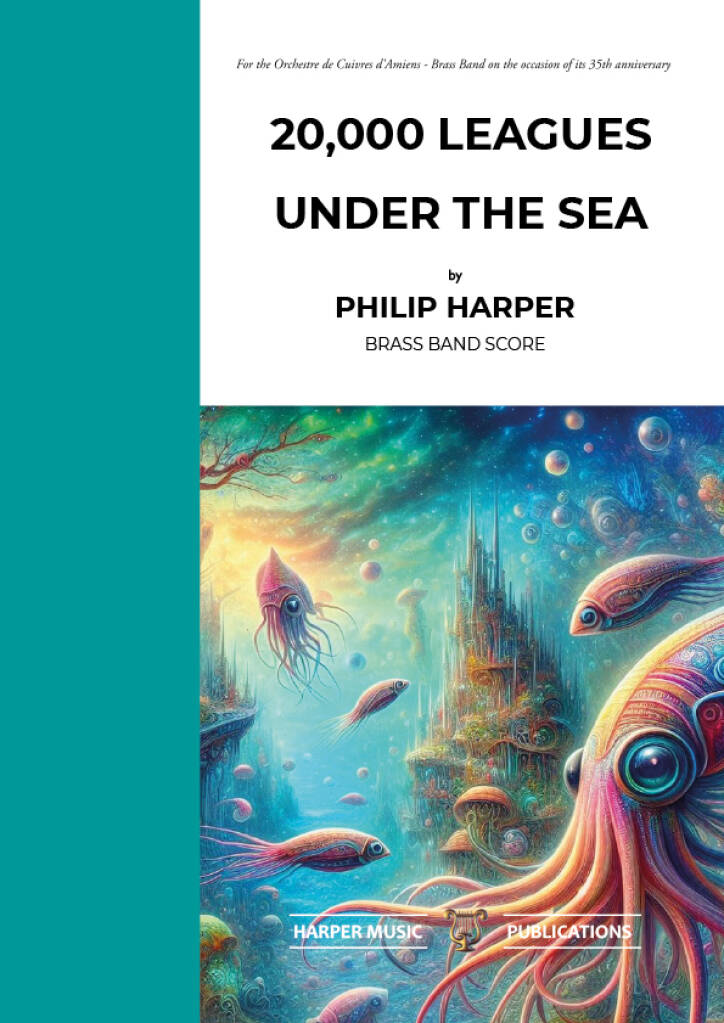
20,000 Leagues under the Sea - Philip Harper
Frenchman Jules Verne was a pioneer in science fiction during the late 19th Century, penning some classic stories such as Journey to the Centre of the Earth and Around the World in 80 Days - both of which have already been the subject of brass band test-pieces. It was therefore natural for me to choose Verne's 1869 watery magnum opus as the subject for this piece to which there are five sections, as well as an introduction and a finale.I. THE NAUTILUS. After a mysterious introduction we are introduced to The Nautilus - a fantastical submarine.II. THE CORAL KINGDOM. We visit awe-inspiring underwater coral formations.III. SQUID ATTACK. The Nautilus is attacked by a school of giant squid, or 'devilfish'.IV. CAPTAIN NEMO. Captain Nemo is a loner and an eccentric. Some say he is a madman. Soloists of the band help to uncover the character of this enigmatic but powerful figure.V. MAELSTROM. The Nautilus is dragged into the ocean's deadliest whirlpool but Captain Nemo lives to fight another day.
Estimated dispatch 5-14 working days
-
 £125.00
The World Rejoicing (Brass Band - Score and Parts)
The World Rejoicing was commissioned by the National Brass Band Associations of Belgium, Netherlands, Norway, Switzerland, and the British Open, as the test piece for their competitions in 2020/21. Although the work was completed in 2019, the pandemic of 2020 meant that these competitions were postponed until 2021/22. The premiere took place in September 2021 at Symphony Hall, Birmingham, UK.In searching for a common link between the brass band traditions of the various European countries that commissioned this work, I considered the fact that hymns have always played an important role in the relationship that brass bands have with their particular communities; and thus I turned to a well- known Lutheran chorale, Nun danket alle Gott (Now thank we all our God), written around 1636 by Martin Rinkart, with the melody attributed to Johann Cruger. A number of composers have incorporated this chorale into their music, most famously J.S. Bach in his Cantatas no. 79 and 192, and Mendelssohn in the Lobsegang movement of his 2nd Symphony (the harmonisation of which is usually used when this hymn is sung).It seemed fitting therefore for me to return to a compositional form I have used many times before (Variations) and to write a work based on this hymn. I have used it in a similar way to that which I employed in my Variations on Laudate Dominum of 1976 - that is, rather than writing a set of variations using elaborations of the complete tune, I have taken various phrases from the chorale and used them within the context of other musical material, applying an overall symphonic process of continuous variation and development. The structure, or sub-divisions of the work, which is through composed and plays without a break, is as follows:Prelude, Capriccio, La Danza 1, Processional, La Danza 2, Arias and Duets, Fuga Burlesca, Chorale, and Postlude.The work, which is around 16 minutes in length, is also partly autobiographical - in the manner say of Strauss's Ein Heldenleben - in that I have incorporated into the score brief quotations from many of my other major works for brass band. In that respect, The World Rejoicing sums up a particular facet of my life as a composer, and reflects the admiration I have always had for what is surely one of the great amateur music-making traditions in the world.Duration: 16.00
Estimated dispatch 7-14 working days
-
£40.00
The World Rejoicing (Brass Band - Score only)
The World Rejoicing was commissioned by the National Brass Band Associations of Belgium, Netherlands, Norway, Switzerland, and the British Open, as the test piece for their competitions in 2020/21. Although the work was completed in 2019, the pandemic of 2020 meant that these competitions were postponed until 2021/22. The premiere took place in September 2021 at Symphony Hall, Birmingham, UK.In searching for a common link between the brass band traditions of the various European countries that commissioned this work, I considered the fact that hymns have always played an important role in the relationship that brass bands have with their particular communities; and thus I turned to a well- known Lutheran chorale, Nun danket alle Gott (Now thank we all our God), written around 1636 by Martin Rinkart, with the melody attributed to Johann Cruger. A number of composers have incorporated this chorale into their music, most famously J.S. Bach in his Cantatas no. 79 and 192, and Mendelssohn in the Lobsegang movement of his 2nd Symphony (the harmonisation of which is usually used when this hymn is sung).It seemed fitting therefore for me to return to a compositional form I have used many times before (Variations) and to write a work based on this hymn. I have used it in a similar way to that which I employed in my Variations on Laudate Dominum of 1976 - that is, rather than writing a set of variations using elaborations of the complete tune, I have taken various phrases from the chorale and used them within the context of other musical material, applying an overall symphonic process of continuous variation and development. The structure, or sub-divisions of the work, which is through composed and plays without a break, is as follows:Prelude, Capriccio, La Danza 1, Processional, La Danza 2, Arias and Duets, Fuga Burlesca, Chorale, and Postlude.The work, which is around 16 minutes in length, is also partly autobiographical - in the manner say of Strauss's Ein Heldenleben - in that I have incorporated into the score brief quotations from many of my other major works for brass band. In that respect, The World Rejoicing sums up a particular facet of my life as a composer, and reflects the admiration I have always had for what is surely one of the great amateur music-making traditions in the world.Duration: 16.00
Estimated dispatch 7-14 working days
-
 £15.00
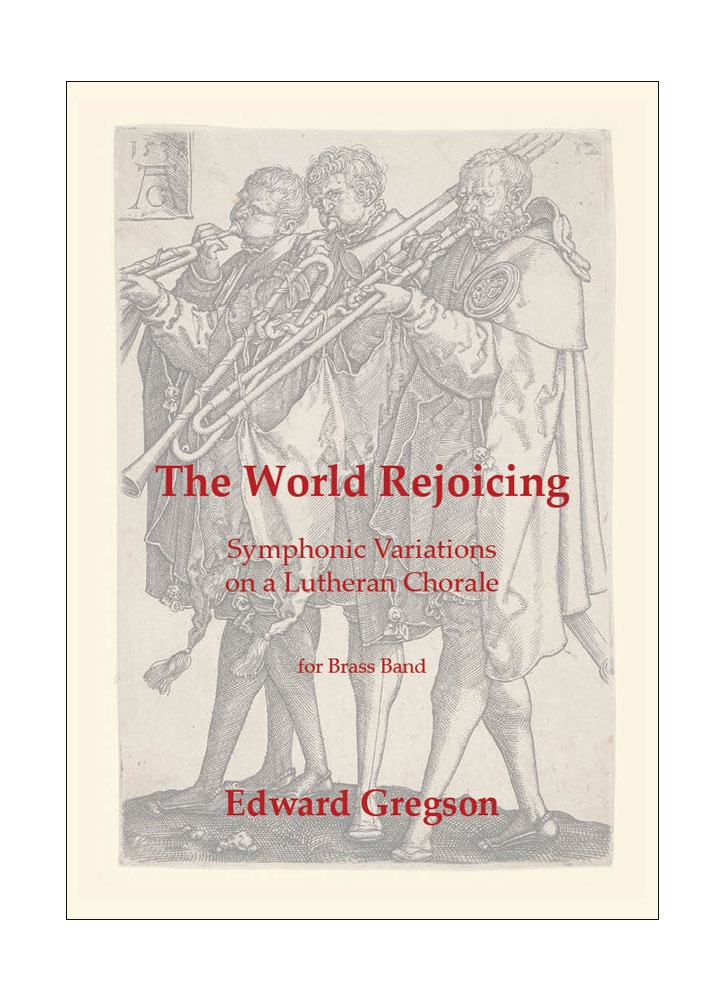
The World Rejoicing (Brass Band - Study Score)
In searching for a common link between the brass band traditions of the various European countries that commissioned this work, I considered the fact that hymns have always played an important role in the relationship that brass bands have with their particular communities; and thus I turned to a well-known Lutheran chorale, Nun danket alle Gott (Now thank we all our God), written around 1636 by Martin Rinkart, with the melody attributed to Johann Crger. A number of composers have incorporated this chorale into their music, most famously J.S.Bach in his Cantatas no. 79 and 192, and Mendelssohn in the Lobsegang movement of his 2nd Symphony (the harmonization of which is usually used when this hymn is sung).It seemed fitting therefore for me to return to a compositional form I have used many times before (Variations) and to write a work based on this hymn. I have used it in a similar way to that which I employed in my Variations on Laudate Dominum of 1976 - that is, rather than writing a set of variations using elaborations of the complete tune, I have taken various phrases from the chorale and used them within the context of other musical material, applying an overall symphonic process of continuous variation and development. The structure, or sub-divisions of the work, which is through composed and plays without a break, is as follows: Prelude, Capriccio, La Danza 1, Processional, La Danza 2, Arias and Duets, Fuga Burlesca, Chorale, and Postlude.The work is also partly autobiographical - in the manner say of Strauss's Ein Heldenleben - in that I have incorporated into the score brief quotations from many of my other major works for brass band. In that respect, The World Rejoicing sums up a particular facet of my life as a composer, and reflects the admiration I have always had for what is surely one of the great amateur music-making traditions in the world.The World Rejoicing is dedicated 'in loving memory of my brother', Bramwell Logan Gregson, who sadly passed away in the Autumn of 2018.Edward Gregson
Estimated dispatch 7-14 working days
-
 £84.95
In League with Extraordinary Gentlemen (Euphonium Solo with Brass Band)
Concerto for EuphoniumIn League with Extraordinary Gentlemen combines two of composer Peter Graham's life interests - composition and 19th century popular fiction. Each of the concerto's three movements takes its musical inspiration from extraordinary characters who have transcended the original genre and have subsequently found mass audiences through film, television and comic book adaptations.The first movement follows a traditional sonata form outline with one slight modification. The order of themes in the recapitulation is reversed, mirroring a plot climax in the H.G. Wells novella The Time Machine (where the protagonist, known only as The Time Traveller, puts his machine into reverse bringing the story back full circle).The Adventure of the Final Problem is the title of a short story published in The Memoirs of Sherlock Holmes by Arthur Conan Doyle. This is an account of the great detective's final struggle with his long-time adversary Professor Moriarty at the Reichenbach Falls in Switzerland. The music takes the form of a slowed down lndler (a Swiss/Austrian folk dance) and various acoustic and electronic echo effects call to mind the alpine landscape. The final bars pose a question paralleling that of Conan Doyle in the story - have we really seen the last of Sherlock Holmes?The final movement, The Great Race, (available separately) follows Phileas Fogg on the last stage of his epic journey "Around the World in Eighty Days" (from the novel by Jules Verne). The moto perpetuo nature of the music gives full rein to the soloist's technical virtuosity. As the work draws to a conclusion, the frantic scramble by Fogg to meet his deadline at the Reform Club in Pall Mall, London, is echoed by the soloist's increasingly demanding ascending figuration, set against the background of Big Ben clock chimes.In League with Extraordinary Gentlemen was first performed in the brass band version by David Thornton and the Black Dyke Band, conductor Nicholas Childs, at the RNCM Concert Hall Manchester on January 30, 2009.
Estimated dispatch 7-14 working days
-
 £44.95
The Great Race (Euphonium Solo with Brass Band)
Finale from In League with Extraordinary GentlemenThe Great Race, for solo euphonium and band, follows Phileas Fogg on the last stage of his epic journey "Around the World in Eighty Days" (from the novel by Jules Verne). The moto perpetuo nature of the music gives full rein to the soloist's technical virtuosity. As the work draws to a conclusion, the frantic scramble by Fogg to meet his deadline at the Reform Club in Pall Mall, London, is echoed by the soloist's increasingly demanding ascending figuration, set against the background of Big Ben clock chimes.
Estimated dispatch 7-14 working days
-
 £94.99
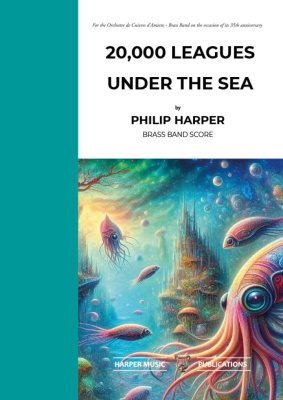
20,000 Leagues Under the Sea (Brass Band - Score and Parts)
Frenchman Jules Verne was a pioneer in science fiction during the late 19th Century, penning some classic stories such as Journey to the Centre of the Earth and Around the World in 80 Days - both of which have already been the subject of brass band test-pieces. It was therefore natural for me to choose Verne's 1869 watery magnum opus as the subject for this piece to which there are five sections, as well as an introduction and a finale.THE NAUTILUS. After a mysterious introduction we are introduced to The Nautilus - a fantastical submarine.THE CORAL KINGDOM. We visit awe-inspiring underwater coral formations.SQUID ATTACK. The Nautilus is attacked by a school of giant squid, or 'devilfish'.CAPTAIN NEMO. Captain Nemo is a loner and an eccentric. Some say he is a madman. Soloists of the band help to uncover the character of this enigmatic but powerful figure.MAELSTROM. The Nautilus is dragged into the ocean's deadliest whirlpool but Captain Nemo lives to fight another day.Duration: 12.30
Estimated dispatch 7-14 working days
-
£43.99
20,000 Leagues Under the Sea (Brass Band - Score only)
Frenchman Jules Verne was a pioneer in science fiction during the late 19th Century, penning some classic stories such as Journey to the Centre of the Earth and Around the World in 80 Days - both of which have already been the subject of brass band test-pieces. It was therefore natural for me to choose Verne's 1869 watery magnum opus as the subject for this piece to which there are five sections, as well as an introduction and a finale.THE NAUTILUS. After a mysterious introduction we are introduced to The Nautilus - a fantastical submarine.THE CORAL KINGDOM. We visit awe-inspiring underwater coral formations.SQUID ATTACK. The Nautilus is attacked by a school of giant squid, or 'devilfish'.CAPTAIN NEMO. Captain Nemo is a loner and an eccentric. Some say he is a madman. Soloists of the band help to uncover the character of this enigmatic but powerful figure.MAELSTROM. The Nautilus is dragged into the ocean's deadliest whirlpool but Captain Nemo lives to fight another day.Duration: 12.30
Estimated dispatch 7-14 working days
 View Music