
Results
-
 £149.99
A Tribute to Henk Badings - Rob Goorhuis
The motivation for composing this test piece for the Concert Division Brassband of the 2001 WMC was Rob Goorhuis's deep respect for one of the greatest Dutch composers of the 20-th century who also enlarged the wind band repertoire in a most valuable way. Goorhuis wanted to light up the "soft and kind" side of the brassband and wrote about this composition : "The basis is a theme of twelve tones wich Badings once played at an International Organ Improvisation Contest in Haarlem.My organ teacher participated in that contest and so the theme remained somehow in the back of my mind." The composer worked out a series of variations and clustered them into bundles ofthree and so the melody kept its diversity while remaining easy to recognise.
Estimated dispatch 5-14 working days
-
£104.99
Firestorm - Stephen Bulla
The inspiration for this piece, commissioned by the United States Army Band, came from the Gulf and its constant presentation to the world as a media event on television. The composer wanted to capture the colour and events of war as they were played out on the television screen. Composed as a single movement rhapsody, the work is framed by the riveting sounds of airborne bombing raids with brass and percussion combining to create a gripping sense of tension.
Estimated dispatch 5-14 working days
-
 £72.99
English Dances, Set 1, Op. 27: No. 1 - Sir Malcolm Arnold - Ray Farr
English Dances, Set I, opus 27, is a light classic composition that was written for orchestra by the British composer Malcolm Arnold in 1950. The set contains four dances that continue without pause: the individual movements are indicated by the tempo markings. The work came about at the request of Bernard de Nevers, at the time the head of publisher Alfred Lengnick & Co., who asked Arnold to write a suite of dances as an English counterpart to Dvo ak's Slavonic Dances and Bartok's Romanian Folk Dances. The premiere took place in the spring of 1951, played by the London Philharmonic Orchestra, conducted by Sir Adrian Boult. Following the success of the first set, DeNevers asked the composer to write a second one, which Arnold completed the next year (Op. 33). The Andantino from the first set has been skilfully arranged and orchestrated for brass band by Ray Farr.
Estimated dispatch 5-14 working days
-
 £87.99
Centennial Salute - Philip Sparke
Just based on its title, this piece has to be celebratory and up-beat, which it is! It opens with a stately fanfare, first played on the low brass before the entire band joins in. This gives way to a contrasting lyrical theme which develops until it joins up with the fanfare to complete the opening section. A lively and heavily syncopated vivo follows, cast as a traditional march, complete with a 'bass strain' and trio. After the original march theme returns, a climax leads back to a reprise of the majestic opening, which brings the piece to an appropriately triumphant close.
Estimated dispatch 5-14 working days
-
 £60.99
Fantasia Di Pasqua - Michael Bilkes
Fantasia di Pasqua is a fantasy in which traditional Easter melodies have been used. The work is written for brass band with a separate brass quartet which, since this music is often performed in churches, the composer suggests should be positioned on a gallery. This creates a double choir effect and perfectly fits the Renaissance-like style. Each of the melodies is played in various dance-like cadences that, partly because of the double choir effect, will result in a very lively and original performance.
Estimated dispatch 5-14 working days
-
 £60.99
Bandstand Boogie - C. Albertine - Peter Wain
Charles Albertine played Tenor Saxophone with the Sammy Kaye band in the late 1940s, and was the lead arranger for the new Las Elgart band. He arranged most of the Three Suns later music. Most of his later career was spent in television. 'Bandstand Boogie' was adopted by Dick Clark as the theme song for his long-running series, 'American Bandstand.'
Estimated dispatch 5-14 working days
-
 £52.70
Drink To Me Only With Thine Eyes - Willy Hautvast
As the tune is so well known and played and sung regularly all over the world, the piece needs no extra comment. Yet this wind band arrangement is, no doubt, a fine acquisition for the repertoire.
Estimated dispatch 5-14 working days
-
 £105.20
Hymne til gleden - Ludwig van Beethoven - Bjorn Morten Kjaernes
Schiller's text of 1785 was partially used by Beethoven in1824 when he did finish the 4th movement of his 9th Symphony. The melody has later been used in very many contexts. As the anthem of the European Union, a lot of movies (A clockwork Orange, Die Hard, etc.), music to video games, as the anthem of Rhodesia, as rebel song in Chile and by FIFA. Therefore, it can be used in most settings This Young Band arrangement focuses on the main melody. In the original, the B part is repeated in each variation, but to get three variations (out of four), this repetition has been cut. The first variation should be played as soft as possible, but still with a nice sound. Crescendo to forte(f) and going back to pp should be as a surprise.
Estimated dispatch 5-14 working days
-
 £127.30
Rendezvous - Torstein Aagaard-Nilsen
Rendezvous was commissioned by Krohnengen Brass Band for their 50th Anniversary in 2019.Rendezvous is devided into three sections. Each section are referring to Edvard Grieg's own titles. but twisted, to make sure that everybody understand that this music is a mash-up of themes Edvard Grieg used in opus 54 (for piano) and opus 61 (songs for children).1. Trolltog med avsporing (March of the Trolls derailment)March of the Trolls is a famous part of Edvard Grieg lyric pieces, opus 54.2. Klokkeklang i feil sang (Bell ringing in wrong tune).Bell ringing show that Grieg was one of the first composers to write the way impressionists did. What happens if this beatiful piece is combined with several other themes from the same book? It somehow works in its own way.3. Pep talk til Blakken (Pep talk to Blakken)The riff used in the first part becomes an important part of the third part: a funky treat of the childrens song "Kveldssang for Blakken" (Evening song for Blakken).I felt that a rather tired old horse needed a pep talk more than a slow tune. So that is why you get this music(!) - and this is how my rendezvous with Grieg ends.Not sure what maestro Grieg would have thougt... But, I have read that the fiddlers that played the tunes Grieg used was not happy with the way Grieg used them.So there you go...Torstein Aagaard-Nilsen
Estimated dispatch 5-14 working days
-
 £92.20
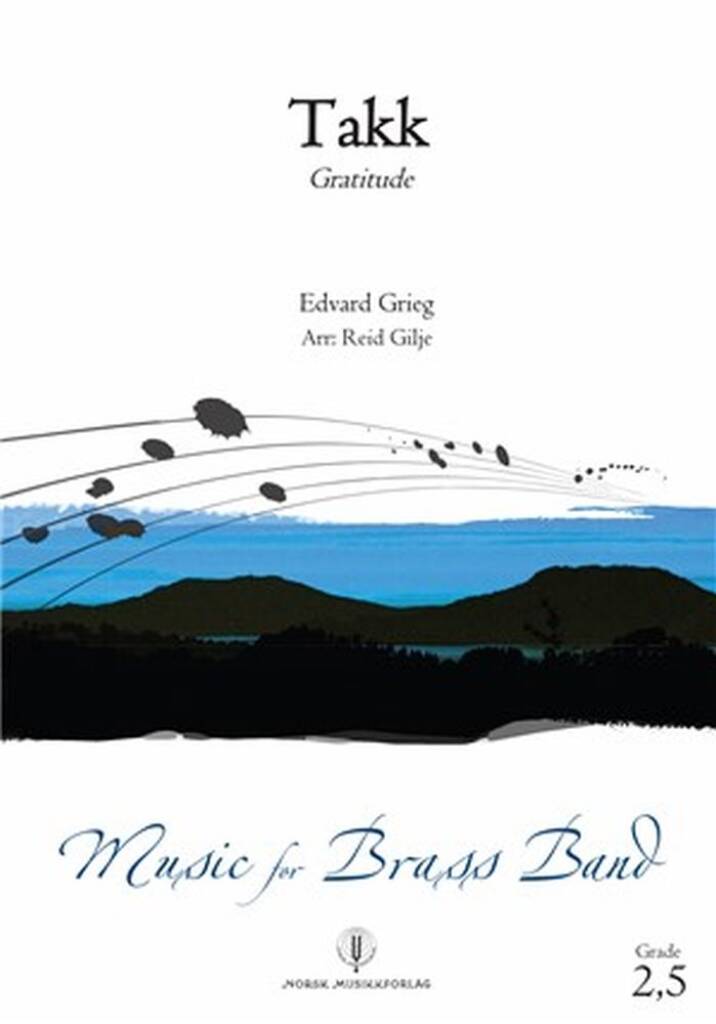
Takk - Edvard Grieg - Reid Glje
"Gratitude" is one of Grieg's beautiful lyrical pieces, Op. 62 No. 2.Eva Knardahl made a beautiful recording that I well remember was used as background for a picture cavalcade by the Norwegian Broadcasting Corporation during the passing of His Majesty King Olav V of Norway in 1991.In this arrangement for band, I have tried to vary the instrumentation, both for the sake of more colours and to emphasize the drama.This piece should be played rubato with elastic phrasing. The form can be described as AABACoda. The most dramatic section is the B part from measure 25, which peaks just before measure 38. The last four measures (from measure 53) can be done a bit 'meno' in tempo.Reid Gilje
Estimated dispatch 5-14 working days
 View Music