
Results
-
 £34.99
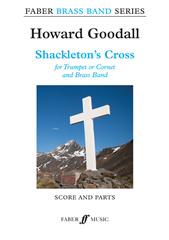
Shackleton's Cross (Cornet Solo with Brass Band - Score and Parts)
Shackleton's Cross was inspired by a painting created in 1957 by the English artist Edward Seago (1910 1974). The title refers to a cross which was erected to the memory of Sir Ernest Shackleton, who led a number of explorations to the Antarctic. Shackleton died in 1922 whilst on a Polar expedition, and the cross can be found on a promontory at the entrance to the bay at Grytviken Whaling Station in South Georgia. The painting is owned by HRH The Duke of Edinburgh, and was part of an exhibition at Buckingham Palace from October 2011 to April 2012. Originally scored for oboe, trumpet and small orchestra, Daniel Hall's sensitive arrangement for trumpet or cornet and brass band follows the composer's alternative version for solo trumpet and organ, created for Crispian Steele-Perkins (trumpet) and David Goode (organ). Duration: 5.00
Estimated dispatch 7-14 working days
-
 £45.00
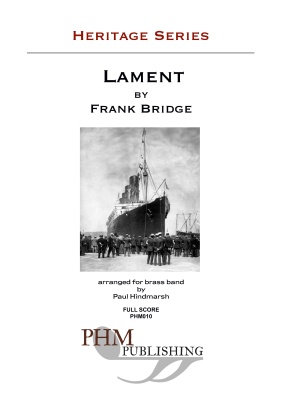
Lament (Brass Band - Score and Parts)
The English composer Frank Bridge (1879 - 1941) did not take an active part in the First World War. However, he was devastated by the slaughter on the western and the eastern fronts, especially the loss of so many of his musicians friends and colleagues. Writing in 1963, his former pupil Benjamin Britten confessed that 'a lot of my feelings about the First World War which people seemed to see in the War Requiem came from Bridge. He had written a piano sonata in memory of a friend killed in France and though he didn't encourage me to take a stand for the sake of a stand, he did make me argue and argue and argue. His own pacifism was not aggressive, but typically gentle'.Bridge composed this Lament for string orchestra on 14 June 1915, in memory of Catherine Crompton, who drowned when the Cunard liner Lusitania was torpedoed by a German submarine on 7 May, 1915. According to figures researched by Liverpool historian Kevin Roach (www.lusitania.net), 1201 men, women and children lost their lives out of the 1962 people aboard. Ninety-four children died, including Catherine, her twin brother Paul and four other siblings. Paul Crompton, Snr. (44), a British businessman working in Philadelphia, his wife Gladys (40) and the family nanny were also drowned. How Bridge's dedication came about is uncertain. The music critic Edwin Evans, who knew Bridge well, has written that the Catherine was a young friend. It is also possible that he came across the family photograph which was published in many newspapers in the wake of the tragedy. By that time, Bridge was greatly distressed by the war as a whole. It seems perfectly in keeping with his pacifist leanings and the strength of his reaction, that this poignant and deeply touching 'war memorial' should mourn a child who he did not know, rather than one of the thousands of young men who fell in battle.Through the musical tears of this melancholy lullaby, Bridge may have regarded the death of young Catherine Crompton as symbolic of the loss of so many innocent lives in wartime. His response to this personal tragedy was characteristically spontaneous and utterly sincere. It is one of his most effective miniatures, poignant yet restrained in its lyrical beauty, with a compelling directness and simplicity of construction.This brass band transcription is pitched one tone lower than the original for string orchestra.- Paul HindmarshDuration: 5.00
Estimated dispatch 7-14 working days
-
£7.50
120 Hymns for Brass Band (1st Baritone) - Steadman-Allan
Download the PDF for a sample of the part and the index of hymns.
In Stock: Estimated dispatch 1-3 working days
-
£7.50
120 Hymns for Brass Band (1st Horn E) - Steadman-Allan
Download the PDF for a sample of the part and the index of hymns.
In Stock: Estimated dispatch 1-3 working days
-
£7.50
120 Hymns for Brass Band (1st Trombone) - Steadman-Allan
Download the PDF for a sample of the part and the index of hymns.
In Stock: Estimated dispatch 1-3 working days
-
£7.50
120 Hymns for Brass Band (2nd & 3rd Cornet) - Steadman-Allan
Download the PDF for a sample of the part and the index of hymns.
In Stock: Estimated dispatch 1-3 working days
-
£7.50
120 Hymns for Brass Band (2nd Baritone) - Steadman-Allan
Download the PDF for a sample of the part and the index of hymns.
In Stock: Estimated dispatch 1-3 working days
-
£7.50
120 Hymns for Brass Band (2nd Horn E) - Steadman-Allan
Download the PDF for a sample of the part and the index of hymns.
In Stock: Estimated dispatch 1-3 working days
-
£7.50
120 Hymns for Brass Band (2nd Trombone) - Steadman-Allan
Download the PDF for a sample of the part and the index of hymns.
In Stock: Estimated dispatch 1-3 working days
-
£7.50
120 Hymns for Brass Band (Bass Trombone) - Steadman-Allan
Download the PDF for a sample of the part and the index of hymns.
In Stock: Estimated dispatch 1-3 working days
 View Music