
Results
-
 £69.99
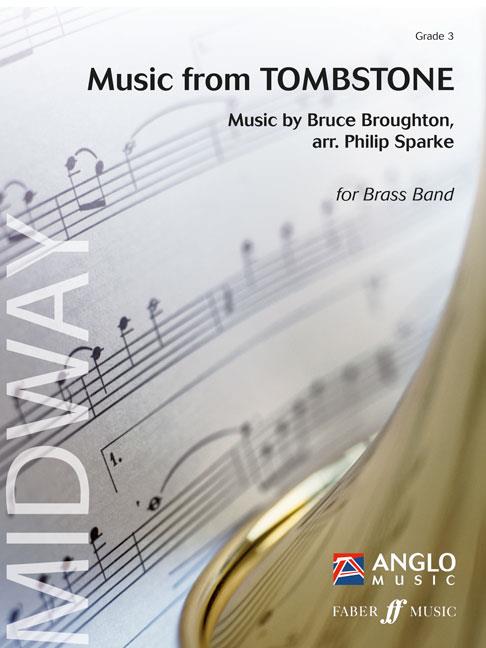
Tombstone, Music from (Brass Band - Score and Parts) - Broughton, Bruce - Sparke, Philip
Released in cinemas in 1993, Tombstone is an American western written by Kevin Jarre and directed by George Cosmatos. Starring Kurt Russell and Val Kilmer, it was narrated by Robert Mitchum and is based on events relating to the Gunfight at the OK Corral, and the subsequent Wyatt Earp Vendetta, both of which took place in Tombstone, Arizona. The theme is crime, political corruption and law enforcement in the American west during the 1880s. The score was by Bruce Broughton, and this selection features music from the opening and closing credits.Duration: 5.00
Estimated dispatch 7-14 working days
-
 £95.00
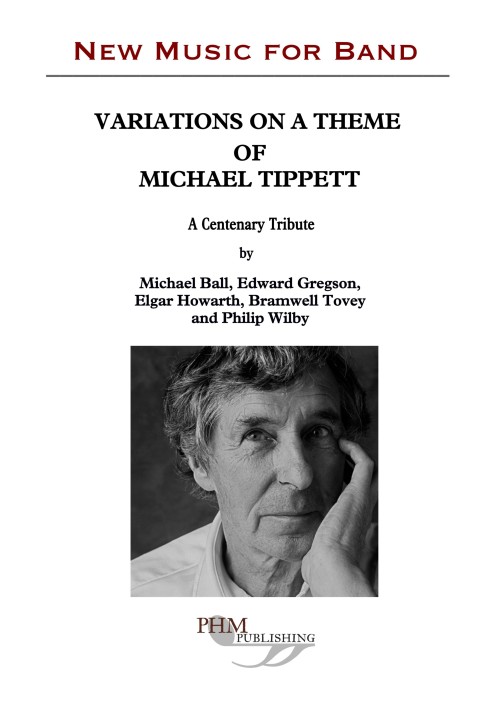
Variations on a Theme of Michael Tippett (Brass Band - Score and Parts) - Hindmarsh, Paul
A Centenary Tribute by Michael Ball, Edward Gregson, Elgar Howarth, Bramwell Tovey and Philip WilbyThis unique 'pice d'occasion' arose out of a telephone conversation in 2004 with Alan Wycherley, who was the soprano cornet player of the Foden's Richardson Band at the time. He indicated that the band would like to include an original birthday tribute for Edward Gregson (60) and Elgar Howarth (70) in its concert at the 2005 RNCM Festival of Brass in Manchester. I have been Artistic Director of Manchester's Festival of Brass since it was established in 1990 as a BBC Radio 3 series, As the centenary of the birth of Sir Michael Tippett fell on 5 January 2005, I devised this collective work as a way of embracing all three anniversaries in a novel way.The idea of joint compositions is not a new one in the classical music world. In the 1860s, Verdi was joined by a number of his contemporaries in a Requiem Mass for Rossini. In this country there have been a number of orchestral examples over the past fifty years, but never before for the brass band. Although Tippett composed only one work for brass band, Festal Brass with Blues, his orchestral works and operas are full of idiomatic brass writing. The theme I chose for this celebration is one of Tippet's most memorable miniatures featuring wind and brass. In the opera Midsummer Marriage it marks the entry of the Ancients. It is also included in the orchestral Suite in D (1948), for the Birthday of Prince Charles.I invited five of the leading contemporary voices in brass band music to add their own creative perspectives to the little Tippett theme, with it's characteristic rhythms, embellishments and modality - the Lydian mode. Each contribution was designed to fit into a tonal and formal template to give the whole work a flow and continuity. In Danse des Amis, Bramwell Tovey has composed a jazzy, humorous variation. Inspiration came from Tippett's love of jazz and, more personally, from the characteristically syncopated gait of the distinguished music critic John Amis, who Tovey once observed leaving a performance of Tippett's opera King Priam before the end. Incidentally, that performance was conducted by Elgar Howarth.We hear Edward Gregson in lyrical mode. His Midsummer Song is redolent of the sound world of Tippett's opera A Midsummer Marriage and it ends with a brief reference to a favourite of Gregson's, Tippett's Concerto for Orchestra. Michael Ball provides a brief moment of light, airy activity bringing to mind perhaps Tippett's love of Shakespearian fantasy, especially The Tempest. Elgar Howarth juxtaposes a slowed down version of the processional theme with distant recollections of fanfares from King Priam. Philip Wilby has rounded the tribute off with a spectacular fugue. During its inexorable progress Wilby ingeniously introduces the two other birthday references - the three-note musical signature that Elgar Howarth includes in much of his music and the characteristic theme which begins Edward Gregson's substantial work for brass an organ The Trumpets of the Angels. An elaborated reprise of Tippett's little theme is followed by a dynamic coda.- Paul HindmarshDuration: 13.00
Estimated dispatch 7-14 working days
-
£40.00
Variations on a Theme of Michael Tippett (Brass Band - Score only) - Hindmarsh, Paul
A Centenary Tribute by Michael Ball, Edward Gregson, Elgar Howarth, Bramwell Tovey and Philip WilbyThis unique 'pice d'occasion' arose out of a telephone conversation in 2004 with Alan Wycherley, who was the soprano cornet player of the Foden's Richardson Band at the time. He indicated that the band would like to include an original birthday tribute for Edward Gregson (60) and Elgar Howarth (70) in its concert at the 2005 RNCM Festival of Brass in Manchester. I have been Artistic Director of Manchester's Festival of Brass since it was established in 1990 as a BBC Radio 3 series, As the centenary of the birth of Sir Michael Tippett fell on 5 January 2005, I devised this collective work as a way of embracing all three anniversaries in a novel way.The idea of joint compositions is not a new one in the classical music world. In the 1860s, Verdi was joined by a number of his contemporaries in a Requiem Mass for Rossini. In this country there have been a number of orchestral examples over the past fifty years, but never before for the brass band. Although Tippett composed only one work for brass band, Festal Brass with Blues, his orchestral works and operas are full of idiomatic brass writing. The theme I chose for this celebration is one of Tippet's most memorable miniatures featuring wind and brass. In the opera Midsummer Marriage it marks the entry of the Ancients. It is also included in the orchestral Suite in D (1948), for the Birthday of Prince Charles.I invited five of the leading contemporary voices in brass band music to add their own creative perspectives to the little Tippett theme, with it's characteristic rhythms, embellishments and modality - the Lydian mode. Each contribution was designed to fit into a tonal and formal template to give the whole work a flow and continuity. In Danse des Amis, Bramwell Tovey has composed a jazzy, humorous variation. Inspiration came from Tippett's love of jazz and, more personally, from the characteristically syncopated gait of the distinguished music critic John Amis, who Tovey once observed leaving a performance of Tippett's opera King Priam before the end. Incidentally, that performance was conducted by Elgar Howarth.We hear Edward Gregson in lyrical mode. His Midsummer Song is redolent of the sound world of Tippett's opera A Midsummer Marriage and it ends with a brief reference to a favourite of Gregson's, Tippett's Concerto for Orchestra. Michael Ball provides a brief moment of light, airy activity bringing to mind perhaps Tippett's love of Shakespearian fantasy, especially The Tempest. Elgar Howarth juxtaposes a slowed down version of the processional theme with distant recollections of fanfares from King Priam. Philip Wilby has rounded the tribute off with a spectacular fugue. During its inexorable progress Wilby ingeniously introduces the two other birthday references - the three-note musical signature that Elgar Howarth includes in much of his music and the characteristic theme which begins Edward Gregson's substantial work for brass an organ The Trumpets of the Angels. An elaborated reprise of Tippett's little theme is followed by a dynamic coda.- Paul HindmarshDuration: 13.00
Estimated dispatch 7-14 working days
-
 £60.99
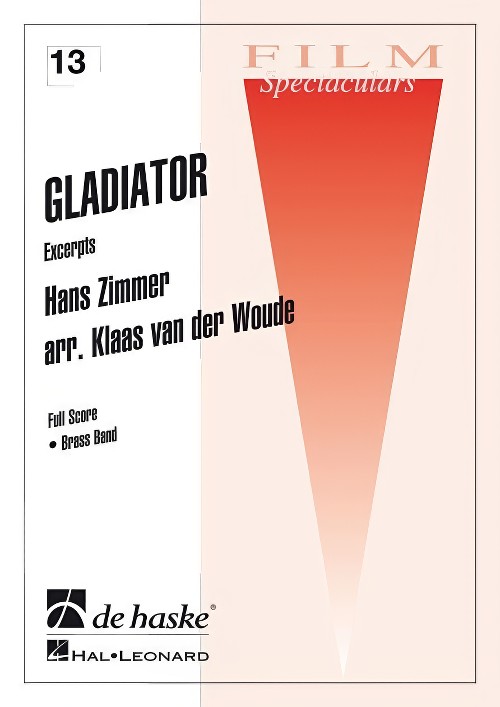
Gladiator (Brass Band - Score and Parts) - Zimmer, Hans - Woude, Klaas van der
The long list of musical film scores by the German composer Hans Zimmer includes such works as Armageddon, Rain Man, Speed and Thelma and Louise, showing he is at ease with many types of film music. Some of his best work was his music for the epic Gladiator. Klauss van der Wourde has created a great arrangement from this wonderful score.Duration: 5:30
Estimated dispatch 7-14 working days
-
 £35.00
I Vow to Thee, My Country (Brass Band - Score and Parts) - Holst, Gustav - Littlemore, Phillip
!!I Vow to Thee My Country. Originally for unison voices with orchestra, Holst adapted it as a hymn tune and called it Thaxted , named after the village where he lived for many years. Because of the sentiment in the words it has now become a staple of Remembrance services.The American Composer, Geoff Knorr, incorporated Holst's music into his score for the strategy-based video game Civilisation, where it is used to depict the England of Elizabeth I. It is from this music that the transcription is made. Duration: 5.40
Estimated dispatch 7-14 working days
-
 £45.00
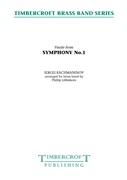
Symphony No.1, Finale from (Brass Band - Score and Parts) - Rachmaninoff, Sergei - Littlemore, Phillip
Rachmaninov composed his First Symphony in 1895, at the age of just 22 years. It received its first performance on March 27, 1897, at a Russian Symphony Society concert in St. Petersburg with Alexander Glazunov conducting. The premiere was not well-received, and Rachmaninov himself blamed Glazunov for a lacklustre approach for beating time rather than finding the music. Some contemporary reports even suggested that Glazunov was inebriated when he took to the stage! Despite the disappointment of the premiere performance, Rachmaninov never destroyed the score but left it behind when he left Russia to settle in the West, eventually it was given up for lost. After the composer's death, a two-piano transcription of the symphony surfaced in Moscow, followed by a set of orchestral parts at the conservatory in Saint Petersburg. In March 1945, the symphony was performed in Moscow for the first time since its 1897 premiere. It was a grand success, and this led to a new and more enthusiastic evaluation of the symphony. In March 1948 it received a similarly successful American premiere and the work proceeded to establish itself in the general repertory. The final movement (Allegro con fuoco) is colourful and grand but not without its darkly contrasting, menacing episodes that intensifies its malevolence. It is a work overflowing with ideas demonstrating a strong, highly individual, and self-assured young talent. Duration: 5:40
Estimated dispatch 7-14 working days
-
 £37.95
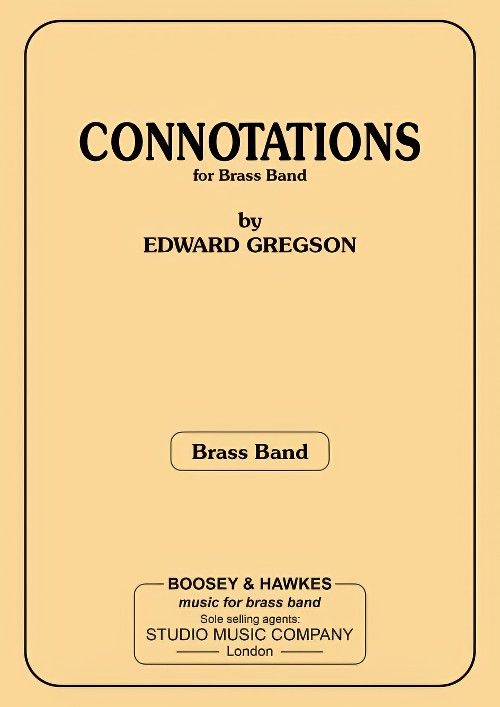
Connotations (Brass Band - Score only) - Gregson, Edward
Connotations was commissioned for the 1977 National Brass Band Championship finals, held in the Royal Albert Hall, London (the winner, incidentally, of that particular competition was the famous Black Dyke Mills Band).At the age of 32 Gregson was the youngest composer to have received the honour of such a commission. It came at the end of a productive five years writing for the brass band publisher R Smith. Some of those works - The Plantagenets, Essay and Patterns for example, with their direct and tuneful style, have remained popular with brass bands the world over.For Gregson, these were the means by which he sharpened the tools of his trade, preparing the ground, as it were, for his finest work to date - Connotations. He thought of calling the piece Variations on a Fourth, but with due deference to Gilbert Vinter perhaps (Variations on a Ninth), he chose a more appropriate one. As Gregson has written, 'Connotations suggests more than one way of looking at something, an idea, and this is exactly what the piece is about'.Writing a competition piece brought its own problems. 'It has to be technically difficult and yet musically satisfying. I didn't like being kept to an eleven-minute maximum. The inclusion of short cadenzas for less usual solo instruments seems to signify a certain test-piece mentality'.Gregson solved the problems admirably by adopting a symphonic approach to variation form: Introduction - fanfares, a call to attention, in effect Variation 1; Theme - a six-note motif, given a lyrical and restrained first statement; Variation 2 - a delicate toccata; Variation 3 - typically robust in melody and rhythm; Variation 4 - lyrical solos; Variation 5 - a scherzo; Variation 6 - cadenzas; Variations 7-9 - an introduction, fugato and resounding restatement of the theme.Duration: 10.30
Estimated dispatch 7-14 working days
-
£74.95
Connotations (Brass Band - Score and Parts) - Gregson, Edward
Connotations was commissioned for the 1977 National Brass Band Championship finals, held in the Royal Albert Hall, London (the winner, incidentally, of that particular competition was the famous Black Dyke Mills Band).At the age of 32 Gregson was the youngest composer to have received the honour of such a commission. It came at the end of a productive five years writing for the brass band publisher R Smith. Some of those works - The Plantagenets, Essay and Patterns for example, with their direct and tuneful style, have remained popular with brass bands the world over.For Gregson, these were the means by which he sharpened the tools of his trade, preparing the ground, as it were, for his finest work to date - Connotations. He thought of calling the piece Variations on a Fourth, but with due deference to Gilbert Vinter perhaps (Variations on a Ninth), he chose a more appropriate one. As Gregson has written, 'Connotations suggests more than one way of looking at something, an idea, and this is exactly what the piece is about'.Writing a competition piece brought its own problems. 'It has to be technically difficult and yet musically satisfying. I didn't like being kept to an eleven-minute maximum. The inclusion of short cadenzas for less usual solo instruments seems to signify a certain test-piece mentality'.Gregson solved the problems admirably by adopting a symphonic approach to variation form: Introduction - fanfares, a call to attention, in effect Variation 1; Theme - a six-note motif, given a lyrical and restrained first statement; Variation 2 - a delicate toccata; Variation 3 - typically robust in melody and rhythm; Variation 4 - lyrical solos; Variation 5 - a scherzo; Variation 6 - cadenzas; Variations 7-9 - an introduction, fugato and resounding restatement of the theme.Duration: 10.30
Estimated dispatch 7-14 working days
-
 £94.95
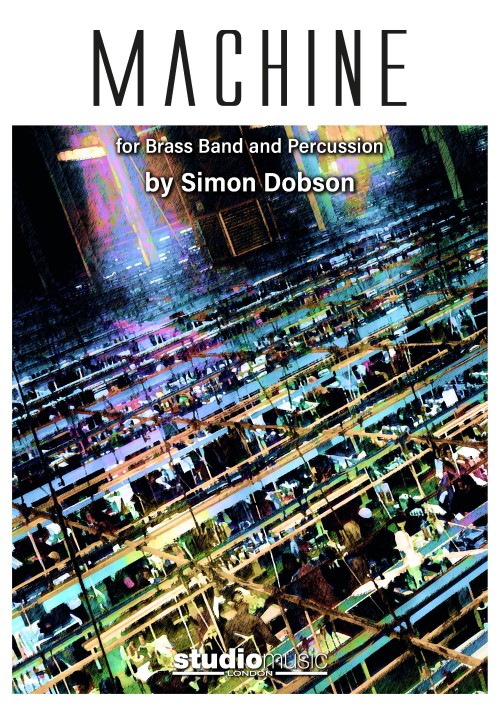
Machine (Brass Band - Score and Parts) - Dobson, Simon
Machine, was commissioned by the Salvation Army Trading Company for the National Youth Brass Band of Great Britain.The work speaks of the perils of the fast fashion industry, the part it plays in our current understanding of late-stage capitalism and it's complicity in the destruction wrought on our one home planet. It also seeks to portray the incredible efforts of the Salvation Army in their quest to slow the fast fashion industry and recycle clothing in the most innovative and progressive ways.The work is through composed and comprises five movements.Movement 1: The great Machine. The band is placed into 8 groups of three (expect tubas, in their normal position as a 4), who stand in specific places on the stage. This will create machine like antiphonal movement in the written music. The great Machine in question is the fast fashion industry, in all its chaos, seeming grandeur and relentless momentum.Movement 2: Mode phmre is fast, angular and quirky, a nod to the perilous speed and waste of the fast fashion industry (the movement title is the French for fast fashion).Movement 3: A planet to treasure (for DA) is a love letter to our home planet and its finite resources and as well as the beauty of the natural world, which unfortunately, we are destroying (hence the dedication to David Attenborough on his 100th year).Movement 4: The wheels keep turning, returns to the fast, angular, almost unstoppable grasp of capitalism and the damaging structures it promotes.Movement 5: Recycle, re-use, mirrors the opening (though without stage directions) in reference to the cyclic nature of fast fashion and the wonderful work that The Salvation Army do in trying to halt this system.
Estimated dispatch 7-14 working days
-
 £44.95
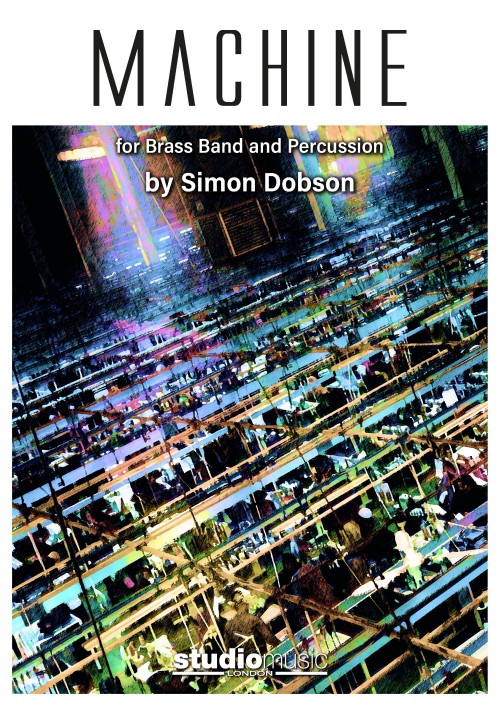
Machine (Brass Band - Score only) - Dobson, Simon
Machine, was commissioned by the Salvation Army Trading Company for the National Youth Brass Band of Great Britain.The work speaks of the perils of the fast fashion industry, the part it plays in our current understanding of late-stage capitalism and it's complicity in the destruction wrought on our one home planet. It also seeks to portray the incredible efforts of the Salvation Army in their quest to slow the fast fashion industry and recycle clothing in the most innovative and progressive ways.The work is through composed and comprises five movements.Movement 1: The great Machine. The band is placed into 8 groups of three (expect tubas, in their normal position as a 4), who stand in specific places on the stage. This will create machine like antiphonal movement in the written music. The great Machine in question is the fast fashion industry, in all its chaos, seeming grandeur and relentless momentum.Movement 2: Mode phmre is fast, angular and quirky, a nod to the perilous speed and waste of the fast fashion industry (the movement title is the French for fast fashion).Movement 3: A planet to treasure (for DA) is a love letter to our home planet and its finite resources and as well as the beauty of the natural world, which unfortunately, we are destroying (hence the dedication to David Attenborough on his 100th year).Movement 4: The wheels keep turning, returns to the fast, angular, almost unstoppable grasp of capitalism and the damaging structures it promotes.Movement 5: Recycle, re-use, mirrors the opening (though without stage directions) in reference to the cyclic nature of fast fashion and the wonderful work that The Salvation Army do in trying to halt this system.
Estimated dispatch 7-14 working days
 View Music