
Results
-
 £45.00
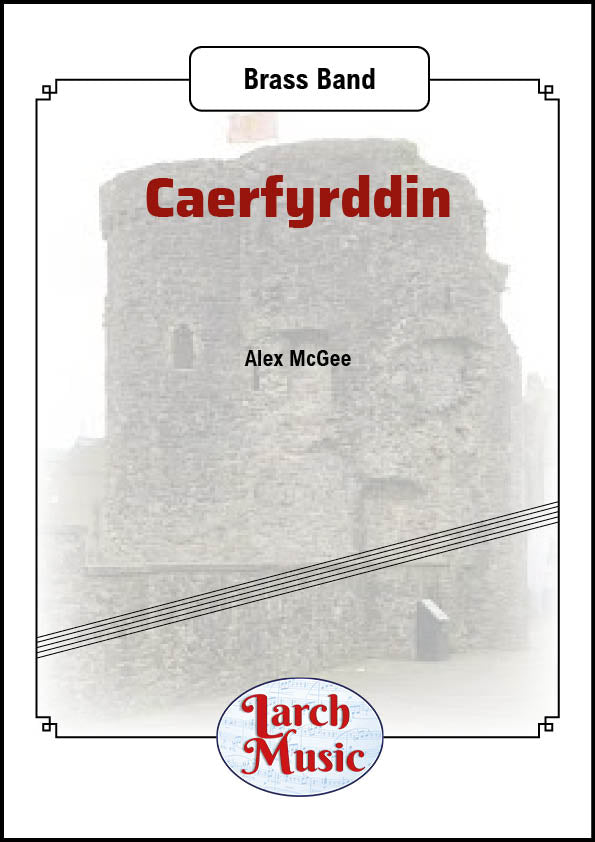
Caerfyrddin - Brass Band - LM957
COMPOSER: Alex McGeeA four movement work describing the historic county town of Carmarthen.1. FanfareThe first movement is an opening Fanfare,2. Castell Caerfyrddyn(Carmarthen Castle)The second movement is a lament describing the now ruined castle.Carmarthen Castle(Welsh:Castell Caerfyrddin) is a ruinedcastleinCarmarthen,West Wales. First built by Walter, Sheriff of Gloucester in theearly 1100s, the castle was captured and destroyed on severaloccasions before being rebuilt in stoneduring the 1190s. The castle was captured byOwain Glyndrin 1405.Henry VII's father died at Carmarthen Castle in 1456. During theWars of the Rosesthe castle fell toWilliam Herbertand, during theCivil War,was captured by Parliamentary forces. It was dismantled by order ofOliver Cromwellin the mid 1600s.It has been used as the site of Carmarthen's gaol until the 1920s.The remains of the castle were given a Grade Iheritage listingin 1954and is currently a tourist attraction and site of the town's Tourist Information Centre.3. Pysgota Cwrwgl(Coracle Fishing)The third movement is a Scherzo which depicts coracle fishing on the river Towy.Should you take an evening stroll down by the River Towy,if the weather and river conditions are suitable, you may be lucky enough to see apair of coracles float gently down river with a net suspended between them.The coracle man will hold the net in one hand and skilfully moving the paddle in afigure of eight motion in the other. As soon as a fish in caught, which many havedescribed as a 'silent noise travelling from the fish, into the net and up into thefisherman's arm', the two coracles are drawn together by pulling at the net.Sewin (sea trout) or salmon being the chosen catch.4. MarchThe Fourth movement is a March representing the town itself. Carmarthenshire in West Wales lies on the River Towy and claims to be the oldest town in Wales. Some variants of theArthurian legendclaim thatMerlinwas born outside the town and that he lies imprisoned in a cave in nearbyBryn Myrddin(Merlin's Hill), which stands right by the A40 trunk road.The myth maintains that his groans can be heard issuing forth from the hill and will continue until he is called to help his fellow countrymen. It is also claimed that, when Merlin's Oak fell, it would be the downfall of the town.For many years great effort was employed to brace the tree, situated in the town.Although it eventually died, it is hoped that catastrophe was averted by preservingsome bits in theCarmarthenshire County Museum.Larger branches are in the Civic Hall in Nott Square and a statue of Merlincarved from another local tree stands in the town centre.St. Peter's Church, the largest parish church in Wales,also has thelongest navemeasuring 60 metres and its tower containseight bellswith the heaviest weighing just under a tonne.It is surprising that few traces survive of the medieval town; however,a small section ofCivil War defences, thrown up by the Royalists, survives on the south-west of the town. They are known as "The Bulwarks," and consist of an earthwork bank and a well-preserved four-sided bastion.Suitable for Most Bands - Duration 8 mins (Approx.)
In Stock: Estimated dispatch 3-5 working days
-
 £65.00
Spiral - Marc Jeanbourquin
Marc Jeanbourquin composed 'Spiral' during a music camp, for himself and 9 other fellow musicians. Due to the success of this piece, some years later, he has taken the main theme and developed it, with a kind of tribute to Camille Saint-Saens, one of his favourite composers. The constant changes between the minor and major keys, and between the often changing 2 and 3 feeling, with the occasional 2/4 bar thrown in, do not disrupt the flow of the piece in the slightest; in fact it is what has inspired the title. A percussion interlude, which is broken up by the unregularly occurring meter, brings the piece to a restatement of the original theme, which then ends in a large crescendo. Spiral is perfectly suited to either the opening or the close of any concert.
Estimated dispatch 10-14 working days
-
 £20.00
atrium phase
Descriptionatrium phase was inspired by listening to works performed at the 2013 Huddersfield Contemporary Music Festival in the atrium of the Huddersfield University Creative Arts Building. The atrium, despite being a functional area incorporating meeting areas and a cafe, has almost coincidentally evolved into a fantastic (if somewhat resonant) performance space. Performers can be positioned on three different sides and three different levels, making the atrium ideally suited to spatially separated performances of a variety of music from Gabrieli to Christian Wolff.In atrium phase the band is separated into four groups - ideally these should be positioned around the audience as follows: group A to the left of the audience, group B in front of the audience, group C to the right of the audience and group D (the four basses) behind the audience. The music "phases" between the groups in the manner of contemporary electroacoustic music, with the bass group acting as a kind of "subwoofer". Starting very slowly, the music accelerates using metrical modulations to finish at considerable speed.The music is intended to be performed without a conductor wherever possible - the three percussionists should set and control the tempo, and there are clear points of overlap for percussionists to allow synchronisation between groups.atrium phase won the inaugural Foden's Band Composition Competition in 2014 and the first performance was given on 24 January 2015 at the RNCM Festival of Brass by Foden's Band.Performance Notes:The band is separated into four groups - ideally these should be positioned around the audience as follows: group A to the left of the audience, group B in front of the audience, group C to the right of the audience and group D (the four basses) behind the audience. The music "phases" between the groups in the manner of contemporary electroacoustic music, with the bass group acting as a kind of "subwoofer". Starting very slowly, the music accelerates using metrical modulations to finish at considerable speed.Instruments in group A require cup mutes (soprano, 2 x cornets, horn, baritone, trombone, euph), group B harmon mutes (4 x cornets, baritone and trombone - the baritone should use a trombone mute) and group C require fibre straight mutes (3 x cornets, flugel, 2 x horns, euph., bass trom - NOT metal mutes if possible).Percussion instruments required are claves, wood block and 2 x temple blocks. The music is intended to be performed without a conductor wherever possible - the three percussionists should set and control the tempo, and there are clear points of overlap for percussionists to allow synchronisation between groups.Approximate duration 6'17"
Estimated dispatch 7-14 working days
-
£59.95
MY STRENGTH, MY TOWER Rhapsodic Variations (Brass Band Set) - Dean Goffin
This music consists of a theme followed by five extensive variations. The theme is the composer's own tune set to the words, 'Thee will I love, my strength, my tower', a hymn by Johann Scheffler translated by John Wesley. A strong modal flavour is characteristic of the theme. Variation 1: This is a light and graceful variation with a good deal of imitative writing. It leads, without a break, into the next variation. Variation 2: Fire and ferocity are asked for in the course of this variation. Variation 3: This variation demonstrates the original approach of the composer. Solo lines for cornet and euphonium are included with their arabesques and arpeggii. Variation 4: Taking the form of a passacaglia, the 'ground' is given out at once by the basses. Fragments of the 'ground', plain or decorated, are combined and used in a number of ways, revealing the composer's mastery of counterpoint. Variation 5: The briskly moving and scintillating final variation abounds in sudden variations of dynamic. The tempo remains constant until an increase is called for in the coda. This 'contest' version has been prepared by Brian Bowen who was asked to re-work the percussion part and introduce a repiano cornet part (Salvation Army band publications do not, in general, have a part for repiano cornet).
Estimated dispatch 7-14 working days
-
£59.95
QUINTESSENCE (Brass Band Set) - Robert Redhead
Originally written for the Melbourne Staff Band's tour of the UK in 1978 and, more specifically, their participation in The Salvation Army International Congress in London, the music expresses the quintessence of Australian Salvationism. The five sections are; 1. An original theme expressing the immensity of the Australian continent. 2. Australia's sons, let us rejoice representing the character of the people. 3. Glory, glory, glory hallelijah from the song The Christian Mission. 4. A meditative setting of At Thy feet I bow adoring, written by two Australian Salvationists. 5. A development of the previous themes bringing the work to its climactic conclusion.
Estimated dispatch 7-14 working days
-
 £35.00
In Pitch Black - Lucy Pankhurst
An extremely emotional and poignant work for brass band composed by Lucy Pankhurst, in memory and tribute to those affected by the Pretoria Pit disaster in Lancashire on 21st December 1910. The piece is chilling in its depiction of the tragic story, sensitively conveying the atmosphere and emotions as perceived before, during and after the event. Through its use of playing techniques, effects, sound combinations and even silences, In Pitch Black offers a powerfully reflective piece.Pritoria Pit DisasterLancashire's worst pit disaster and Britain's third largest loss of life from a single mining accident happened at the No. 3 Bank Pit belonging to the Hulton Colliery Company, just 4 days before Christmas 1910. The pit known as the 'Pretoria Pit' was situated on Hulton Parkland on the border of Atherton and Westhoughton. An explosion occurred at 7.50 am on Wednesday, 21 December 1910, resulting in the death of 344 men and boys, including many members of The Wingates Band.The Writing ExperienceDuring Lucy's research for this work, she acknowledges that she found the harsh reality from the shocking images and historical accounts of the event most disturbing, and is not embarrassed to disclose that it was wholly a very emotional experience in creating the composition. Consequently, she chose to create something to illustrate the true emotion of the situation. She wanted to pay tribute to the lives lost and the devastation which remained in their absence, by creating a piece of music which begins in darkness; desolate and claustrophobic, whilst still leaving the audience feeling uplifted and thoughtful in the final bars.The significance and musical appreciation for the creation of In Pitch Black was formally recognised by BASCA in 2011, when Lucy Pankhurst won the internationally acclaimed British Composer Award (the first time a brass band work had received the award, and the first time a female composer had won the category).Full programme notes are included in the product images.Look and Listen (performance courtesy of Manchester University Brass Band):
In Stock: Estimated dispatch 3-5 working days
-
 £40.00
Moon Pictures - Andrew Duncan
Moon Pictures is a piece depicting mans enduring fascination with our nearest neighbour in the sky, the Moon.Following the introduction there are four continuous sections.1. Moon Dance, describes the ancient and widespread worship of the moon by many cultures.2. Tidal Flows, is about the soothing and constant heartbeat of our oceans and seas.3. Invasion of the Little Green Men, is a more light-hearted depiction of a 1950's Sci-Fi style invasion by silver suited aliens from the moon.4. 1969 A.D, describes the preparations, launch and eventual touchdown on the Moon of the historic Apollo 11 mission.Moon Pictures was written for the Todmorden Old Band in 21 with funds provided by the Millennium Commission and recorded by them on their CD 'Moon Pictures'.
In Stock: Estimated dispatch 3-5 working days
-
Christmas Dream - Andrew Lloyd Webber & Tim Rice - Len Jenkins
The music playing in the background at the start of the 1974 Columbia film 'The Odessa File' Christmas Dream is a song written by Andrew Lloyd Webber and Tim Rice. This arrangement has a seasonal flavour, with typical Germanic 'bounce', and features an optional finish at about 3 minutes 25 seconds, or the full version at 4 minutes 15 seconds. Extra percussion parts are included (see Score).
-
 £42.00
Hymn at Sunrise (Score only) - Ray Steadman-Allen
The idea for this work was prompted by a poem - Hymn Before Sunrise - which describes the majesty of a mountain in darkness, the sounds of a nearby waterfall and so on. Nothing came of the exposure to these pictures except for general thoughts about the dawn of day and a series of movements expressing a personal response to the wonder of creation in an imaginary moment in time. The movement titles, which were added later, are intended to underline a prevailing sense of worship, wonder and exaltation. The music is pure, not pictoral, though listeners may conjure their own images. An actual hymn - Tallis' Cannon - is incorporated. There are five movements: 1. Thanksgiving: A short prelude in two parts. First a brief passage of 'dawn music' before things become more vigorous: fanfare-like music ushers in the trombone section's presentation of the Tallis tune. A broad band version concludes the movement. 2. De Profundis: A slow movement shot through with anxious questionings featuring flugel and trombone. The mood lightens a little in the centre where the soprano cornet is featured and the movement ends serenely. 3. Celebration is characterised by rhythmic drive, this is buoyant with plenty of incident pointed up by the percussion. 4. Invocation: Melodic in nature and sober in mood, the first section is a series of short solos mingled with chorale-like statements. Central to the movement is a chorale-prelude style presentation of the Tallis tune. The third section reintroduces the earlier solo music by the full ensemble. Dissolving, the music enters the last movement without a break. 5. Paean: Marked allegro con spirito there is, quite rightly, a fair amount of fun in the rejoicing. Snatches of Tallis are heard, then comes a gentle passage with a cornet solo leading to fanfare music and recapitulation. Two recitatives are succeeded by a coda which brings the work to a sonorous and exultant conclusion.
Estimated dispatch 7-9 working days
-
 £52.00
Hymn at Sunrise (Parts only) - Ray Steadman-Allen
The idea for this work was prompted by a poem - Hymn Before Sunrise - which describes the majesty of a mountain in darkness, the sounds of a nearby waterfall and so on. Nothing came of the exposure to these pictures except for general thoughts about the dawn of day and a series of movements expressing a personal response to the wonder of creation in an imaginary moment in time. The movement titles, which were added later, are intended to underline a prevailing sense of worship, wonder and exaltation. The music is pure, not pictoral, though listeners may conjure their own images. An actual hymn - Tallis' Cannon - is incorporated. There are five movements: 1. Thanksgiving: A short prelude in two parts. First a brief passage of 'dawn music' before things become more vigorous: fanfare-like music ushers in the trombone section's presentation of the Tallis tune. A broad band version concludes the movement. 2. De Profundis: A slow movement shot through with anxious questionings featuring flugel and trombone. The mood lightens a little in the centre where the soprano cornet is featured and the movement ends serenely. 3. Celebration is characterised by rhythmic drive, this is buoyant with plenty of incident pointed up by the percussion. 4. Invocation: Melodic in nature and sober in mood, the first section is a series of short solos mingled with chorale-like statements. Central to the movement is a chorale-prelude style presentation of the Tallis tune. The third section reintroduces the earlier solo music by the full ensemble. Dissolving, the music enters the last movement without a break. 5. Paean: Marked allegro con spirito there is, quite rightly, a fair amount of fun in the rejoicing. Snatches of Tallis are heard, then comes a gentle passage with a cornet solo leading to fanfare music and recapitulation. Two recitatives are succeeded by a coda which brings the work to a sonorous and exultant conclusion.
Estimated dispatch 7-9 working days
 View Music