
Results
-
 £59.95
Sinfonietta - Saints and Devils (Brass Band - Score and Parts) - Wiffin, Rob
Saints and Devils is a challenging three movement work:Dance with the Devil (4.30)A Glimpse of Paradise (4.45)Reyes Magos (3.45)I wrote it when I was living in Spain where the Catholic culture is still much more prevalent than in the UK. The first two movements are a transition from dark to light; Dance with the Devil is aggressive and occasionally macabre whereas A Glimpse of Paradise is serene.The first and final parts of the second movement were originally written for a sequence in the Royal Military Tattoo 2000, played under the John Magee poem High Flight - 'Oh I have slipped the surly bonds of Earth ............ Put out my hand, and touched the face of God'- with videos of eagle owls in flight dramatically projected onto the buildings of Horse Guards in Whitehall, London.The last movement, Reyes Magos, is the joyous fiesta of the Three Kings. In Spain, January 6th, rather than Christmas Day, is the main day of present-giving, marking the Epiphany, the arrival of the Kings from the Orient at the Nativity. Saints and Devils is technically and expressively demanding but is written within the realms of tonal language.- Rob WiffinDuration: 13.00
Estimated dispatch 7-14 working days
-
 £23.00
King Lear Fanfare (Brass Band - Score and Parts) - Debussy, Claude - Wilson, Duncan
King Lear is a tragedy by William Shakespeare. Lear descends into madness bringing tragic consequences for all. Based on a mythological pre-Roman Celtic king, the play has been widely adapted for the stage and motion pictures, with the title role coveted by many of the world's most accomplished actors. Its first known performance was in 1607, George Bernard Shaw wrote, "No man will ever write a better tragedy than Lear". Originally orchestrated for 2 flutes, 4 horns, 3 trumpets, timpani, side drum, 2 harps, and strings, Debussy wrote five minutes of incidental music for a production of King Lear, produced at the Theatre Mogador Paris in 1904. Duration: 1.30. Suitable for 4th Section Bands and above.
Estimated dispatch 7-14 working days
-
 £59.99
MacArthur Park (Brass Band - Score and Parts) - Webb, Jimmy - Sparke, Philip
Over a period of four decades Jimmy Webb (b. 1946) has written hits for a number of singers including Glen Campbell, Art Garfunkel, Frank Sinatra, Willie Nelson, Johnny Cash and Linda Ronstadt. His songs are often epic in character and include By the Time I Get to Phoenix; Up, Up and Away; Didn't We; Wichita Lineman and Galveston. MacArthur Park (1968) was unlike anything that had gone before it. Running at over 7 minutes, it is 2 or 3 times the length of most pop songs and has an extended orchestral interlude. Richard Harris' seminal recording topped the music charts in Europe, while peaking at number two on the U.S. charts. Philip Sparke has made this excellent arrangement for brass band, which is sure to become a regular feature on your concert programme.Duration: 07:30
Estimated dispatch 7-14 working days
-
 £69.99
The Pioneers (Brass Band - Score and Parts) - Sparke, Philip
In The Pioneers Philip Sparke salutes the bicentenary of an expedition by two all time American heroes - Meriwether Lewis and William Clark. They were commissioned by US President Thomas Jefferson to find the headwaters of the Missouri and a route to the Pacific following the Louisiana Purchase, which doubled the size of the USA. They set out as the 'Corps of Discovery' from Louisville, Kentucky, in May 1804 and not only did they succeed in reaching the Pacific through hostile territory, but also found their way back - in 3 years! The piece is not descriptive of the journey but gives the composer the opportunity to celebrate the 200th anniversary of this amazing feat. Add a touch of the wild-west to any concert with this exciting work.Duration: 5:30
Estimated dispatch 7-14 working days
-
 £115.00
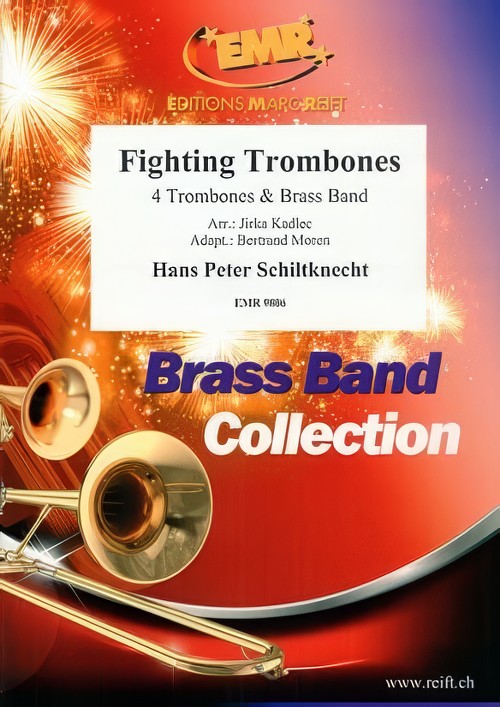
Fighting Trombones (Trombone Quartet with Brass Band - Score and Parts) - Schiltknecht, Hans-Peter - Kadlec & Moren
for 3 or 4 trombonesDuration: 1.30
Estimated dispatch 7-14 working days
-
 £40.00
Magic Flute Overture, The (Brass Band - Score and Parts) - Mozart, Wolfgang Amadeus - Littlemore, Phillip
Mozart's The Magic Flute is a two-act opera composed in 1791, the year of his death. It was the culmination of a period of increasing involvement by Mozart with Emmanuel Schikaneder's theatrical troupe, which since 1789 had been the resident company at the Theater auf der Wieden. The Magic Flute is noted for its prominent Masonic elements; both Schikaneder and Mozart were believed to be Masons and also lodge brothers. Much of Mozart's Masonic music is written in the key of E flat. This key, with 3 flats is indicative of Masonic symbolism. There are other examples of the number three in the opera as well. The opening chords of the introduction sound three times, which also happens during the Temple scenes. Also represented in threes are the three temples of Wisdom, Reason and Nature. Tamino tries to open the three doors of the temple. There are three ladies, the attendants to the Queen of the Night, and three boys who serve as guides to Tamino and Papageno. Duration: 6:30
Estimated dispatch 7-14 working days
-
 £119.95
The Torchbearer (Symphonic Variations on a Theme by Eric Ball) (Brass Band - Score and Parts) - Graham, Peter
2015 National Championships Regionals - Championship Section. The variations are based upon the first phrase of the trio from Eric Ball's Salvation Army march, Torchbearers. After opening statements of the theme, variation 1 (an energetic allegro brillante utilising fragment A) commences. Cadenza passages for Eb Bass and Euphonium lead to variation 2 (an andante appassionato based upon fragment B) Variation 3 (a vivace featuring C as an ostinato) is followed by variation 4 (the central andante e sciolto molto for solo cornet). The work culminates in a reprise of the cornet solo, now fully metamorphosised and mirroring in music a concept at the centre of Ball's broader philosophy, that of transformation. Eric Ball will be remembered as a composer whose classic works for brass shine through with integrity and sincerity. There has been no less sincere in the composers' efforts to pay musical tribute to the 20th century's most influential composer of brass band music. Duration: 12:30
Estimated dispatch 7-14 working days
-
£37.95
The Torchbearer (Symphonic Variations on a Theme by Eric Ball) (Brass Band - Score only) - Graham, Peter
2015 National Championships Regionals - Championship Section. The variations are based upon the first phrase of the trio from Eric Ball's Salvation Army march, Torchbearers. After opening statements of the theme, variation 1 (an energetic allegro brillante utilising fragment A) commences. Cadenza passages for Eb Bass and Euphonium lead to variation 2 (an andante appassionato based upon fragment B) Variation 3 (a vivace featuring C as an ostinato) is followed by variation 4 (the central andante e sciolto molto for solo cornet). The work culminates in a reprise of the cornet solo, now fully metamorphosised and mirroring in music a concept at the centre of Ball's broader philosophy, that of transformation. Eric Ball will be remembered as a composer whose classic works for brass shine through with integrity and sincerity. There has been no less sincere in the composers' efforts to pay musical tribute to the 20th century's most influential composer of brass band music. Duration: 12:30
Estimated dispatch 7-14 working days
-
 £37.95
Connotations (Brass Band - Score only) - Gregson, Edward
Connotations was commissioned for the 1977 National Brass Band Championship finals, held in the Royal Albert Hall, London (the winner, incidentally, of that particular competition was the famous Black Dyke Mills Band).At the age of 32 Gregson was the youngest composer to have received the honour of such a commission. It came at the end of a productive five years writing for the brass band publisher R Smith. Some of those works - The Plantagenets, Essay and Patterns for example, with their direct and tuneful style, have remained popular with brass bands the world over.For Gregson, these were the means by which he sharpened the tools of his trade, preparing the ground, as it were, for his finest work to date - Connotations. He thought of calling the piece Variations on a Fourth, but with due deference to Gilbert Vinter perhaps (Variations on a Ninth), he chose a more appropriate one. As Gregson has written, 'Connotations suggests more than one way of looking at something, an idea, and this is exactly what the piece is about'.Writing a competition piece brought its own problems. 'It has to be technically difficult and yet musically satisfying. I didn't like being kept to an eleven-minute maximum. The inclusion of short cadenzas for less usual solo instruments seems to signify a certain test-piece mentality'.Gregson solved the problems admirably by adopting a symphonic approach to variation form: Introduction - fanfares, a call to attention, in effect Variation 1; Theme - a six-note motif, given a lyrical and restrained first statement; Variation 2 - a delicate toccata; Variation 3 - typically robust in melody and rhythm; Variation 4 - lyrical solos; Variation 5 - a scherzo; Variation 6 - cadenzas; Variations 7-9 - an introduction, fugato and resounding restatement of the theme.Duration: 10.30
Estimated dispatch 7-14 working days
-
 £34.95
A Swedish March and Fanfare (Brass Band - Score and Parts) - Gregson, Edward
A Swedish March:This little march was written in 1975 and was commissioned for the Jnkping Summer School, Sweden, where Edward Gregson was guest composer and conductor. It incorporates the old Swedish folksong Britta at its heart, but otherwise is quite conventional in every aspect.Duration: 3.00Fanfare:This fanfare was originally written for brass ensemble, organ and percussion, under the title Fanfare for Europe, and was commissioned for a concert at the Royal Albert Hall, London, to celebrate Great Britain's entry into Europe. The composer then created this version for brass band which was published in 1976.Duration: 1.30
Estimated dispatch 7-14 working days
 View Music