
Results
-
 £118.99
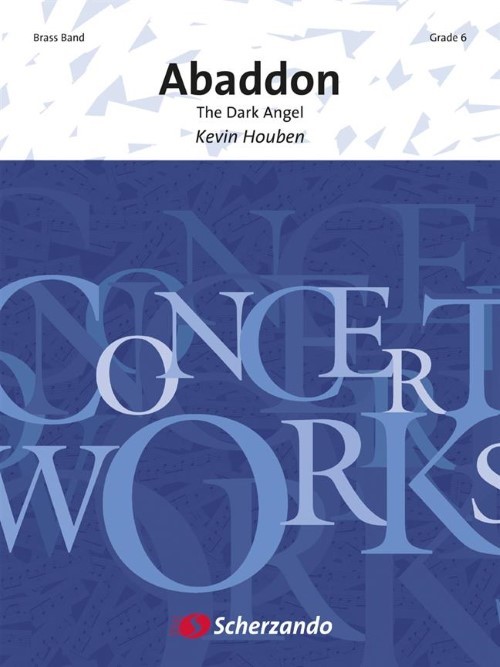
Abaddon (The Dark Angel) (Brass Band - Score and Parts) - Houben, Kevin
Abaddon was commissioned by the NLBB (Noord-Limburgse Brassband - North Limburg Brass Band) from Belgium. Abaddon is the demon reigning over the underworld. In the New Testament - in the Book of Revelation by John (9:11) - he is called the angel of the bottomless pit. The work Abaddon lives up to its name. Technically and physically, it holds an enormous challenge for every band in the champions division. The composition has a traditional form structure (fast-slow-fast), and it consists of ornamentations around the letters IVAN, after Ivan Meylemans, the conductor who since 2001 has obtained great successes with the NLBB, and who in this case has also been essential in taming the demon in Abaddon.Suitable for Championship Section BandsDuration: 14:15
Estimated dispatch 7-14 working days
-
 £118.99
Elegy I (Brass Band - Score and Parts)
Elegy I 'Jealousy' has been named after John Donne's poem of the same name. This English poet (1572-1631) wrote an entire series of elegies, each with its own theme. Jealousy can trigger various emotions, ranging from disappointment, grief, or regret, to madness and anger. All these emotions have been incorporated into this composition. Jacob de Haan was inspired by three different works of art: a poem (the aforementioned poem by John Donne), a painting by the Norwegian painter Edvard Munch (Jealousy in the Garden) and an old French chanson about jealousy (Je ne l'ose dire) by the sixteenth-century French composer Pierre Certon. The music refers repeatedly to this chanson - sometimes through key notes from the melody that serve as the starting point for new, isolated themes and sometimes through quotations of the original version
Estimated dispatch 7-14 working days
-
 £118.99
GRACES OF LOVE (Le Gratie d'Amore) (Brass Band Set) - Waespi, Oliver
2015 National Championships Finals Testpiece - Third Section. The Graces of Love (Le Gratie d'Amore) is the title of a book published in 1602 by Cesare Negri, the famous dance master of the Milan court in the Renaissance. It contains numerous dance tunes and precise descriptions of courtly dances. It also includes the tune Il bianco fior (The White Flower) on which the first movement of the present piece is based. A vigorous dance in three-four, it leads to an acceleration and a sudden shift to an even meter towards the end. The second movement, calm and contemplative in character, features the tune Vaghe bellezze ... (Veiled Beauty ...). Widely spaced melodic parts surround two solos during which the tune is varied and developed. Finally, the third movement contains a saltarello with a hypnotic rhythm, ending the work with flair and gusto. Duration: 11:30
Estimated dispatch 7-14 working days
 View Music