
Results
-
 £59.95
Swedish Festival Music (Brass Band - Score and Parts)
This three-movement suite was commissioned by the Swedish Brass Band Association as the test piece for the Championship Section of their 2008 National Contest. The first movement is inspired by the magnificent Swedish hymn 'How Great Thou Art'. Indeed the influence of that hymn can be traced in all three movements. The declamatory style of the opening gives way to other, more reflective expressions of awe and wonder. A more animated section develops before a final, triumphant statement of the 'How Great' idea returns to finish the movement. The slow second movement features another much-loved Swedish hymn. The music provides plenty of scope for expressive playing, and a feeling of intimacy should be created by the use of several short solo passages. The third movement Allegro brings a totally different, dance-like mood with frequent references to a reel from the region of Uppland. This eventually brings a return to the opening subject and a final, triumphant reference to 'How Great Thou Art'.
Estimated dispatch 7-14 working days
-
 £34.95
Tribute Music (Brass Band - Score and Parts)
The composer writes: Having received delightful reports about Neil Ferguson from his colleagues in Granite City Brass, I thought it might be a good idea to incorporate the musical initials from his name, EFEG, in the opening idea of the music. I used this short idea as a motif during the piece. A recurring comment in the tributes referred to his dry sense of humour, and particularly his ability to deliver a one-liner when least expected. The music does therefore contain a few surprises and sudden changes of direction. I also thought that it might be in character for me to include a little "joke" of my own, which is there to be heard by the very careful listener! Such listeners would do well to remember that the Granite City Brass, the commissioning band, is based in Aberdeen. The idea of commemorating such a faithful member of the band with a piece of music led me to try and write a noble, upright theme, which might be remembered as a melody in the future. I hope that it is a fitting tribute.
Estimated dispatch 7-14 working days
-
 £42.95
Visions of Kolkhis (Brass Band - Score and Parts)
Visions of Kolkhis was commissioned by Jason Katsikaris and the Leyland Band as a finale for their appearance at the 2009 Brass in Concert Championship Inspired by Jason Katsikaris's Greek lineage, the subject of the work could be considered a metaphor for his impact on the British brass band scene, and the Leyland Band's commitment to striving for excellence.Written in thee continuous sections, the work paints a vivid picture of the island of Kolkhis, a place instrumental in so many tales in Greek mythology. The music represents three individual stories; Jason and the Argonauts, the Golden Fleece, and the liberation of Prometheus by Hercules. However, musical material is drawn from the Leyland Band's signature march, Harold Moss's The Royal Tiger, named after the bus made by Leyland Vehicles in the 1950's.
Estimated dispatch 7-14 working days
-
 £32.00
Amazing Grace (Brass Band with optional Bagpipes - Score and Parts)
There are several occasions when a brass band is invited to play along with bagpipes and one of the first titles to be mentioned is the American traditional hymn melody, "Amazing Grace". This arrangement was prepared for one such occasion when Brass Band of the Western Reserve, musical director, Dr Keith M Wilkinson, was invited to play at a wedding in 2007. Parts for bagpipes are included in Concert Pitch (as shown in the full score) and in Db, the key in which they are normally pitched.There are optional parts which make the arrangement equally effective without bagpipes. A suggestion when this version is used is to place the cornet soloist at the beginning some distance from the band.
Estimated dispatch 7-14 working days
-
 £27.00
Auld Lang Syne (Brass Band - Score and Parts)
It is a tradition in most English-speaking countries to sing this song at the stroke of midnight on New Year's Eve to usher in the New Year. The words are at least partially written by Robert Burns and the words "Auld Lang Syne" literally mean "old long ago" or "the good old days", providing a moment of reflection before moving forwards into the New Year.The tubular bells, although pitched, sound midnight when they enter at bar 10.This arrangement was prepared for Brass Band of the Western Reserve, musical director Keith M Wilkinson, to perform at First Night, Akron, Ohio, December 31st, 2007. The following choreography is suggested:Commence the performance with all the cornets scattered around the auditorium.At the end of bar 18 invite the audience to sing along with the band.At bar 27 the cornets move to stand in front of the other members of the band to lead to the stirring conclusion. Should auld acquaintance be forgot and never brought to mind?Should auld acquaintance be forgot and days of auld lang syne?For auld lang syne, my dear, for auld lang syne,We'll take a cup of kindness yet, for auld lang syne.
Estimated dispatch 7-14 working days
-
 £20.00
Infinity (Brass Band - Study Score)
In the post-modern age in which we live, 'absolutes' are difficult for many to comprehend. Yet infinity, which means absolute, total, all-embracing, having no limits or boundaries in time, space, extent, or magnitude, has always been central to the Christian's concept of God.Through the ages, as human understanding has grown, particularly at a remarkable rate from the latter part of the twentienth century, Christianity has been continually challenged to interpret traditional beliefs in the light of new discoveries, but always within the reality of the infinite Being. In addition, scripture tells us that 'humanity was made in God's image'. Humankind is part of God's creation and as such, responsible for its upkeep. Such a commission has never been more relevant than in this present age. Psalm 8 creates a great picture of the majesty, eternal, infinte quality of God and yet reveals the desire of God to share in spirit with humankind. It recognises humankind as being, not a tool of the infinite, but as a creative contributing part of the ongoing movement and activity of the infinite. The music is deliberately melodic in context, creating a sense of unity with the infinite, in tandem with the varying expressions of individuality. It is not based on the Psalm but reflects some of the sentiments lying therein. The 'hymn-like' theme expresses the nature of the Divine using the Old Testament image of the infinite God coming to finite humankind, not in the 'wind', the 'earthquake', the 'fire', but in the 'still small voice' of quietness (1 Kings 19: 11-13). The ensuing musical development, in different styles and patterns, expresses this continual link between infinite and finite. Thus the conclusion, rather than being a symbol of might, power and magnificence, reflects the same sentiment as the opening.
Estimated dispatch 7-14 working days
-
 £64.95
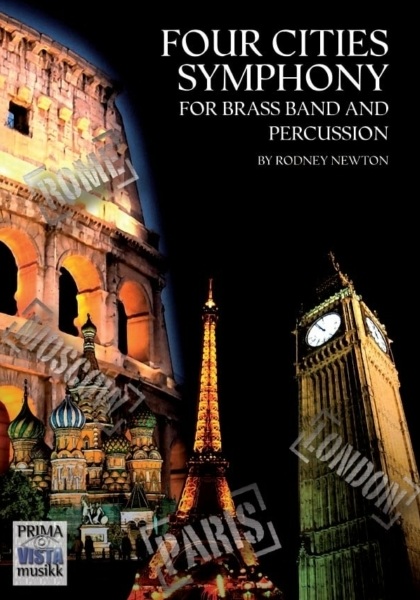
Four Cities Symphony (Brass Band - Score and Parts)
This piece was commissioned by the National Contesting Council as the 4th section test piece for the 2008 Regional Brass Band Championships of Great Britain.This symphony (the composer's 12th) has four movements played without a break. The first centres on two aspects of the city of London: its history and pageantry and its role as a busy modern metropolis.The second movement depicts Paris, its street cafes and boulevards and riverside walks, in the form of a romantic waltz.The third movement is constructed around the Gregorian chants of the Lord's Prayer (Pater noster, qui es in caelis) and the Creed (Credo in unum Deum) in an evocation of the city of Rome. After a powerful climax, mysterious tramping footsteps are heard as the ghosts or a Roman legion march through the city by night. The vision fades and the pater noster is heard once again before the movement is brought to a close with the ancient Ambrosian chant, Christus Vincit, Christus Regnet, Christus Imperat.The final movement is an evocation of the city of Moscow, with its great historic buildings, its turbulent history and its fiery traditional music. At the outset a rather dour folk-like melody is heard which is transformed into a lively Cossack dance.This work is dedicated to Howard Wilson, former principal euphonium of City of Coventry Band who, in 1972, introduced the composer to top section brass band contesting.Duration: 11.00
Estimated dispatch 7-14 working days
-
 £168.50
Music of the Spheres (Brass Band - Score and Parts)
Music of the Spheres was commissioned by the Yorkshire Building Society Band and first performed by them at the European Brass Band Championships in Glasgow, May 2004. The piece reflects the composers fascination with the origins of the universe and deep space in general. The title comes from a theory, formulated by Pythagoras, that the cosmos was ruled by the same laws he had discovered that govern the ratios of note frequencies of the musical scale. ('Harmonia' in Ancient Greek, which means scale or tuning rather than harmony - Greek music was monophonic). He also believed that these ratios corresponded to the distances of the six known planets from the sun and thatthe planets each produced a musical note which combined to weave a continuous heavenly melody (which, unfortunately, we humans cannot hear). In this work, these six notes form the basis of the sections Music of the Spheres and Harmonia. The pieces opens with a horn solo called t = 0, a name given by some scientists to the moment of the Big Bang when time and space were created, and this is followed by a depiction of the Big Bang itself, as the entire universe bursts out from a single point. A slower section follows called The Lonely Planet which is a meditation on the incredible and unlikely set of circumstances which led to the creation of the Earth as a planet that can support life, and the constant search for other civilisations elsewhere in the universe. Asteroids and Shooting Stars depicts both the benign and dangerous objects that are flying through space and which constantly threaten our planet, and the piece ends with The Unknown, leaving in question whether our continually expanding exploration of the universe will eventually lead to enlightenment or destruction.Duration: 18:00
Estimated dispatch 7-14 working days
-
 £29.95
Aria for Philip (Brass Quintet - Score and Parts)
Instrumentation:2 Trumpets in CHorn in FTromboneTubaWritten in memory of Philip Jones, this short work was first performed at his memorial concert held at the Royal Northern College of Music in 2000. Scored for Brass Quintet, it was performed by former members of the Philip Jones Brass Ensemble.My friendship with Philip Jones stretched back to my student days, when my Quintet for Brass was performed during my final year at the Royal Academy of Music. Philip was present at that premiere in 1967, and soon after that his ensemble performed and broadcast the Quintet on a UK Tour, including a performance in the finals of the BBC Young Composer's Competition. I owe him a huge debt of gratitude for promoting a work by a then unknown young composer.I use a brief quote from the opening of my 1967 Brass Quintet in this work, which is generally rather sombre in character, except for the sudden change of mood and tempo in the short final section, when the clouds suddenly lift and the sun shines through.- Edward GregsonDuration: 5.00
Estimated dispatch 7-14 working days
-
 £119.95
Harrison's Dream (Brass Band - Score and Parts)
At 8.00pm on the 22nd of October 1707, the Association, flagship of the Royal Navy, struck rocks off the Scilly Isles with the loss of the entire crew. Throughout the rest of the evening the remaining three ships in the fleet suffered the same fate. Only 26 of the original 1,647 crew members survived. This disaster was a direct result of an inability to calculate longitude, the most pressing scientific problem of the time. It pushed the longitude question to the forefront of the national consciousness and precipitated the Longitude Act. Parliament funded a prize of �20,000 to anyone whose method or device would solve the dilemma. For carpenter and self-taught clockmaker John Harrison, this was the beginning of a 40 year obsession. To calculate longitude it is necessary to know the time aboard ship and at the home port or place of known longitude, at precisely the same moment. Harrison's dream was to build a clock so accurate that this calculation could be made, an audacious feat of engineering. This work reflects on aspects of this epic tale, brilliantly brought to life in Dava Sobel's book Longitude. Much of the music is mechanistic in tone and is constructed along precise mathematical and metrical lines. The heart of the work however is human - the attraction of the �20,000 prize is often cited as Harrison's motivation. However, the realisation that countless lives depended on a solution was one which haunted Harrison. The emotional core of the music reflects on this, and in particular the evening of 22ndOctober 1707. Peter GrahamCheshireJuly 2000
Estimated dispatch 7-14 working days